
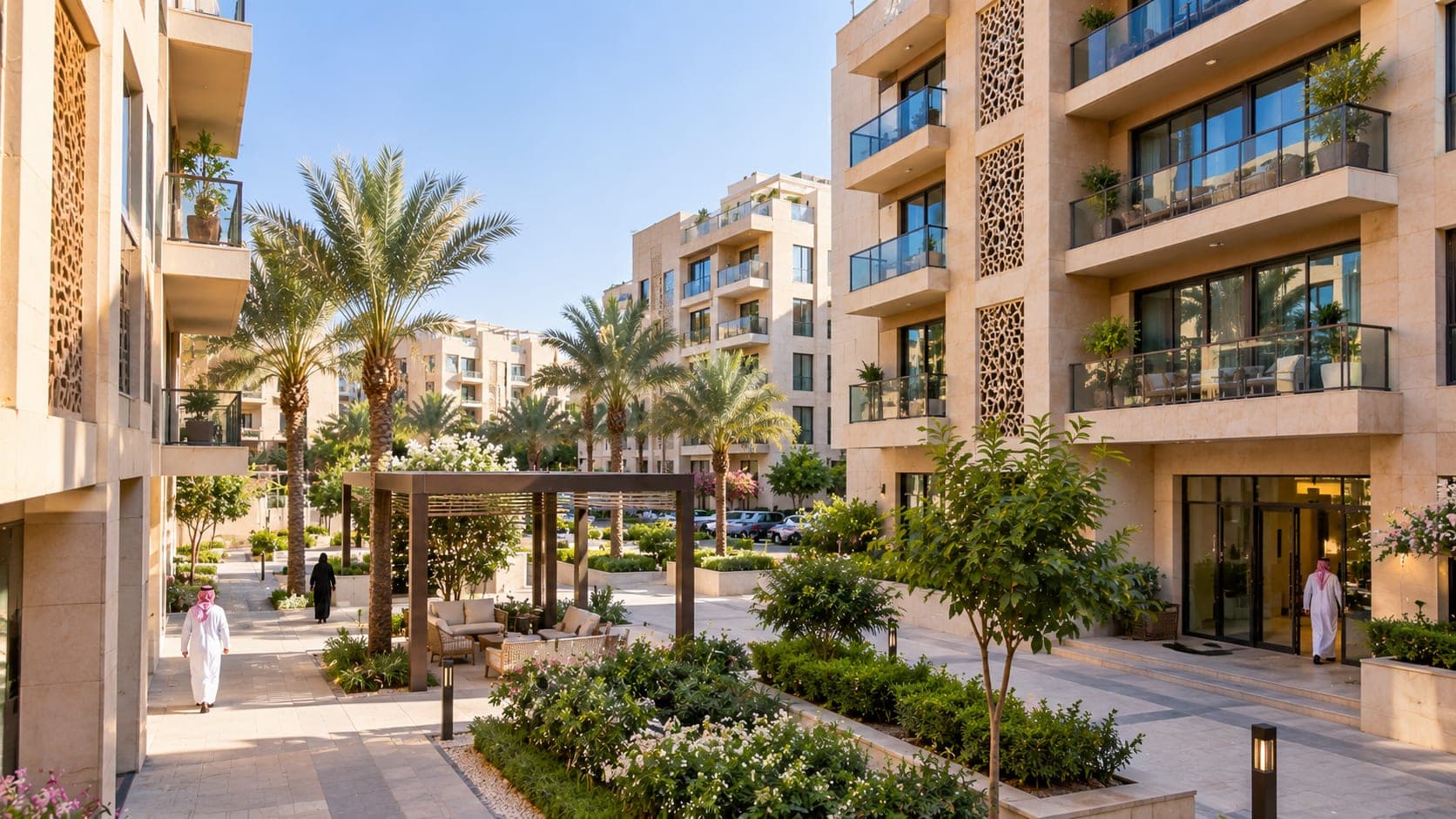
Saudi apartment market Q3 2026 research from JLL shows apartments accounting for approximately 77%–85% of residential sales transactions in Riyadh, Jeddah and Dammam, even as prices moved in markedly different directions. The consultancy reported annual apartment-price increases of 13.8% in Jeddah and 22.5% in Dammam, against an 8.6% decline in Riyadh. Riyadh nevertheless recorded an 18.1% quarter-on-quarter recovery in residential transaction volumes. These results describe JLL's analysed markets and measures, not a nationwide apartment share or a price change applying to every home.
Quick Facts
Indicator | JLL-reported finding |
|---|---|
Research | KSA Living Market Dynamics, Q3 2026 |
JLL research webpage | Dated 6 November 2026 |
Associated press release | Distributed 25 November 2026 |
Apartment transaction share | Around 77%–85% across Riyadh, Jeddah and Dammam |
Jeddah apartment-price change | +13.8% year on year |
Dammam apartment-price change | +22.5% year on year |
Riyadh apartment-price change | -8.6% year on year |
Riyadh residential deal volumes | +18.1% quarter on quarter |
Makkah residential sale transactions | +14.1% year on year |
Research provider | JLL; not a government statistical release |
The figures in this table describe different indicators and comparison periods. They should not be compared as though transaction shares, sales volumes and annual price estimates measure the same thing.
Which property type & region do you prefer?
Select property type and preferred city in Saudi Arabia.
What JLL's Third-Quarter Research Actually Reports
The official JLL Saudi living-market review is labelled Q3 2026 and dated 6 November on the firm's website. An associated JLL press release distributed by Zawya appeared on 25 November and gives more detail about individual cities. These are separate publication dates, not contradictory periods for the housing figures.
The study assesses residential transaction composition, price changes and development trends. It is professional consultancy research, not a property-price announcement by REGA or the General Authority for Statistics.
Saudi apartment market Q3 2026: What the 77%–85% Share Means
JLL says apartments made up approximately 77%–85% of sales transactions across the three named cities during the third quarter. That is a range describing those markets, not a claim that each city had an identical 85% share or that 85% of all residential transactions throughout Saudi Arabia concerned apartments. The summary does not specify the individual percentage for each city within the range.
A transaction share also differs from the number of apartments sold. Real Estate Saudi's Saudi property market outlook provides broader context, but the present news is about JLL's newly reported mix of residential sales.
Why Buyers May Be Considering Apartments More Closely
JLL interprets the prominence of apartments partly through affordability, access to services and interest in developments offering shared amenities. Apartments can serve households comparing purchase budgets and proximity to employment, education and transport, but that reasoning should not be turned into a claim about the preferences or income of every buyer.
Nor does a high share establish that apartment prices are always lower than villa prices in a given neighbourhood. Buyers must compare space, specification, maintenance obligations and the total acquisition cost of suitable properties. Real Estate Saudi's guide to buying property in Saudi Arabia covers those property-level checks separately.
Master-Planned Communities and Housing Choice
It cites schemes such as Sedra in Riyadh and AlArous in Jeddah as examples of the broader development approach. Convenient access and the design of communal space may influence choices, although the research does not establish how much of the 77%–85% transaction share came from those specific projects.
A planned neighbourhood is also different from completed homes. Future amenities, announced phases and properties offered off-plan should not be described as already delivered unless separately verified. The Saudi off-plan property investment guide explains why approvals, handover obligations and contract terms matter when comparing proposed and completed housing.
Jeddah Apartment Prices Rise 13.8% Annually
JLL reports that average apartment prices in Jeddah increased by 13.8% year on year in Q3 2026. Its distributed release also states an average apartment measure of approximately SAR 4,100 per square metre and describes a different increase for villas. Those are JLL's city-level research observations, not a price list for new apartments or an official rate fixed by an authority.
An average can change as the properties represented in a sample change, so it cannot establish what a particular flat should sell for. The Jeddah real estate market guide offers local context without replacing current comparable transactions for an individual building.
Dammam Records a 22.5% Annual Apartment Increase
The strongest annual apartment-price movement among the three headline cities was the 22.5% rise JLL reported for Dammam. The release also cites a 3.3% increase for apartments in neighbouring Al Khobar, reinforcing that performance can differ even within the wider eastern metropolitan area. Neither observation should be extended automatically to villas, residential land or every district.
Real Estate Saudi's Dammam property investment overview provides background on the city's residential environment, but cannot prove a 22.5% price change for a specific home.
Riyadh Apartment Prices Decline by a Reported 8.6%
Riyadh followed a different annual price pattern. JLL's associated press release states that apartment prices fell approximately 8.6% year on year in the third quarter, while villa prices were broadly flat by its measures. This is not evidence that every apartment in the capital lost the same proportion of its value or that the entire housing market entered a uniform decline.
Local property mix, development stage and comparability still matter when interpreting the average. Real Estate Saudi's Riyadh property market guide is relevant background, but the JLL estimate should not be presented as a property-specific appraisal.
Riyadh Transactions Recover 18.1% From the Previous Quarter
Despite softer annual apartment prices, JLL reports that Riyadh's residential transaction volume rose 18.1% from Q2 to Q3 2026, reaching approximately 9,100 deals. This was a sequential recovery, not an 18.1% increase in selling prices. The firm's official research page also says the city's transaction volume was 30.2% below Q3 2025, showing that quarterly improvement and annual weakness can occur simultaneously.
The reported activity does not disclose how many of those deals involved new-project purchases or how mortgage financing was arranged.
Makkah Sales Increase 14.1% Year on Year
JLL's report identifies Makkah as an exception to the annual declines in transaction volumes it observed in several other cities. Residential sales transactions there increased approximately 14.1% from Q3 2025 to Q3 2026, reaching around 820, according to the associated release. The same release identifies approximately 719 apartment transactions and describes a 16.3% annual increase in that apartment count.
Makkah is not interchangeable with the Makkah Region, and the figure is not a statement about Jeddah. Neither should its annual increase be compared directly with Riyadh's 18.1% quarterly rebound. Real Estate Saudi's Makkah property market overview addresses the city's separate housing context.
Transaction Share, Transaction Count and Prices Are Different
Three metrics appear repeatedly in this research. Apartment transaction share is the proportion of analysed residential sales attributed to apartments. Transaction volume is the actual count of qualifying deals over a defined period. A price movement describes a change in the selected pricing measure. A rise in one does not mathematically require a rise in the other two.
An apartment segment can represent most transactions even if the overall number of property deals contracts. Likewise, a higher transaction count could coincide with lower average prices if different properties sold. The Real Estate General Authority's real estate indicators provide a distinct official source for examining recorded transactions, subject to their own classifications and reference periods.
What is your approximate budget?
Narrow down property options based on your target budget.
Annual Changes Are Not the Same as Quarterly Rebounds
The 13.8% Jeddah increase, 22.5% Dammam increase and 8.6% Riyadh decline are described as annual apartment-price comparisons. Riyadh's 18.1% change in transaction volume is measured against the immediately preceding quarter. Makkah's 14.1% change compares sales volumes with the same quarter a year earlier.
Placing these figures in one sentence without their measurement bases would produce an inaccurate comparison. Real Estate Saudi's editorial reading is therefore limited to the divergence of recorded conditions, not a ranking of guaranteed investment opportunities.
Apartment Trends Do Not Describe Every Residential Property Type
JLL's headline focuses on apartments, but Saudi residential transactions can include villas, duplexes, townhouses and residential land, each with different characteristics. It would be incorrect to treat apartment-price growth in Dammam as evidence that villas there appreciated at an equivalent rate. In fact, the consultancy's distributed release identifies separate annual villa movements across several cities, illustrating how materially product categories can diverge.
Selling prices, leasing terms, vacancy, service charges and maintenance costs are separate inputs when assessing residential investment. The press release does not give a universal apartment rental-yield benchmark that can be applied to the three cities.
What the Findings Mean for Residential Developers
Developers can read the high apartment share as a signal to investigate whether their product design fits local buyer budgets, transport needs and expectations about communal amenities. That is an analytical use of the research, not proof that any specific apartment project will achieve sales targets.
The consultancy also highlights construction costs and supply-chain conditions as potential challenges for delivery. Its forecasts about possible delays are research expectations, not a verified postponement of every named scheme. Developers still need executable construction programmes and finance, rather than relying solely on an announced supply pipeline or the reported popularity of a particular property type.
Announced Supply Is Different From Completed Housing
JLL cites ongoing housing pipelines in major cities and developments incorporating apartments and townhouses. A pipeline may include planned phases, under-construction units and scheduled deliveries. It cannot be added to completed housing stock without verifying which buildings have been handed over and are available for occupation. Changes in project timing can also affect when anticipated choice materialises for buyers.
A similarly important distinction concerns price expectations. The launch of additional units does not by itself establish future price reductions, just as a project announcement does not prove that homes have been sold. Individual project descriptions, construction progress and official approvals remain necessary before describing housing as completed or available.
How Financing and Affordability Enter the Picture
JLL identifies affordability and financing conditions as considerations in its assessment of buyer decisions. Those details should not be invented to explain the reported city changes.
The Saudi Central Bank publishes separate banking statistics, while Real Estate Saudi's property financing guide explains the distinction between purchase prices and the terms of borrowing. Mortgage amounts and approved lending are not interchangeable with sales transaction counts.
What Buyers Should Verify Before Choosing an Apartment
The Saudi apartment market Q3 2026 findings give buyers a reason to examine local comparables rather than rely on national headlines. Relevant checks include the precise neighbourhood, unit size, condition, completion status, ownership documentation, service charges and actual selling terms. The JLL percentages should be used as context, not a substitute for inspecting an individual property or establishing the seller's lawful authority.
Where buyers compare developments in different cities, the same definition of price and property type is essential. An average per-square-metre figure for Jeddah is not directly comparable with an unqualified asking price for a large apartment elsewhere. Official registered evidence and professional advice may help clarify the comparison.
What Investors Should Check Before Drawing Conclusions
A buyer's actual outcome depends on acquisition costs, financing, maintenance, possible rental income, holding period and eventual sale proceeds. The report neither guarantees appreciation nor identifies a standard net yield for apartments across Riyadh, Jeddah and Dammam.
Institutional and individual investors also need to distinguish observed occupied housing demand from projected demand for uncompleted developments. A scheme's location and verified delivery schedule can matter as much as the wider city's sales composition. This is original editorial analysis of the implications of JLL's findings, not a separate JLL forecast.
Methodological Limits of the Published Research
JLL's official summary and associated release verify the headline percentages and the principal annual or quarterly comparison bases. They do not, in the public material inspected, supply a complete sample-size table for each city's apartment-price estimate or enough methodological detail to establish uniformly whether every cited figure is based on registered completions, valuation estimates or advertised asking prices.
Jeddah's release explicitly describes an average per-square-metre apartment measure, but that should not be assumed to define all other city estimates identically. The General Authority for Statistics' real estate price-index methodology provides a separate official statistical framework; it does not certify JLL's commercial research methodology.
How would you like to be contacted?
Choose your preferred channel for a private consultation.
What to Monitor After the Third Quarter
Further JLL releases, REGA transaction datasets and official price statistics can help show whether the observed city differences persist. Useful measures include apartment-specific transaction numbers, consistent price comparisons, actual completed housing deliveries and lending activity by the relevant period. The Ministry of Municipalities and Housing provides policy and programme information, which should not be interpreted as a guarantee of future transaction or price outcomes.
No single quarterly study can establish a reliable forecast for every district, residential category or individual purchase.
Conclusion
The Saudi apartment market Q3 2026 findings from JLL show apartments taking approximately 77%–85% of analysed residential transactions in Riyadh, Jeddah and Dammam. Yet annual apartment-price movements differed sharply: gains of 13.8% in Jeddah and 22.5% in Dammam contrasted with an 8.6% decline in Riyadh. Riyadh's quarterly transaction recovery and Makkah's annual increase add further evidence that activity must be assessed by place and period.
The report supports careful city-level analysis rather than a single national narrative. Its estimates are useful context, but individual prices, financing terms and future returns remain unverified by the headline figures alone.
Talk to Our Real Estate Experts
Get real-time insights on investment options, commercial properties, and market guidelines.
Frequently Asked Questions
JLL reported that apartments represented approximately 77%–85% of residential sales transactions across Riyadh, Jeddah and Dammam in its analysed markets. The range does not identify each city's exact percentage or provide a total count of apartments sold throughout Saudi Arabia. It concerns transaction composition, not national housing stock.
No. The upper end of the reported range concerns the three cities named by JLL. It is not an official nationwide estimate, and the research summary does not say that all three cities individually reached 85%. Other Saudi cities may have different property mixes and transaction patterns.
JLL's associated Q3 2026 press release reported an approximately 8.6% annual decrease in Riyadh apartment prices. The figure is a city-level research estimate and does not imply that every individual apartment lost 8.6% of its value. Riyadh residential transaction volumes nevertheless rose compared with the preceding quarter.
JLL reported a 13.8% annual rise in Jeddah apartment prices in Q3 2026. The distributed release also described an average of approximately SAR 4,100 per square metre. These measures are not an asking-price guarantee for an individual flat, and neighbourhood-level differences remain relevant.
The consultancy reported an annual increase of 22.5% in Dammam's apartment-price measure, compared with a smaller 3.3% rise in nearby Al Khobar. Those changes should not be assumed to apply to every building, neighbourhood or residential property type in the Eastern Province.
Counts and prices measure different characteristics. More properties may change hands even if the prices observed in the analysed sample decrease, or if the mix of transacted homes changes. The Riyadh quarterly volume recovery and annual apartment-price decline are therefore not mathematically contradictory, and neither identifies the cause of the other.
JLL reported approximately 9,100 residential sales transactions, an 18.1% increase from Q2 2026. Compared with Q3 2025, however, the volume was 30.2% lower. These comparisons use different reference periods, and the 18.1% quarterly figure is not a price-growth rate.
According to JLL, Makkah recorded around 820 residential sale transactions in Q3 2026, approximately 14.1% more than in Q3 2025. This refers to Makkah's reported city market, not the entire Makkah Region. The comparison is annual, unlike Riyadh's 18.1% quarter-on-quarter increase.
No. JLL is a commercial real estate research and advisory company. Its analysis may use various market information sources, but its estimates and interpretations remain JLL findings. REGA and GASTAT publish their own official transaction and price measures, with separately defined methods and reporting periods.
No. Price changes observed in Q3 2026 do not guarantee future appreciation, rental income or investment yield. Outcomes depend on the actual property, purchase terms, financing, expenses, occupation and eventual sale conditions. The public research also does not provide transaction-level evidence for every individual apartment or neighbourhood.
