
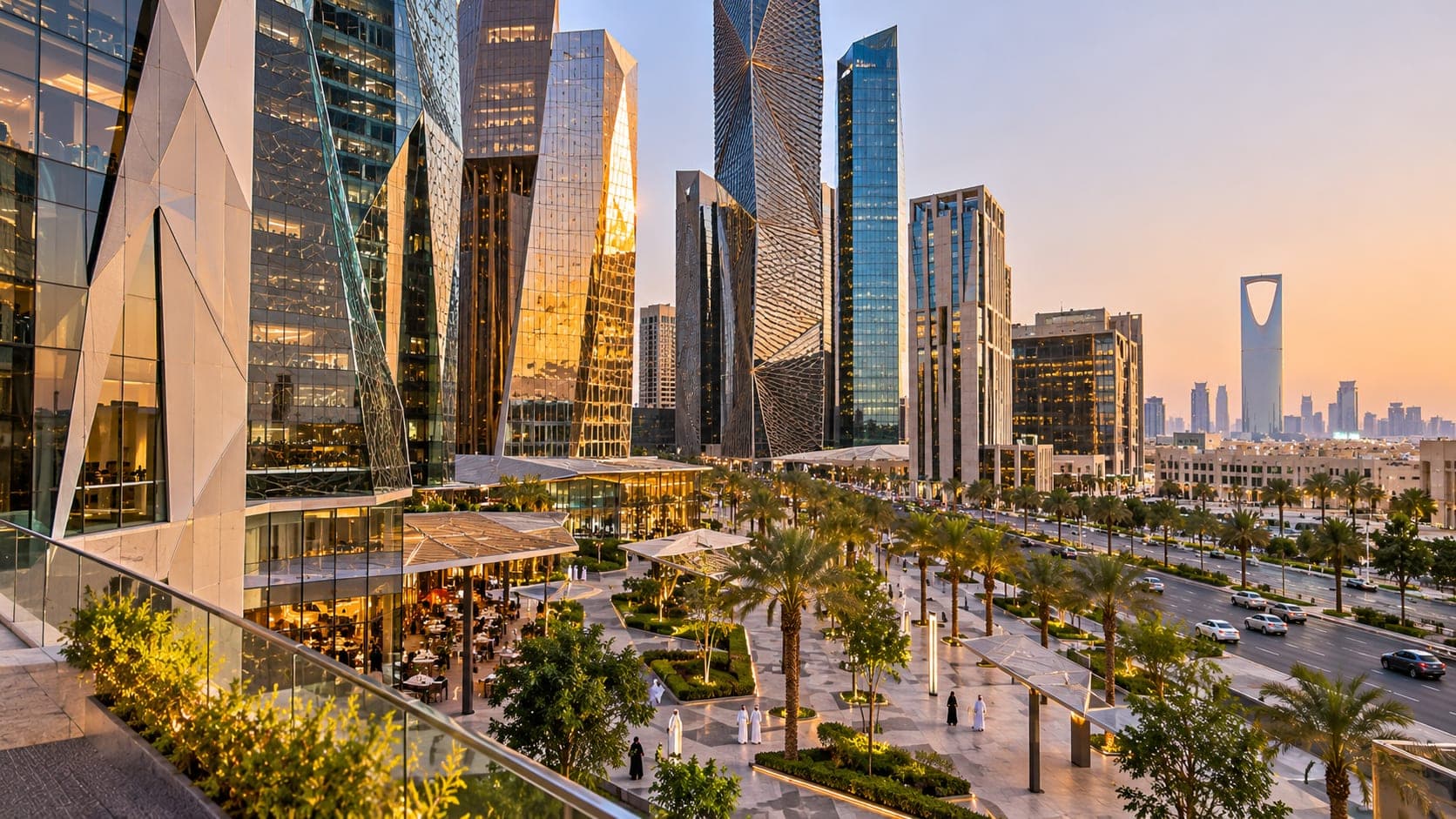
Saudi real estate market Q3 2026 research published by CBRE on 24 November shows an industry in which occupier requirements and major development activity remain evident, but investors are placing greater emphasis on execution, financing and the timing of returns. The advisory firm's review spans offices, residential property, retail, hospitality and industrial logistics. It reports a 15% year-on-year decline in nationwide real estate transaction value during August and cites weaker economy-wide foreign direct investment inflows in the second quarter. Overall, CBRE describes uneven conditions across property types and cities.
Quick Facts
Indicator | CBRE-reported detail |
|---|---|
Research publisher | CBRE Saudi Arabia |
Publication date | 24 November 2026 |
Reporting period | Third quarter of 2026 |
August property transaction value | SAR 24.4 billion, down 15% annually |
Residential share of August value | Approximately 73% |
Q2 gross FDI inflows cited | SAR 22.3 billion, down 16.9% annually |
September Riyad Bank PMI | 55.3 |
Riyadh Grade A office occupancy | Approximately 97% |
Main interpretation | Continued occupier demand, more selective capital deployment |
What CBRE's New Property Review Covers
The CBRE Saudi Arabia Q3 2026 market review was published on 24 November. Its findings are the analysis of a commercial property adviser, not a Saudi government policy announcement or official projection. The report brings together the firm's sector observations and economic indicators drawn from other sources. Accordingly, its conclusions about sentiment and investment decisions should be attributed to CBRE, while the time periods of cited statistics must remain clear.
The complete CBRE research report provides more detailed distinctions than a national headline can capture. Some assets retained strong occupier interest even as other segments showed pressure on pricing or visitor demand.
Which property type & region do you prefer?
Select property type and preferred city in Saudi Arabia.
Saudi real estate market Q3 2026: Demand and Investment Diverge
CBRE's central observation is that demand for occupied space and willingness to commit investment capital were not moving uniformly. Businesses still sought offices and logistics facilities, while established and planned residential communities remained an active development focus. Yet capital deployment became more measured during the third quarter as investors weighed economic conditions and regional uncertainty. These observations concern different stages of the property cycle.
Why Capital Deployment Became More Selective
CBRE associates more cautious investment decisions with softer macroeconomic indicators and heightened uncertainty in the surrounding region. It notes that strategically significant developments continued to attract access to funding, while investors paid closer attention to project execution capability, financing arrangements and the timing of eventual returns.
This is a finding about the investment environment, not proof that finance disappeared across the Kingdom. In editorial terms, selectivity means that the quality of an individual scheme's planning, committed capital and delivery arrangements may deserve closer examination than a headline pipeline announcement.
The Q2 Foreign Investment Figure Is Not Real Estate-Only FDI
The report cites gross foreign direct investment inflows of SAR 22.3 billion in the second quarter of 2026, down 16.9% from SAR 26.8 billion a year earlier. The reference quarter precedes the Q3 property review, and the measure covers foreign investment into the economy more broadly. It is not the value of foreign purchases of Saudi buildings or land during Q3.
The DataSaudi economic-data portal provides wider context on measures such as foreign investment and economic activity. Using a general FDI figure as though it measured real estate investment alone would materially distort the report.
August Transaction Value Fell 15% Year on Year
CBRE reports SAR 24.4 billion in nationwide real estate transaction value during August 2026, 15% below the corresponding month in 2025. The report says residential assets contributed approximately 73% of the August value, equivalent to around SAR 17.9 billion. Its residential section separately describes an annual decline of 8% in residential transaction value and 7% in residential volume for August.
Total property sales combine different asset classes; a residential share concerns only a subset of that value; and deal count differs from the consideration paid across deals. Real Estate Saudi's October property-transaction analysis addresses another reporting month and regional rankings, rather than this CBRE assessment of Q3 investment conditions.
Why Falling Transaction Value Does Not Prove Falling Prices
A lower aggregate sales value may reflect fewer completed transactions, a different mix of property types or changes in the sizes and locations of properties sold. It does not alone establish that an identical home, office or plot changed hands for 15% less.
The Real Estate General Authority's indicators platform allows analysis of transactions across periods, locations and property types. Separately, GASTAT's real estate price statistics use a statistical framework distinct from total transaction consideration. Neither should be treated as interchangeable with CBRE's August sales-value observation.
Riyadh Offices Remain Tight at the Premium End
CBRE estimates that Grade A offices in Riyadh were approximately 97% occupied during Q3, with prime assets in the King Abdullah Financial District around 99% occupied. The report describes strong requirements from multinational companies, regional headquarters and expanding domestic occupiers, particularly for well-located, high-quality buildings.
The review puts Riyadh's total office stock above 6.3 million square metres of gross leasable area and identifies about 1.7 million square metres scheduled for delivery from late 2026 through 2028. Scheduled additions remain future supply until their buildings are handed over. CBRE notes that some tenants have favoured pre-leasing space closer to completion rather than committing at the earliest construction stage. Real Estate Saudi's Riyadh commercial-property guide provides separate context for comparing property locations and uses.
Lease Renewals and Office Quality Matter
According to CBRE, commercial rent-stabilisation measures introduced in September 2025 contributed to more office lease renewals during the year. Its interpretation is that some existing occupiers preferred to retain premises rather than relocate. The firm's reported annual prime office rent increase was about 3%, while Grade A availability remained tight in established locations.
Nor does a high occupancy rate establish a uniform rent trajectory for secondary buildings or other cities. The Riyadh property market overview offers local background, but the report's premium-office findings should not be extended to every district and property grade.
Residential Conditions: Activity With Affordability Constraints
Residential assets remained a substantial component of recorded transactions, but CBRE highlights affordability and differences among products. Its report estimates that countrywide average apartment prices per square metre declined approximately 3.6% year on year, while Riyadh apartment prices increased about 2.3% and Riyadh villa prices declined about 6.5%. Those figures describe specified measures and geographies; they are not a single national property-price change.
CBRE also notes that developers continued projects within established communities and announced additional schemes. Housing demand can coexist with price sensitivity if buyers face different budgets or financing requirements.
Foreign Ownership Reform Does Not Remove Asset-Specific Questions
The report discusses the potential for changes to non-Saudi ownership rules to broaden the pool of buyers over time, while noting that regional uncertainty may affect the speed and scale of any resulting investment. This is CBRE's assessment, not a quantified forecast of foreign property purchases in Q3.
Prospective purchasers must still evaluate the rules applying to their status, intended property rights and location. Real Estate Saudi's guide to non-Saudi property ownership deals with those requirements separately. The Q3 review supplies no basis for assuming that every residential development is open to all foreign buyers or that regulatory change has already produced a specified number of sales.
What is your approximate budget?
Narrow down property options based on your target budget.
Retail: Consumer Activity and Destination Development
CBRE cites a 3.5% rise in nationwide point-of-sale spending during a seven-day period ending in late September, describing domestic consumption as supportive of retail activity. That is a narrowly timed spending measure, not a growth rate for retail rents or shopping-centre occupancy over the whole quarter. It also notes continued work on destination-led retail and entertainment schemes.
The report describes growing attention to places combining shopping, leisure and food and beverage uses, while acknowledging uncertainty around visitor flows. Announced retail projects represent potential future supply; their commercial performance cannot be assumed from construction plans or a short period of consumer-payment data.
Hospitality: Domestic Visits and International Uncertainty
CBRE presents a mixed tourism picture rather than uniform hospitality growth. Citing Ministry of Tourism figures for the first quarter of 2026, it reports domestic trips up 16% annually to 28.9 million and inbound arrivals down 13% to 8.3 million. Overall tourism spending was 2% lower, according to those cited data. The Q1 reference period should not be confused with Q3 hotel performance.
In its September hotel discussion, CBRE describes softer operating conditions in Riyadh alongside continued support from religious travel in Makkah and Madinah. The report also examines how regional tensions affected aviation and business-travel confidence.
Industrial and Logistics Occupiers Show Continued Demand
The industrial section identifies demand associated with warehousing, freight access and supply-chain resilience. CBRE cites a 7.1% year-on-year increase in manufacturing production in August, even as the broader Industrial Production Index declined in that month because of weakness in oil-related activities. A manufacturing indicator is not a direct measure of warehouse occupation or property investment.
In reported rental benchmarks, Riyadh East logistics space averaged SAR 313 per square metre annually, up 15.1% year on year, while Jeddah South recorded a 16.7% increase to approximately SAR 217. These are specific submarkets and reported averages, not national industrial rent increases. The Jeddah property market guide provides broader city context, but logistics rents require industrial comparables rather than residential or retail averages.
Development Pipelines Are Not Delivered Floor Space
CBRE describes an active project pipeline but says contract awards, procurement and mobilisation featured prominently in Q3. The report refers to development activity in destinations such as Diriyah and to continuing construction within residential communities. A contract award demonstrates that work has been commissioned under relevant arrangements; it does not prove a building has been completed, leased or placed into service.
Future floor space should be distinguished from present stock, and a planned handover date is not a guarantee of delivery. Investors who combine announced pipelines with operational supply risk overstating what can currently earn rent or accommodate occupiers.
Execution Capability and Delivery Certainty
A central implication of CBRE's analysis is the greater attention being paid to delivery. For a developer, that can involve the maturity of design, procurement packages, contractor capability and the availability of funding across a project's stages. For an occupier, it may mean choosing a building close enough to handover to support a realistic move-in plan.
How Developers May Respond to More Selective Capital
For developers, the findings suggest that project communication should distinguish what is planned, contracted, financed, under construction and ready for occupation. Investors may also examine whether proposed housing, offices or mixed-use space correspond to verified local requirements instead of relying on nationwide demand claims. CBRE notes that development continues, but describes a more discriminating investment setting.
Commercially credible analysis requires site-level evidence, executable schedules and actual financing terms. Real Estate Saudi's guide to real estate financing in Saudi Arabia covers lending arrangements that are distinct from CBRE's observation about sentiment.
Implications for Institutional Investors and Lenders
For capital providers, the review underscores the difference between a promising asset class and a bankable or investable individual scheme. Leasing progress, purchaser demand, construction status and the timing of cash flows may affect investment assessments. The Saudi Central Bank's official publications provide additional financial-system context, but the CBRE report does not publish an individual lender's underwriting decision or investment return.
Within the Saudi real estate market Q3 2026 assessment, the analytical lesson is to test each claim against a relevant measure. Occupier enquiries do not equal signed leases; a transaction-value movement is not a standardised price index; and announced projects are not operational supply. Real Estate Saudi's property valuation guide explains why asset-specific evidence is necessary when assessing value.
Confirmed Findings Versus CBRE Interpretation
For a broader time horizon, Real Estate Saudi's 2026–2027 Saudi property outlook examines long-term factors separately from this quarterly research. The report's published figures include the August national sales-value comparison, Q2 gross FDI inflows, September PMI and sector-specific observations such as Riyadh Grade A office occupancy. Those are numbers cited by CBRE with their respective periods and sources. Its statements about geopolitical uncertainty, investor selectivity, affordability and delivery risks are professional research conclusions, not announcements by the Saudi government.
This article's editorial interpretation is that the separate data series reveal a market in which commercial requirements continue but investment decisions vary by asset and stage.
How would you like to be contacted?
Choose your preferred channel for a private consultation.
Indicators to Monitor After the Third Quarter
Useful follow-up evidence will include REGA transaction data by geography and property type, comparable price measures, SAMA lending statistics and later CBRE reports on delivered floor space and occupancy. Leasing enquiries should be distinguished from completed deals, while a scheduled completion should be checked against later handover information. Comparisons must retain their original periods: August transaction values, Q2 FDI and September PMI are not interchangeable quarterly results.
Until then, market participants should avoid projecting a single month's movement into annual sales or assigning a uniform forecast to cities with different occupier and supply characteristics.
Conclusion
The Saudi real estate market Q3 2026 review from CBRE depicts continuing demand across several property segments alongside more cautious capital decisions. August transaction value was lower than a year earlier, Riyadh's prime office supply remained tight, and residential, hospitality and logistics conditions varied by location and property type.
The central takeaway is not a nationwide boom or collapse. It is the increasing importance of verifiable execution, realistic delivery schedules and asset-specific evidence when evaluating Saudi property opportunities. CBRE's findings provide an informed market perspective, not a guarantee of future investment outcomes.
Talk to Our Real Estate Experts
Get real-time insights on investment options, commercial properties, and market guidelines.
Frequently Asked Questions
CBRE published the review on 24 November 2026. It examines conditions during the third quarter while using several economic observations from other periods, including Q2 foreign investment data and August property transactions. Readers should retain those dates rather than assume every figure measures the full July–September quarter.
CBRE reports continued requirements for high-quality offices, logistics space and several residential and mixed-use offerings. It also emphasises differences between property types and locations. Demand from occupiers or purchasers is not the same as completed leasing, sales or construction, and conditions were not uniformly strong across all sectors.
No. CBRE's 15% annual decline refers to nationwide aggregate real estate transaction value in August 2026. The total can change because of transaction counts and the types or sizes of assets sold. A reliable statement about price changes needs comparable-property evidence or an appropriate price index.
CBRE reports SAR 24.4 billion in nationwide property transaction value, 15% lower than in August 2025. Residential property accounted for approximately 73% of that recorded value. The total concerns transactions completed during August rather than new construction spending or all investment commitments made during Q3.
CBRE links increased caution to softer economic signals and heightened regional uncertainty, alongside closer scrutiny of execution capability and return timing. It also says funding remained available for strategically important developments. The report does not establish that every project encountered the same financial conditions or that capital deployment stopped.
The report covers offices, residential property, retail, hospitality and industrial and logistics real estate, alongside economic and development context. Conditions differ across these segments. For example, strong Riyadh premium-office occupancy does not establish equivalent demand for hotels, apartments or warehouses in every Saudi city.
No. A pipeline can include proposals, announced projects, awarded construction packages and work in progress. Completed supply requires later delivery, and occupation or trading can involve additional stages. CBRE's discussion of procurement and construction milestones should not be presented as evidence that every planned property is already operational.
The report draws attention to project delivery, financing structures and occupier requirements. Developers can assess whether their plans have realistic procurement and handover schedules and whether local demand supports the proposed product. The report does not prescribe one solution or guarantee that a given project will secure funding or achieve a target return.
Relevant indicators include official property transactions, comparable prices, occupancy, signed leasing activity, bank financing, project handovers and the timing of cash flows. Investors should review data for the specific asset and location rather than assume that national averages or one sector's performance apply to every opportunity.
No. CBRE is a commercial real estate research and advisory business. Its Q3 review combines its own market assessments with indicators attributed to other organisations. Official government statistics should be consulted for their own definitions, while CBRE's views about investment sentiment and sector prospects should remain attributed to CBRE.
