
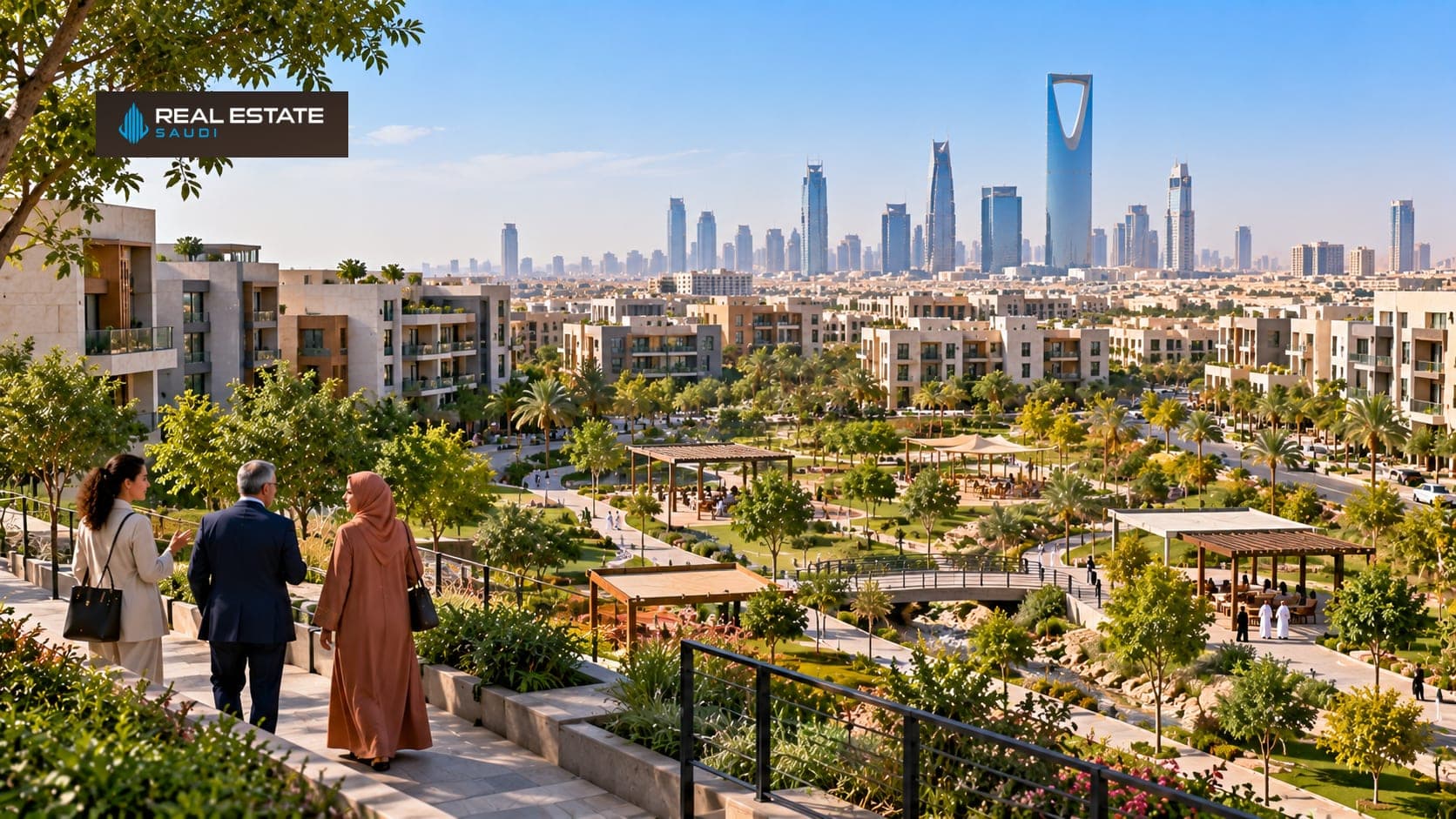
The Real Estate Market in Riyadh in 2026 is no longer a simple story of relentlessly rising prices. Apartments, villas, offices and rental properties are moving at different speeds as affordability pressures, new housing projects and regulatory changes reshape decisions. Buyers want reliable price benchmarks, families want livable neighborhoods, and investors need to understand income after expenses—not just optimistic sales projections.
This guide explains the latest available residential data, how Riyadh districts compare, the five-year rent-increase restriction, rules for non-Saudi buyers and practical checks before committing money. The central lesson is straightforward: assess the specific building, location, ownership eligibility and transaction economics rather than relying on a citywide headline.
What Is Happening in the Real Estate Market in Riyadh in 2026?
Riyadh remains a major employment, government and corporate center, which supports long-term demand for housing and business premises. Yet demand does not automatically translate into rising transaction volumes. Households must manage mortgage payments, down payments and commuting costs, while sellers compete with newly launched communities.
The Real Estate Market in Riyadh has become more selective. According to recent research, apartment prices continued to edge higher year on year in the second quarter of 2026, while villas recorded a modest annual decline. The national residential transaction market was also slower than a year earlier. That combination matters: a price trend and the number of completed sales tell different stories.
For readers comparing the capital's neighborhoods and property categories, the Riyadh property area guide is a useful starting point. Treat every advertised price as an asking figure until comparable completed transactions, property condition and ownership records support it.
Which property type & region do you prefer?
Select property type and preferred city in Saudi Arabia.
Riyadh Property Prices in 2026: What Do the Latest Reports Show?
The most useful benchmark for the Real Estate Market in Riyadh is not a blanket statement that a district is "expensive" or "cheap." It is a dated, clearly defined measure that can be compared with the property under consideration. Knight Frank's Saudi residential and office sector review for Q2 2026 reported the following Riyadh figures:
Q2 2026 indicator | Reported result | How to interpret it |
|---|---|---|
Average apartment sale value | SAR 6,369 per m² | Broad city benchmark, not a quote for every building |
Apartment value change | +3.1% year on year | Moderate annual increase in the measured segment |
Villa value change | −2.2% year on year | Evidence that villas and apartments diverged |
Grade A office rent | SAR 2,810 per m² | Commercial rental benchmark, not residential pricing |
Citywide office occupancy | 96% | Market indicator; individual buildings vary |
These are research figures for Q2 2026, published in September—not live October quotations or guaranteed achievable prices. They also should not be confused with the government's real estate price index, which tracks price changes using a different method.
As an illustration, applying SAR 6,369 per m² to a 110 m² apartment gives SAR 700,590 before transaction charges. That arithmetic is not a valuation of any particular apartment. Age, construction quality, title status, parking, floor level and the project's amenities can move a real quotation substantially above or below the benchmark.
Why Riyadh Housing Demand Remains Important
Riyadh's residential demand comes from several overlapping sources: Saudi families forming new households, residents relocating for work, employees wanting shorter commutes and investors purchasing rental accommodation. The capital's role as a corporate center also supports demand for managed apartments and homes near major business corridors.
However, household income and borrowing capacity place limits on the prices buyers can support. A district may have excellent infrastructure yet remain difficult to sell into if monthly payments exceed the budgets of its typical buyers. Some prospective purchasers instead rent for longer, seek smaller units or examine development corridors outside the most established northern neighborhoods.
Savills' 2026 research on Riyadh residential and office conditions emphasizes employment, corporate demand, new supply and the likelihood that extraordinary earlier residential price growth will moderate. That makes affordability, unit specifications and neighborhood access especially important when interpreting market momentum.
Best Areas to Buy Property in Riyadh
No district is best for everyone. A buyer seeking a school-oriented villa, an apartment close to work and an investment unit with reliable tenants will often reach different conclusions. The following comparison is a screening guide, not a ranking of guaranteed returns.
Riyadh area | Typical appeal | Main due-diligence question |
|---|---|---|
Al-Malqa, Hittin and other northern districts | Modern housing and access to northern business corridors | Does the premium match the specific home's quality? |
Al-Olaya and surrounding central districts | Offices, services and established connections | Are parking, noise and building maintenance acceptable? |
Al-Rimal and eastern growth areas | Newer residential choices and ongoing development | Are promised amenities delivered or still planned? |
Western districts and Diriyah surroundings | Mixed established housing and development exposure | Will road access and nearby construction affect daily life? |
Southern and southwestern communities | Potentially different price points and family-oriented projects | How long is the actual commute at peak hours? |
For a deeper local comparison, explore the site's best residential neighborhoods in Riyadh. Compare actual listings within the same district by built-up area, finishing level, number of bedrooms and whether parking or service charges are included.
North Riyadh: Al-Malqa, Hittin and nearby communities
Northern Riyadh often appeals to buyers prioritizing contemporary villas, apartment developments, schools and proximity to growing business areas. Yet "north" covers many distinct neighborhoods. A newer apartment beside a busy arterial road may be less attractive to a family than a quieter building slightly farther away.
The Al-Malqa area guide helps narrow one popular northern micro-market. Examine walking access, parking capacity, nearby plots still under construction and the time needed to reach work rather than using the district's reputation as a substitute for inspection.
East, west and south: look beyond headline prices
Eastern districts such as Al-Rimal and Qurtubah offer different housing ages and development patterns. In the west, proximity to Diriyah-related activity can be appealing but also requires careful attention to construction and access. Southern and southwestern destinations deserve a fair comparison if schools, family networks and commuting routes fit your needs.
The correct test is total living cost: purchase price or rent, daily travel, maintenance, service quality and realistic resale demand. A lower entry price loses some of its appeal if journeys become consistently expensive or the property requires major repairs.
Apartments Versus Villas: Which Is Better in 2026?
Apartments usually offer a smaller total purchase commitment and can be practical for singles, couples, smaller families and tenants who prefer managed buildings. Important differences include homeowners' association arrangements, lift maintenance, parking allocations, sound insulation and the developer's handover standard. Browse apartments for sale in Riyadh to compare layouts and specifications, but confirm current availability directly.
Villas provide more private space and may suit larger households, yet roof waterproofing, air-conditioning, garden care and utilities can make ownership more demanding. Buyers reviewing villas for sale in Riyadh should compare land area and built-up area separately; the two measurements are not interchangeable.
Neither format is automatically the better investment. The Q2 2026 split between modest apartment price growth and softer villa values is a reminder that buyers should analyze property type separately, even within the same district.
Riyadh Rental Market: What Changed Under the Five-Year Rule?
Riyadh's rental regulations are one of the most consequential differences between its 2026 market and older investment guides. Under REGA's official September 2025 landlord–tenant provisions, annual increases in total rental value for residential and commercial properties within Riyadh's urban boundaries were suspended for five years beginning 25 September 2025.
The rule covers new and existing contracts, but the way initial rent is determined depends on the property's leasing history. For a vacant property previously leased, the last executed Ejar contract generally establishes its rental value. For a unit never previously leased, the landlord and tenant agree on the initial rent, subject to the applicable framework.
The provisions also set renewal and notice rules, with defined exceptions and processes for objections. A landlord should not assume that a lease can be repriced freely every year. Equally, tenants should check the precise contract, property boundary and available official remedies before relying on a generalized online explanation.
For investors, this changes income projections. Model a stable contractual rent, allow for vacancy and repairs, and do not build an acquisition plan on automatic annual rent escalation. The restriction concerns qualifying rents, not a general freeze on the sale price of property.
Can Riyadh Rental Property Still Produce a Good Return?
Yes, an appropriately priced and efficiently managed rental can generate income, but yield depends on the actual property and expenses. Gross yield is annual rent divided by the acquisition price. Net yield is lower after recurring operating costs and realistic allowances for vacancy, maintenance and management.
Consider a purely hypothetical apartment purchased for SAR 900,000 that produces SAR 45,000 in annual contracted rent. Its gross yield is 5%. If allowable recurring costs, vacancy and maintenance consume SAR 9,000 annually, the simplified operating yield falls to 4%, before financing and other personal taxes or charges. These numbers illustrate the calculation; they are not a verified Riyadh market average or promised return.
For a broader discussion of investment strategies, use the Riyadh real estate investment guide. A credible investment forecast should show a pessimistic scenario alongside its preferred outcome and explain what happens if resale takes longer than expected.
Commercial Real Estate: Offices, Retail and Mixed-Use Demand
Riyadh's office market remains relevant to businesses seeking a Saudi headquarters and to investors evaluating commercial premises. Knight Frank reported high office occupancy in Q2 2026, although the level differed between Grade A and Grade B properties. It also identified a substantial pipeline of announced office development through 2028.
Today's tight occupancy therefore does not prove every new building will remain fully let in future. Ask how much additional space is scheduled for the immediate submarket, whether tenants are secured, and whether service charges, fit-out contributions and rent-free periods alter the effective rent.
Investors can use offices for sale in Riyadh to understand available formats. Retail and mixed-use buildings need separate analysis of local purchasing power, pedestrian traffic, parking and permitted use. Do not apply a residential apartment yield assumption to an office or shop without an appropriate comparable lease.
What is your approximate budget?
Narrow down property options based on your target budget.
New Developments and Housing Supply
New planned neighborhoods can widen buyer choice and improve access to schools, parks and services. They can also introduce uncertainty: a master plan, a sales brochure and a fully operational community describe different stages of delivery. Check each stage rather than assuming every amenity shown in promotional material already exists.
For an example of an identifiable developer-led project, NHC's Al-Assalah community in southwest Riyadh describes a residential destination and its planned facilities. Its official project page is useful evidence of the developer's stated scope, not a reason to assume particular future resale prices.
When comparing an off-plan home with a completed unit, ask for the applicable project license, approved plans, delivery milestones, payment schedule, defect-remedy terms and process for title registration. Inspect any completed phases if possible. Delayed possession also carries a real cost when a buyer continues paying rent elsewhere.
Can Foreigners Buy Property in Riyadh in 2026?
Non-Saudi ownership is possible under Saudi Arabia's updated framework, but eligibility depends on the buyer category, permitted geography and other legal controls. The framework took effect on 22 January 2026. It should not be reduced to a blanket claim that every foreign national may buy any home anywhere in Riyadh.
The REGA Law of Real Estate Ownership by Non-Saudis describes geographical limits, relevant ownership rights, residency-related provisions and rules for companies. Individual owners, foreign-controlled companies, licensed funds and holders of certain other statuses may follow different routes.
Before paying a reservation fee, confirm the specific parcel is eligible for your buyer category and that your intended ownership structure is permitted. Verify required registration, identity documents and relevant approvals using official channels. Legal eligibility to acquire property also does not automatically grant residency rights or permission to conduct unrelated commercial activity.
Step-by-Step: How to Buy a Home in Riyadh
The safest purchasing sequence starts with eligibility and the intended use of the property—not with a large deposit. Follow a documented process that keeps each decision reversible until the relevant checks are complete.
Define the purpose. Decide whether the home is for occupation, a long-term tenant or future resale, then set a total affordable budget.
Confirm eligibility. Establish the buyer's permitted ownership route and whether the identified property is eligible, particularly for non-Saudi buyers.
Shortlist comparable homes. Compare actual floor area, age, location, parking, service charges and completed transaction evidence.
Inspect and investigate. Check condition, defects, building permits where relevant, title or registry records, any liens, and the identity and authority of the seller.
Arrange financing and contracts. Obtain financing terms in writing; have a qualified professional review sale, deposit and cancellation provisions.
Complete authorized transfer. Follow the current registration and payment process, preserve receipts and record the handover condition.
Off-plan purchases require additional developer, project and completion checks. A low advertised reservation amount is not evidence that the full purchase is affordable.
Taxes, Fees and the True Cost of Ownership
Purchase price is only the starting figure. Saudi Arabia's ZATCA Real Estate Transaction Tax guidance states that the general Real Estate Transaction Tax rate is 5%, subject to the law's rules and applicable exemptions. Buyers and sellers should confirm the current tax treatment and contractual allocation before closing.
Depending on the transaction, additional costs may include professional advice, finance charges, valuation, registration, brokerage, insurance, fit-out and initial maintenance. Do not assume that all fees apply to every buyer, or that a first-home program automatically covers a particular purchase.
Build a cash-flow sheet containing the deposit, financed amount, repayment schedule, transaction-related charges and a realistic post-handover reserve. For apartments, ask whether shared-building fees are already established; for villas, budget separately for upkeep of exterior areas and major building systems.
How Transport and Infrastructure Affect Home Values
Metro access, road improvements, parks and public services can influence how useful a location feels to residents. But infrastructure announcements do not create identical price effects across every nearby street. Accessibility depends on walking routes, station entrances, connection times, traffic and the quality of surrounding development.
For a neighborhood-specific perspective, read the analysis of how the Riyadh Metro may influence nearby property demand. When evaluating a supposed "metro premium," compare similar completed homes with and without convenient station access rather than adding an arbitrary percentage to the listing price.
The same discipline applies near major parks and development districts. A project might improve long-term amenities while temporary construction reduces convenience. Ask for confirmed milestones, inspect the street and consider how neighborhood conditions may change during your intended holding period.
Biggest Risks for Buyers and Investors
The main risks are usually practical rather than dramatic. Paying for projected future infrastructure instead of existing utility, accepting an optimistic rental forecast, or overlooking renovation needs can undermine an otherwise reasonable property purchase.
Overpaying for reputation: A famous district does not make every unit equally valuable. Compare like-for-like evidence.
Misreading rental rules: Forecasting annual rent rises despite Riyadh's restrictions can inflate expected returns.
Ignoring future supply: Nearby completions may create additional competition for tenants and resale buyers.
Treating asking prices as transactions: A listing can remain unsold or be negotiated substantially lower.
Skipping legal verification: Title, ownership eligibility, registered interests and permitted use must be checked.
Underestimating maintenance: Poor waterproofing or air-conditioning can turn a cheap purchase into a costly one.
Request written disclosures where available, appoint independent specialists when the stakes justify them, and do not allow urgency claims to replace verification. A useful rule is to identify the three assumptions that would have to be true for your purchase to work—and then test each one.
How would you like to be contacted?
Choose your preferred channel for a private consultation.
Riyadh Real Estate Outlook for Late 2026 and Beyond
The most defensible 2026 outlook is mixed rather than uniformly bullish or bearish. Apartment prices showed positive annual movement in the latest Knight Frank Q2 data, villas were softer, and office occupancy was high even as substantial future supply was announced. These segments can follow different trajectories for years.
The Real Estate Market in Riyadh will also respond to delivery of new homes, lending conditions, household affordability and the implementation of ownership and rental regulations. The direction of the broader economy matters, but neighborhood-level prices depend on choices people can actually finance and on homes ready for occupation.
Watch three indicators before making a decision: comparable registered sales rather than marketing prices; completed units and credible construction schedules rather than headline project totals; and effective rental income after vacancies and costs. Revisit the data each quarter, because a report describing June transactions cannot reliably tell you what a specific home will sell for in December.
Conclusion
Riyadh offers genuine choices for owner-occupiers, landlords and businesses, but the right purchase depends on price, suitability and legal certainty. The Real Estate Market in Riyadh is increasingly shaped by differentiated apartment and villa performance, new communities, a major rental-policy change and evolving non-Saudi ownership rules.
Begin with verified comparisons, inspect the individual asset, calculate the full ownership cost and model a conservative financial outcome. A well-researched home that fits your actual needs is a stronger decision than chasing any prediction of guaranteed appreciation.
Talk to Our Real Estate Experts
Get real-time insights on investment options, commercial properties, and market guidelines.
Frequently Asked Questions
Knight Frank reported an average Riyadh apartment value of SAR 6,369 per square metre for Q2 2026. This citywide research measure is not a current asking price for every district or a valuation of an individual unit. Building age, finish, location, title status and available services can produce substantial differences.
Both trends appear in different segments. Knight Frank's Q2 2026 results showed apartment values 3.1% higher than a year earlier, while villa values were 2.2% lower. Buyers should compare property type, neighborhood and individual condition rather than applying one citywide direction to every sale.
Areas such as Al-Malqa, Hittin, Al-Rimal and established suburban communities may suit different household needs. The best choice depends on school access, commuting times, budgets, parking and nearby services. Visit shortlisted streets during rush hour and compare similarly sized properties before selecting a district.
The Riyadh urban-boundary framework introduced on 25 September 2025 generally suspends annual increases in the total rental value of covered residential and commercial leases for five years. Specific treatment of existing, vacant previously leased and never-leased units differs. Check the official provisions and registered Ejar contract for the relevant situation.
Non-Saudi ownership is available subject to the updated law, geographic controls, eligibility category and registration procedures. The framework came into force on 22 January 2026. Buyers should verify their own status and whether the exact property is eligible before making payments or relying on promotional claims.
Neither is universally better. Apartments may have a lower total entry cost and broader potential tenant pool; villas may suit families seeking space but involve different maintenance expenses. Analyze purchase price, actual obtainable rent, vacancy, service charges, repair exposure and exit demand for the specific property.
Saudi Arabia generally applies a 5% Real Estate Transaction Tax, subject to the legislation's conditions and exemptions. Other potential costs include brokerage, professional reviews, financing and maintenance. Confirm which party is responsible for each charge and obtain current advice before signing a binding agreement.
No. Better transport can increase an area's attractiveness, but price effects vary with station access, property quality, local supply and the premium already reflected in the asking price. Buyers should compare real transactions and inspect pedestrian routes rather than assuming a fixed gain from proximity to a station.
An off-plan purchase can be appropriate when the project is properly authorized and the buyer understands the schedule, payment obligations and remedies for delay or defects. Verify the developer, project approvals, contract terms, handover milestones and registration process. Do not treat advertising illustrations as proof of completed amenities.
Start with a realistic total budget and finance approval. Then check location during real commuting hours, property condition, legal title, seller authority, area measurements and current market comparables. Include applicable taxes, service costs and future repairs in the calculation. For non-Saudi buyers, confirm property-specific ownership eligibility before paying a deposit.
