
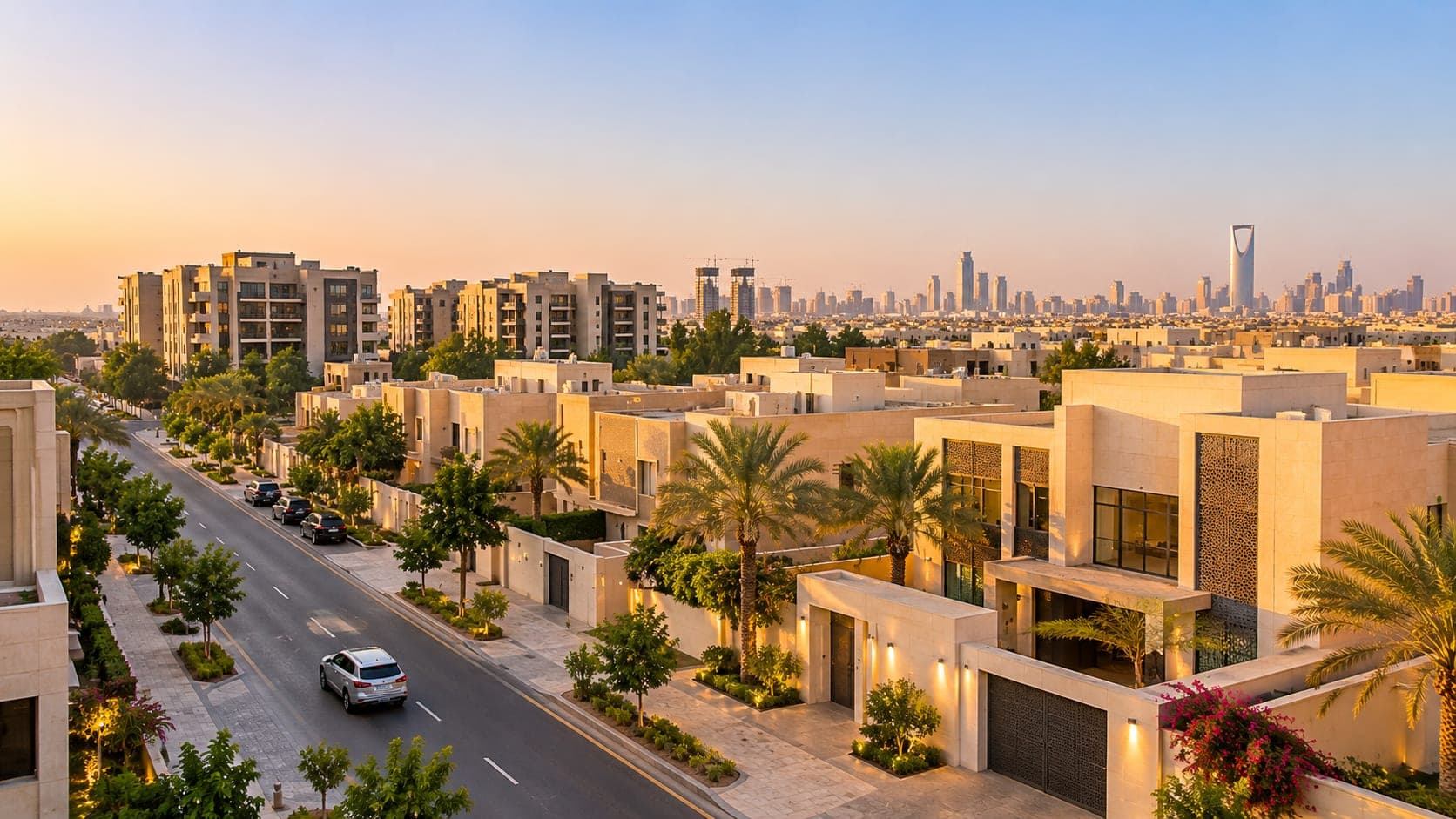
Riyadh property prices 2026 have declined across more than 200 residential neighbourhoods, according to Abdullah bin Saud Alhammad, chief executive of Saudi Arabia's Real Estate General Authority (REGA). Speaking at the Budget 2027 Forum on 25 November 2026, he attributed the changes to measures intended to restore balance to the capital's property market. He also outlined a continuing housing supply-demand imbalance, a shift in residential land transactions, progress under the Tawazoun land programme and restrictions on annual rental increases. The announcement does not establish that prices fell uniformly throughout Riyadh or that every home in the affected neighbourhoods became cheaper.
Quick Facts
Indicator | Officially reported information |
|---|---|
Announcement date | 25 November 2026 |
Speaker | Abdullah bin Saud Alhammad, REGA chief executive |
Event | Budget 2027 Forum, Riyadh |
Residential price finding | Declines reported in more than 200 neighbourhoods across five city sectors |
Estimated average annual housing demand | Approximately 130,000 units |
Estimated annual housing supply | Approximately 50,000 units |
Indicative demand-supply difference | Approximately 80,000 units; editorial arithmetic, not a separate REGA statistic |
Tawazoun first-year land allocation | More than 10,000 plots |
Tawazoun land price ceiling | SAR 1,500 per square metre, subject to programme rules |
Rental contracts covered by restriction | Approximately one million |
Residential land's share of transactions, Q1 2025 | 49% |
Residential land's share of transactions, Q3 2026 | 22% |
Detailed affected-neighbourhood list | Not provided in the announcement |
Which property type & region do you prefer?
Select property type and preferred city in Saudi Arabia.
What REGA Announced at the Budget 2027 Forum
In the Saudi Press Agency's official account of the Budget 2027 Forum, Alhammad described the residential property market as responding to a package of measures aimed at addressing Riyadh's imbalance between demand and available housing. He linked the observed declines in more than 200 neighbourhoods to the programme's efforts to moderate rapid price increases, while acknowledging differences in how individual areas had responded. His remarks concerned the Saudi capital rather than a nationwide property-price measure.
The announcement also covered land allocation, rental regulation and the changing composition of recorded residential sales. A neighbourhood price movement, an allocated residential plot, a registered lease and a completed home sale should not be treated as interchangeable evidence of additional housing supply. Real Estate Saudi's Riyadh property market guide offers wider background, while the new report focuses specifically on Alhammad's November statements.
Riyadh property prices 2026: What the Neighbourhood Finding Shows
REGA's chief executive said residential price declines had been observed in more than 200 neighbourhoods distributed across five sectors of Riyadh. The statement describes a geographically broad response to the market-balancing decisions, rather than a single change applying equally to every property in the city. Differences in local supply, the pattern of demand and site readiness were among the considerations cited in explaining why neighbourhoods responded differently.
The official report does not identify the individual neighbourhoods within that finding. Consequently, it cannot be used to declare that a particular apartment building, villa or street has experienced a verified reduction. The number of affected areas is not a complete transaction database, and the guide to Riyadh residential neighbourhoods should not be mistaken for REGA's unpublished list of price movements.
What the Price Announcement Does Not Reveal
The public statement provides no full list of the affected neighbourhoods, starting and ending prices, property-level observations or common comparison dates for each area. It also does not disclose the number of transactions in the analysis, detailed statistical methodology or a breakdown of apartment, villa and residential land results by neighbourhood. Without that information, readers cannot reproduce the finding as a uniform citywide percentage or use it to calculate a discount on a specific home.
Local prices can differ between completed dwellings and vacant land and among assets of different sizes, quality and legal status. Official REGA real estate indicators provide a separate route to examine available market measures, but the Budget Forum statement does not supply the complete underlying neighbourhood-level dataset.
Riyadh's Annual Housing Demand and Supply Gap
Alhammad estimated average annual demand for approximately 130,000 residential units in Riyadh against annual supply of around 50,000 units. The comparison helps explain why housing availability remained central to the capital's market-balancing agenda even as the authority reported price declines in numerous areas. It distinguishes continuing demand for accommodation from the movement in transaction prices across particular locations.
Subtracting the two estimates produces an indicative difference of approximately 80,000 units per year. That is a RealEstateSaudi.com calculation based on the two figures cited by REGA, not an additional independently published shortage estimate or a measured backlog of completed homes. Demand and supply estimates can be revised, and neither figure establishes where the gap falls by district, household type or property specification.
Residential Land's Share of Transactions Falls From 49% to 22%
Another significant figure concerns the composition of residential property sales. Alhammad said transactions involving residential land accounted for 49% of residential deals in the first quarter of 2025, compared with 22% in the third quarter of 2026. That represents a decline of 27 percentage points in transaction share between the stated quarters, not a 27% fall in land prices. The measure describes the relative proportion of transactions classified as land.
A smaller share does not, by itself, show that the absolute number of land deals fell by the same amount. The denominator includes other types of residential transactions, which can move independently. REGA's chief executive associated the change with greater attention to development and purchases of completed or off-plan property, but the public figures do not isolate a precise cause for each transaction.
From Holding Land to Developing and Buying Homes
REGA framed the shift in the transaction mix as part of a move away from speculative land holding towards land development and investment in ready or off-plan units. This is the authority's interpretation of changing market behaviour rather than proof that all buyers have adopted a particular strategy.
For developers, a greater emphasis on deliverable housing can make land readiness, financing and regulatory approvals important considerations. Yet an off-plan reservation is not a completed home, and development intent is not the same as construction completion. The relevant question is how many properties ultimately become available for occupation, not merely whether transaction composition changes in a quarterly series.
Tawazoun Adds Planned Residential Land Options
The Royal Commission for Riyadh City's official Tawazoun programme forms another strand of the market-balancing measures. Alhammad said more than 10,000 plots were made available during the programme's first year for eligible citizens. The initiative is intended to provide planned residential land and expand qualifying households' access to ownership within Riyadh, rather than operate as an unrestricted commercial land sale programme.
The announced first-year allocation must be distinguished from building completion. Parcels may pass through application, eligibility, allocation, documentation, physical preparation and eventual construction at different times. The programme does not demonstrate that more than 10,000 completed homes have entered the occupied housing stock.
First Handover Progress and the Next Tawazoun Draw
The Royal Commission confirmed that the first batch of Tawazoun ownership documents was handed over in October 2026. This represented progress from allocation towards ownership procedures for selected beneficiaries. Real Estate Saudi's report on the first Tawazoun land handover covers that earlier event in detail and distinguishes the first delivery batch from the overall first-year allocation.
At the Budget Forum, Alhammad indicated that a second-year draw and additional batches were expected in the following weeks. His forward-looking statement does not confirm that a draw had already occurred on 25 November. Nor does the October document handover prove that every allotted plot was physically delivered or ready for building. Later Royal Commission notices are needed to establish the dates, numbers and completion status of subsequent phases.
What is your approximate budget?
Narrow down property options based on your target budget.
What the SAR 1,500 Per Square Metre Ceiling Means
Tawazoun's published framework sets a ceiling of SAR 1,500 per square metre for eligible residential plots offered under the programme. It is a maximum price rate for qualifying land within the applicable allocation process, not a quoted asking price for every plot in Riyadh. It is also not the purchase price of a completed villa, apartment or townhouse.
The rules and procedures matter: the figure cannot simply be applied to every parcel on the private market, and it does not establish entitlement for an applicant who has not met programme conditions. Additional costs associated with designing, financing, permitting and constructing a home are separate.
Riyadh's Five-Year Rent-Increase Restriction
Alhammad said approximately one million rental contracts fall within Riyadh's five-year restriction on annual rent increases. That is a contract count, not the number of unique tenants, households or properties. The restriction concerns qualifying rental agreements within Riyadh's defined urban area and covers residential and commercial premises under the applicable provisions.
REGA's official rental regulations state that the suspension took effect on 25 September 2025 for five years. Other rules address previous lease values, registration and renewals, with specific procedures and exceptions. They do not establish that every tenant's total housing expenses are identical or that the selling price of a rented home must decline.
Why Rental Stability Is Separate From Sales Prices
The rental restriction and the price changes reported by REGA sit within the same policy package but affect different parts of the market. Rent provisions regulate specified lease relationships, while residential sale prices depend on transactions involving ownership rights. A one-million-contract coverage figure should therefore not be used as a measure of property purchases or a direct explanation of a particular sale price.
Real Estate Saudi's Riyadh rental-yield guide discusses income measurement, but its historical benchmarks cannot establish how the November policy findings affected a specific property. The authority's statement describes the scale of regulatory coverage, not a verified change in investment returns.
White-Land Fees and the Wider Supply Strategy
Additional measures seek to encourage more effective use of undeveloped urban land. White-land fee rules and geographical updates are intended to influence the incentives facing affected landowners, but mapped inclusion, assessment, development and completed construction are separate stages. The related official programme includes requirements that vary according to classification and the applicable regulations.
Real Estate Saudi's report on Riyadh's November white-land fee boundary expansion covers the addition of more than 21 million square metres under a separate announcement. That figure should not be added to Tawazoun's plot count or interpreted as new homes.
Implications for Buyers, Sellers and Developers
For buyers, evidence of declines in numerous neighbourhoods warrants careful local research rather than an assumption that every listed property is discounted. Comparable sales should be reviewed for the same type of dwelling and similar location, quality, size and ownership conditions. Real Estate Saudi's property valuation guide explains why valuation depends on individual asset characteristics rather than a headline about a city's market.
For sellers, the findings reinforce the need to distinguish asking prices from achieved prices. Developers should also examine financing, infrastructure and realistic delivery stages. Real Estate Saudi's Riyadh property investment guide discusses broader risk factors without making claims about this specific REGA price finding.
A Neighbourhood-Level Approach to Due Diligence
The Riyadh property prices 2026 discussion requires particular care because the market-balancing statement concerns more than 200 areas without naming each one. Buyers should identify their specific property, confirm its lawful use and title, examine verified comparable transactions and distinguish completed housing from planned supply. A district mentioned in an unrelated Tawazoun announcement is not automatically one of the areas where REGA reported falling prices.
Saudi Arabia's Real Estate Registry provides official ownership-document and property-record services relevant to legal due diligence. Those services do not independently set a property's current market price. Real Estate Saudi's guide to buying property in Saudi Arabia offers broader purchasing context, but any claim of a particular price decline still requires property-specific market evidence.
Confirmed Facts Versus Editorial Interpretation
The confirmed November announcement concerns the more-than-200-neighbourhood finding, estimated annual demand and supply, first-year Tawazoun availability, rental-contract coverage and the two stated land-transaction shares. The official speaker associated these outcomes with efforts to moderate price pressures and encourage development. His attribution is a policy assessment reported at the Budget Forum; it is not the same as releasing a complete causal research dataset.
RealEstateSaudi.com's interpretation is that the statistics point to an evolving balance between new housing demand, supply initiatives and transaction behaviour. They do not prove that Riyadh's accommodation needs have been met, that all landholders have changed strategy or that a particular home has become affordable. Readers should keep reported observations, programme objectives and possible market consequences distinct.
How would you like to be contacted?
Choose your preferred channel for a private consultation.
Information Still Missing and What to Monitor
REGA did not publish the list of neighbourhoods underpinning the price finding, the underlying sample size, a standardised neighbourhood-level method or property-specific starting and ending prices in the cited announcement. It also did not establish a uniform completion timetable for the plots under Tawazoun or identify exactly how many new homes will become occupied as a consequence of the measures.
Subsequent official releases may clarify the geographical evidence, track the delivery of residential units, update transaction patterns and document the next Tawazoun allocations. Any later claims about housing affordability need comparable prices, household costs and verified supply, not only allocation announcements.
Conclusion
The Riyadh property prices 2026 update from REGA describes declines across more than 200 residential neighbourhoods alongside continuing pressure on housing supply. At the Budget 2027 Forum, Alhammad estimated annual demand at approximately 130,000 units against annual supply of about 50,000 and highlighted changes in land-transaction shares, Tawazoun allocations and rental regulation.
Those figures demonstrate a substantial policy response and evidence of changing market conditions, but not a uniform citywide price decline or the elimination of the housing gap. Homebuyers, owners and property professionals should evaluate neighbourhood-level evidence and later official delivery data before drawing conclusions about specific properties.
Talk to Our Real Estate Experts
Get real-time insights on investment options, commercial properties, and market guidelines.
Frequently Asked Questions
At the Budget 2027 Forum on 25 November 2026, REGA chief executive Abdullah bin Saud Alhammad said market-balancing decisions had contributed to residential price declines across more than 200 Riyadh neighbourhoods. The statement concerned selected geographical areas and a period of policy implementation. It was not a published price adjustment for every dwelling or a guarantee that prices will continue to fall.
No. The official finding concerns more than 200 neighbourhoods across five sectors, not every district or every asset in the capital. Prices can differ between streets and among apartments, villas and land. The public announcement does not establish a uniform reduction for all Riyadh properties, so any individual comparison requires more detailed local evidence.
The announcement did not provide a complete neighbourhood-by-neighbourhood list. It would be misleading to name districts as affected without the underlying official information. Locations mentioned separately in Tawazoun's land handover are not automatically confirmed as part of the price-decline finding. Buyers should consult official indicators and verified comparable transactions for the particular property they are assessing.
The public statement discussed varying changes across more than 200 neighbourhoods but did not provide a reproducible property-level series for each location. It cannot be used to assign one citywide percentage to a particular apartment, villa or plot. A reliable estimate requires the relevant comparison period, transaction sample and property characteristics, which were not provided in the summary.
REGA's chief executive cited average annual demand of approximately 130,000 residential units. This is a broad estimate for the capital rather than an announced number of purchases or households receiving homes in November. It should be compared with the supply estimate cautiously, as the figures do not reveal how demand is distributed across neighbourhoods or housing categories.
Alhammad cited annual supply of approximately 50,000 residential units. Against estimated demand of 130,000 units, the simple arithmetic difference is around 80,000 units. This is an editorial calculation based on the two disclosed estimates, not a separately audited REGA housing-shortage figure or proof that the difference will remain constant in future years.
Residential land accounted for 49% of residential property transactions in Q1 2025 and 22% in Q3 2026, according to the authority's CEO. The change is 27 percentage points in the composition of deals. It does not indicate that land prices fell by 27%, and the share figures alone do not identify changes in the absolute count or value of transactions.
The applicable five-year provisions suspend annual increases in covered residential and commercial lease values within Riyadh's urban boundaries, beginning on 25 September 2025. REGA said approximately one million rental contracts were covered. That is not a count of unique tenants, and the rules include provisions on registration, renewals and specific circumstances requiring official review. Individual obligations depend on the applicable contract and rules.
The Tawazoun programme offers eligible citizens planned residential plots under a maximum price rate of SAR 1,500 per square metre, subject to its rules. The figure concerns land, not completed houses or the cost of constructing one. More than 10,000 plots were made available in the first year, but that does not mean every plot has been physically handed over or developed.
No. The reported declines do not establish uniform prices or affordability across the city. Housing affordability depends on the cost of a specific property, financing, household resources and available supply. The announcement provides policy and market observations, not household-level affordability measurements. Buyers should verify individual property documentation, current comparables and the financial commitments attached to a purchase.
