
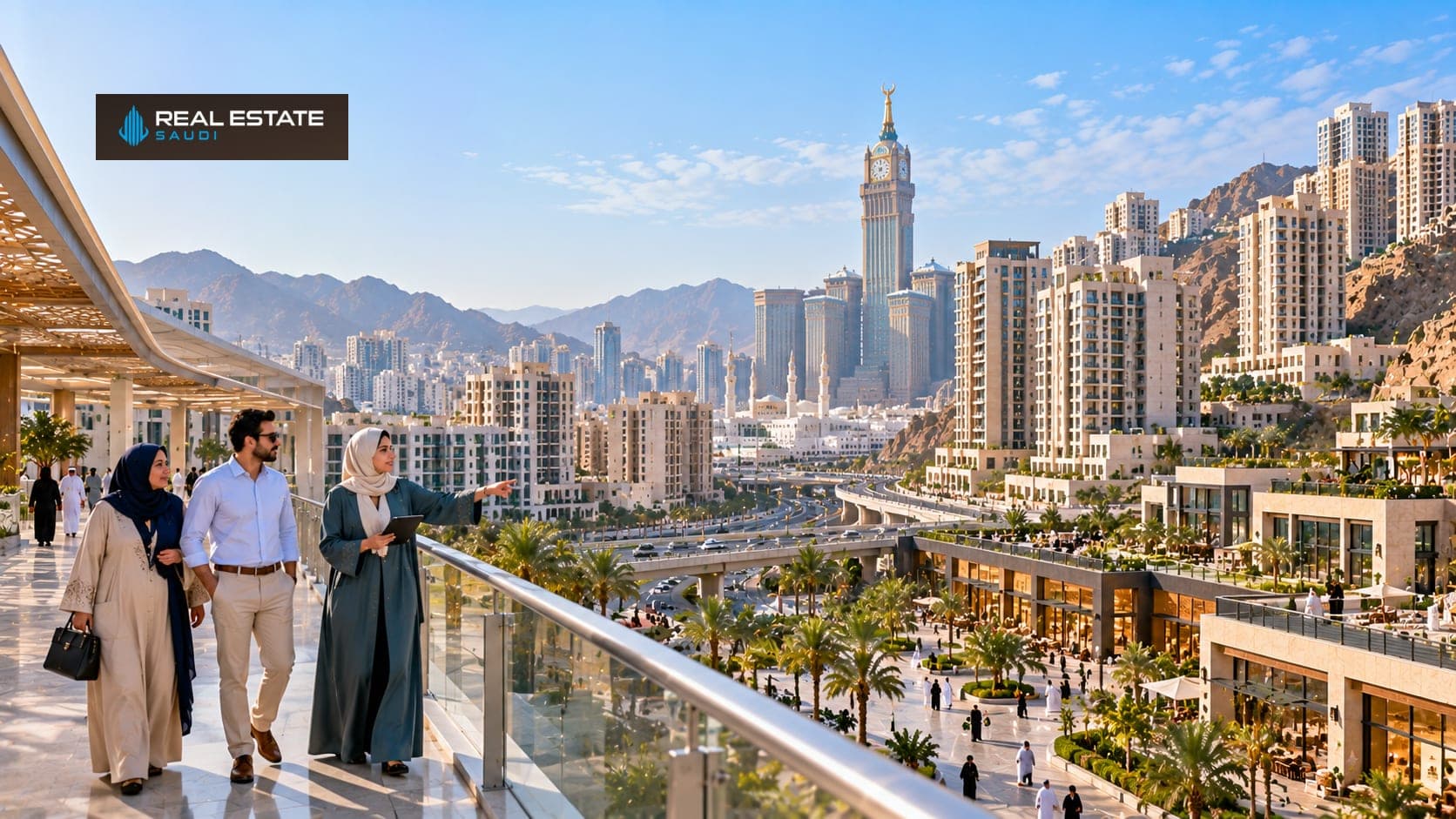
The Real Estate Market in Mecca in 2026 offers contrasting opportunities. Apartments in established residential districts serve families and workers, while hotels, serviced accommodation and commercial premises near Al Masjid Al Haram respond to visitor demand. These markets should not be valued in the same way: an apartment for permanent residents has different costs, risks and occupancy patterns from a hospitality asset.
Makkah, also called Mecca, is Saudi Arabia's holiest city. Its property market reflects a combination of local housing needs, the Hajj and Umrah visitor economy, major redevelopment projects and ownership rules specific to the holy cities. Location matters, but so do legal use, building condition, access, financing and the price actually paid.
This guide explains verified price benchmarks, neighbourhood choices, investment opportunities, property-buying costs and the rules buyers should check in 2026. It distinguishes published market evidence from forecasts and advertised prices so readers can make better-informed decisions.
Real Estate Market in Mecca: 2026 Overview
Makkah is not one uniform market. The central area around the Grand Mosque contains highly specialised property, including hospitality buildings and commercial space. Farther from the Haram, neighbourhoods serve permanent households seeking schools, healthcare, parking and manageable commuting routes. The same price per square metre does not imply equal value across these different uses.
The Makkah real estate area guide provides an overview of local districts and property categories. Buyers should begin by defining whether the property is for a family, long-term letting, business operations or a visitor-facing investment. That decision determines which transactions and legal requirements are relevant.
For 2026, affordability, the pace of new supply, transport access, ownership eligibility and actual rental evidence deserve closer attention than sweeping statements about inevitable capital appreciation.
Makkah Property Prices: Verified Market Benchmarks
Citywide price statistics are useful only when the reporting date is made explicit. Knight Frank's Destination Saudi 2026 residential report recorded average Makkah apartment values of SAR 3,500 per square metre at the end of Q4 2025, down 5% year-on-year. Villa values averaged SAR 3,260 per square metre, a 6% annual decline.
Indicator | Reported benchmark | Period |
|---|---|---|
Average apartment value | SAR 3,500/m² | Q4 2025 |
Annual apartment movement | -5% | Year to Q4 2025 |
Average villa value | SAR 3,260/m² | Q4 2025 |
Annual villa movement | -6% | Year to Q4 2025 |
These are the latest detailed citywide figures cited from that research, not verified asking prices for October 2026. The report also noted that some apartments nearest the Grand Mosque can trade above SAR 15,000 per square metre, depending on proximity, views, access and quality. That premium segment must not be confused with ordinary family housing across the city.
The report estimated roughly 763,800 residential units in Makkah and forecast supply of approximately 851,000 by 2028. Forecast homes are not necessarily completed or available for sale; delivery timing and market absorption remain uncertain.
Which property type & region do you prefer?
Select property type and preferred city in Saudi Arabia.
How to Find Current Transaction Prices
Asking prices show sellers' expectations. Completed transactions offer stronger evidence of what buyers paid. The Real Estate General Authority's property indicators platform allows research by city, district, property category and period, with separate sales and rental indicators. Its averages are market measures, not valuations of individual buildings.
Start with the correct asset type. Residential land, apartments, villas, commercial floors and hotel property should not be combined into one comparison. Next, match the district and check the number and dates of transactions. A few unusual sales can distort an average even when statistical filtering is used.
Within an apartment building, compare usable floor area, finishing standard, parking, lift access and ongoing fees. For villas, establish plot size, building age, construction condition and any required renovation. The Mecca apartment price guide can help frame a search, but any advertised range still needs checking against recent deeds and independent inspection.
Best Areas to Buy Property in Mecca
There is no universally best district. Some locations favour visitors and businesses, while others better serve households who need daily services and predictable access. The following is an editorial comparison, not a verified ranking of returns or prices.
Area | Potential appeal | Due-diligence priority |
|---|---|---|
Ajyad and central approaches | Access to the Grand Mosque and visitor services | Exact access, permitted use, high acquisition costs |
Al Aziziyah | Established residential and commercial activity | Local traffic, building condition, seasonal effects |
Al Shara'i | Wider suburban family-housing search | Schools, travel time and infrastructure |
Al Taneem | Housing choices away from the central core | Neighbourhood services and connections |
Al Kakiyyah | Residential and commercial mix | Road access and street-level differences |
Al Naseem | Family accommodation in some communities | Property condition and actual comparables |
Batha Quraish | Residential options beyond the Haram core | Plot details, amenities and commute |
The guide to residential areas in Mecca provides additional local context. It is wise to visit potential neighbourhoods during ordinary weekdays as well as busier periods. A journey that looks short on a map may take substantially longer under pilgrimage traffic conditions.
For family buyers, the best district is generally the one that meets budget, school and employment needs without depending on speculative price growth. Commercial investors need a more specific study of tenant demand, foot traffic and licensed use.
Central Makkah Versus Outer Residential Districts
Proximity to the Grand Mosque can create convenience and a scarcity premium, but it also brings specialised operating considerations. Pedestrian circulation, vehicle restrictions, loading arrangements and visitor-season changes can all influence a building's practical value. A hotel with efficient guest access is not equivalent to an ordinary residential flat a similar distance away.
Outer districts can provide larger layouts and a wider search for family-oriented housing. Buyers should examine completed road connections, schools, medical services and public utilities. Lower acquisition cost alone does not prove better value if daily travel becomes difficult or a building requires expensive repairs.
Property condition also varies sharply within a district. Inspect the immediate street, not just the neighbourhood label. Nearby construction may improve future amenities, but it can create noise, access problems or new competition in the meantime.
Apartment Prices, Supply and Buyer Demand
Apartments can appeal to first-time purchasers, smaller households and landlords targeting year-round residents. Shared services make some buildings convenient, yet they introduce common-area maintenance, service charges and decisions about repairs. An older apartment with a low asking price may be expensive to operate if cooling, waterproofing or lifts need attention.
Buyers comparing apartments for sale in Makkah should note exact area, layout, parking and building management. Listings can show current inventory but cannot establish completed sale values. A unit advertised as suitable for visitors also requires legal confirmation of the intended accommodation activity.
In developments with many similar units, additional supply may strengthen buyers' negotiating positions or affect landlords' ability to maintain rents. Compare completed projects and real handover schedules rather than treating every proposal as available housing.
Villas and Long-Term Family Housing
Villas provide privacy and may offer more flexible living space, parking and outdoor areas. Their total costs can be substantial because owners may maintain roofing, exterior walls, water systems, cooling equipment and gardens individually. Plot dimensions and actual built-up area are essential for comparison.
Families reviewing villas for sale in Makkah should investigate structural integrity, drainage, insulation and the condition of surrounding roads. A renovated property can be more suitable than a newer but poorly finished home. Independent technical assessment is worthwhile before a large purchase.
Rental investors should also consider the smaller tenant pool for some expensive villas. A bigger residence does not automatically produce a stronger yield or faster resale. Assess who would realistically occupy the home and at what cost.
Pilgrimage Demand and the Rental Market
The Hajj and Umrah economy is central to Makkah's visitor accommodation sector. Saudi Arabia's Pilgrim Experience Program focuses on improving infrastructure, access and visitor services. That wider activity supports demand for hospitality, retail and transport, but it does not guarantee income for an individual property.
The Real Estate Market in Mecca includes two distinct rental patterns. Family accommodation may aim for reliable longer-term tenants, while visitor-linked lodging can experience changing occupancy and rates across the year. Tourism operations may also require different licences, staffing, cleaning, marketing and management arrangements.
For any rental property, seek evidence of achieved rents rather than the highest advertised nightly or monthly figure. Calculate annual income after vacancies, operating expenses, commissions, maintenance and financing commitments. Seasonal peaks cannot safely be multiplied into a full-year forecast.
Hotels, Serviced Apartments and Commercial Investment
Hotels and furnished accommodation near the Haram have different economics from ordinary residential units. Revenue depends on licensed capacity, brand or operator agreements, guest access, staffing, utilities, refurbishment and distribution costs. Investors should ask whether they are buying an entire building, an individual unit, a leasehold interest or shares in an investment structure.
The hotels for sale in Makkah category provides a starting point for identifying asset formats. It does not replace independent review of occupancy, historical financial statements, permissions, contracts and future capital expenditure.
Retail and office properties should be analysed separately. A shop relies on its frontage, pedestrian movement and nearby customer base; an office needs access, suitable layouts and reliable services. Expensive locations can underperform if acquisition costs are not supported by sustainable net operating income.
Assessing Property Investment Returns
An investor should begin with a realistic income-and-cost model. Gross yield divides annual rent by the purchase price, but ignores important expenses. Net yield is more informative because it deducts recurring costs and uses the complete investment amount, including qualifying acquisition expenses and necessary improvements.
The Mecca real estate investment guide explores additional investment considerations. In practice, investors should model a conservative scenario with vacancy, maintenance and slower-than-expected rent growth. They should also test a more stressful case involving a large repair or delayed tenant replacement.
The strongest acquisition is not always the highest advertised yield. Good legal rights, building condition, liquid resale demand and a manageable financing burden are equally important. No property market offers assured appreciation or occupancy.
What is your approximate budget?
Narrow down property options based on your target budget.
King Salman Gate and Major Development Projects
Large developments are changing parts of central Makkah. In October 2025, the Public Investment Fund announced King Salman Gate, a mixed-use project adjacent to the Grand Mosque. The PIF announcement on King Salman Gate describes plans for up to 12 million square metres of gross floor area, not a completed 12-million-square-metre land parcel. The proposed uses include hospitality, residential, cultural and commercial facilities.
Masar Destination is another major urban development associated with improved connections and mixed-use accommodation. Such projects may alter visitor routes and the supply of modern buildings. However, completion phases, construction disruption and the number of competing rooms or apartments matter to surrounding owners.
Buyers should distinguish official project announcements from delivered infrastructure. A nearby apartment does not automatically gain value merely because a development has been announced; the result depends on access, quality, competition and its original purchase price.
Can Foreigners Buy Property in Makkah in 2026?
Foreign ownership in Makkah is subject to a specific legal framework. Saudi Arabia's updated non-Saudi property ownership system came into effect on 22 January 2026. Under the Real Estate General Authority's law on ownership by non-Saudis, individual ownership rights in Makkah and Madinah are limited to eligible Muslim natural persons. Qualifying Saudi companies, including certain structures with non-Saudi shareholders, are addressed separately under the law.
Eligibility also depends on approved geographical areas, the type of right and applicable procedural requirements. Holding a residence permit, owning a company or receiving a seller's offer does not independently establish the right to purchase a particular plot.
Foreign buyers should verify the exact asset through official channels and obtain qualified legal advice before paying a deposit. The Makkah and Madinah foreign-buyer guide provides additional background, but it must be read alongside the current law and designated-zone rules. Investment through securities is different from direct registered ownership of real estate.
Taxes, Fees and Ownership Costs
Saudi Arabia generally imposes a 5% Real Estate Transaction Tax on taxable property disposals, subject to applicable exemptions and detailed statutory conditions. The ZATCA Real Estate Transaction Tax law explains the rate and current legislation, which took effect in April 2025. Parties should confirm the tax treatment and legal responsibility for their particular transaction.
Additional expenditure may include valuation, brokerage, legal review, technical inspection, financing charges, registration-related costs and repairs. For apartments, investigate recurring shared-building expenses. For villas or commercial buildings, allow for periodic large maintenance projects.
Ask for a written completion-cost estimate before signing. A buyer whose budget covers only the advertised price may struggle with the cash required at transfer or shortly after occupation.
Mortgage Financing and Affordability
Financing approval depends on applicant income, existing obligations, down payment, lender policy and the acceptability of the property. Saudi citizens, residents, foreign applicants and companies may face different conditions. Never assume an attractive advertised mortgage applies to every buyer or building.
Compare the annual percentage rate where disclosed, total repayment, fees, term, protection products and early-settlement clauses. A longer term can reduce monthly instalments while increasing the overall cost of financing.
Households should retain savings for emergencies and maintenance. Investors should evaluate whether rent still covers expenses and debt service during periods of vacancy or weaker demand. Financing should support a sound purchase, not justify paying above fair value.
Ready Homes Versus Off-Plan Projects
A completed property allows physical inspection before commitment. Buyers can assess orientation, noise, finishes, common facilities and surrounding services. However, hidden defects or unclear ownership records can still create substantial problems, making technical and legal checks essential.
An off-plan purchase may offer staged payments or modern layouts, but it adds construction, developer and delivery risks. Verify relevant project licensing, approved plans, payment protections and contractual remedies. Marketing visualisations are not substitutes for written specifications.
Evaluate how much competing supply may be delivered at similar price points. A new project can improve consumer choice without ensuring investment gains for every early buyer.
How to Buy Property in Mecca: Step by Step
1. Set the objective. Decide whether the asset is for a household, long-term rental income, visitor accommodation or commercial use. This determines appropriate comparisons and permissions.
2. Calculate the budget. Include purchase price, applicable tax, financing, legal review, inspections, service charges and an initial repair allowance.
3. Choose suitable districts. Assess workplace and school access for family property, or actual customer and guest access for commercial accommodation.
4. Study comparable sales. Use transactions from similar properties in the same area and period. Record differences in layout, condition and permitted use.
5. Confirm ownership eligibility. Verify the title, seller authority, boundaries, encumbrances and any foreign-buyer restrictions before making binding commitments.
6. Inspect and value. Commission appropriate structural, mechanical and legal assessments. For operating assets, examine genuine income statements and contractual obligations.
7. Review the contract. Understand the deposit, payment schedule, handover terms, defects, cancellation rights and treatment of delayed completion.
8. Complete registration. Use authorised conveyancing channels, settle applicable taxes, retain documentary evidence and arrange utility and management handover.
Common Risks and Buying Mistakes
One mistake is treating every property near the Grand Mosque as a profitable tourism asset. A unit's actual legal use, guest access, operating costs and occupancy evidence are fundamental. Another is applying citywide apartment averages to specialised hotel buildings or premium central apartments.
Some investors accept unrealistic seasonal rent projections, ignore building service charges or underestimate the cost of refurbishing older property. Others rely on verbal promises about infrastructure or assume foreign ownership approval follows automatically from a residency status.
The solution is disciplined due diligence: compare transactions, inspect the asset, confirm its rights and test a conservative financial model. Research can reduce avoidable mistakes but cannot eliminate market uncertainty.
How would you like to be contacted?
Choose your preferred channel for a private consultation.
Real Estate Market in Mecca: Trends Beyond 2026
Future conditions will depend on household affordability, visitor-related investment, completed transport improvements and the pace of new residential and hospitality supply. Projects around the Haram may reshape parts of the central area, while outer communities will continue to compete on services, housing quality and commuting convenience.
The Real Estate Market in Mecca is likely to remain highly differentiated. A modern hotel, older apartment, family villa and suburban land plot each face different buyer pools and maintenance requirements. Investors should follow actual completed sales and leasing evidence rather than rely only on national headlines.
The most defensible purchases combine transparent ownership, a clear user or tenant market, manageable operating costs and pricing supported by comparable transactions.
Conclusion
The Real Estate Market in Mecca offers residential and visitor-related opportunities, but a good investment depends on the individual asset. Dated research benchmarks are useful starting points; they cannot replace current transaction comparisons and property-specific due diligence.
Buyers should compare districts, understand legal eligibility, calculate the full acquisition cost and inspect building quality. Investors must also distinguish gross seasonal revenue from sustainable net income. Sound decisions rely on evidence, not guarantees of capital growth.
Talk to Our Real Estate Experts
Get real-time insights on investment options, commercial properties, and market guidelines.
Frequently Asked Questions
Knight Frank reported a citywide average of SAR 3,500 per square metre at Q4 2025, not a verified average for all of 2026. Actual apartment prices vary considerably by location, condition and proximity to the Grand Mosque. Check current completed transactions for the specific district rather than treating the citywide benchmark as a quotation.
The right area depends on purpose and budget. Ajyad and central routes are relevant to some visitor-facing assets, while Al Aziziyah, Al Shara'i, Al Taneem, Al Kakiyyah and other residential districts offer different housing choices. Compare exact streets, travel routes, nearby services and recent sales before making a decision.
Central property can benefit from visitor access, but high acquisition costs and operational complexity may reduce returns. Hospitality assets require careful review of permissions, management agreements, seasonal occupancy, maintenance and competing supply. A prestigious location alone does not guarantee profit or resale appreciation.
Eligible Muslim non-Saudi individuals may acquire rights within the approved framework, while qualifying Saudi companies are governed by separate provisions. The exact location, rights, applicant category and official registration requirements must be verified. Non-Muslim individuals should not assume direct ownership is permitted in Makkah under the general non-Saudi framework.
Knight Frank's Q4 2025 benchmark recorded a 6% annual decline in Makkah's average villa values to SAR 3,260 per square metre. That is historical research, not evidence that every villa declined or that the same movement continued through 2026. Compare current transactions for similar homes in the same neighbourhood.
Use achievable annual rental income, not a headline peak-season rate. Deduct vacancy, maintenance, utilities or service charges, management and other recurring costs, then compare net income with the total investment cost. Hotel and furnished-apartment models should also include staffing, bookings, licensing and refurbishment expenses where applicable.
Taxable real estate disposals generally attract a 5% Real Estate Transaction Tax, with statutory exemptions and specific conditions. Other acquisition expenses can include legal, brokerage, valuation, finance and inspection costs. Confirm who is responsible for each payment in the actual transaction and obtain professional tax guidance when necessary.
The project may change access, visitor services and the supply of modern mixed-use buildings around central Makkah. Its effect on an individual asset is not guaranteed. Evaluate delivery phases, construction disruption, competing rooms or homes and the property's original purchase price before assuming benefits.
Each has different risks. Ready apartments allow physical inspection but may contain hidden defects or maintenance liabilities. Off-plan units introduce developer, construction and handover uncertainty. In both cases, verify ownership or project licensing, contractual rights, payment protections and technical quality before committing funds.
Compare recent completed sales involving similar assets in the same district. Adjust for building age, legal use, floor area, access, quality and expected repair costs. For commercial property, also test achievable net operating income. If reliable comparables are scarce, an independent licensed valuation is particularly useful.
