
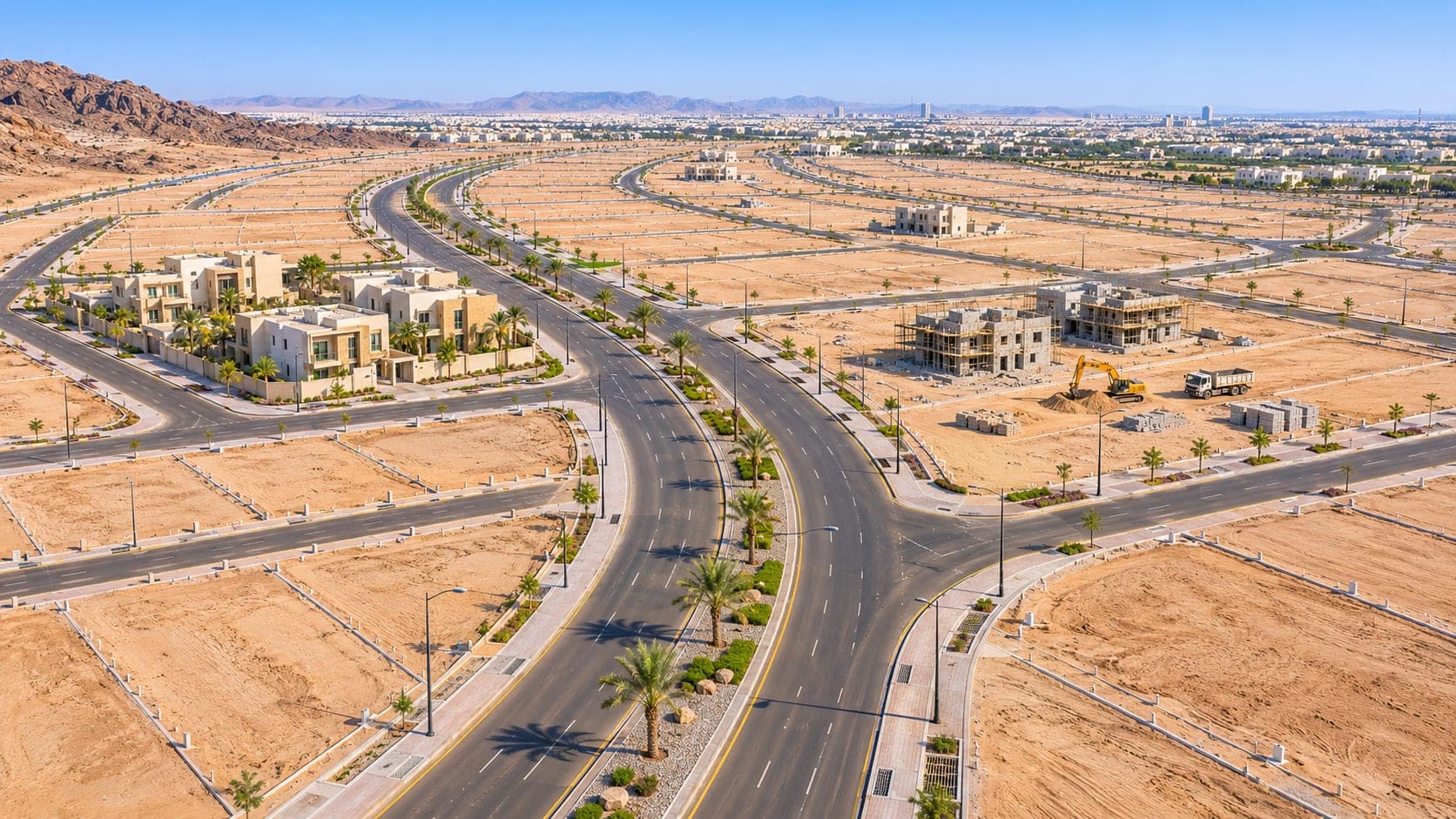
Saudi Arabia's Ministry of Municipalities and Housing announced on 9 November 2026 that 15,129 Saudi Sakani residential plots had been made available through the Sakani platform between 1 January and 31 October 2026. The land offerings were distributed across 63 residential plans in cities and governorates throughout the Kingdom, reflecting the Ministry's continuing efforts to increase residential land supply and expand housing choices for Saudi families.
October recorded the highest monthly figure reported during the ten-month period, with 3,447 residential plots made available across seven plans. The Ministry also disclosed significant monthly offerings in May, September, July and August. These figures describe land made available through the housing platform, rather than completed property transfers, confirmed reservations or newly constructed homes.
According to the Ministry of Municipalities and Housing's official announcement, the initiative forms part of a broader approach to providing residential, housing-support and financing options suited to different household circumstances. Eligible beneficiaries can review available land and housing choices through the Sakani website and application, subject to the applicable programme conditions.
Quick Facts
Indicator | Official Information |
|---|---|
Announcement date | 9 November 2026 |
Reporting period | January–October 2026 |
Responsible authority | Ministry of Municipalities and Housing |
Housing platform | Sakani |
Residential plots made available | 15,129 |
Residential plans | 63 |
October plots | 3,447 |
October residential plans | 7 |
May plots | 2,002 |
September plots | 1,949 |
July plots | 1,830 |
August plots | 1,755 |
Geographical coverage | Saudi cities and governorates |
Plots transferred or handed over | Not disclosed |
Plot sizes and prices | Not disclosed |
Construction commencement | Not confirmed |
What the Ministry Officially Announced
The Ministry confirmed that more than 15,000 residential land plots had been offered through Sakani from the beginning of 2026 until the end of October. Its precise reported total was 15,129 plots within 63 residential plans, representing land opportunities made available through the national housing platform.
The announcement emphasised increasing the available residential land offering and providing Saudi families with more choices for meeting their housing requirements. It also connected the initiative with wider urban growth in cities and governorates, recognising that housing options must respond to differences in household requirements and location.
The Saudi Press Agency's report on the residential land announcement provides an official account of the Ministry's release. Both sources describe land availability rather than a completed distribution of ownership to individual households. This distinction is essential because a plot can be offered through a platform before a beneficiary completes the relevant selection, approval or transfer procedures.
The reported figures therefore represent an important land-supply indicator, but not a direct measure of finished housing. Understanding that distinction helps prevent comparisons between available plots, occupied homes and housing-support beneficiaries that measure different stages of Saudi Arabia's housing system.
Which property type & region do you prefer?
Select property type and preferred city in Saudi Arabia.
Saudi Sakani Residential Plots Made Available Across 63 Plans
The availability of 15,129 plots across 63 residential plans indicates that the reported land offering is distributed across multiple planned residential locations. However, the Ministry did not identify the number of plots in each city, provide a comprehensive list of individual plans or state that every plan represents a newly launched project.
A residential plan generally provides a planning framework for land subdivision, access and intended development uses. The precise characteristics of each plan depend on the relevant approvals and location-specific documentation. Accordingly, inclusion within the Ministry's ten-month announcement does not independently establish that every road, utility connection or other supporting facility has been completed.
For residential developers and land-market observers, the geographical spread of offerings is relevant because land availability can differ substantially between urban markets. Some households may prioritise established neighbourhoods, while others may consider developing districts where housing construction is expected to occur over time.
Real Estate Saudi's guide to government housing projects in Saudi Arabia provides broader context on public housing initiatives and the different ways housing options are made available. The new plot announcement is a separate, specific measure of residential land supply and should not be added to housing-unit totals from unrelated programmes.
Why October Recorded the Highest Monthly Total
October was the strongest month identified in the Ministry's January–October reporting period, with 3,447 plots made available across seven residential plans. It exceeded each of the other monthly figures individually disclosed by the Ministry.
Based on Real Estate Saudi's calculation, October represented approximately 22.8% of the ten-month total, calculated by dividing 3,447 by 15,129. This percentage is an editorial calculation using official numbers, rather than a percentage separately announced by the Ministry.
The October concentration is notable, but the Ministry did not explain what caused that month's higher figure. It did not identify whether the difference arose from the timing of planning approvals, the release of land within existing plans, new plan availability or other administrative and development factors.
Therefore, the higher October total should not be interpreted as proof of a sudden increase in residential demand or completed infrastructure. It establishes the number of plots offered during that month, not the number selected by beneficiaries or subsequently developed.
What October's figure does and does not indicate
The availability of 3,447 plots across seven plans shows that a substantial portion of the reported offering entered the platform during October. However, the announcement does not provide corresponding reservation figures, confirmed ownership transfers or the number of households completing applications.
Without these additional measures, it is not possible to establish whether the monthly offering was fully taken up. Nor can October's result be used to determine whether residential land prices increased or decreased in affected locations.
Monthly Residential Plot Figures Disclosed for 2026
Alongside October's 3,447 plots, the Ministry reported 2,002 plots in May, 1,949 in September, 1,830 in July and 1,755 in August. These are five individual monthly figures within the January–October reporting period, not a complete ten-month sequence.
Together, the five disclosed months account for 10,983 plots. Subtracting this amount from the official cumulative total leaves 4,146 plots attributable collectively to January, February, March, April and June. This is a Real Estate Saudi arithmetic reconciliation; the Ministry did not provide the individual figures for those remaining months in the reviewed announcement.
The available information therefore cannot support a complete month-by-month trend analysis. Although October recorded the largest monthly total, there is insufficient detail to establish whether the overall pace of land availability rose consistently throughout the year.
The figures also do not establish how many residential plans were represented in each month apart from October. A higher number of plots does not necessarily mean a higher number of plans, because individual residential plans can differ in scale.
What Does “Made Available Through Sakani” Mean?
The wording of the announcement is commercially and legally important. The Ministry stated that the residential plots were made available through Sakani, indicating their inclusion among housing options offered to potential eligible beneficiaries.
Availability is not the same as reservation, allocation, ownership transfer or construction completion. These stages can involve different administrative, legal and practical requirements, depending on the housing product and the conditions attached to an individual site.
For example, a beneficiary may be able to review available land before completing the applicable selection and approval procedures. A confirmed entitlement or subsequent ownership-related step would require separate documentation. The Ministry's cumulative announcement does not identify how many plots progressed through each stage.
The official Sakani residential land service explains that residential land is a housing-support option available to eligible beneficiaries and refers to in-kind support through the grant of land. However, the precise conditions applying to individual offerings must be checked through the current service and relevant documentation.
Residential Land Availability Versus Plot Handover
A central distinction concerns the difference between a plot being available on a digital platform and a beneficiary obtaining the rights needed to use that land. An available plot may still be subject to selection, eligibility confirmation and subsequent formal procedures.
The Ministry did not report that 15,129 individual beneficiaries received ownership of plots. It also did not say that all 15,129 sites had been physically handed over or were ready for immediate construction.
From a real estate perspective, an individual plot's legal status, approved use, boundaries and ownership documentation matter considerably. The Real Estate General Authority's property registration framework explains how property records can establish location, area, boundaries, rights and restrictions within the applicable registration system.
These considerations are particularly important for buyers and beneficiaries contemplating construction. An advertised or offered plot should not be treated as equivalent to an unrestricted development site without checking the relevant records, approvals and contractual conditions.
How the Sakani Platform Supports Housing Choices
Sakani operates as a digital channel through which eligible users can explore housing-support services and different property options. Its platform brings together information on residential land, completed housing, properties under development and self-construction-related services.
The Ministry's announcement places land availability within this wider group of housing solutions. The intention is to offer different pathways rather than assume that every eligible family wants an identical type of home or can follow the same financing and development process.
Through the official Sakani platform, users can examine the current services and housing products relevant to their circumstances. Available plots and service conditions may change, so an announcement covering January–October should not be interpreted as a live inventory of plots that remain selectable on a later date.
Real Estate Saudi's detailed affordable housing guide for Saudi Arabia discusses housing-support options alongside practical affordability considerations. Access to land can be one part of a housing strategy, but households must also evaluate the financial and practical requirements associated with developing a home.
Why Residential Land Supply Matters for Saudi Arabia
Residential land is an essential input into future housing development, but it represents an earlier stage in the property-supply process than a completed dwelling. Making additional land available can increase the range of locations that eligible households may consider, particularly where they wish to construct homes suited to their needs.
The potential contribution to housing supply depends on several subsequent steps. Land must be suitable for its intended residential use, the applicable infrastructure and approvals must be addressed, and beneficiaries must have the means to pursue construction where that is their chosen pathway.
Land availability may therefore support future housing development without producing an immediate increase in occupied housing units. It would be incorrect to classify the 15,129 plots as 15,129 new completed houses or to assume that an equal number of families have already moved into homes.
The Ministry's initiative is nevertheless relevant to the wider supply discussion because access to developable residential land can affect the choices available to households. Its actual contribution will become clearer through future information on beneficiary selections, land transfers, construction activity and completed dwellings.
What is your approximate budget?
Narrow down property options based on your target budget.
Potential Role in Self-Construction Pathways
Self-construction is one of the housing pathways available through Sakani and can allow eligible households to pursue a home built according to applicable plans and requirements. Residential land availability may support this approach where the relevant plot, beneficiary status and financing arrangements permit it.
However, obtaining access to a plot is only one stage of the self-construction process. Households may need to consider architectural design, required permissions, contractor selection, building costs, infrastructure connections and the time needed to complete a habitable property.
The official Sakani land service also describes access to engineering designs from certified offices among the product's features. The announcement of 15,129 plots does not establish that all recipients will pursue self-construction or that identical design and construction arrangements apply to every location.
For financial context, Real Estate Saudi's guide to real estate financing in Saudi Arabia explains the distinction between housing-support arrangements and financing decisions. Eligibility for a housing product should not be confused with automatic approval of a construction loan or guaranteed completion funding.
Significance for Saudi Cities and Governorates
The Ministry stated that the plots were offered across cities and governorates in Saudi Arabia. This geographical description indicates that the programme was not limited to one municipality, although the published announcement did not identify individual city-level figures.
Regional distribution is important because land markets differ in infrastructure provision, population demand, available amenities and housing preferences. A plot in a developing district may involve different practical considerations from a plot in an established urban neighbourhood.
These differences also influence how a household might evaluate the suitability of a site for construction. Schools, healthcare services, employment access, transport connections and utilities can affect residential convenience once a dwelling is completed.
The Ministry linked housing choices to the broader relationship between the home and its surrounding urban environment. That emphasis is consistent with approaches to planning that consider neighbourhood functionality alongside the provision of residential land.
Real Estate Saudi's coverage of Saudi Urban October 2026 and urban-planning initiatives provides related context. However, that initiative and the Sakani plot announcement are separate developments and should not be presented as a single programme.
Connection With Saudi Housing and Homeownership Objectives
The announcement forms part of the Ministry's continuing efforts to widen housing choices and support Saudi homeownership. Residential land can contribute to these objectives where eligible households are able to obtain suitable sites and subsequently develop homes.
Saudi Arabia's Vision 2030 Housing Program provides the wider national policy framework. The programme includes the objective of increasing Saudi household homeownership to 70% by 2030, alongside measures addressing housing accessibility and market development.
The availability of 15,129 plots should not, however, be interpreted as a corresponding increase in the national homeownership rate. That indicator concerns households owning homes, whereas the Ministry's November release concerns residential land offered through Sakani.
An important comparison is Real Estate Saudi's recently published report that 90,836 Saudi families entered their first homes during January–September 2026. That figure describes a first-home occupancy milestone and covers a different reporting period. It cannot be added to, subtracted from or directly equated with the 15,129 plots made available through October.
How the Announcement Differs From Completed Housing Supply
Residential land and completed homes occupy different positions in the housing-development process. A completed unit may be ready for occupation subject to the relevant transaction and handover requirements, whereas a vacant residential plot may require substantial additional activity before it can support a dwelling.
Off-plan housing represents another distinct category because the buyer may enter an agreement for a dwelling that has not yet been completed. The Real Estate Saudi guide to off-plan property investment explains how development status, licensing and contractual arrangements affect that pathway.
The Sakani plot figures should therefore be assessed as an indicator of land availability, not finished residential supply. The announcement provides no corresponding count of completed buildings, construction permits or properties available for immediate occupation.
This distinction is particularly important when comparing official housing releases. Land offerings, housing-support contracts, mortgage approvals and occupied homes each measure a different activity, and combining them without recognising their definitions can overstate development outcomes.
What the Announcement Does Not Disclose
The Ministry's November statement provides the cumulative plot total, number of residential plans and selected monthly figures, but it does not present a comprehensive geographical or commercial inventory. Individual plot sizes, prices, infrastructure conditions, reservation rates and beneficiary numbers are not disclosed.
It also does not state that all 63 plans are newly established projects. Some offerings could relate to plans introduced previously, but the reviewed announcement does not provide enough information to determine the status of each plan. No assumption should therefore be made about the age or development stage of individual locations.
The release does not specify how many plots were transferred, how many beneficiaries completed the necessary procedures or how many houses were subsequently constructed. Nor does it publish an expected construction schedule or occupancy timetable for the land offered.
Without those details, it would be premature to forecast changes in land prices, housing affordability, mortgage demand or future occupancy. Such outcomes require additional evidence from property transactions, programme administration and physical development activity.
What Prospective Beneficiaries Should Verify
Saudi families considering a residential plot should begin by reviewing the current information on Sakani rather than relying exclusively on an earlier national announcement. The platform can provide updated information on available housing products and the conditions associated with an individual offering.
Applicants should establish their eligibility under the relevant support programme and examine the plot's recorded location, approved residential use, availability status and applicable restrictions. Where construction is intended, the household should also verify requirements concerning designs, permits, infrastructure and financing before making commitments.
The Saudi housing land development rules consultation provides separate background on proposals concerning the development of planned municipal land allocated to housing-support programmes. Those draft arrangements should not be assumed to govern every Sakani plot, nor should a consultation be treated as a final regulation without official confirmation.
Most importantly, users should distinguish the existence of an available land option from an entitlement to immediate ownership or construction. The applicable service documents, approvals and property records determine the position for any individual site.
How would you like to be contacted?
Choose your preferred channel for a private consultation.
Outlook for Residential Land Supply Beyond October 2026
The January–October figures establish that the Ministry made a substantial number of residential plots available during the first ten months of 2026. The announcement also indicates that work to diversify housing choices and provide residential land across the Kingdom is continuing.
Future releases may clarify whether additional plots enter the platform during November and December, how offerings are distributed geographically and how many beneficiaries successfully progress through the relevant procedures. These details would provide a fuller picture of the relationship between announced land availability and practical housing outcomes.
For planners and property professionals, further evidence on infrastructure readiness, construction approvals and completed homes would be particularly useful. Such information would help distinguish the expansion of available residential land from the actual delivery of occupied dwellings.
The Saudi Sakani residential plots announcement is therefore best understood as an update on the supply of housing opportunities. Its contribution to long-term housing delivery will depend on how available plots progress through selection, development and eventual residential use.
Conclusion
Saudi Arabia's Ministry of Municipalities and Housing confirmed that 15,129 Saudi Sakani residential plots were made available across 63 residential plans between January and October 2026. October recorded the highest monthly offering, with 3,447 plots across seven plans, followed by other substantial releases in May, September, July and August.
The announcement illustrates the Ministry's efforts to broaden housing choices and improve access to residential land for eligible Saudi families. It also highlights the potential importance of land availability within self-construction and longer-term housing-development pathways.
However, plots made available through Sakani should not be counted as completed homes, confirmed ownership transfers or beneficiaries who have already received land. Further official reporting will be necessary to establish the number of plots selected, developed and eventually occupied as residential properties.
Talk to Our Real Estate Experts
Get real-time insights on investment options, commercial properties, and market guidelines.
Frequently Asked Questions
The Ministry of Municipalities and Housing reported that 15,129 residential plots were made available through Sakani from 1 January to 31 October 2026. The figure represents plots offered through the platform during that reporting period. It does not establish how many were reserved, transferred to beneficiaries or developed into completed homes, and it is not a full-year total for 2026.
The 15,129 residential plots were distributed across 63 residential plans in Saudi cities and governorates. The Ministry did not publish a complete plan-by-plan inventory in the reviewed announcement. It also did not state that all 63 plans were newly launched developments, so the figure should be understood as the number of plans covered by the reported offerings.
October recorded 3,447 residential plots made available across seven plans, making it the highest month reported for January–October 2026. Real Estate Saudi calculates that this represents approximately 22.8% of the ten-month total. The Ministry did not disclose how many of October's plots were subsequently reserved or transferred to beneficiaries.
No. The official wording means that the residential plots were offered through the Sakani platform. It does not confirm that every plot was selected, allocated, legally transferred or physically handed over. Those outcomes may depend on separate eligibility, approval and documentation procedures. The Ministry did not publish a completed-handover total for the reporting period.
The official Sakani land-service page describes in-kind housing support involving the grant of residential land to eligible beneficiaries. However, applicants should not assume that every available plot has identical financial conditions or that all associated development expenses are covered. The November announcement does not provide individual plot prices, fees or construction-cost arrangements.
Sakani residential land support is intended for beneficiaries who satisfy the applicable housing-support eligibility requirements. The Ministry's November announcement does not provide a complete list of those criteria. Applicants should use the official Sakani platform to verify their current eligibility, available products and any conditions associated with a particular plot or residential plan.
Eligible users can visit the official Sakani website or use its application to explore residential land and housing choices. They should review current availability, plot details and applicable programme conditions rather than assume that all plots included in the January–October announcement remain available. Any selection, application or approval requirements should be confirmed through the platform.
Not necessarily. The ability to begin construction depends on the rights obtained, relevant development conditions, approved designs, permits and other applicable requirements. The Ministry's announcement does not confirm construction readiness for all 15,129 plots. Beneficiaries intending to build should verify the individual site's documentation, infrastructure arrangements and construction requirements before commencing work.
The Ministry stated that the plots were offered across cities and governorates throughout Saudi Arabia, but it did not publish a complete city-level distribution in the reviewed announcement. Consequently, there is no verified basis for assigning a specific number of plots to Riyadh, Jeddah, Dammam or other individual cities from this release alone.
No. A residential plot is land intended for residential use, while a completed home is a constructed dwelling that has reached the relevant stage of completion and readiness for occupation. The 15,129 plots reported by the Ministry are not equivalent to 15,129 completed housing units or 15,129 families moving into their first homes.
