
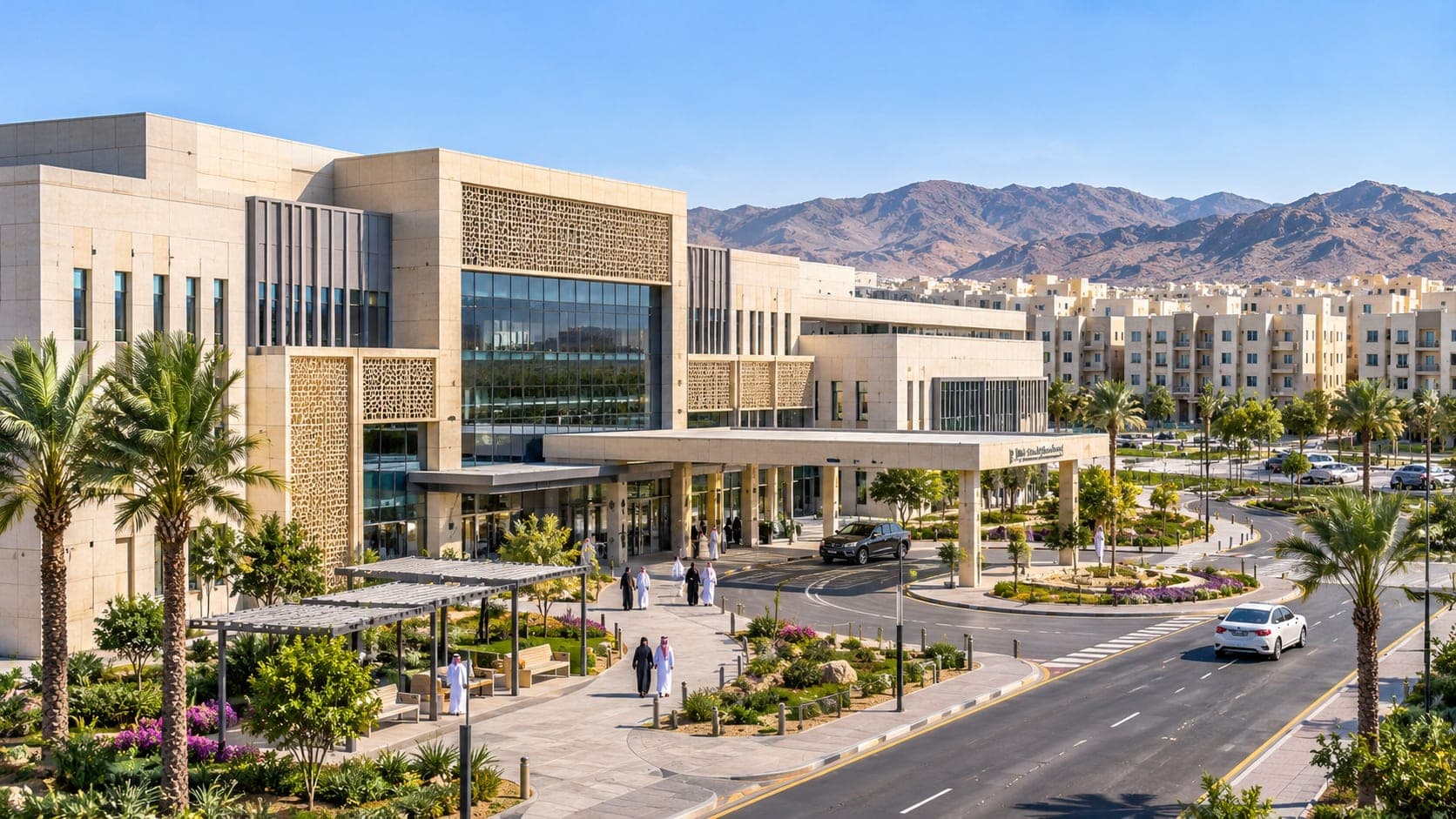
National Housing Company (NHC) has agreed to donate approximately 15,000 square metres of land within its Makkah Gate destination for the Makkah Gate oncology centre, a planned endowment-based cancer treatment facility supported by SAR 380 million from Saudi Arabia's General Authority for Awqaf. The project is being developed through two related agreements involving NHC, King Faisal Specialist Hospital and Research Centre (KFSH) and the General Authority for Awqaf. Both agreements were signed on 4 November 2026, while NHC published its separate announcement on 8 November 2026.
The proposed centre will provide advanced radiotherapy and specialised oncology services, with primary healthcare also identified in NHC's announcement. Operations are currently scheduled to begin in 2029, and the initial phase is expected to accommodate approximately 1,200 patients annually. The project is intended to improve access to specialised cancer treatment within the Makkah Region, reducing the need for repeated journeys to healthcare facilities elsewhere.
According to the National Housing Company's official announcement, the land allocation reflects its commitment to developing integrated urban destinations that provide essential services alongside residential neighbourhoods. The agreement also demonstrates how healthcare infrastructure can form part of large-scale property development, rather than being treated as a separate investment in medical facilities.
Quick Facts
Project Detail | Officially Confirmed Information |
|---|---|
Project | Endowment-based oncology and radiotherapy centre |
Location | Makkah Gate destination, Makkah, Saudi Arabia |
Agreement signing | 4 November 2026 |
NHC announcement published | 8 November 2026 |
Land contributor | National Housing Company |
Land allocation | Approximately 15,000 sqm |
Healthcare institution | King Faisal Specialist Hospital and Research Centre |
Funding organisation | General Authority for Awqaf |
Announced financial support | SAR 380 million |
Wider Makkah Gate destination | Approximately 5 million sqm |
Planned services | Advanced radiotherapy, specialised oncology and primary healthcare |
Scheduled operations | 2029 |
Initial annual patient capacity | Approximately 1,200 |
Construction status | Start not officially confirmed |
Total construction cost | Not separately disclosed |
Project contractor | Not announced |
Which property type & region do you prefer?
Select property type and preferred city in Saudi Arabia.
What NHC Announced About the Makkah Gate Oncology Centre
NHC's announcement confirms that it has signed an agreement with King Faisal Specialist Hospital and Research Centre to allocate land within the Makkah Gate destination for a specialised oncology facility. The agreement forms part of a broader initiative involving the General Authority for Awqaf, which has separately committed SAR 380 million in support towards establishing the centre.
The signing ceremony took place under the patronage of Prince Saud bin Mishaal bin Abdulaziz, Deputy Governor of the Makkah Region. The participating organisations were represented by senior officials, including KFSH Chief Executive Officer Dr Majid Al-Fayyadh, General Authority for Awqaf Governor Emad Al-Kharashi and NHC Chief Executive Officer Mohammed Al-Bati. The participation of these organisations reflects cooperation between a specialist healthcare institution, an endowment-sector authority and a major Saudi real estate developer.
The Saudi Press Agency's English announcement confirms that the agreements were signed on 4 November 2026. NHC's subsequent publication on 8 November should therefore be understood as its corporate announcement date, not a separate signing event. The development represents one healthcare infrastructure initiative supported by two complementary agreements, rather than two independent oncology projects.
For the real estate sector, the announcement is significant because it involves the dedication of land within an existing urban destination to a specialised public-service function. Real Estate Saudi's profile of National Housing Company and its residential developments provides broader context on NHC's role in creating large communities that combine housing with supporting infrastructure.
Two Agreements: Land Donation and SAR 380 Million Funding
The project involves two distinct contractual arrangements, each addressing a different requirement for establishing the proposed healthcare facility. The first agreement was concluded between King Faisal Specialist Hospital and Research Centre and the General Authority for Awqaf, providing SAR 380 million in financial support for establishing the centre and its advanced radiotherapy services.
The second agreement was concluded between KFSH and NHC. Under this arrangement, NHC will donate approximately 15,000 square metres of land within Makkah Gate to provide the site for the proposed facility. This creates an important separation between the physical land contribution and the financial support required for establishing the healthcare development.
The official KFSH announcement explicitly describes the SAR 380 million as support from the General Authority for Awqaf. It does not identify that amount as the acquisition price of the donated land, and the announcement does not separately establish a final all-inclusive construction budget.
Why the financial distinction matters
Property investors and development professionals should avoid combining the land contribution with the announced funding into an assumed project valuation. The land donation concerns the allocation of a site, while the Awqaf agreement concerns financial support for establishing the healthcare centre. Neither agreement publicly establishes an independently appraised land value or the complete cost of construction, equipment, commissioning and future operation.
This distinction is particularly relevant when assessing healthcare-related property developments because their financial structures can differ substantially from conventional residential or commercial projects. A facility supported through an endowment arrangement is not automatically comparable with a privately financed hospital, an investment property offered for sale or a development designed primarily to generate rental income.
Makkah Gate Destination and the 15,000 sqm Land Allocation
The proposed centre will be located within Makkah Gate, an NHC urban destination in the Makkah Region. KFSH identifies the wider destination as covering approximately five million square metres within the boundaries of the Makkah Haram. The oncology centre's allocated site of approximately 15,000 square metres is therefore a specific component of a much larger development.
The allocation represents approximately 0.3% of the wider destination's announced land area, based on the two reported figures. This mathematical comparison helps illustrate the relative scale of the healthcare site, although it does not establish the percentage of developable land, the final site boundaries or the amount of floor space that will be constructed.
The land allocation is significant from an urban-planning perspective because specialist healthcare facilities require an appropriate relationship with surrounding development. Access roads, patient arrival areas, emergency arrangements, parking, utilities and building circulation are all relevant considerations when incorporating a medical facility into a larger urban destination. The official announcement does not disclose how these particular design elements will be arranged at Makkah Gate.
The wider Makkah real estate market includes residential communities, hospitality developments and commercial property serving a city with distinctive population and visitor requirements. The planned oncology centre adds a healthcare dimension to the discussion of how land should be allocated among different uses within major urban projects.
Why Healthcare Infrastructure Matters for Integrated Communities
Integrated urban developments are generally evaluated through more than the number of residential units they contain. The availability of schools, healthcare facilities, transport connections, public spaces, commercial services and essential infrastructure can influence how effectively a community functions over time.
The inclusion of a specialised healthcare centre within Makkah Gate illustrates this broader approach to urban development. Rather than reserving land exclusively for housing or commercial premises, NHC is allocating part of its destination to a facility intended to meet a defined public-service need. This can contribute to a more diverse range of uses within the master-planned environment.
Healthcare infrastructure can also affect how residents and businesses evaluate a location. Access to dependable services is relevant to household convenience, employee wellbeing and the practical attractiveness of a neighbourhood. However, the effect depends on the actual services provided, the catchment population, transport accessibility and the way the facility operates.
A specialist oncology centre should not be equated with a general neighbourhood clinic. It will serve patients with particular healthcare needs and may draw users from a wider geographical area. Its presence may strengthen the destination's service infrastructure, but it does not mean that every surrounding resident will use the facility or that demand for nearby property will automatically increase.
Real Estate Saudi has examined similar principles of integrated development in its report on Saudi urban planning, housing and the proposed Urban Lab, where land management and quality-of-life considerations form part of broader planning discussions.
Planned Oncology, Radiotherapy and Primary Healthcare Services
The proposed healthcare development is intended to expand access to specialised cancer treatment in the Makkah Region. The official announcements identify advanced radiotherapy as a central service, while NHC also refers to the provision of primary healthcare. The project is therefore designed to address specialised healthcare requirements within a broader service environment.
Radiotherapy services often require purpose-built infrastructure and careful coordination between medical equipment, building design and operational processes. For real estate and construction professionals, this makes specialist healthcare facilities different from standard office or residential buildings. Their technical requirements may influence design, services engineering, construction sequencing and commissioning arrangements.
Nevertheless, the published announcements do not specify the number or types of radiotherapy machines, clinical departments, consultation rooms or inpatient beds planned for the centre. They also do not establish whether particular diagnostic or surgical services will be available. The facility should therefore be described according to the services officially announced, without assuming additional clinical capabilities.
The significance of specialised building requirements
Healthcare buildings generally require considerable coordination between clinical operations and physical infrastructure. Access for patients, infection prevention, equipment installation, mechanical and electrical services, safety arrangements and long-term maintenance can influence design decisions. These are general characteristics of healthcare construction rather than confirmed specifications for this particular project.
The eventual architectural and engineering arrangements will depend on detailed project planning and the requirements established by the responsible healthcare institution. No verified building drawings, technical specifications or construction contracts have been released in the official material reviewed. Consequently, neither the likely number of floors nor the final built-up area can responsibly be inferred from the 15,000-square-metre land allocation.
Improving Cancer Treatment Access Across the Makkah Region
One of the central objectives of the planned centre is to improve access to specialised oncology services for patients living in the Makkah Region. The participating organisations have identified the potential to reduce repeated travel for treatment as a key benefit, alongside easing pressure on existing healthcare facilities elsewhere in western Saudi Arabia.
This objective has a clear spatial dimension. Access to specialist medical services is influenced not only by the presence of healthcare infrastructure but also by the distances patients must travel, the frequency of appointments and the connections between healthcare facilities and surrounding communities.
For patients who require repeated treatment visits, geographical accessibility can be particularly important. Locating additional specialist services within the region may reduce some journeys that would otherwise be necessary. The actual effect will depend on referral arrangements, available clinical services and the locations from which patients travel.
The Saudi Press Agency's Arabic report on the agreements also identifies the region's population growth and demand for specialised medical care as reasons for establishing the centre. Makkah's role as a destination for Hajj and Umrah pilgrims contributes to the wider importance of resilient healthcare infrastructure, although the announced annual oncology capacity should not be interpreted as a specific allocation for pilgrims.
The Planned 2029 Opening and Annual Patient Capacity
The proposed centre is currently scheduled to begin operations in 2029. According to KFSH and SPA, the first phase is expected to accommodate approximately 1,200 patients annually. These figures provide an initial indication of the intended operational timetable and service scale, but they remain forward-looking targets rather than achieved outcomes.
The annual patient figure describes the expected capacity of the first phase, not the number of hospital beds, treatment sessions or individual radiotherapy procedures. A patient may require multiple appointments, and the announced capacity cannot be converted into a reliable figure for treatment machines, clinical staff or operating hours.
The 2029 date should likewise be treated as the currently scheduled operational year. The participating organisations have not published a comprehensive construction programme specifying the commencement of site works, completion of the building, installation of medical equipment or final operational approvals.
These omissions are important for property and construction professionals seeking to assess delivery risk. A planned opening year establishes a development objective, but the actual timing will depend on subsequent implementation and regulatory milestones. No official construction-start announcement has been identified in the reviewed primary sources.
What is your approximate budget?
Narrow down property options based on your target budget.
Makkah Gate Oncology Centre and Long-Term Urban Development
The land donation adds a specialised public-service function to the Makkah Gate destination and demonstrates how major developers can participate in infrastructure beyond conventional residential construction. In this instance, NHC's contribution involves providing a site for healthcare services rather than announcing another housing phase or commercial building for sale.
From a master-planning perspective, land allocations for healthcare facilities can influence how a destination develops over time. They may shape transport priorities, utility planning, public access and relationships between different land uses. The importance of these considerations increases when a facility is intended to serve a wider regional population rather than only residents of its immediate surroundings.
The project may also contribute to the destination's identity as an integrated urban environment. For households considering where to live, the overall range of accessible services can be relevant alongside housing quality, transport, schools and neighbourhood amenities. However, the presence of a planned oncology facility alone is not sufficient evidence that residential property will achieve higher selling prices or rental returns.
An appropriate comparison is with other large urban developments in Makkah, where land is allocated to different functions according to the intended role of each destination. Real Estate Saudi's report on the Masar Destination land sale for a planned hospitality tower illustrates a separate commercial transaction within another Makkah development. The two announcements should not be compared as equivalent land valuations because the Masar transaction involves a disclosed sale consideration, whereas the NHC agreement involves a donated healthcare site.
The Role of Endowment Funding in Healthcare Infrastructure
The General Authority for Awqaf's SAR 380 million support introduces an endowment-sector dimension to the development. In Saudi Arabia, the waqf sector can support public-benefit activities through arrangements intended to serve social, educational, charitable and healthcare objectives. The oncology project reflects this broader role by bringing together funding support, a healthcare institution and land provided by a major developer.
For real estate professionals, the structure demonstrates that socially important facilities can be delivered through arrangements different from ordinary commercial property investment. The use of donated land and dedicated financial support may help assemble resources needed for an infrastructure project without presenting the underlying site as a conventional property acquisition.
However, the public announcements do not establish the complete legal structure of the endowment, the timing of funding disbursements or the allocation of future operating expenses. They also do not disclose whether additional funds will be required or how individual construction and equipment contracts will be procured.
The project's financial arrangements should therefore be understood only to the extent officially confirmed. The SAR 380 million support is a reported contribution towards establishing the centre, not a published appraisal of the donated land or an independent valuation of the completed facility.
Connection With Saudi Vision 2030 and Healthcare Transformation
The project aligns with Saudi Arabia's Health Sector Transformation Program, which seeks to improve healthcare accessibility, service quality and the integration of health services across the Kingdom. Its emphasis on specialised treatment closer to patients' homes is consistent with national priorities concerning the geographical distribution of healthcare facilities.
The official Health Sector Transformation Program identifies improving access to healthcare, modernising facilities and strengthening the wider healthcare system among its objectives. The Makkah development offers a specific example of cooperation involving a specialist hospital, an endowment-sector institution and a real estate developer.
This collaboration is also relevant to Saudi Arabia's broader urban-development agenda. Healthcare infrastructure is part of the physical and social environment that supports functioning communities, alongside housing, transportation, education and public services.
Real Estate Saudi's analysis of how Vision 2030 is transforming Saudi real estate examines the relationship between national development objectives, infrastructure investment and changes in the property sector. The oncology centre should be viewed within that broader context, while maintaining a distinction between stated national objectives and verified outcomes from individual projects.
What the Announcement Means for Property Investors and Developers
The agreement provides an example of healthcare-led land use within a major urban destination. For developers, it illustrates the importance of planning for essential facilities at the master-development level. For investors, it highlights the distinction between developments intended primarily for commercial returns and infrastructure allocated to deliver public services.
Healthcare facilities may influence the character and functionality of nearby urban areas, but their effect on property markets requires evidence rather than assumption. Location, competing supply, transport conditions, property quality, local demand and broader economic circumstances remain important when assessing individual real estate assets.
The donated land should not be treated as an available private investment plot. Neither NHC nor KFSH has announced a sale or commercial offering of the allocated site. Its intended purpose is to accommodate the proposed oncology centre under the agreement between the participating organisations.
Investors reviewing the wider city should instead examine the local property market on its own terms. Real Estate Saudi's guide to residential areas in Makkah considers neighbourhood characteristics and the practical factors that influence housing decisions. Such market assessments remain separate from the healthcare project's publicly stated objectives.
Confirmed Details Versus Editorial Analysis
The officially confirmed elements include the two agreements, the identity of the participating organisations, the approximate land area, the SAR 380 million financial support, the planned medical services, the scheduled 2029 operational year and the initial annual patient-capacity target. The wider Makkah Gate destination's approximately five-million-square-metre area is also reported by KFSH.
The anticipated reduction in repeated patient travel is a stated objective of the initiative, not a result that has already been measured. Similarly, the potential for the centre to strengthen integrated urban development is a reasonable planning interpretation rather than a verified increase in property values or commercial demand.
The distinction matters because large development announcements can be misinterpreted when financial contributions, land allocations and future operating targets are presented as completed outcomes. The agreements establish a framework for the proposed centre, but the physical delivery of the healthcare facility remains subject to future implementation.
From an investment-analysis perspective, no reliable calculation of capital appreciation, rental yield or commercial return can be made from the announced land donation. The project is principally a healthcare infrastructure initiative within an urban destination, and its public-service objectives should not be converted into unsupported property-market forecasts.
How would you like to be contacted?
Choose your preferred channel for a private consultation.
Missing Information and Future Project Milestones
Several material details remain unavailable in the official announcements reviewed as of 10 November 2026. These include the appointed construction contractor, construction commencement date, total built-up area, architectural design, number of beds, medical equipment specifications and detailed construction timetable.
The authorities have also not separately disclosed the land's market valuation or a final comprehensive construction-cost statement. Although the SAR 380 million support is confirmed, the available sources do not provide a detailed breakdown showing how the funds will be allocated among construction, equipment and other project requirements.
Further announcements may clarify planning approvals, procurement arrangements, construction progress and the steps necessary before the facility becomes operational. The scheduled 2029 opening will be an important milestone to monitor, but the current announcements do not guarantee that all services will begin on a particular date within that year.
For real estate professionals, continuing verification is essential. The relevant site information, any applicable ownership documentation and future project approvals should be assessed through official records when available. The wider importance of property documentation is also discussed in Real Estate Saudi's report on first property registration covering 26,858 plots in the Makkah Region, although that separate registration programme does not establish the legal status of this donated site.
Healthcare Infrastructure Becomes Part of Makkah Gate's Development
The Makkah Gate oncology centre represents a significant planned healthcare addition to NHC's wider urban destination in Makkah. Through two agreements signed on 4 November 2026, NHC has committed approximately 15,000 square metres of land, while the General Authority for Awqaf is providing SAR 380 million in support towards establishing a specialist oncology and radiotherapy facility.
The centre is scheduled to begin operating in 2029, with an initial planned capacity of approximately 1,200 patients annually. Its primary objective is to improve access to cancer treatment within the Makkah Region and reduce the need for patients to travel repeatedly for specialised care.
For the real estate sector, the announcement demonstrates the importance of integrating healthcare infrastructure into major urban developments. The project's contribution to community services and destination functionality may become clearer as implementation progresses, but any claims about construction completion, property-price appreciation or investment performance would be premature.
Talk to Our Real Estate Experts
Get real-time insights on investment options, commercial properties, and market guidelines.
Frequently Asked Questions
The proposed facility is an endowment-based specialist cancer treatment centre within NHC's Makkah Gate destination in Saudi Arabia. It is intended to provide advanced radiotherapy and specialised oncology services, while NHC also identifies primary healthcare among the planned services. The project is supported by two agreements involving National Housing Company, King Faisal Specialist Hospital and Research Centre and the General Authority for Awqaf. It is not yet confirmed as an operational healthcare facility.
NHC has agreed to donate approximately 15,000 square metres of land within the Makkah Gate destination. The allocation provides the proposed site for the specialist healthcare facility. It should be distinguished from the wider destination, which KFSH describes as covering approximately five million square metres. The official announcements do not disclose the land's market valuation, precise plot boundaries or total building floor area.
The General Authority for Awqaf is providing SAR 380 million in financial support towards establishing the oncology centre. This arrangement was announced through an agreement with King Faisal Specialist Hospital and Research Centre. The amount is not identified as the price of the donated land, and the reviewed announcements do not establish that it represents the final comprehensive construction and operating budget.
The two agreements were signed on 4 November 2026 under the patronage of Prince Saud bin Mishaal bin Abdulaziz, Deputy Governor of the Makkah Region. King Faisal Specialist Hospital and Research Centre is the hospital party to both arrangements. NHC published its own announcement on 8 November 2026, which is a separate corporate publication date rather than the date of an additional agreement.
The centre is currently scheduled to begin operations in 2029. This is the planned operational year reported by King Faisal Specialist Hospital and Research Centre and the Saudi Press Agency, not a guaranteed completion date. The participating organisations have not disclosed a detailed construction programme or confirmed the date when physical construction will commence. Future official announcements will be needed to assess delivery progress.
The initial phase is expected to have capacity for approximately 1,200 patients annually. This is a forward-looking capacity estimate rather than a confirmed number of patients already receiving care. It also does not establish the number of beds, treatment appointments, radiotherapy machines or clinical staff. Actual annual activity will depend on the final service arrangements and operational readiness.
The announced services include advanced radiotherapy and specialised oncology treatment, while NHC also refers to primary healthcare. The centre is intended to improve access to cancer treatment for patients in the Makkah Region. The official announcements do not provide a complete list of clinical departments, diagnostic services, treatment equipment or inpatient facilities, so additional capabilities should not be assumed.
The land allocation forms part of NHC's approach to developing integrated urban destinations that include essential services alongside residential and other facilities. The proposed oncology centre is intended to improve access to specialised healthcare within the Makkah Region. Its location within Makkah Gate also demonstrates how healthcare infrastructure can be incorporated into a wider urban development rather than being considered separately from land-use planning.
No such conclusion can be established from the announcement. Healthcare infrastructure can contribute to the functionality and service provision of an urban destination, but property prices depend on many factors, including location, supply, demand, transport connectivity and individual asset characteristics. Neither NHC nor the healthcare institutions has published a verified property-price forecast or guaranteed investment return associated with the centre.
Construction commencement has not been confirmed in the official statements reviewed as of 10 November 2026. The current milestone is the signing of agreements covering financial support and the donation of land for the proposed facility. No appointed construction contractor, detailed construction schedule or percentage of physical completion has been officially established in those announcements. Subsequent project updates will be necessary to verify progress.
