
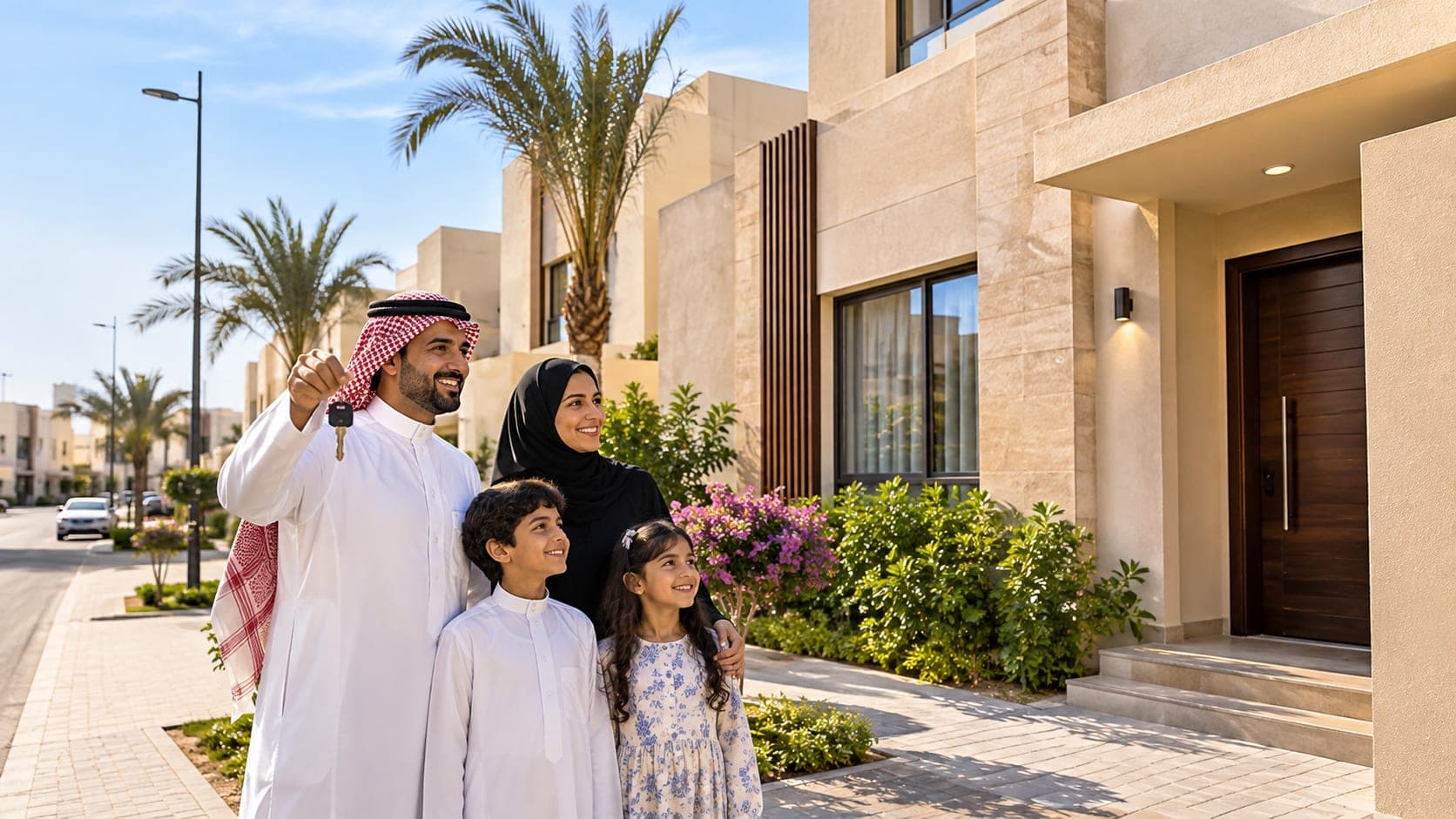
Saudi Arabia's Developmental Housing Programme announced on 11 November 2026 that more than 25,000 eligible families had been enabled to own suitable homes between 1 January and 30 September 2026. The latest Saudi developmental housing update marks a cumulative nine-month milestone for a programme that works with nonprofit housing organisations to identify households in need and arrange appropriate housing solutions. The Ministry of Municipalities and Housing reports two principal pathways: direct ownership and usufruct arrangements that ultimately lead to ownership, subject to approved eligibility standards and family circumstances.
The result does not establish how many homes were newly built or how many title deeds were transferred. It is different from the separate 90,836-family first-home announcement, which measures another housing outcome.
Quick Facts
Indicator | Official Information |
|---|---|
Announcement date | 11 November 2026 |
Reporting period | January–September 2026 |
Programme | Developmental Housing Programme |
Responsible ministry | Ministry of Municipalities and Housing |
Families enabled by end of March | More than 3,800 |
Families enabled by end of June | More than 14,000 |
Families enabled by end of September | More than 25,000 |
Housing pathways | Direct ownership; usufruct ending in ownership |
Delivery partners | Nonprofit housing organisations and relevant authorities |
Eligibility | Subject to approved standards and household needs |
Saudi homeownership target | 70% by 2030 |
Exact title deed transfers | Not disclosed |
New homes built during 2026 | Not disclosed |
Which property type & region do you prefer?
Select property type and preferred city in Saudi Arabia.
What the Ministry Announced on 11 November 2026
The Ministry of Municipalities and Housing's official announcement says the programme enabled more than 25,000 qualifying families to obtain suitable homeownership solutions from the beginning of the year to the end of September. Its emphasis is on families with substantial housing needs and on arrangements suited to each household's circumstances, rather than one standard product offered to everybody. The statement presents housing stability and improved quality of life as the intended social outcomes.
The Ministry also describes continuing cooperation with nonprofit housing bodies, which help reach eligible families, communicate with them and evaluate the housing solutions available. These organisations form part of a delivery network that connects household assessment with practical housing arrangements. The release does not identify a list of participating associations or specify how many families each partner supported during the reporting period.
For readers comparing the initiative with other public housing programmes, Real Estate Saudi's guide to affordable housing in Saudi Arabia explains the wider range of support and housing options. The Developmental Housing Programme, however, has its own eligibility and operating framework, and it should not be treated as interchangeable with standard mortgage assistance or privately marketed affordable apartments.
Saudi developmental housing: progress through September 2026
The latest release establishes three cumulative milestones. More than 3,800 eligible families had been enabled by the end of the first quarter, the figure passed 14,000 by the end of the first half, and it exceeded 25,000 by 30 September. These are thresholds, not exact totals, because the official announcement repeatedly uses the wording "more than".
The milestones indicate that the reported cumulative number increased over the first nine months. They do not supply monthly results or allow an exact calculation of families added during the second or third quarter: subtracting lower-bound figures would produce an unjustified precise estimate. The Ministry also does not disclose whether families entered their properties on the date they were recorded as enabled or at a subsequent stage.
An earlier Ministry update on first-half developmental housing activity separately referred to more than 14,000 families benefiting from solutions in 13 Saudi regions. That release provides useful context for the June milestone, but its terminology should not be silently converted into an exact ownership-transfer count. The November report remains the controlling source for the latest cumulative figure and its stated housing pathways.
How the Programme's Ownership Pathways Work
The November announcement identifies direct ownership and usufruct ending in ownership as available routes under the programme. Their inclusion demonstrates that a household's legal position may differ depending on the arrangement provided, even though both routes are intended to improve access to secure housing. The official statement does not publish individual contract templates or establish that all participants receive identical ownership rights at the outset.
Direct ownership
Direct ownership refers to a pathway under which the intended housing solution involves ownership rights for the beneficiary, in accordance with the applicable rules and documentation. It should not be interpreted as proof that every family counted in the nine-month release received a registered title deed on the announcement date. Property identification, contractual steps and any required registration must be evaluated from the individual case and the relevant official records.
Usufruct ending in ownership
A usufruct arrangement concerns a right to use or benefit from a property under defined conditions. Where that arrangement is intended to end in ownership, the transition is governed by the applicable agreement and programme rules; it is not identical to immediate unrestricted freehold ownership. The Ministry's Developmental Housing Programme overview describes the role of housing-use rights, while the newer November announcement expressly includes the additional direct-ownership route. Those sources differ in detail, not necessarily in the substance of the programme.
Nonprofit Partners and Family Needs Assessment
Nonprofit housing associations are integral to the delivery model described by the Ministry. They help identify families who may qualify, maintain contact, assess housing needs and contribute to finding suitable solutions. Their involvement matters because the suitability of a home cannot be established from a general household count alone; different families may need different locations, accommodation arrangements and levels of support.
An official Ministry description of developmental housing explains that housing can be provided through different supply channels, including existing market units, construction and housing made available through the Ministry. This is background information about programme mechanisms, not evidence that all homes counted in the 2026 update were purchased, newly built or delivered through any single channel. The November announcement does not allocate its 25,000-plus families among these methods.
Why This Housing Update Matters for the Real Estate Sector
For property professionals, the announcement is an indicator of targeted housing access rather than a conventional market-sales report. It shows a programme using public and nonprofit cooperation to connect eligible households with housing solutions, but it does not disclose transaction prices, land values or market-wide demand. The role of residential property here is principally to provide suitable, stable accommodation rather than to demonstrate investment returns.
Real Estate Saudi's overview of government housing projects in Saudi Arabia discusses how public initiatives fit within the broader housing ecosystem. The 25,000-plus result is narrower: it measures reported programme enablement among eligible families and should not be presented as a national construction-output statistic or a forecast for developers.
Why Supported Families Are Not the Same as Newly Built Homes
A family enabled to follow a housing pathway is a programme outcome, whereas a newly completed home is a physical construction outcome. One figure records support to households and the other would require evidence of building completion. The Ministry did not report that more than 25,000 houses were constructed between January and September or that every participating family moved into a newly completed unit.
Recent discussion of municipal land development rules for Saudi housing-support programmes provides separate policy context on potential land and construction arrangements. That consultation is not proof that any specified share of the families in the November release received dwellings from those proposed mechanisms. Draft proposals and reported housing outcomes should be analysed independently.
Why the 25,000 and 90,836 Housing Figures Must Stay Separate
The Ministry's Developmental Housing release covers more than 25,000 eligible families enabled through a targeted programme during January–September 2026. The separate announcement examined by Real Estate Saudi in its report on 90,836 families entering their first homes describes first-home move-ins over the same period. The datasets therefore answer different questions and should not be treated as alternative estimates of the same event.
They must not be added together to claim a combined national figure. The official announcements do not provide the household-level information required to determine whether some families appear in both measures. Equally, it would be misleading to assert that the groups are entirely separate, or to subtract one figure from the other to infer how many households received support through a different route.
What is your approximate budget?
Narrow down property options based on your target budget.
Housing Partnerships, Finance and Land Policy
The separate October 2026 Saudi housing-support deposit report concerns a different support measure administered through the housing-finance ecosystem. Payments reported there cannot be assigned to the developmental housing families without specific evidence. Likewise, eligibility for assistance does not establish that a household took out a particular mortgage or paid a particular purchase price.
The official Sakani platform provides access to broader housing products and services, but product availability and entitlement depend on the relevant route. As the separate Sakani residential land release illustrates, land offered through a platform is another distinct measure and should not be counted as programme-enabled families. Keeping those measures separate is necessary for a reliable assessment of Saudi housing-market activity.
The Connection With the 70% Homeownership Goal
The November release links the programme to Saudi Arabia's objective of raising the homeownership rate among Saudi families to 70% by 2030. The target belongs to the wider housing-policy agenda under Vision 2030, which addresses housing access, suitable homes and the functioning of the residential sector. Helping families with significant housing needs can contribute to that agenda without requiring every household to use the same property or financing arrangement.
The official Vision 2030 Housing Program provides the national strategy context. Real Estate Saudi's analysis of how Vision 2030 is reshaping Saudi real estate explores wider changes in housing supply, development and property markets. Those broader themes help explain the programme's relevance but do not provide additional unit counts for the 11 November announcement.
Crucially, more than 25,000 programme-supported families should not be presented as a percentage-point rise in the national homeownership rate. Such a rate requires a consistent definition of ownership across the household population. The November update does not publish a new national rate or confirm that the 2030 objective has already been reached.
Confirmed Government Facts Versus Market Interpretation
The confirmed facts are the reporting period, the three cumulative family thresholds, the Ministry's identification of nonprofit partners, the two named housing pathways and the continuing connection with housing stability and the 2030 target. The official release also states that programme solutions are subject to approved eligibility standards and household circumstances. These points establish what the government actually announced, rather than what analysts might infer from it.
Real Estate Saudi's analysis is that targeted housing enablement can be relevant to the use of existing residential stock, the planning of suitable accommodation and the coordination of housing providers. These are potential property-sector implications, not measured increases in construction, sales or prices. There is no verified project-level breakdown with which to attribute a particular economic effect to the 25,000-plus family figure.
What the Ministry Has Not Disclosed
The November announcement does not provide an exact final family count beyond "more than 25,000". It also omits a city-by-city or region-by-region breakdown, individual property locations, unit types, unit sizes, prices and valuations. The number of title deeds already registered and the number of households using each legal pathway are not specified.
Neither the total construction expenditure nor the number of homes built specifically during 2026 is disclosed. The release does not identify individual project names, purchasing arrangements, completion dates or a detailed distribution of assistance by housing partner. No reliable calculation of average programme cost per family or new residential supply is possible from the published thresholds alone.
What Eligible Families Should Verify
Households interested in the programme should use official channels to check the current eligibility rules and the nature of the housing arrangement applicable to their circumstances. It is important to establish whether an individual offer involves direct ownership or a usufruct arrangement that ends in ownership, because the legal rights and conditions may differ. Applicants should also verify what any agreement says about occupation, responsibilities, transfer conditions and documentation.
The programme's statement that it serves eligible families does not publish a universal income cutoff or establish that every home is provided without charge. A family should not treat a general announcement as personal approval or an entitlement to a specific property. The Real Estate Saudi guide to financing and housing-support distinctions provides separate context, but official programme documentation remains decisive for any individual applicant.
How would you like to be contacted?
Choose your preferred channel for a private consultation.
Outlook for Saudi developmental housing
The latest report shows that the cumulative number of eligible families enabled by the Developmental Housing Programme had exceeded 25,000 by the end of September. Its next useful reporting milestones would include an updated cumulative total, the distribution between direct ownership and usufruct pathways and clearer information on how housing solutions were sourced. Such disclosures would help distinguish legal access, occupation and newly completed property supply.
Continued cooperation with nonprofit housing bodies is an explicit programme priority. The relevance of Saudi developmental housing to the residential sector will ultimately depend on how suitable homes are secured for eligible families and how the arrangements function over time. No official forecast was supplied for the number of additional families to be enabled during the final quarter of 2026.
Conclusion
Saudi developmental housing enabled more than 25,000 eligible families to follow suitable homeownership pathways during January–September 2026, according to the Ministry's 11 November announcement. The cumulative figure rose from more than 3,800 after the first quarter to more than 14,000 after the first half, with nonprofit housing organisations supporting the identification of families and appropriate solutions.
The result is a significant update on targeted housing access, but it is not an exact count of title deeds transferred or newly built homes. Direct ownership and usufruct ending in ownership remain distinct arrangements, and the separate 90,836 first-home figure must not be combined with this dataset. Further official detail will be needed to assess residential construction, property locations and the programme's longer-term contribution to the national homeownership goal.
Talk to Our Real Estate Experts
Get real-time insights on investment options, commercial properties, and market guidelines.
Frequently Asked Questions
It is a Ministry of Municipalities and Housing initiative that works with nonprofit housing organisations to help eligible families with significant housing needs obtain suitable accommodation. The official programme describes housing-use and ownership-oriented arrangements, subject to approved standards. It is distinct from a general private-market property sale or an automatic mortgage offer.
The 11 November 2026 announcement reports that more than 25,000 eligible families were enabled to own suitable homes between January and September 2026. The cumulative number exceeded 3,800 by the end of March and 14,000 by the end of June. No exact total above 25,000 was provided.
That was not established. The announcement measures families enabled through the programme, not the number of new homes completed in 2026. It does not specify how many properties were newly constructed, purchased from existing stock or provided through other channels. A supported family should not automatically be counted as a new-build delivery.
Direct ownership is one of the routes named in the official announcement. It indicates an ownership-oriented solution, governed by the applicable rules and documents. However, the cumulative family total does not confirm that exactly that many title deeds were transferred or that every family completed identical legal steps during the reporting period.
Usufruct concerns the right to use or benefit from housing under defined terms. In the route described as ending in ownership, a later ownership outcome is envisaged subject to the applicable arrangement. It must not be treated as the same thing as immediate freehold ownership; individual rights and conditions need confirmation in official documentation.
The programme serves eligible families with significant housing needs, based on approved criteria and individual household circumstances. Nonprofit partners assist with identifying and assessing needs. The November announcement does not publish comprehensive income thresholds, required documents or rules for every situation, so applicants should confirm current eligibility directly through official programme channels.
The November announcement does not state that every beneficiary receives a completely free home or identical financial terms. It identifies different housing pathways but does not publish their individual charges, obligations or contract conditions. Families should review the specific offer and official documents before assuming that no payment or other responsibility applies.
Partner organisations help reach eligible households, maintain contact, assess their housing needs and participate in finding suitable solutions. The Ministry presents this collaboration as central to programme delivery. The report does not disclose how many cases were handled by each organisation or identify a complete list of partners in the nine-month results.
The two announcements measure different outcomes over January–September 2026. The developmental housing figure concerns eligible families enabled through a targeted programme; 90,836 refers to families entering their first homes. Their overlap was not disclosed, so they cannot responsibly be added together or described as entirely separate populations.
The Ministry links the programme to Saudi Arabia's goal of a 70% homeownership rate among Saudi families by 2030. Supporting eligible households can contribute to housing access, but the nine-month family count is not a national ownership percentage. The announcement does not supply a new homeownership rate or confirm that the target has been achieved.
