
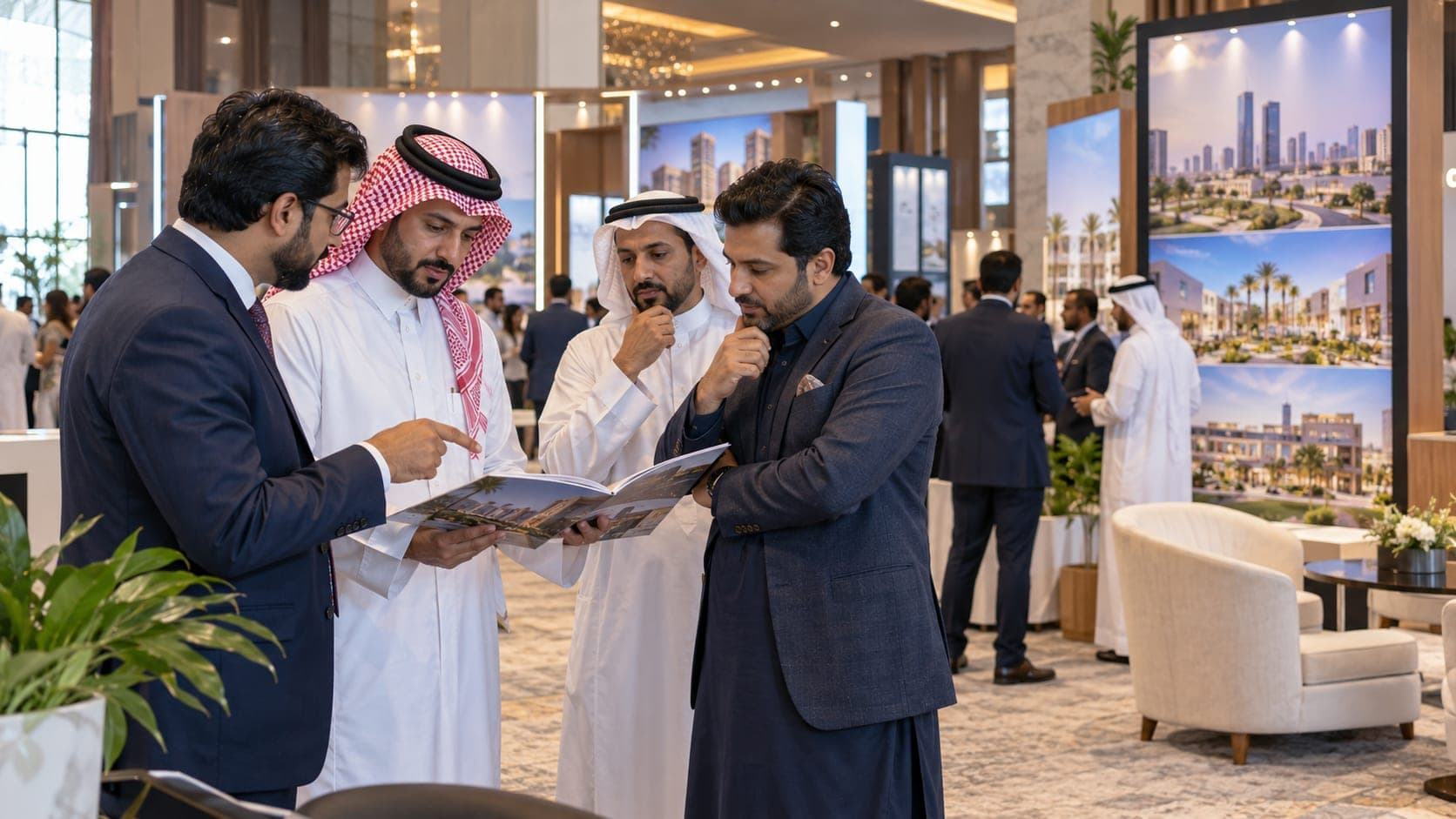
The Saudi-Pakistan Real Estate Expo concluded in Lahore on 23 October 2026, following three days of exhibitions and discussions aimed at strengthening property-investment cooperation between Saudi Arabia and Pakistan.
Held from 21 to 23 October at Lake City, the exhibition was organised by the Saudi-Pakistani Business Council in coordination with relevant authorities. It brought together 19 Saudi entities and a delegation of around 60 representatives, alongside Pakistani government officials, developers, business leaders and prospective investors.
Saudi Arabia's Real Estate General Authority (REGA) participated through a dedicated pavilion, highlighting the Kingdom's real-estate regulations and updated foreign-property-ownership framework.
The exhibition showcased residential, commercial and investment developments, including opportunities associated with Makkah, Madinah and other Saudi cities. Pakistani urban-development organisations also presented potential projects to Saudi participants.
However, the reviewed official reports did not disclose a verified number or value of binding agreements completed during the exhibition. Final visitor numbers, property sales and registered ownership transfers were also not established.
Saudi-Pakistan Real Estate Expo: Quick Facts
Detail | Verified information |
|---|---|
Event | Saudi-Pakistan Real Estate Expo 2026 |
Official REGA English name | Saudi-Pakistani Real Estate Exhibition 2026 |
Abbreviation | SPREX 2026, used by Pakistani government and a participating company |
Event status | Concluded |
Dates | 21–23 October 2026 |
Closing date | 23 October 2026 |
Closing report | 24 October 2026 |
Host city | Lahore, Punjab, Pakistan |
Venue | Lake City |
Official slogan | Own or Invest in the Kingdom of Saudi Arabia |
Organiser | Saudi-Pakistani Business Council |
Saudi regulatory participant | Real Estate General Authority |
Supporting authorities | Relevant Saudi and Pakistani government bodies |
Saudi entities | 19 |
Delegation | Around 60 representatives |
Pakistani participation | Government, business and urban-development stakeholders |
Presidential visit | Asif Ali Zardari, 22 October |
Punjab Governor | Sardar Saleem Haider Khan |
Saudi council chairman | Prince Mansour bin Mohammed Al Saud |
Pakistani urban-development participation | Ravi Urban Development Authority and CBD Punjab |
Actual visitor total | Not disclosed |
Pre-event visitor target | Approximately 5,000 |
Pre-event qualified-investor target | Approximately 1,000 |
Saudi project locations discussed | Makkah, Madinah and other Saudi cities |
Verified binding agreement total | Not disclosed |
Completed property sales | Not disclosed |
Announced investment value | Not disclosed |
Principal regulatory subject | Law of Real Estate Ownership by Non-Saudis |
Current status | Exhibition concluded; commercial outcomes require verification |
Sources: Saudi Press Agency, REGA, Pakistan Press Information Department and participating-company announcements. Visitor targets are not actual attendance figures.
ما نوع العقار والمنطقة المناسبة؟
اختر نوع العقار والمدينة المستهدفة لاستعراض أنسب الخيارات.
What Was the Saudi-Pakistan Real Estate Expo?
The Saudi-Pakistan Real Estate Expo was an international property exhibition intended to connect Saudi real estate companies with investors and business organisations in Pakistan.
According to the official REGA event announcement, the exhibition was organised by the Saudi-Pakistani Business Council under the slogan “Own or Invest in the Kingdom of Saudi Arabia.”
Its purpose was to present Saudi property and investment opportunities while strengthening direct communication between developers and prospective investors.
The exhibition also served as a platform for explaining the Kingdom's changing real-estate legislation.
For international buyers, understanding the regulatory environment is essential because property ownership in Saudi Arabia is not determined solely by the availability of advertised developments.
A developer's participation establishes its presence at the event, but it does not mean that all its properties were available for immediate purchase or approved for foreign ownership.
When and Where Was the Expo Held?
The exhibition took place from Wednesday, 21 October, to Friday, 23 October 2026, at Lake City in Lahore, Pakistan.
REGA's official calendar confirms the three-day period and host city.
The exact Lake City venue is also identified in the Pakistan government's presidential visit report, dated 22 October.
Saudi Press Agency published its report on REGA's participation on 22 October, followed by a conclusion report on 24 October.
The event's final day and the publication date of the closing report are different dates.
The exhibition's conclusion on 23 October should not be confused with Pakistan's President visiting on 22 October.
Who Organised and Supported the Exhibition?
The Saudi-Pakistani Business Council was the organiser.
The event was coordinated with relevant authorities in both countries, including involvement associated with the Saudi Embassy's commercial representation, Pakistan's investment authorities and the Government of Punjab.
REGA participated in its capacity as Saudi Arabia's real-estate regulator, not as the principal organiser.
Organisation | Reported role |
|---|---|
Saudi-Pakistani Business Council | Organiser and business-cooperation platform |
REGA | Saudi real-estate regulatory participant |
Saudi Embassy's commercial representation | Coordination and commercial engagement |
Pakistan Board of Investment | Investment-related cooperation |
Government of Punjab | Host-region institutional support |
Saudi property companies | Exhibitors and project presenters |
Pakistani development organisations | Presenters of local investment opportunities |
The distinction matters because attendance or sponsorship does not automatically make a government body responsible for the commercial claims of every exhibitor.
Saudi-Pakistan Real Estate Expo: Participation
The closing coverage reported 19 Saudi entities and a delegation of around 60 representatives.
These measures describe different aspects of participation.
The 19-entity figure represents participating organisations, while the approximately 60-person figure describes the visiting Saudi delegation.
Not every Saudi entity was necessarily a residential developer, and not every delegation member was necessarily a developer or property salesperson.
The exhibition also attracted Pakistani business representatives and government officials.
Earlier publicity referred to potential attendance of approximately 5,000 visitors, including 1,000 qualified investors.
However, the reviewed closing reports do not establish that those targets were achieved.
Consequently, the projected figures should not be published as actual visitor statistics.
Which Saudi Companies Participated?
Pakistan's official presidential report named eight Saudi companies or investment organisations participating in the exhibition.
Named participant | Verified connection |
|---|---|
Safa Investment | Exhibition participant and principal sponsor |
Knowledge Economic City | Named Saudi participant |
Sumou Investment | Named Saudi participant |
Al-Majidiya | Named Saudi participant |
Ulo Real Estate | Named Saudi participant |
Al-Diyar Al-Arabiya | Named Saudi participant |
Bin Daood Investment | Named Saudi participant |
International Gate Investment | Named Saudi participant |
This is a partial list, not the complete roster of 19 Saudi entities.
The official Pakistani report confirms their participation but does not provide a full project catalogue, individual transaction values or details of every property presented.
Safa Investment separately confirmed its participation through its official company announcement.
The company stated that its presentation included its wider real-estate portfolio in Riyadh, Jeddah and Madinah.
That confirmation does not establish that every project within the portfolio was available for sale to Pakistani buyers.
What Role Did REGA Play?
During the Saudi-Pakistan Real Estate Expo, REGA used its pavilion to present the Kingdom's real-estate regulatory framework.
According to the Saudi Press Agency's 22 October report, the authority highlighted legislation intended to improve market transparency, strengthen rights protection and increase the efficiency of property transactions.
A central subject was the updated Law of Real Estate Ownership by Non-Saudis.
REGA explained the framework governing international property ownership and the importance of approved geographical zones.
Its participation provided visitors with access to official information on the rules applicable to different property buyers.
However, an authority explaining regulatory requirements is not the same as approving each project exhibited.
No blanket approval of participating developers, property listings or investment products can be inferred from REGA's presence.
What Property Opportunities Were Presented?
The exhibition included presentations involving residential, commercial and other property-investment opportunities.
Saudi project locations discussed included Makkah and Madinah, while participant-company information also identified portfolios covering Riyadh and Jeddah.
Developers used the event to explain their projects and communicate with potential investors.
However, the reviewed reports do not provide a comprehensive list of every project displayed.
They also do not establish that the properties offered the same legal rights, purchase conditions or investment structures.
A residential apartment, a commercial development, a hotel investment and a long-term property-use right may involve significantly different regulations.
Buyers should assess each offering separately.
For general market context, Real Estate Saudi's guide to buying property in Saudi Arabia as a foreigner explains the distinction between market access, property eligibility and completing a registered acquisition.
Did the Exhibition Announce Completed Investments?
The reviewed official reports did not disclose a verified number or value of binding agreements completed during the exhibition.
The closing reports describe meetings, investment opportunities and efforts to encourage future partnerships.
However, these activities are not equivalent to completed commercial transactions.
No verified total was established for property reservations, signed purchase contracts, investment commitments or registered ownership transfers.
Similarly, an exhibition displaying a development does not demonstrate that a foreign buyer has completed its purchase.
Actual investment outcomes would require subsequent documentation identifying the parties, contractual obligations, investment amounts and relevant completion conditions.
Were Any Memoranda of Understanding Signed?
Pre-event coverage included expectations that the exhibition might facilitate memoranda of understanding and commercial agreements.
However, an expectation that an agreement will be signed is not proof that signing occurred.
A memorandum of understanding can describe intentions to cooperate without necessarily establishing a completed property investment.
A definitive commercial agreement may be legally binding, but closing and payment conditions can still remain outstanding.
A registered property purchase requires additional legal steps.
The reviewed official closing information did not establish a complete MoU count, binding contract count or total transaction value.
Can Pakistani Citizens Buy Property in Saudi Arabia?
Yes, qualifying Pakistani citizens may be able to acquire permitted property rights in Saudi Arabia, but nationality alone does not create unrestricted ownership eligibility.
Saudi Arabia's updated Law of Real Estate Ownership by Non-Saudis came into force on 22 January 2026.
The new framework provides routes for qualifying non-Saudi residents, non-resident individuals and certain foreign companies.
However, the applicable rules depend on the buyer category, the property's location, approved geographical zones and the type of right being acquired.
A buyer may be eligible to acquire ownership in one location but not another.
Similarly, some properties may offer a different legally recognised right, such as a time-limited usufruct.
Real Estate Saudi's guide to the updated non-Saudi property-ownership law explains the broader statutory framework.
What Is the Official Foreign-Ownership Process?
The REGA foreign-property-ownership guidance distinguishes between resident and non-resident applications.
Eligible foreign residents can apply using their Saudi residency identification information.
For qualifying non-residents, the application journey begins through Saudi diplomatic representations to establish the required digital identity.
Foreign companies without an existing Saudi presence may need to register through the Ministry of Investment before proceeding with the property-ownership process.
The official implementation platform is Saudi Properties.
The portal provides an entry point for determining eligibility and completing the applicable procedure.
However, application submission does not guarantee approval of a particular purchase.
Why Geographical Ownership Zones Matter
The foreign-ownership framework uses geographical rules that determine where particular buyers can acquire specific real-estate rights.
Under the official Law of Real Estate Ownership by Non-Saudis, the relevant controls can include:
Permitted geographical areas.
Types of ownership or other real-estate rights.
Maximum non-Saudi ownership percentages.
Duration of usufruct rights.
Buyer categories and additional conditions.
Applicable registration and approval requirements.
This means a developer's statement that a project is available to international investors must be checked against the precise legal entitlement being offered.
Exhibition marketing cannot override the geographical-zone rules.
Were Makkah and Madinah Projects Available to Pakistani Buyers?
The exhibition's display of properties in Makkah and Madinah does not establish that every displayed unit was legally available for direct ownership by individual Pakistani buyers.
The updated Saudi ownership law contains additional restrictions relating to both holy cities.
Under the relevant provisions, non-Saudi individual ownership in these cities is limited to qualifying Muslim individuals and remains subject to the approved geographical framework.
Different rules apply to certain Saudi-incorporated companies and regulated investment structures.
A Pakistani buyer's religion, residency status, buyer classification and chosen property right can therefore be relevant.
Even where a buyer qualifies, the exact project's eligibility must be checked independently.
Real Estate Saudi's guide to foreign property ownership in Makkah and Madinah explains these additional considerations.
حدد ميزانيتك الاستثمارية
حدد ميزانيتك التقديرية لنقوم بتضييق خيارات العروض.
Does Buying Saudi Property Grant Residency?
No. Property ownership does not automatically grant Saudi residency, work authorisation or citizenship.
Real estate ownership and immigration status are governed by different legal frameworks.
Saudi Arabia has a separate Premium Residency system, under which certain applicants may qualify through specific routes.
However, acquiring an ordinary property interest does not automatically approve a Premium Residency application.
Likewise, establishing a company or purchasing investment property does not create unrestricted employment rights.
Buyers should verify any residency-related claims through the relevant Saudi authority before entering a purchase agreement.
How Should Buyers Verify an Exhibited Project?
International buyers should not rely exclusively on exhibition brochures, sales presentations or promotional architectural images.
They should establish the identity of the legal developer and seller, confirm ownership of the underlying property and understand what is being sold.
For unfinished developments, off-plan licensing becomes particularly important.
The official REGA Wafi off-plan sales and leasing platform provides information about developer qualification, project licensing and regulated off-plan activities.
A project may fall within an eligible foreign-ownership zone but still require separate project-specific sales authorisation.
Similarly, a developer's participation at the exhibition does not establish a valid Wafi licence.
Real Estate Saudi's guide to off-plan property investment in Saudi Arabia explains why buyers must review escrow arrangements, construction risks, contractual delivery terms and buyer protections.
Pakistani Participation and Investment Opportunities
The exhibition also created opportunities for Saudi investors and developers to examine potential projects in Pakistan.
Pakistan's Ravi Urban Development Authority presented urban-development opportunities associated with Lahore.
The Punjab Central Business District Development Authority, also known as CBD Punjab, participated alongside RUDA in presenting local development opportunities.
This gave the event a two-way investment dimension.
Saudi businesses could explore opportunities in Pakistan, while Pakistani investors could learn about the Saudi real-estate market.
However, no completed cross-border property purchase or binding investment commitment should be inferred solely from those presentations.
President Zardari's Visit
Pakistan's President Asif Ali Zardari visited the exhibition on 22 October 2026.
According to the official presidential statement, he was received by Punjab Governor Sardar Saleem Haider Khan and Dr Gohar Ejaz, Chief Executive Officer of Lake City.
The President met participants and was briefed on participating companies, their projects and investment opportunities.
Prince Mansour bin Mohammed Al Saud, Chairman of the Saudi-Pakistani Business Council, was among the Saudi representatives involved.
The President encouraged stronger commercial cooperation between the two countries and greater private-sector participation.
Importantly, he visited the exhibition. This should not be inaccurately described as his formal inauguration of the event.
Why the Exhibition Mattered for Saudi Developers
For Saudi developers, the event provided direct access to potential international buyers, investment groups and business partners.
It also offered an opportunity to explain the characteristics of their projects to a market with established commercial and cultural ties to Saudi Arabia.
Developers could assess investor preferences, discuss financing expectations and understand common questions about ownership rights.
However, international exposure is not a guaranteed source of completed sales.
The commercial outcome depends on whether interested parties satisfy legal requirements and subsequently enter binding transactions.
Why It Mattered for Pakistani Investors
Pakistani investors gained an opportunity to speak directly with Saudi property businesses and learn about the applicable regulatory framework.
This may be useful because cross-border property transactions can involve differences in ownership rights, registration procedures, banking, taxation and contractual protections.
The ability to compare several developers in one location can support preliminary research.
However, a meeting with an exhibitor does not replace formal due diligence.
Real Estate Saudi's property ownership-verification guide explains why the seller, property boundaries, official title information and transfer authority should be checked before paying.
Potential Implications for Saudi-Pakistan Investment Relations
The exhibition reflects efforts to expand business cooperation beyond traditional areas of Saudi-Pakistani relations.
Property development, construction, infrastructure and investment services provide possible areas for future collaboration.
The Saudi-Pakistani Business Council can facilitate engagement between businesses, but commercial projects still require individual agreements and approvals.
The event may support future partnerships by improving communication and regulatory understanding.
Nevertheless, there is no verified event-specific investment total demonstrating how much new capital will move between the countries as a result.
What Was Not Confirmed?
The closing information did not establish a complete roster of all 19 Saudi entities or a final breakdown of the approximately 60 delegation members.
No reliable final visitor count or number of qualified investors was disclosed.
The complete number of meetings and projects displayed also remains unconfirmed.
Similarly, there was no verified aggregate total for signed MoUs, binding agreements, property reservations, completed purchases or registered title transfers.
Individual project prices, financing arrangements, delivery dates and foreign-buyer eligibility were not comprehensively published.
No confirmed event-specific total for Saudi investment in Pakistan or Pakistani investment in Saudi property was established.
What the Expo Does Not Mean
The exhibition should not be interpreted as confirmation that every showcased Saudi project is approved for foreign ownership.
It does not mean that every Pakistani citizen can buy property in any Saudi city.
Properties in Makkah and Madinah remain subject to specific restrictions.
REGA's participation does not constitute an endorsement of every exhibitor.
Likewise, meetings, expressions of interest and promotional presentations do not amount to completed investments.
A reservation does not automatically establish registered ownership.
Property acquisition does not automatically confer residency, citizenship or employment rights.
No property-price growth, rental return or investment yield is guaranteed.
Practical Checklist for International Buyers
Before purchasing property presented at an international exhibition, buyers should verify:
Their eligibility under the current non-Saudi ownership framework.
The property's exact location and approved geographical zone.
The permitted ownership or usufruct right.
The legal identity of the developer and seller.
The seller's registered title and transfer authority.
The applicable Wafi licence for an off-plan development.
The authorised project escrow account, where required.
Construction progress and documented completion dates.
The individual unit's approved area and specifications.
Purchase price, payment schedule and financing terms.
Taxes, government fees, service charges and other costs.
Contract language, dispute-resolution terms and buyer remedies.
Foreign-currency transfer and banking requirements.
The official property-registration process.
Makkah and Madinah restrictions, where relevant.
Resale, inheritance and ownership-transfer conditions.
Whether any separate residency eligibility exists.
Independent Saudi legal, tax, financial, property and immigration advice is advisable before entering a binding agreement or transferring funds.
Editorial Analysis
The Saudi-Pakistan Real Estate Expo demonstrates the growing importance of international regulatory education in Saudi Arabia's property-investment outreach.
The participation of 19 Saudi entities and approximately 60 delegation representatives indicates an organised effort to engage Pakistani businesses and investors.
REGA's presence provided an important regulatory dimension by allowing visitors to learn about the updated non-Saudi ownership framework directly from the competent authority.
This was particularly relevant because Saudi Arabia's ownership rules changed in January 2026.
However, a more accessible legal framework does not eliminate geographical restrictions or project-level verification requirements.
The same distinction applies to commercial outcomes.
The exhibition provided an opportunity to meet potential buyers and investment partners, but it did not publish verified figures demonstrating completed investment or property sales.
The appearance of projects in Makkah and Madinah also requires careful interpretation because ownership in those cities is subject to additional rules.
A meaningful assessment of the exhibition's long-term commercial impact will depend on future disclosures identifying actual contracts, investments and registered transactions.
Until then, the confirmed achievement is international engagement and the presentation of investment opportunities rather than a measured increase in cross-border property ownership.
Information Still Requiring Verification
Future reporting should establish the complete 19-entity roster, the final delegation composition and the number of visitors and qualified investors who attended.
Additional information is required about the specific projects exhibited, their ownership rights, unit availability, developer approvals and any confirmed sales conditions.
Commercial outcomes need to be verified through dated announcements of MoUs, definitive agreements, investment commitments, property reservations and completed purchases.
The value of any confirmed investments must be attributed to the correct parties and transaction types.
Project-specific foreign ownership, Wafi licensing and registered title transfers must also be checked independently.
Future reports should identify follow-up business meetings and any subsequent Saudi-Pakistani property exhibitions.
كيف تفضل التواصل معك؟
اختر وسيلة التواصل الأكثر ملاءمة لك لمناقشة فرصك الاستثمارية.
What Readers Should Monitor Next
Readers should follow REGA's official announcements for updates on foreign-property ownership and the applicable geographical-zone framework.
The Saudi-Pakistani Business Council and participating developers may issue subsequent statements about projects or partnerships.
The Saudi Exchange may provide disclosures where a listed company enters a material agreement.
Pakistan's Board of Investment and provincial development authorities may publish information about future projects involving Saudi partners.
However, each announcement should be assessed according to its actual legal and commercial status.
Conclusion
The Saudi-Pakistan Real Estate Expo concluded in Lahore on 23 October 2026 after three days of property presentations, regulatory discussions and business meetings.
Organised by the Saudi-Pakistani Business Council, the exhibition involved 19 Saudi entities and around 60 delegation representatives.
REGA participated to explain Saudi real-estate regulations, including the updated foreign-property-ownership framework.
President Asif Ali Zardari's visit and the participation of Saudi and Pakistani development organisations highlighted the event's broader commercial significance.
However, the reviewed official reports did not establish final visitor numbers, completed property sales or a verified aggregate investment value.
The exhibition created opportunities for engagement, while actual cross-border property investment remains subject to legal eligibility, project verification and completed transactions.
تحدث معنا عبر قناتك المفضلة
استشارات عقارية مباشرة حول الاستثمار والسوق العقاري في المملكة العربية السعودية.
الأسئلة الشائعة
The Saudi-Pakistan Real Estate Expo was a three-day property and investment exhibition held in Lahore in October 2026. Organised by the Saudi-Pakistani Business Council, it connected Saudi developers, investment organisations and government representatives with Pakistani business leaders and prospective investors. The event showcased property opportunities and explained Saudi regulatory requirements. Its purpose was to encourage communication and potential partnerships, not to confirm that every exhibited property had been sold or that investment agreements were completed.
The exhibition took place from 21 to 23 October 2026 at Lake City in Lahore, Punjab, Pakistan. REGA's official event calendar confirms the three-day schedule and Lahore location, while Pakistan's presidential press statement identifies Lake City as the venue. President Asif Ali Zardari visited on 22 October. The exhibition concluded on 23 October, and the Saudi Press Agency published its closing report on 24 October.
The Saudi-Pakistani Business Council organised the exhibition in coordination with relevant Saudi and Pakistani authorities. The event involved support and cooperation associated with Saudi diplomatic commercial representation, Pakistani investment institutions and Punjab's government. REGA participated as Saudi Arabia's real-estate regulator rather than the principal organiser. Developers and investment companies attended as exhibitors. These roles should be distinguished because regulatory participation does not mean government endorsement of every commercial project.
The closing coverage reported 19 Saudi entities participating in the exhibition, with a delegation of around 60 representatives. These figures describe organisations and delegation members respectively; they are not the same as the number of visitors or completed property transactions. Pakistan's official presidential report named eight participating Saudi companies, but it did not provide the full 19-entity roster. The exact composition of the delegation and final visitor totals were not established.
REGA participated through a pavilion explaining Saudi Arabia's real-estate regulations and legislation, particularly the updated Law of Real Estate Ownership by Non-Saudis. The authority highlighted ownership eligibility, geographical restrictions, transparency and property-rights protection. Its role was to provide regulatory information and support understanding of the Saudi market. REGA's participation did not automatically approve displayed developments, confirm Wafi project licences or guarantee that Pakistani visitors were eligible to purchase individual properties.
Participating companies presented residential, commercial and investment opportunities, including developments associated with Makkah and Madinah. Safa Investment separately confirmed that its exhibited portfolio covered Riyadh, Jeddah and Madinah. However, the official reports did not provide a complete project-by-project catalogue covering all 19 Saudi entities. Displaying a project did not establish its current unit availability, pricing, construction status, licensing or eligibility for direct ownership by Pakistani buyers.
The reviewed official reports did not disclose a verified total or value of binding property agreements completed during the exhibition. Pre-event expectations about memoranda of understanding cannot be treated as evidence that they were signed. Meetings and expressions of interest are also different from definitive contracts, investment payments or registered property transfers. Any subsequent commercial outcome should be confirmed through an official announcement identifying the parties, agreement type, financial terms and completion status.
Qualifying Pakistani citizens may be able to acquire permitted Saudi property rights under the updated foreign-ownership framework effective from 22 January 2026. Eligibility depends on the applicant's legal category, residency circumstances, property location, approved geographical zone and type of ownership right. Pakistani nationality alone does not provide unrestricted access to every property. Buyers should check the official Saudi Properties portal and current REGA guidance before paying deposits or signing purchase agreements.
Some qualifying Pakistani Muslim individuals may be eligible to acquire permitted property rights in approved parts of Makkah or Madinah, subject to Saudi law and applicable geographical restrictions. The rules for companies and other investment structures are different. A project appearing at the Lahore exhibition does not establish that its units are legally available to a particular Pakistani buyer. The exact property, buyer category, permitted right and registration requirements must be independently verified.
No. Purchasing property in Saudi Arabia does not automatically grant residency, citizenship, employment rights or approval under the Premium Residency system. Those matters are governed by separate legal requirements. Property ownership also does not guarantee rental income, capital appreciation, liquidity or profitable investment performance. Buyers must assess the individual property's legal status, financing, location, operating costs, contractual conditions and market risks before committing funds. Independent professional advice is recommended.
