
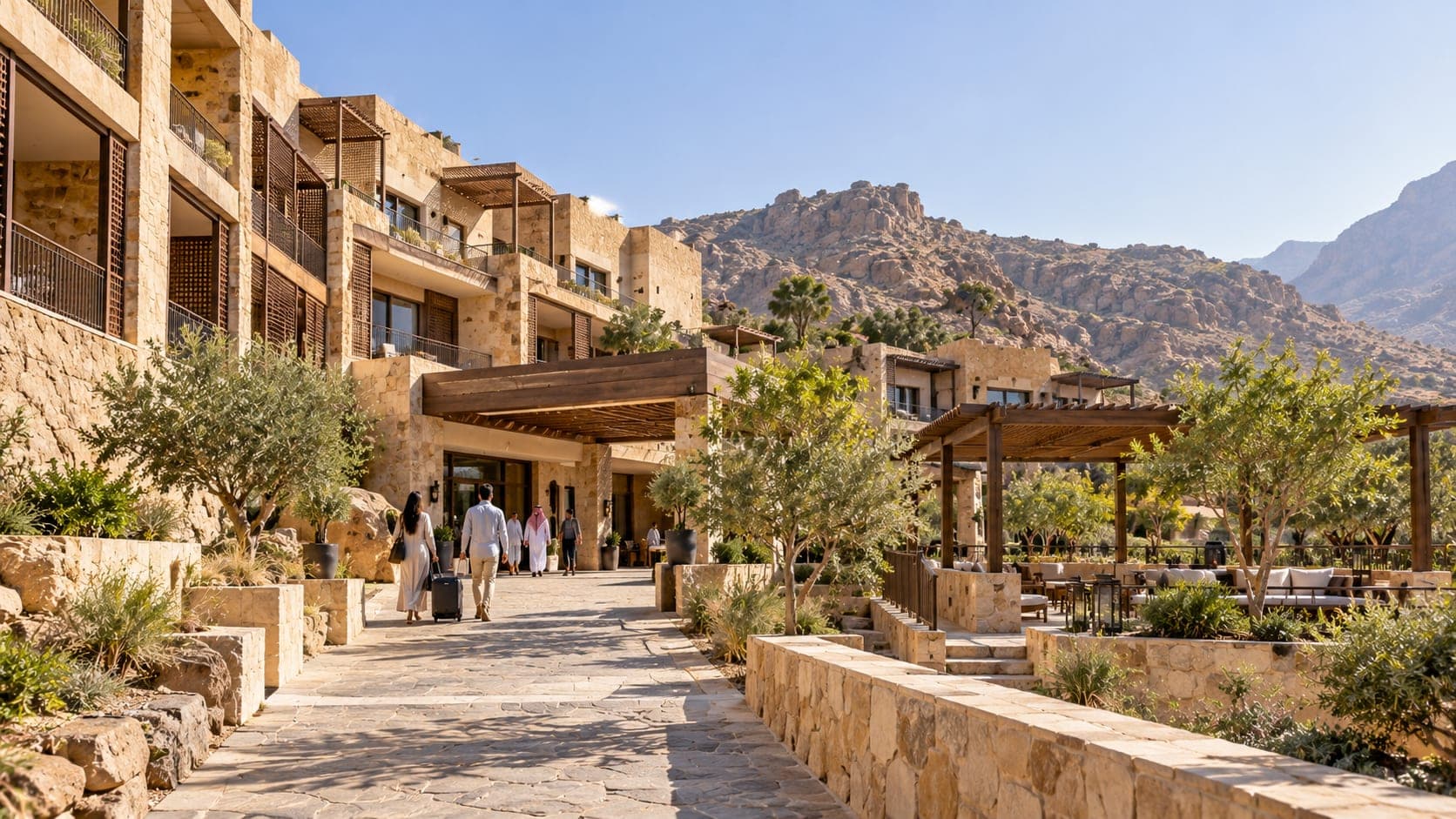
Saudi Arabia's Ministry of Tourism and Ministry of Investment have approved the first group of 19 Saudi hospitality investment projects under the Hospitality Investment Enablers Programme, with the selected developments expected to activate investment of up to SAR 6.7 billion across five tourism destinations.
The announcement, published on 19 October 2026, outlines plans to add more than 3,000 hotel rooms, with approximately 40% of that planned capacity located in coastal destinations.
The ministries also project more than 17,000 new jobs, an annual direct contribution to gross domestic product exceeding SAR 2.4 billion by 2030, and a local-content contribution exceeding SAR 5.3 billion.
The first participating project is scheduled to begin operations by the end of 2026, with other openings expected to follow through 2029.
However, the official announcement does not provide a complete list of the 19 developments, their individual locations, investors, hotel brands, construction stages or financing arrangements.
Saudi Hospitality Investment Projects: Quick Facts
Detail | Official information |
|---|---|
Announcement | First approved group of hospitality investment projects |
Announcement date | 19 October 2026 |
Announcing authorities | Ministry of Tourism and Ministry of Investment |
Programme | Hospitality Investment Enablers |
Wider initiative | Tourism Investment Enablers Programme |
Programme stage | First approved group |
Number of projects | 19 |
Tourism destinations | Five |
Complete destination names | Not disclosed in the announcement |
Potential investment | Up to SAR 6.7 billion |
Planned hotel rooms | More than 3,000 |
Planned coastal-room share | Approximately 40% |
Projected employment | More than 17,000 jobs |
Projected annual direct GDP contribution by 2030 | More than SAR 2.4 billion |
Projected local-content contribution | More than SAR 5.3 billion |
First proposed operation | By the end of 2026 |
Wider proposed opening period | Through 2029 |
Project owners and developers | Complete list not disclosed |
Hotel brands and operators | Not identified |
Project-specific investment amounts | Not disclosed |
Project-specific construction stages | Not disclosed |
Financing commitments | Not individually verified |
Building permits | Not individually verified |
Hotel operating licences | Not individually verified |
Current status | Approved for programme support; project delivery remains subject to verification |
Source: Ministry of Tourism announcement, 19 October 2026. The figures represent announced plans and projections rather than completed economic results.
What Did Saudi Arabia Announce?
The Ministry of Tourism's official announcement of the first approved hospitality projects confirms that the Ministry of Tourism and Ministry of Investment jointly announced the first group of developments benefiting from the Hospitality Investment Enablers Programme.
The announcement took place in the presence of Minister of Tourism Ahmed bin Aqeel Al-Khateeb and Minister of Investment Fahad bin Abduljalil Al-Saif.
The programme is intended to improve the feasibility and attractiveness of private-sector hospitality developments in promising Saudi tourism destinations.
Its enablers are designed to reduce certain operating costs and improve conditions for investment.
Tourism Minister Al-Khateeb emphasised the importance of expanding accommodation capacity while encouraging investment and economic activity beyond individual hotels.
Investment Minister Al-Saif highlighted tourism's role in economic diversification and the importance of cooperation between government institutions and the private sector.
The announcement establishes approval for programme support. It does not establish that all projects have completed construction, received operating licences or begun welcoming guests.
ما نوع العقار والمنطقة المناسبة؟
اختر نوع العقار والمدينة المستهدفة لاستعراض أنسب الخيارات.
What Is the Hospitality Investment Enablers Programme?
The Hospitality Investment Enablers Programme is a government initiative designed to encourage private investment in tourism accommodation across selected Saudi destinations.
The original Arabic programme name is برنامج ممكنات الاستثمار في قطاع الضيافة.
The programme is part of the wider Tourism Investment Enablers Programme, introduced in 2024.
According to the Ministry of Tourism's original Tourism Investment Enablers announcement, the initiative is intended to make tourism investment easier and more commercially attractive.
Its wider approach includes facilitating access to suitable land, reducing barriers to market entry, improving development procedures and addressing operational-cost challenges.
The October 2026 approvals represent a specific group of projects benefiting from the hospitality initiative.
They should not be confused with the entire national programme or its broader long-term investment objectives.
Saudi Hospitality Investment Projects: Headline Figures
Indicator | Ministry figure | Correct interpretation |
|---|---|---|
Approved projects | 19 | First group approved for programme support |
Destinations | 5 | Exact individual destinations not listed |
Investment | Up to SAR 6.7 billion | Potential investment to be activated |
Hotel rooms | More than 3,000 | Future accommodation capacity |
Coastal share | Approximately 40% | Share of planned rooms, not project count |
Jobs | More than 17,000 | Projected employment |
Annual direct GDP contribution | More than SAR 2.4 billion | Projection for 2030 |
Local content | More than SAR 5.3 billion | Projected contribution; period unspecified |
Openings | End-2026 through 2029 | Proposed operating timetable |
These figures describe expected contributions from the approved group.
They do not establish that the projects have already produced their forecast economic benefits.
Where Are the 19 Hospitality Projects Located?
The Ministry confirms that the approved group covers five promising tourism destinations in Saudi Arabia.
However, the official October announcement does not identify all five by name.
The Ministry's general tourism investment portal lists a wider set of targeted destinations under its investment-enablers framework, including Asir, Hail, Taif, Al-Ahsa, Al-Baha, Al-Jouf, Dammam and other locations.
These are programme-level target locations, not a verified list of where the first 19 approved projects are situated.
They should not be used to construct an unsupported project distribution.
The announcement also does not disclose how many hotels or rooms are planned in each of the five destinations.
Without individual property information, it is not possible to establish which developments are located in major cities, emerging coastal destinations or more established visitor markets.
Future project-specific disclosures will be necessary to map the approved portfolio accurately.
What Does the SAR 6.7 Billion Investment Figure Mean?
The SAR 6.7 billion figure represents investment that the programme's enablers are expected to activate, rather than money already spent.
The Ministry's wording identifies investment of up to SAR 6.7 billion.
This qualification is important because a projected investment value is not equivalent to completed construction expenditure or fully committed financing.
The announcement does not provide a breakdown between development expenditure, financing, land costs and other capital requirements.
It also does not establish that the government is directly providing SAR 6.7 billion in grants or subsidies.
The programme offers investment enablers intended to improve project feasibility.
Private-sector investors remain responsible for meeting the applicable investment, development and financing requirements.
The full financial contribution of each project will only become clear through detailed project-level disclosures.
How Many Hotel Rooms Are Planned?
The first group of projects is expected to add more than 3,000 hotel rooms to Saudi Arabia's tourism-accommodation supply.
This represents proposed future capacity rather than rooms already available for reservations.
The Ministry's announcement does not identify how those rooms are divided among the 19 projects.
It also does not provide the brands, quality classifications, operating models or exact accommodation configurations of the individual developments.
Although the programme's wider eligibility framework includes three-, four- and five-star hotels, that does not prove every project in the approved group has the same classification.
Further information will be required to distinguish rooms under construction, completed rooms, licensed rooms and commercially operational accommodation.
Readers exploring differences between hotel-based property models can review Real Estate Saudi's guide to investment in hotel apartments in Saudi Arabia.
Approximately 40% of Planned Rooms Are in Coastal Destinations
The Ministry states that approximately 40% of the planned hotel rooms are associated with coastal destinations.
This is a share of room capacity, not a statement that 40% of the projects or investment value is located on the coast.
The figure suggests that coastal tourism forms an important element of the programme's intended accommodation expansion.
Potential coastal hospitality developments can serve visitors seeking leisure, beach and resort experiences.
However, the Ministry does not identify the exact coastal properties or provide their individual room counts.
It would therefore be inaccurate to attribute this capacity to a particular coastal city or resort without additional official information.
The announcement also does not establish future occupancy rates or commercial profitability for those locations.
How Many Jobs Could the Projects Create?
The approved group is expected to generate more than 17,000 new jobs, according to the Ministry.
This is a forward-looking employment projection.
The announcement does not specify how many positions would be direct or indirect, temporary or permanent, or related to construction rather than hotel operations.
It also does not provide a separate figure for Saudi-national employment.
Hospitality developments can potentially create demand for staff in hotel operations, maintenance, management, food services, procurement and supporting activities.
Construction and development can involve additional employment before an establishment opens.
However, these examples should not be treated as an official breakdown of the 17,000-job projection.
Actual employment outcomes will depend on completed projects, operating capacity and staffing decisions.
What Economic Contribution Is Expected?
The Ministry projects that the approved group will contribute more than SAR 2.4 billion directly and annually to GDP by 2030.
It also projects more than SAR 5.3 billion in local-content contribution.
The local-content estimate reflects anticipated demand for domestic goods, services and materials.
Relevant commercial activity may involve construction suppliers, local contractors, hospitality services, food and beverage businesses, retail and supporting tourism operations.
However, the announcement does not explain the full calculation methodology.
It also does not specify whether the SAR 5.3 billion local-content figure is cumulative or measured over another defined period.
The GDP estimate is explicitly annual and associated with 2030.
These different measures should not be added together as though they represent the same financial category.
When Are the Hotels Expected to Open?
The Ministry states that the first participating project is scheduled to begin operations by the end of 2026.
Further openings are expected to follow through 2029.
The intended timetable is designed to bring the approved portfolio into operation ahead of major international events hosted by Saudi Arabia, including Expo 2030 and the 2034 FIFA World Cup.
However, the official announcement does not identify the first project expected to open.
It also does not establish exact opening dates for the remaining properties.
Construction progress, financing, regulatory approvals, operator appointments and licensing can affect delivery schedules.
The proposed timetable should therefore be treated as an official target rather than a guarantee that every hotel will open as planned.
Are the Approved Hotels Already Under Construction?
Programme approval does not prove that all 19 hospitality projects are under construction.
The Ministry's general eligibility framework includes both new developments and qualifying projects already underway.
As a result, participating projects may be at different stages of preparation and delivery.
Some may require additional planning, financing or construction approvals.
Others may have progressed further.
However, the October announcement does not provide a verified project-by-project construction register.
No overall completion percentage, number of commenced sites or confirmed building-permit count was disclosed for the approved group.
An approved beneficiary should therefore not automatically be described as an operational hotel or completed development.
Have Hotel Brands and Operators Been Announced?
The Ministry's October announcement does not provide a complete list of hotel brands or operators for the 19 projects.
It also does not identify all project owners or developers.
A hotel brand, development company and property owner can represent different parties within a hospitality project.
The developer may arrange construction, while a separate specialist company operates the completed hotel.
An international brand may participate through a management, franchise or other commercial arrangement.
However, no specific relationship should be attributed to an approved project without official confirmation.
Hotel brands involved in other Saudi developments must not be assumed to participate in this programme.
What Types of Developments May Qualify?
The Ministry's published programme criteria identify several categories of potentially eligible developments.
Programme criterion | Official guidance |
|---|---|
Project stage | New or qualifying ongoing projects |
Construction progress | Ongoing projects less than 70% complete |
Project structure | Hospitality or mixed-use developments |
Hospitality component | At least 20% |
Target accommodation | Three-, four- and five-star hotels |
Minimum investment | SAR 15 million |
Land value | Excluded from the minimum-investment calculation |
Investor structures | Local, regional and international joint ventures |
Selection | Subject to eligibility assessment and approval |
Applicants are directed to assess eligibility, submit an application, receive an assessment result and access applicable benefits if approved.
These are general programme criteria.
They do not disclose the precise characteristics of every project within the first group.
Importantly, satisfying a minimum investment threshold does not guarantee selection or commercial success.
حدد ميزانيتك الاستثمارية
حدد ميزانيتك التقديرية لنقوم بتضييق خيارات العروض.
How Could the Enablers Improve Project Feasibility?
Hospitality projects involve substantial costs before and after opening.
Initial expenditure can include land arrangements, design, construction, building systems, furnishings and equipment.
Operating costs can include staffing, maintenance, utilities, management and other ongoing requirements.
The Ministry's programme aims to address certain barriers that may affect project feasibility.
Reducing relevant operating costs or administrative friction may improve the commercial environment for qualifying developments.
However, these measures do not remove market risk.
A development may still face construction delays, financing challenges, operating losses or weaker-than-expected visitor demand.
Programme approval should therefore be assessed as one element of the investment structure rather than a guarantee of profitability.
Potential Impact on Saudi Hospitality Real Estate
The first 19 approvals could contribute to a more geographically varied Saudi hotel-development pipeline.
The policy focus extends beyond simply adding luxury accommodation in already established markets.
It aims to encourage private participation in promising tourism destinations where suitable accommodation and supporting services may be needed.
The coastal-room share also indicates an intention to strengthen beach and leisure tourism.
Over time, hotel development can create opportunities for construction, infrastructure, food services, retail and property operations.
However, these are potential economic effects.
Actual results will depend on where the projects are delivered, when they open and how they perform commercially.
For wider development context, Real Estate Saudi's overview of tourism development projects in Saudi Arabia examines the Kingdom's broader hospitality and destination-development landscape.
The first 19 supported projects should not automatically be linked to other tourism developments unless their participation is officially established.
Potential Relevance for Property Developers
Developers interested in the hospitality sector should evaluate the programme alongside their project-specific regulatory and financial requirements.
Land availability is only one consideration.
Development permissions, infrastructure, building design, financing, contractor capacity and hotel operations can all influence viability.
Mixed-use developments may also require a clear separation between accommodation and other property uses.
The programme's minimum hospitality component and construction-progress conditions make early eligibility checks particularly important.
Developers should confirm whether their intended project classification and investment structure satisfy current Ministry requirements.
Participation in the scheme does not replace the need for normal property, construction or tourism approvals.
Potential Relevance for Investors
For investors, the announcement indicates government support for increasing private-sector participation in hospitality development.
However, it does not represent a verified list of publicly available investments.
The project owners, investment structures and rights offered to potential outside investors have not been fully disclosed.
Investors considering hospitality assets should assess project feasibility, financing, operating costs, demand, destination maturity and contractual risks.
Real Estate Saudi's guide to real estate investment opportunities in Saudi Arabia provides broader comparisons between hospitality, residential and other property sectors.
International investors also need to consider business establishment and property ownership separately.
The guide to foreign-company property ownership in Saudi Arabia explains why corporate status, ownership rights and geographical conditions must be independently verified.
No investor should assume that programme approval creates unrestricted access to an individual property's ownership.
Financing and Tourism Development Fund Support
Saudi Arabia's tourism-investment ecosystem includes financing institutions as well as regulatory and administrative authorities.
The Tourism Development Fund supports tourism investment through financing-related programmes.
The Saudi government's official Tourism Development Fund profile provides information about the Fund and its wider investment-development mandate.
However, the existence of tourism-financing programmes does not establish that the Fund has financed all 19 approved projects.
The October announcement does not disclose individual financing packages, government loan amounts or guaranteed credit facilities.
Each developer's financing position requires separate confirmation.
Relationship With Saudi Vision 2030
The hospitality-enablers programme is aligned with Saudi Arabia's broader tourism and economic-diversification objectives.
Tourism is an important component of the Kingdom's strategy to expand non-oil activity, encourage private-sector investment and improve the visitor experience.
Increasing accommodation options may support destinations seeking to attract domestic and international visitors.
Local procurement and employment opportunities are also relevant to the programme's economic objectives.
Real Estate Saudi's analysis of how Vision 2030 is transforming Saudi real estate provides broader context on tourism-related property development.
However, inclusion in an investment-enablers programme does not mean that each participating hotel is a separately funded government Vision 2030 development.
What Was Not Disclosed?
Despite the programme's headline figures, significant project-level information remains unavailable.
The announcement does not provide a complete list of the five destination names, the 19 project names or all participating developers.
Hotel brands, operators, individual development values and accommodation counts were not identified.
Similarly, the Ministry did not publish a consolidated breakdown of land rights, financing commitments, construction progress, planning approvals, building permits or operating licences.
The projected employment figure was not accompanied by a detailed classification of jobs.
The local-content and GDP estimates also lack a complete public calculation methodology in the announcement.
Exact project-opening dates remain unconfirmed.
What the Announcement Does Not Mean
The approval of the first project group should not be interpreted as confirmation that SAR 6.7 billion has already been invested.
It does not mean the government has paid that amount to developers.
It also does not establish that all 19 projects are under construction, fully financed or licensed to operate.
The planned 3,000-plus rooms are not necessarily available for reservations.
The projected employment figures do not represent jobs already created.
Nor does the announcement guarantee room occupancy, hotel profitability, property-price growth or investment returns.
Specific foreign-investor rights and property ownership arrangements must be verified independently.
Practical Due-Diligence Checklist
Before participating in a Saudi hospitality development, investors and developers should verify:
Project identity and approved programme status.
Legal project owner and developer.
Land ownership, lease or other development rights.
Permitted use and planning approvals.
Building permit and construction authorisation.
Tourism-development and operating requirements.
Investment budget and financing commitments.
Programme benefits actually approved.
Contractor appointments and construction agreements.
Confirmed hotel operator and brand, if applicable.
Planned room count and accommodation classification.
Construction progress and proposed opening date.
Employment and local-procurement commitments.
Foreign-investor eligibility, taxes and contractual terms.
Financial projections, operating costs and exit risks.
Independent Saudi legal, planning, tourism-licensing, property, tax and financial advice is recommended before entering binding agreements.
Editorial Analysis
The approval of the first Saudi hospitality investment projects represents a policy effort to connect private-sector hotel development with investment-enabling measures.
The significance lies in the programme's attempt to improve project feasibility rather than merely announcing future construction.
Hospitality developments can face challenges involving land, infrastructure, approvals, operating costs and financing.
Addressing these constraints may encourage private investment in destinations that have growth potential but require additional accommodation capacity.
The Ministry's projected coastal-room share also suggests attention to a wider range of visitor experiences.
If delivered, the projects could support accommodation supply, hospitality services and local business activity.
However, the forward-looking figures must be interpreted cautiously.
The SAR 6.7 billion investment ceiling is not verified completed expenditure.
The projected jobs and economic contributions depend on future delivery and commercial operations.
The announcement also provides limited transparency about individual projects, making it difficult to assess construction readiness or geographical distribution.
A more complete evaluation will require named developments, financing information, operating arrangements, building progress and actual opening dates.
For investors, the quality of individual projects will matter more than the overall programme headline.
Information Still Requiring Verification
Future official reporting should establish the five exact destinations and the complete list of approved projects.
Further disclosures should identify owners, developers, hotel brands, operators, project budgets and individual room counts.
Land ownership or lease arrangements, financing commitments, government-enabler values, building permits, construction stages and hotel classifications also remain outstanding.
Employment reporting should clarify job types and the timing of recruitment.
Additional methodology is needed for the projected local-content and GDP contributions.
The identity of the first project scheduled for operation by the end of 2026 is particularly important.
Subsequent updates should distinguish construction completion, tourism operating licences, hotel openings and full commercial operation.
كيف تفضل التواصل معك؟
اختر وسيلة التواصل الأكثر ملاءمة لك لمناقشة فرصك الاستثمارية.
What Readers Should Monitor Next
Readers should monitor future Ministry of Tourism and Ministry of Investment announcements for project-level details.
Developer and hotel-operator statements may provide evidence of signed agreements, construction milestones or confirmed opening dates.
Financing announcements can help establish whether individual projects have secured the funding required for delivery.
The first expected opening before the end of 2026 will be an important milestone to verify.
Further openings are planned through 2029.
Once projects begin operating, actual room delivery, employment, local-content expenditure and economic contributions can be compared with the original projections.
Conclusion
Saudi Arabia has approved 19 Saudi hospitality investment projects across five tourism destinations under the Hospitality Investment Enablers Programme.
The approved group is expected to activate investment of up to SAR 6.7 billion and add more than 3,000 planned hotel rooms, approximately 40% of them in coastal destinations.
The Ministry also projects over 17,000 jobs, annual direct GDP contributions exceeding SAR 2.4 billion by 2030 and local-content contributions above SAR 5.3 billion.
The first project is scheduled to start operating by the end of 2026, with other openings expected through 2029.
However, programme approval does not establish completed construction, secured financing, issued operating licences or guaranteed commercial success.
تحدث معنا عبر قناتك المفضلة
استشارات عقارية مباشرة حول الاستثمار والسوق العقاري في المملكة العربية السعودية.
الأسئلة الشائعة
The new Saudi hospitality investment projects are the first group of private-sector developments approved to benefit from the Hospitality Investment Enablers Programme. The Ministry of Tourism and Ministry of Investment jointly announced the group on 19 October 2026. The initiative is intended to improve project feasibility and encourage tourism accommodation development. Approval under the programme does not mean every property is completed, licensed, financed or already operating.
Saudi Arabia approved 19 projects in the first group of developments benefiting from the Hospitality Investment Enablers Programme. The Ministry confirmed that these projects cover five tourism destinations. However, the announcement does not provide a complete list of project names, hotel brands or individual construction stages. The 19-project figure represents approved programme beneficiaries rather than 19 completed hotels or properties that have necessarily opened to guests.
The Ministry expects the approved group to activate investment of up to SAR 6.7 billion. This represents potential investment associated with the participating projects, not money already spent or a confirmed government funding allocation. The announcement does not specify the capital invested in each project or establish that all financing has closed. Actual expenditure will depend on project progress, financing arrangements, approvals and delivery.
The Ministry confirmed that the 19 approved projects are distributed across five promising Saudi tourism destinations. However, its 19 October 2026 announcement does not provide a complete list of those destinations or a project-by-project location breakdown. The Ministry's general investment portal lists wider programme target areas, but that list does not establish the locations of the first 19 approved projects. Further official disclosure is needed.
The approved group is expected to add more than 3,000 hotel rooms to Saudi Arabia's tourism accommodation supply. Approximately 40% of the planned rooms are associated with coastal destinations. These figures refer to future capacity, not rooms already open for bookings. The Ministry did not disclose the number of rooms in each project, final hotel classifications or the number of properties already under construction.
The Ministry projects that the approved projects could generate more than 17,000 new jobs. This is a forward-looking estimate rather than a count of positions already created or filled. The announcement does not provide a complete distinction between direct and indirect jobs, construction and operational employment, or temporary and permanent roles. Actual employment will depend on project completion, commercial operations and staffing requirements.
Construction status has not been verified for all 19 projects. The programme's general eligibility framework includes both new developments and qualifying projects already underway, so participating properties may be at different stages. Programme approval does not automatically establish a building permit, secured financing, contractor appointment or construction commencement. Individual project updates will be necessary to confirm which sites have started construction and how far they have progressed.
The Ministry states that the first participating project is scheduled to begin operating by the end of 2026. Further openings are expected through 2029, ahead of major international events including Expo 2030 and the 2034 FIFA World Cup. However, the announcement does not provide a complete opening schedule for the 19 projects. Actual dates remain dependent on construction, financing, regulatory approvals and operating arrangements.
The official October 2026 announcement does not identify a complete list of hotel brands or operating companies associated with the approved group. It also does not provide all project developers and owners. Any future hotel management or franchise agreements will need separate verification through the relevant companies or authorities. International brands involved in unrelated Saudi hospitality developments should not automatically be described as participants in these 19 projects.
No. Approval under the Hospitality Investment Enablers Programme does not guarantee that every participating development will secure all necessary financing, obtain building permits, complete construction, receive operating licences or open on schedule. Government enablers may improve project feasibility, but commercial and development risks remain. Investors should assess each project's ownership, funding, approvals, construction progress, operator arrangements and financial assumptions independently before making commitments.
