
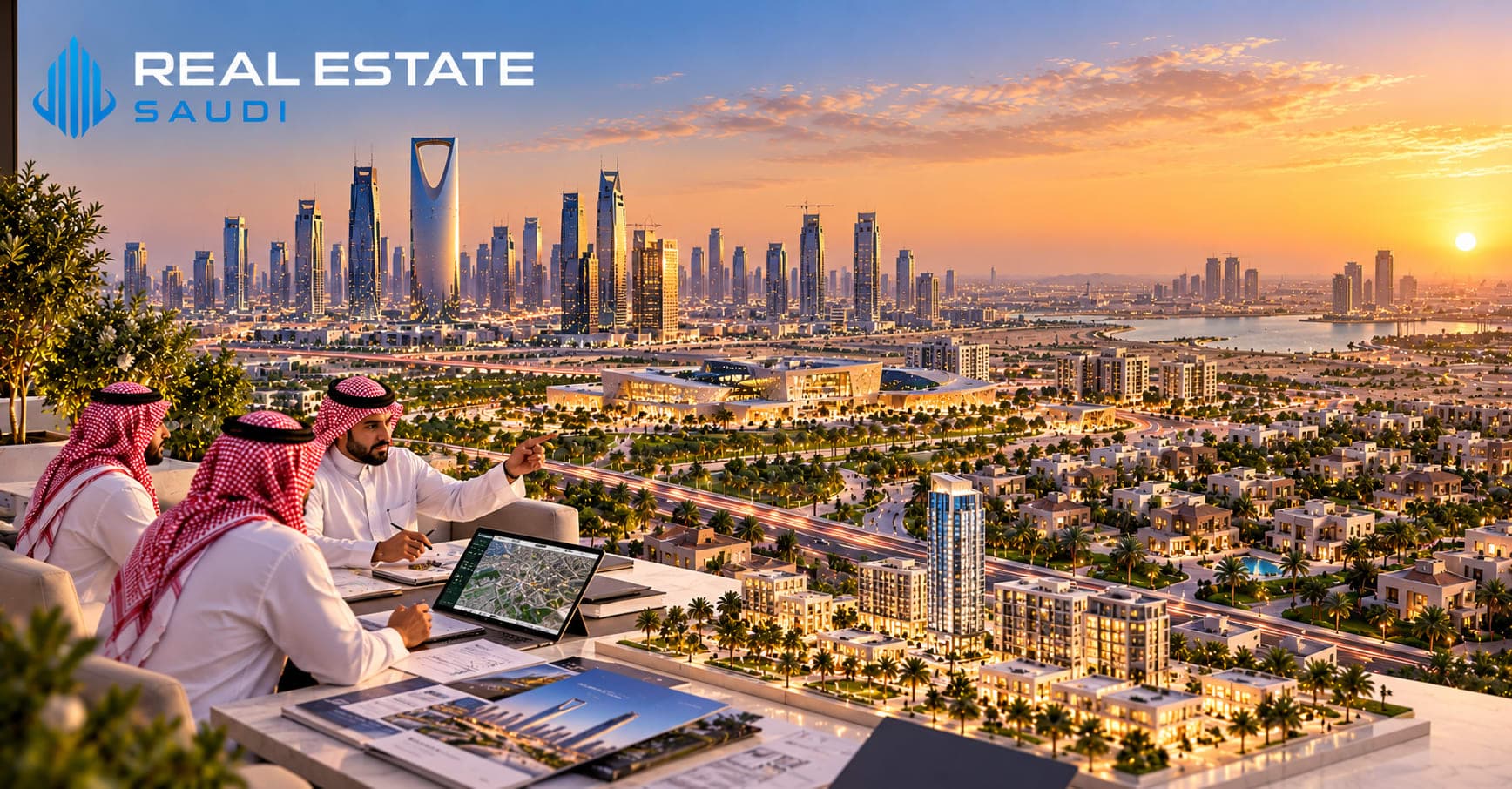
Real Estate Investment Opportunities in Saudi Arabia are attracting local and international investors because the Kingdom is expanding housing, tourism, logistics, business districts and major urban infrastructure at the same time. The opportunity is real, but the market is not uniform: residential land, apartments, villas, offices, hotels and industrial assets can move differently, and returns depend on location, entry price, legal structure and operating demand.
For 2026, the practical approach is to compare sectors and cities rather than assume that “Saudi real estate” behaves as one market. Riyadh offers deep residential and business demand; Jeddah combines housing, commerce and Red Sea tourism; the Eastern Province supports industrial and corporate activity; Makkah and Madinah have pilgrimage-linked demand; and destinations such as the Red Sea and NEOM offer longer-term development exposure. Investors also need to understand the new non-Saudi ownership framework, off-plan licensing, transaction tax and financing rules before committing capital.
Real Estate Investment Opportunities in Saudi Arabia: 2026 Overview
The strongest opportunities sit where real demand, infrastructure and regulated supply overlap. Residential property remains important because Saudi Arabia continues to expand housing supply and homeownership. Commercial assets benefit from business expansion, hospitality from the national tourism strategy, and logistics property from investment in transport, warehousing and distribution networks.
The Vision 2030 Housing Program annual report reported Saudi household homeownership at 65.4% in 2024, against a 70% target for 2030. That does not guarantee property-price growth, but it shows why housing remains strategically important.
Investors should also avoid old national averages. The General Authority for Statistics publishes a Real Estate Price Index that separates different sectors and property types, so movements should not be treated as uniform across the market. Its Q2 2026 publication is more useful than blanket claims that every property segment is rising. Saudi Statistics Authority For a broader framework, the Saudi Arabia real estate investment guide explains how to compare property type, location, holding strategy and exit planning.
Which property type & region do you prefer?
Select property type and preferred city in Saudi Arabia.
Why Saudi Arabia’s Real Estate Market Is Different in 2026
Three changes matter. The new non-Saudi ownership system entered into force on 22 January 2026. Vision 2030-related urban, tourism and logistics investment continues to create new demand centres. At the same time, investors now have clearer channels for checking off-plan projects, ownership, registration and finance providers.
This raises the standard of due diligence. Buying because a project is associated with a famous masterplan is not enough. Investors should identify who will occupy the asset, what comparable properties are achieving, what restrictions apply to the buyer, and whether the opportunity is ready, off-plan, leasehold, freehold or another form of real estate right.
The old idea that every Saudi property sector offers “high ROI” should be replaced by asset-level underwriting. Net income after vacancy, management, service charges, financing and maintenance is more useful than a headline yield.
Best Real Estate Sectors for Investment in Saudi Arabia
Sector | Main demand drivers | Locations to watch | Main investor consideration |
|---|---|---|---|
Residential | Population, employment, homeownership | Riyadh, Jeddah, Dammam, Khobar | Tenant demand, price, service charges |
Commercial offices | Corporate expansion, professional services | Riyadh, Jeddah, Khobar | Occupancy, building grade, lease terms |
Tourism and hospitality | Tourism, pilgrimage, events | Jeddah, Red Sea, AlUla, Makkah, Madinah | Seasonality, operator, room supply |
Industrial and logistics | Warehousing, e-commerce, manufacturing | Riyadh, Jeddah, Eastern Province | Transport access and tenant quality |
Off-plan residential | New supply, master-planned communities | Riyadh, Jeddah, major projects | License, developer and delivery risk |
Residential Property
Residential real estate has the broadest demand base because occupants can include Saudi families, professionals, expatriates and long-term renters. The best investment is not automatically the newest or most luxurious. A well-located apartment near employment, transport and services may have a clearer tenant pool than a high-ticket villa with a narrower audience.
Riyadh is especially important because of its concentration of government, finance, corporate activity and major projects. Investors comparing neighbourhoods should use the real estate investment in Riyadh guide to separate citywide growth narratives from district-level suitability.
Jeddah offers a different mix: local housing demand, port activity, commerce, tourism and Red Sea development. Investors should compare established districts with emerging waterfront and mixed-use areas rather than assume every coastal property commands the same premium. The real estate investment in Jeddah guide provides additional local context.
Commercial Offices and Business Real Estate
Commercial property can benefit from Saudi Arabia’s efforts to attract companies and expand non-oil sectors. Office demand is strongest where occupiers value accessibility, modern specifications, parking, business services and proximity to major commercial nodes.
The opportunity is not simply “buy an office in Riyadh.” Investors should examine building grade, lease length, tenant quality, fit-out responsibility, vacancy and competing supply. Commercial investment can also include retail, clinics, education facilities and serviced business space, so investors should compare each asset type on its own operating fundamentals.
Riyadh’s role as a business centre has also been reinforced by the Regional Headquarters Program, developed by the Ministry of Investment and the Royal Commission for Riyadh City to encourage multinational companies to establish regional headquarters in the Kingdom.
Tourism and Hospitality Real Estate
Tourism is one of the clearest structural themes. Saudi Arabia’s Ministry of Tourism investment platform reports 122.6 million domestic and inbound tourists in 2025 and a national target of 150 million by 2030. That supports potential demand for hotels, serviced apartments, resorts, restaurants and tourism-related retail.
The opportunity varies by location. Jeddah combines business and leisure travel; Makkah and Madinah are linked to religious travel; the Red Sea and AlUla are destination-led markets; and Riyadh is growing as an events and business-travel centre.
Hospitality investors should focus on operator strength, room pipeline, seasonality, access and operating costs. A famous destination does not automatically make every hotel project profitable. The site’s tourism real estate investment guide provides a deeper sector view.
Industrial and Logistics Property
Warehouses, distribution facilities and industrial property deserve more attention. The Ministry of Transport and Logistic Services says the logistics-centres masterplan includes 59 centres with a combined area exceeding 100 million square metres, spread across Riyadh, Makkah, the Eastern Region and other parts of the Kingdom.
That national strategy creates a demand framework, not a guaranteed return. The best logistics assets need road access, suitable loading configuration, adequate power, correct zoning and proximity to customers, ports, airports or industrial clusters. Tenant quality matters because specialized buildings can be expensive to adapt.
Riyadh supports central distribution, Jeddah is important for western-region logistics and port-linked activity, and the Eastern Province benefits from industrial and energy activity. The industrial real estate investment guide covers this sector in more detail.
Off-Plan and Master-Planned Communities
Off-plan property can provide access to new communities and staged payment structures, but it adds construction and delivery risk. In Saudi Arabia, off-plan selling and leasing is regulated by the Real Estate General Authority. The REGA Wafi Off-Plan Sales and Lease platform provides project-licensing and developer-qualification services and allows users to review licensed projects.
Before paying a reservation fee, investors should verify the project and developer, then review the sale contract, payment schedule, completion obligations and applicable escrow arrangements. The benefits and risks of off-plan property investment should be considered together rather than focusing only on launch pricing.
Best Locations for Real Estate Investment in Saudi Arabia
Real Estate Investment Opportunities in Saudi Arabia differ more by city and district than by national headline. A useful location strategy starts with the economic reason people need to live, work, stay or operate a business there.
Riyadh
Riyadh offers the broadest combination of residential, office, retail and mixed-use demand. Government activity, corporate expansion and major infrastructure create a deep occupier base. Investors should compare access to employment nodes, schools, roads, metro connectivity, neighbourhood services and future supply. Strong demand can still produce poor returns if the entry price is too high.
The capital can work for different strategies, from mainstream apartments and family housing to premium offices and mixed-use developments. However, district-level supply is critical: a city can perform well while an individual building or neighbourhood underperforms.
Jeddah
Jeddah combines residential demand with commerce, logistics, tourism and waterfront development. Its Red Sea location and role as a gateway to Makkah provide several demand sources.
Apartments, villas, hospitality, retail and logistics can all be relevant, but the right district depends on whether the strategy is long-term rental, resale, tourism or commercial use. Investors should also distinguish established neighbourhood liquidity from the longer development horizon of some new waterfront destinations.
Dammam and Al Khobar
The Eastern Province is attractive for investors looking beyond Riyadh and Jeddah. Dammam and Al Khobar are connected to energy, industry, corporate employment and regional trade. Residential compounds, apartments, offices and logistics assets may all be relevant where there is a clear employment base.
The Dammam real estate investment guide provides more local context for investors comparing Eastern Province demand with Riyadh or Jeddah.
Makkah and Madinah
The Holy Cities have distinctive demand from religious travel, residents, workers and pilgrimage-related services. Hospitality and commercial property may benefit from visitor flows, but ownership eligibility and location-specific controls need careful review.
Foreign investors should not assume general ownership rules apply identically in Makkah and Madinah. Under the current law, ownership and other real rights in the two cities are subject to special provisions, including restrictions applicable to natural persons.
Red Sea, AlUla and NEOM
Destination-led markets offer longer-term exposure to Saudi Arabia’s tourism and development strategy but require higher tolerance for development and timing risk.
Investors should distinguish between a major national project and property products actually available to individual buyers. Announced infrastructure, hotels or attractions do not automatically mean that every asset within the wider masterplan can be purchased privately.
The NEOM area guide can help provide location context before a specific property or project is assessed.
Foreign Ownership Rules Investors Need to Know in 2026
The current non-Saudi ownership system entered into force on 22 January 2026. Under the Law of Real Estate Ownership and Investment by Non-Saudis, non-Saudis may own real estate or acquire other real rights within geographical areas and subject to conditions set under the regulatory framework. A legally resident non-Saudi natural person may also, subject to the regulations, own one property outside the designated areas for personal residence, except in Makkah and Madinah.
Residents, non-residents, companies and investment entities can follow different procedures. REGA states that applications are handled through the official Saudi Properties platform; for non-residents, the process includes obtaining an approved digital identity before completing the application. Property ownership itself does not provide additional rights or privileges beyond those established by law.
This is a major change for Real Estate Investment Opportunities in Saudi Arabia in 2026, but eligibility remains asset- and location-specific. International buyers should verify the permitted geographical zone, type of real estate right and registration requirements. The foreign investment in Saudi property guide provides further practical background.
Taxes, Transaction Costs and Financing
Saudi Arabia’s Real Estate Transaction Tax law generally imposes RETT at 5% on taxable real estate transactions, subject to statutory exclusions and exemptions. The current law came into force on 10 April 2025.
Investors should model tax alongside brokerage, legal review, financing, service charges, maintenance, furnishing and management expenses. A gross rental yield can look attractive before these costs and much weaker after them.
The guide to real estate taxes in Saudi Arabia is a useful starting point, but the exact treatment of a transaction should be checked against current ZATCA guidance or with a qualified adviser.
Financing also varies by borrower and property. SAMA’s instructions for real estate finance products require banks and real estate finance companies to assess an individual applicant’s financial circumstances and ability to meet the obligations before making an offer. Investors should not assume that every property or non-resident buyer automatically qualifies for finance.
What is your approximate budget?
Narrow down property options based on your target budget.
How to Compare an Investment Opportunity
Evaluate a Saudi property in five layers: legal eligibility, demand, asset quality, cash flow and exit liquidity. Legal eligibility comes first. Demand should be supported by employment, residents, tourism, logistics activity or another identifiable use. Asset quality covers construction, layout, parking, amenities and future maintenance.
Cash flow should include vacancy, service charges, repairs and management rather than advertised gross rent alone. Exit liquidity depends on the future buyer pool and competing supply.
Investors should also verify ownership records where applicable. REGA defines real estate registration as the system used to register ownership, rights, restrictions and subsequent dispositions and issue a title registration deed for properties within announced registration areas. Rega Off-plan buyers should separately confirm the project through Wafi.
Risks to Consider Before Investing
The first risk is paying too much because of a strong national narrative. A good city can still contain an overpriced project.
The second is supply. New residential, office, hotel and retail projects can improve a city while simultaneously increasing competition for tenants and buyers. Investors should compare future supply with realistic absorption rather than assume that demand will immediately match every new launch.
The third is concentration in one employer, tourism season or development phase. An asset dependent on a single demand source may experience more volatility than a property in a diversified location.
Regulatory misunderstanding is another risk. Foreign ownership, Holy City restrictions, off-plan licensing and tax treatment should be checked with the relevant authority. Specialized or high-ticket assets can also take longer to resell.
The old version of this article included precise price-per-square-metre ranges, rental yields and three-year growth forecasts for several cities. Those figures should not be treated as confirmed 2026 market data without a transparent methodology and verifiable transaction source. Official indices and current local comparables are safer.
Practical 2026 Investment Strategy
Start with the demand engine rather than the project name. In Riyadh, that may be employment and corporate expansion; in Jeddah, residential demand, tourism and trade; in the Eastern Province, industry and logistics; and in Makkah and Madinah, pilgrimage and hospitality.
Then define the objective: income, capital preservation, appreciation, business use or development exposure. A rental investor may prefer a liquid apartment in an established district, while an operator may prefer hospitality or logistics property with specialist risks.
Finally, compare several alternatives using the same assumptions. Do not compare a gross-yield apartment with a net-yield warehouse or an off-plan payment plan with a completed property without adjusting for vacancy, timing, transaction costs and operating expenses.
Investors should also separate marketing projections from evidence. Ask for actual comparable transactions, current competing rental listings, service-charge schedules, project licensing and contract documentation rather than relying on one projected ROI number.
How would you like to be contacted?
Choose your preferred channel for a private consultation.
Future Outlook for Saudi Real Estate Investment
Housing supply, corporate expansion, tourism, logistics and large-scale urban development will remain central themes. Saudi Vision 2030 continues to provide the broader policy framework for economic diversification, investment and urban development.
Tourism’s 150 million visitor target for 2030 supports the longer-term hospitality and destination-development story, while the national transport and logistics strategy is designed to strengthen Saudi Arabia’s role as a logistics hub. Ministry of Tourism Saudi Arabia Housing policy continues to support residential development, yet property performance will still vary significantly by city, district and property type.
For that reason, Real Estate Investment Opportunities in Saudi Arabia should be treated as a portfolio of distinct markets rather than one national trade. Investors who combine official data, local comparables and legal verification are better positioned than those who buy solely on project marketing.
Conclusion
Real Estate Investment Opportunities in Saudi Arabia in 2026 span residential housing, commercial offices, tourism, logistics, off-plan developments and mixed-use communities. Riyadh offers the deepest urban opportunity set; Jeddah combines housing, commerce and tourism; the Eastern Province provides industrial exposure; and the Holy Cities and major destination projects have specialized demand.
There is no universal “best” sector or guaranteed return. Verify ownership eligibility, project licensing, taxes, financing, local demand and exit options before committing capital. Current REGA, ZATCA, GASTAT, SAMA and Vision 2030 guidance should take priority over old price tables or promotional forecasts.
Disclaimer: This article provides general real estate and investment information only. It is not legal, tax, financial or investment advice. Regulations, project availability and transaction terms may change, so investors should verify the latest requirements and obtain appropriate professional advice for their specific transaction.
Talk to Our Real Estate Experts
Get real-time insights on investment options, commercial properties, and market guidelines.
Frequently Asked Questions
The strongest opportunities are generally residential property, commercial offices, hospitality, logistics and selected off-plan developments where demand is identifiable. Riyadh has the broadest urban market, while Jeddah, the Eastern Province, the Holy Cities and tourism destinations offer different drivers. The best choice depends on objective, budget, legal eligibility, property type and holding period.
Riyadh is the most diversified choice because it combines government, corporate, residential and infrastructure demand. Jeddah is attractive for residential, tourism and commercial strategies, while Dammam and Al Khobar have industrial and corporate demand. Makkah and Madinah are specialized pilgrimage markets. Investors should compare districts rather than select a city only by reputation.
Yes, non-Saudis can acquire real estate rights under the ownership system effective from 22 January 2026, but rights depend on buyer category, geographical area and regulatory conditions. Residents, non-residents and companies can follow different processes. Makkah and Madinah have additional restrictions, so eligibility should be verified through REGA before payment.
Residential property can be attractive where household and employment demand is strong, but results vary by district and property type. Investors should assess tenant depth, service charges, future supply, building quality and resale liquidity. National housing policy supports development, but it does not guarantee that every apartment or villa will appreciate.
Riyadh’s business expansion can support demand for high-quality offices, retail and mixed-use property. Investors still need to assess building grade, parking, access, tenant profile, lease length and competing new supply. A prime address alone does not ensure occupancy, so realistic rent, vacancy and fit-out assumptions are essential.
Saudi Arabia recorded 122.6 million domestic and inbound tourists in 2025, and the national tourism strategy targets 150 million by 2030. That creates a strong demand framework for hotels and serviced accommodation. Returns still depend on destination maturity, room supply, operator quality, seasonality, occupancy and operating costs.
The Real Estate Transaction Tax is generally 5% on taxable real estate transactions, subject to exclusions and exemptions in the law. Buyers should also consider brokerage, legal, finance, service-charge and operating costs. Exact treatment depends on the transaction, so current ZATCA guidance or professional tax advice should be checked before completion.
Off-plan property operates within a regulated framework, but construction, timing and developer risks remain. Investors should confirm that the project and developer are properly licensed through REGA’s Wafi platform, review the contract and payment schedule, and understand delivery obligations and applicable escrow arrangements before transferring money.
They can be attractive where assets serve established industrial clusters, ports, airports, major roads or distribution networks. The national logistics plan supports the long-term theme, but tenant quality and building suitability remain critical. Investors should verify zoning, access, power, loading capacity, lease terms and adaptation costs.
Confirm legal ownership eligibility, title or project licensing, the seller or developer, transaction tax, financing terms, service charges, comparable rents and sales, future supply and exit liquidity. Foreign buyers should verify geographical ownership rules, and off-plan buyers should check the project through REGA. Avoid relying solely on advertised yields or projected appreciation.
