
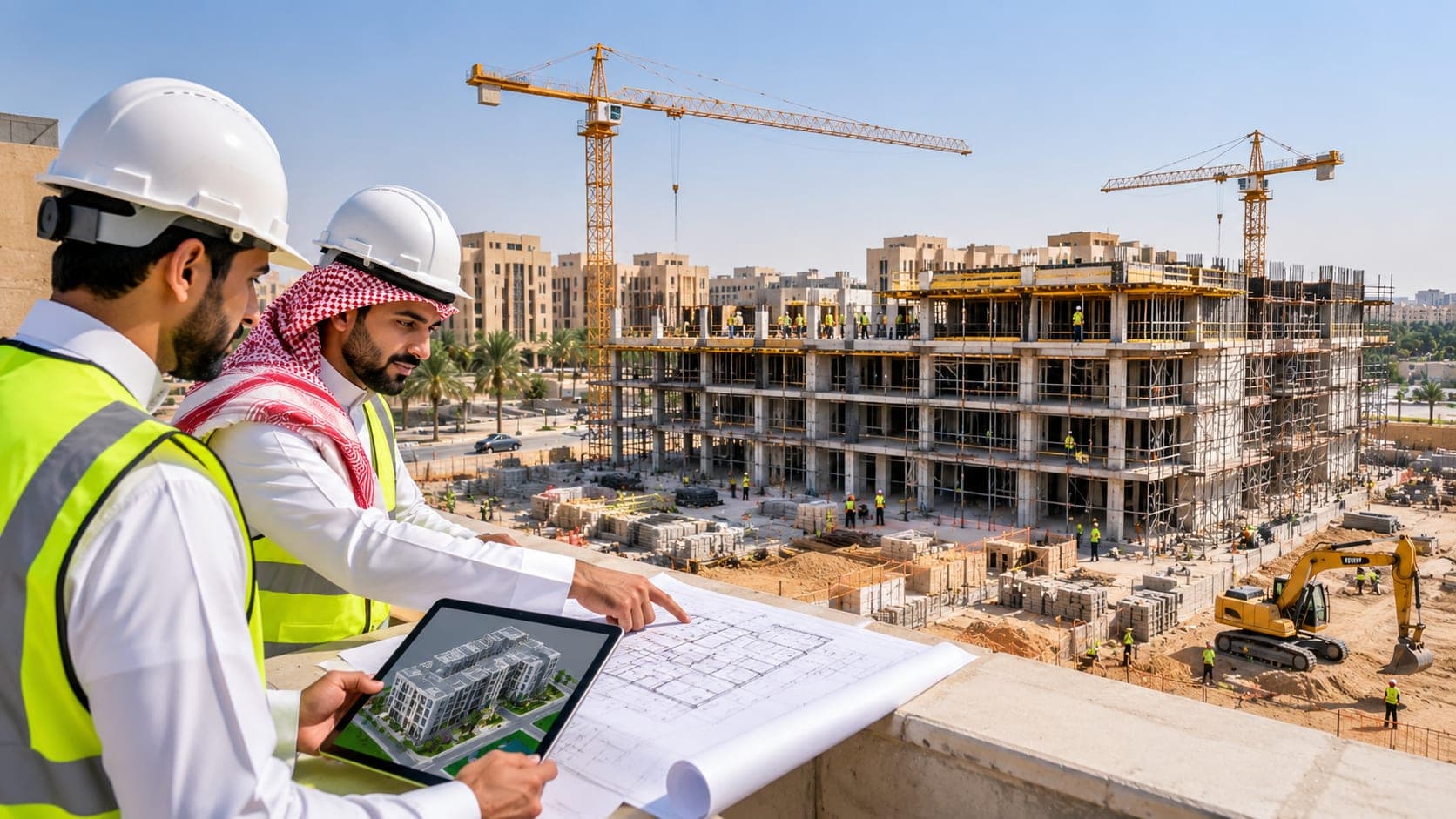
Saudi Arabia's Ministry of Municipalities and Housing announced on 16 November 2026 that municipalities issued 80,775 construction licences between January and September 2026 across different regions of the Kingdom. The Saudi construction licences 2026 figures provide a nationwide measure of municipal approval activity, while highlighting the increasing role of digital services in processing building-permit applications.
According to the Ministry's official announcement, continued improvements to the Balady platform have helped simplify licensing procedures, accelerate application processing and improve access to municipal services. However, the total represents licences issued, not completed buildings, construction starts or newly delivered housing units.
Quick Facts
Indicator | Official Information |
|---|---|
Announcement date | 16 November 2026 |
Reporting authority | Ministry of Municipalities and Housing |
Reporting period | January–September 2026 |
Construction licences issued | 80,775 |
Geographical coverage | Various Saudi regions |
Digital licensing platform | Balady |
Municipal responsibilities | Application review and compliance verification |
Residential versus commercial split | Not disclosed in this announcement |
Regional licence breakdown | Not disclosed |
Project investment values | Not disclosed |
Construction starts or completions | Not disclosed |
Year-on-year growth | Not provided |
Project completion timelines | Not disclosed |
ما نوع العقار والمنطقة المناسبة؟
اختر نوع العقار والمدينة المستهدفة لاستعراض أنسب الخيارات.
What the Ministry Officially Announced
The Ministry confirmed that 80,775 construction licences were issued during the first nine months of 2026 as part of its efforts to regulate building activity, improve municipal procedures and respond to urban development across Saudi cities and governorates.
The announcement places particular emphasis on administrative efficiency. Municipal authorities are responsible for reviewing applications, verifying required conditions and coordinating with relevant parties involved in construction and urban development.
The figures provide an indication of the scale of licensing activity, but not the volume of physical construction subsequently undertaken. Real Estate Saudi's guide to building permits and regulations in Saudi Arabia provides further background on the regulatory considerations facing property owners and developers.
What Saudi construction licences 2026 figures actually measure
A construction licence is an administrative authorisation issued through the applicable municipal process. It is an important regulatory step, but it should not be confused with the physical commencement or completion of building works.
A developer may receive a licence before construction begins, while the timing of subsequent work depends on project readiness, financing, contractors and other requirements.
The Ministry's figure does not establish that 80,775 individual buildings entered construction during the period. It also does not identify how many licences relate to separate developments or different types of authorised work.
This distinction matters when comparing licensing figures with Saudi construction contract awards, which measure different commercial activities and cannot be treated as equivalent indicators.
How Balady Is Improving Building-Permit Procedures
The Ministry highlighted the expansion of digital services through Balady as an important part of its licensing improvements. The platform supports electronic applications, communication with relevant parties and the processing of municipal requirements.
Digitalisation can make procedures more accessible by reducing reliance on manual submissions and improving the visibility of application stages. Nevertheless, the November announcement does not provide a numerical comparison of processing times before and after these improvements.
The Ministry's official building-permit service explains the application process and the role of relevant engineering and municipal checks.
For the Saudi construction licences 2026 report, the importance of Balady lies in its role within the approval system. The published total should not be interpreted as proof that every application was approved immediately or without additional review.
Municipal Verification and Construction Compliance
Municipalities remain responsible for examining licence applications and ensuring that the relevant construction conditions are satisfied. Digital submission does not remove the need for technical or regulatory verification.
Building proposals may require review of architectural and engineering documentation, land-use conditions and relevant safety requirements, depending on the project.
The Saudi Building Code provides the broader technical framework governing building safety and construction requirements within the Kingdom.
Compliance continues to matter after licensing, because an issued permit does not establish that subsequent works satisfy every applicable construction requirement. Related responsibilities are discussed in Real Estate Saudi's coverage of Saudi construction waste management rules, which concerns a separate aspect of construction regulation.
Why the Licence Total Matters for Developers
For developers, municipal licensing represents an important stage between project planning and physical delivery. Greater digital accessibility and clearer application procedures may help businesses coordinate development schedules and regulatory submissions.
However, the commercial significance of a licence depends on the nature of the proposed development. A small building alteration and a major property development may involve very different levels of expenditure and construction activity.
The Ministry did not disclose the total investment value associated with the licences issued during the reporting period.
Property developers should therefore view the figure as evidence of administrative throughput rather than confirmed construction expenditure. Real Estate Saudi's overview of real estate development in Riyadh provides broader context on how approvals fit into the development lifecycle of a major Saudi property market.
Implications for Urban Planning and City Development
Construction licensing plays a role in managing the built environment. Municipal review helps connect proposed building activity with approved land uses, relevant technical standards and local development requirements.
The Ministry described improvements to municipal licensing as part of wider efforts to strengthen city efficiency, enhance the urban environment and improve the experience of individuals and investors.
These are stated policy objectives rather than measured outcomes from the 80,775 licences.
The relationship between development approvals and wider planning priorities is also relevant to Saudi Urban October 2026 and the proposed Urban Lab, which provides separate context on urban planning and the quality of Saudi cities.
حدد ميزانيتك الاستثمارية
حدد ميزانيتك التقديرية لنقوم بتضييق خيارات العروض.
What the Figures Mean for Residential Construction
The reported total covers construction licensing across the Kingdom, but the November announcement does not provide a residential-versus-commercial breakdown.
Consequently, it is not possible to determine how many of the 80,775 licences relate specifically to villas, apartments, commercial buildings or other property categories.
Nor does the figure establish how many housing units will eventually become available to purchasers or occupants.
Residential supply depends on additional stages, including construction, inspections and completion. Real Estate Saudi's guide to government housing projects in Saudi Arabia explores other housing-delivery mechanisms that should be distinguished from general municipal permitting.
Similarly, announced housing land development proposals concern a separate regulatory subject and should not be counted as completed construction activity.
Can Construction Licences Indicate Market Growth?
Licensing activity can provide information about the administrative pipeline for construction, but interpreting market growth requires comparable data from multiple reporting periods.
The Ministry's November statement does not provide a year-on-year comparison for January–September 2026 or a comparable nine-month total for 2025.
An earlier Ministry report on first-half building permits provides separate historical reporting context. However, comparing figures responsibly requires consistent reporting definitions, periods and categories.
The latest announcement alone cannot establish a percentage increase in construction activity, building investment or completed property supply.
What Property Investors Should Understand
For real estate investors, the significance of Saudi construction licences 2026 lies in the scale of regulatory approvals rather than evidence of guaranteed investment opportunities.
The total may be useful alongside other indicators, such as construction starts, contract awards, completed buildings, property transactions and official market statistics.
It cannot independently establish that residential demand has strengthened, development costs have fallen or property prices will increase.
Investors assessing individual developments should verify project-specific licences, land rights, financing arrangements and construction progress. Balady also provides an official building-permit enquiry service for checking relevant permit information.
Confirmed Facts Versus Real Estate Saudi Analysis
The confirmed facts are the issuance of 80,775 construction licences between January and September 2026, their nationwide geographical coverage and the Ministry's emphasis on digital licensing and municipal verification.
Real Estate Saudi's analysis is that efficient licensing procedures can support development planning and regulatory coordination. However, the economic effect of these improvements cannot be quantified from the announcement alone.
The number of licences issued is not a direct measure of construction expenditure, market growth or completed real estate assets.
كيف تفضل التواصل معك؟
اختر وسيلة التواصل الأكثر ملاءمة لك لمناقشة فرصك الاستثمارية.
Missing Information and Future Reporting
The Ministry did not disclose regional licence totals, a residential-commercial breakdown, project values or completion schedules in its November announcement. It also did not publish a year-on-year comparison or state how many licensed developments had commenced construction.
Future reporting that combines approvals with consistent construction and completion indicators would provide a more complete assessment of activity across Saudi Arabia's property sector.
The Ministry's emphasis on digital government services is consistent with the broader efficiency and urban-development objectives outlined in Saudi Vision 2030. However, alignment with these objectives should not be interpreted as proof of a particular market outcome.
Conclusion
The Saudi construction licences 2026 announcement confirms that municipalities issued 80,775 licences during the first nine months of the year, reflecting substantial municipal approval activity across the Kingdom.
The Ministry highlighted Balady's digital services, streamlined procedures and continuing municipal compliance checks as important elements of its licensing framework.
For developers and investors, the figure provides a useful administrative indicator. Its wider market significance will depend on additional evidence concerning actual construction starts, project delivery and completed property supply.
تحدث معنا عبر قناتك المفضلة
استشارات عقارية مباشرة حول الاستثمار والسوق العقاري في المملكة العربية السعودية.
الأسئلة الشائعة
Saudi municipalities issued 80,775 construction licences between January and September 2026, according to the Ministry of Municipalities and Housing. The figure covers the first nine months, not the entire calendar year.
The Ministry published its official announcement on 16 November 2026. The reporting period itself ended on 30 September 2026.
The November announcement does not provide a regional breakdown or identify the region with the highest number of licences. A reliable ranking would require additional official statistics.
No. Licence issuance is a regulatory step and does not confirm that physical construction has commenced. Construction activity must be established through separate project information.
The announcement does not provide a breakdown by property use. It therefore cannot establish how many licences related to residential, commercial or other buildings.
Balady supports digital municipal services, including building-permit applications and related administrative procedures. Municipalities remain responsible for reviewing applications and verifying applicable requirements.
No. Construction licences and completed housing units are different measures. One licence cannot automatically be equated with one newly delivered home.
No. The Ministry did not provide a comparable nine-month figure for 2025 or a year-on-year growth rate in this announcement.
Developers can review the official Balady and Ministry building-permit services for current procedures, technical documentation and applicable municipal requirements.
It indicates the scale of construction-related municipal licensing activity. However, further data on project values, construction starts and building completions is needed to evaluate its wider impact on the property market.
