
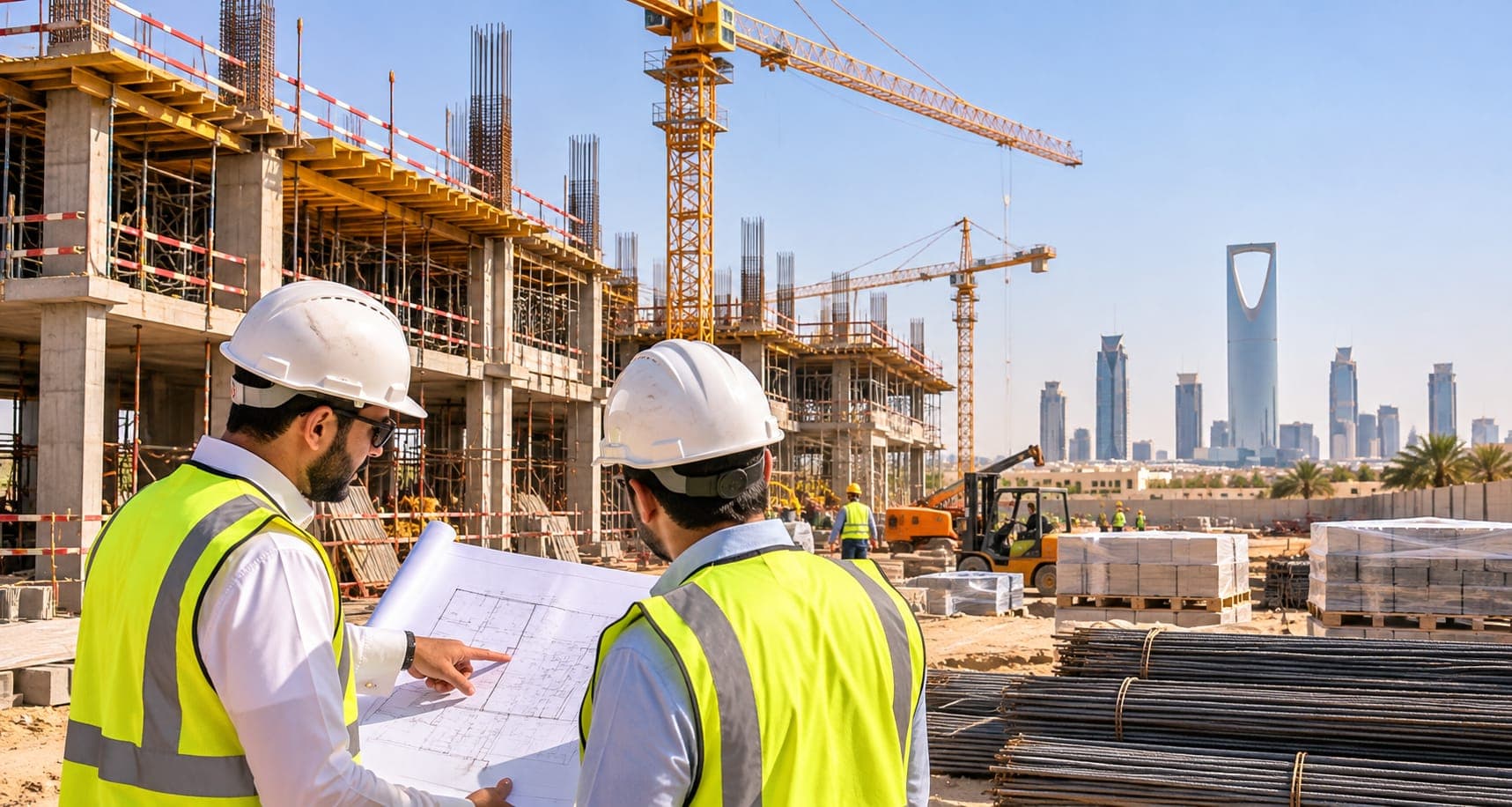
Saudi construction costs October 2026 rose 2.3% year on year, with the Kingdom's Construction Cost Index (CCI) reaching 104.1 points, according to the General Authority for Statistics (GASTAT). The index was 101.7 in October 2025 and 104.0 in September 2026. Non-residential construction recorded a 2.7% annual increase, exceeding the 2.2% rise for residential building activity. On a monthly basis, the overall index edged up 0.1%, rather than recording a sudden 2.3% jump from September. The release measures changes in a defined basket of construction inputs, not the cost of every individual project or the prices paid for completed properties.
Quick Facts
Indicator | October 2026 figure |
|---|---|
Publishing authority | General Authority for Statistics (GASTAT) |
Overall Construction Cost Index | 104.1 points |
Annual change | +2.3%, October 2026 versus October 2025 |
Monthly change | +0.1%, October versus September 2026 |
October 2025 index | 101.7 points |
September 2026 index | 104.0 points |
Residential construction, annual | +2.2% |
Residential construction, monthly | Unchanged at published precision |
Non-residential construction, annual | +2.7% |
Non-residential construction, monthly | +0.1% |
Base year | 2023 = 100 |
Construction inputs tracked | 51 |
Geographical coverage | Saudi Arabia's 13 administrative regions |
What GASTAT Reported for October 2026
GASTAT's official October 2026 Construction Cost Index release places the overall indicator at 104.1 points, compared with 101.7 a year earlier. The published annual movement of 2.3% is a comparison of construction input-cost levels between October 2025 and October 2026. The monthly change, measured against September, was considerably smaller at 0.1%. The index uses 2023 as its reference year.
ما نوع العقار والمنطقة المناسبة؟
اختر نوع العقار والمدينة المستهدفة لاستعراض أنسب الخيارات.
Saudi construction costs October 2026 reach 104.1 index points
The difference between an index level and a percentage change is central to interpreting the headline. An index value of 104.1 means that the measured basket stands above its 2023 reference level under GASTAT's methodology; it does not mean constructing a property costs SAR 104.1 or that every construction input changed by the same amount. The 2.3% annual rise compares two index observations separated by twelve months.
October's 104.1 reading also compares with September's 104.0, consistent with the reported 0.1% monthly increase after rounding. These observations describe gradual movement in the measured series, not a verified acceleration in the number of buildings started or construction contracts awarded. Real Estate Saudi's report on construction contract awards in Saudi Arabia covers a separate measure: the value of contracts awarded, rather than changes in the prices of construction inputs.
Residential Building Input Costs Rise 2.2% Annually
The residential construction component increased 2.2% from October 2025. That finding relates to the input-cost basket for residential building activities and should not be translated into an identical increase in the budget for every apartment project or private villa. Site conditions, specifications, procurement contracts and the composition of construction work differ across developments. GASTAT's index provides a statistical benchmark, not an individual contractor's bill of quantities.
Equipment and Machinery Rental in Residential Construction
Among the reported residential cost components, equipment and machinery rental increased by 4.0% year on year. Within that category, rental of machinery and equipment supplied with an operator increased by 5.4%. These changes were larger than the overall residential increase, making machinery hire a particularly noticeable feature of the release. The figures nevertheless represent category price movements, not measured increases in the amount of machinery used.
Residential Materials, Labour and Energy Costs
Residential basic-material costs increased 1.8% annually. Within the published detail, timber and joinery prices rose 3.4%, a movement above the broader basic-material increase. Labour costs rose 1.6%, while the energy category was 3.0% higher than in October 2025. These are distinct component readings and cannot be added together to obtain a total residential construction-cost increase.
The composition of building inputs matters. A development using different quantities of joinery, concrete, energy or specialist services may experience a purchasing pattern that is not the same as the national reference basket. Real Estate Saudi's guide to building permits and construction regulations in Saudi Arabia covers separate legal and approval obligations; compliance costs and permit milestones cannot be inferred from these input-price movements.
Non-Residential Construction Costs Climb 2.7%
Non-residential building inputs increased by 2.7% year on year, exceeding the residential component's 2.2% rise. This is a comparison between two statistical categories, not a claim that every office, warehouse, hotel or other non-residential project experienced the same cost change. Each project's engineering requirements and procurement arrangements will affect its actual expenditures, and the index does not publish a project-by-project breakdown.
Machinery Rental Shows the Largest Reported Annual Change
Within non-residential construction, equipment and machinery rental costs were 5.8% higher than a year earlier. The subcategory covering equipment and machinery hired with an operator increased by 7.2%. This was the largest percentage movement among the individual figures highlighted in the published breakdown, but it is not automatically the largest contribution to the overall index: contributions depend on the weights assigned to categories and their relative importance in the measured basket.
Non-Residential Materials, Labour and Energy
Non-residential labour costs increased by 2.1% year on year, while energy costs rose 3.0%. Basic-material costs were 2.0% higher. Within the material group, the published changes included a 4.4% rise in other building materials and a 2.1% increase for timber and joinery. The category figures refer to different groups or subgroups and should not be interpreted as cumulative charges on a building contract.
October Versus September: Why the Monthly Change Was Small
GASTAT reported a 0.1% rise in the overall index from September 2026, when it stood at 104.0 points. The non-residential component also increased 0.1% on the month, while the residential component was unchanged at the reported precision. Those findings do not erase the positive annual movements: they describe a different comparison window. Annual and monthly measures should always be labelled with their reference periods.
How October Relates to Earlier Construction-Cost Releases
The September 2026 construction-cost release reported annual growth of 2.2%, whereas the October release reports 2.3%. Those are two separate year-on-year observations and should not be described as a 0.1-percentage-point monthly rise in the level of the index. October's actual month-on-month change was 0.1% in the overall index, as independently reported by GASTAT.
حدد ميزانيتك الاستثمارية
حدد ميزانيتك التقديرية لنقوم بتضييق خيارات العروض.
How GASTAT Calculates the Construction Cost Index
The GASTAT methodology and quality report describes an input-price measure using 2023 as its base year. Available official reporting identifies 51 construction inputs collected monthly across Saudi Arabia's 13 administrative regions. Sources include contracting establishments, engineering offices and suppliers of construction materials. The index aggregates observations through its statistical procedures rather than presenting the actual invoiced cost of every project.
The basket covers basic materials, labour, rental of equipment and machinery, and energy, with separate residential and non-residential construction series. GASTAT's construction-cost information and FAQ page explains the measure's practical uses and its distinction from other economic statistics. Neither the input count nor the national regional coverage means that a published headline can be treated as a quotation for any individual address or building design.
Why Separate Cost Components Cannot Be Added
It would be wrong to add the annual increases in residential machinery rental, energy, materials and labour and describe the result as overall residential inflation. Each component is measured separately and contributes to the broader index according to its statistical weighting. A subcategory such as machinery rented with an operator is also nested within a wider category; adding both would double-count related information.
What Developers Can Learn From the Index
For developers, October's data offer an official benchmark for reviewing tender assumptions and the wider direction of measured input costs. A project still in design or procurement may require updated quotations, while an existing project can be affected differently depending on contract arrangements. These are considerations for project management rather than outcomes established by GASTAT's statistical release.
Real Estate Saudi's Riyadh property-development guide describes the broader planning and financing decisions involved in development. The national index cannot substitute for a project's quantities, specification, site conditions, contractor offers, contingencies or agreed allocation of cost risk. Nothing in the October figures demonstrates that a named developer has delayed, cancelled or repriced a scheme.
What Contractors Should Consider in Tender Pricing
Contractors can use index movements as background context when evaluating their own supplier quotations, machinery-hire arrangements and workforce budgets. The Saudi Contractors Authority provides sector information and contractor services, but the October CCI does not establish a standard increase that contractors may automatically apply to all tender prices or existing agreements. Whether a change can be reflected in a particular contract is a question of that contract's terms.
Construction Budgets, Permits and Project Delivery
A construction budget generally contains elements that a construction input-price index does not measure as a single finished-project total. Land acquisition, design fees, infrastructure, finance, approvals, contingencies and management arrangements can all affect overall development expenditure. Separate Saudi construction-waste compliance rules concern regulatory obligations rather than measured input prices. The statistical cost basket cannot determine how much a proposed villa or commercial project will cost to deliver, and it does not disclose total national construction expenditure.
The Ministry of Municipalities and Housing's construction-service information describes regulatory and municipal services separately from prices for building inputs. Neither a higher index reading nor a new municipal service proves a construction start, building completion or project delay. Accordingly, the October figures should not be used to claim that development activity increased merely because costs rose.
Why Construction Costs Are Not Property Selling Prices
The CCI is not a real estate selling-price index. Property prices can depend on land location, completed building quality, buyer demand, financing arrangements and the mix of recorded transactions. A 2.3% annual rise in construction inputs does not establish a 2.3% increase in apartment prices, villa prices or rent. It is also not a measure of mortgage lending or the value of property transactions.
Real Estate Saudi's analysis of inflation and property prices in Saudi Arabia addresses how different economic indicators should be distinguished. Its report on residential mortgage lending concerns bank financing, a different dataset. Comparing the series can provide context, but they cannot be combined as though they described the same underlying activity.
Off-Plan Housing and the Limits of the Data
A buyer considering a planned development may want to understand whether a developer's quoted price or payment schedule is fixed and which obligations apply to delivery. The index cannot answer those contract-specific questions. Changes in supplier prices also do not, by themselves, establish that an authorised off-plan sale has begun or that delivery dates have changed.
The Real Estate General Authority's official off-plan sales framework deals with licensing and regulation, while Real Estate Saudi's guide to off-plan property investment explains buyer considerations. These sources address matters different from GASTAT's input-price measurements. The October bulletin does not disclose any project's payment terms, financing structure or purchaser eligibility.
Confirmed Findings Versus Editorial Analysis
GASTAT confirms the overall index level, the annual and monthly comparisons and the specified movements in residential and non-residential input categories. It also publishes the methodological framework for collecting and compiling input-price observations. Those are reported statistical facts. They do not, without further evidence, establish why each supplier changed a price or how a particular contractor passed costs to a developer.
Information Not Supplied by the October Report
The release does not disclose total construction spending, the value of new awards, the number of active projects or cost estimates for individual buildings. It does not provide a universal construction rate per square metre, a developer profit-margin measure or data on the prices paid for land, completed homes and rental agreements. Those indicators require separate sources and methodologies.
كيف تفضل التواصل معك؟
اختر وسيلة التواصل الأكثر ملاءمة لك لمناقشة فرصك الاستثمارية.
Indicators to Follow in Future GASTAT Releases
The next CCI editions can show whether the overall, residential and non-residential series continue to move differently. Particularly useful comparisons will involve annual and monthly changes in equipment rental, materials, labour and energy using the same methodological definitions. Where official data allow, analysts can compare several releases without treating one unusual category as a complete explanation of the index.
Other datasets may help answer different questions about building activity, financing and property prices, but their definitions must remain separate. Real Estate Saudi's Riyadh market overview provides a location-focused perspective; it cannot establish a Riyadh-only CCI from the national October result. The most defensible next step is to monitor GASTAT's published observations rather than predict an unreported change.
Conclusion
Saudi Arabia's Construction Cost Index reached 104.1 in October 2026, up 2.3% annually and 0.1% from September. Non-residential construction inputs increased 2.7% year on year, compared with 2.2% for residential buildings. Equipment and machinery hire recorded some of the most pronounced individual category movements, while materials, labour and energy also rose annually.
These findings are evidence about measured construction input prices, not proof of higher property-sale prices or identical cost increases for every project. Their practical value lies in providing a consistent official statistical reference against which project-specific quotations and future releases can be assessed.
تحدث معنا عبر قناتك المفضلة
استشارات عقارية مباشرة حول الاستثمار والسوق العقاري في المملكة العربية السعودية.
الأسئلة الشائعة
The overall Construction Cost Index rose 2.3% compared with October 2025, according to GASTAT. The separate monthly increase, measured against September 2026, was 0.1%. These figures apply to a statistical basket of construction inputs and do not mean that every Saudi building project experienced the same cost change. Project-level costs require specific quotations and information about the work involved.
The overall index stood at 104.1 points, compared with 104.0 points in September 2026 and 101.7 points in October 2025. GASTAT uses 2023 as its base year. The index level is not a monetary construction price, a rate per square metre or a measure of the total value of buildings completed during October.
The residential component increased 2.2% year on year and was unchanged from September at the published one-decimal precision. Machinery rental increased 4.0% annually, basic materials 1.8%, labour 1.6% and energy 3.0%. These component percentages are separate statistical observations and must not be added to produce an alternative overall change for residential construction.
The non-residential component rose 2.7% compared with October 2025 and 0.1% compared with September 2026. Equipment and machinery rental increased 5.8% annually, with the operator-included subcategory up 7.2%. The broader measure does not establish the exact cost increase for a particular office, hotel, industrial building or other individual development.
Among the detailed figures highlighted, the cost of non-residential equipment and machinery hired with an operator increased 7.2% year on year. The wider non-residential machinery-rental category increased 5.8%, while the residential operator-included measure rose 5.4%. A larger percentage change does not necessarily represent the largest contribution to the overall index, which depends on statistical weights.
Yes. The overall measure increased by 0.1% month on month to 104.1 points from 104.0. Non-residential costs rose 0.1%, while residential costs were unchanged at the precision reported by GASTAT. The monthly comparison should not be confused with the 2.3% change measured against October 2025.
GASTAT tracks price changes across a defined group of construction inputs, including basic materials, labour, machinery and equipment rental, and energy. The published methodology uses 2023 as its base and covers monthly observations across the Kingdom's 13 administrative regions. The index reports input-price movements, not completed-project budgets or national construction expenditure.
No. The 2.3% annual increase refers to construction input costs. Prices for existing or newly sold properties depend on additional factors, including location, individual property characteristics, transaction composition and buyer conditions. A real estate price index or appropriately comparable transaction evidence is required to assess actual changes in selling prices. The CCI is not a rental-price index either.
No. A villa budget depends on its design, gross floor area, specifications, location, site conditions, quantities, contractor quotations and other project expenses. The CCI provides a national statistical indicator, not a bill of quantities or a fixed SAR-per-square-metre rate. Owners should obtain current project-specific professional estimates rather than multiply the headline index change into an assumed construction price.
Developers can monitor the overall CCI and the residential and non-residential breakdowns, particularly changes in materials, labour, machinery rental and energy. Comparisons should use clearly labelled monthly or annual periods and consistent definitions. They should then be weighed against real supplier offers, contractual terms and project-specific circumstances; the index does not forecast future prices or guarantee changes in developer margins.
