
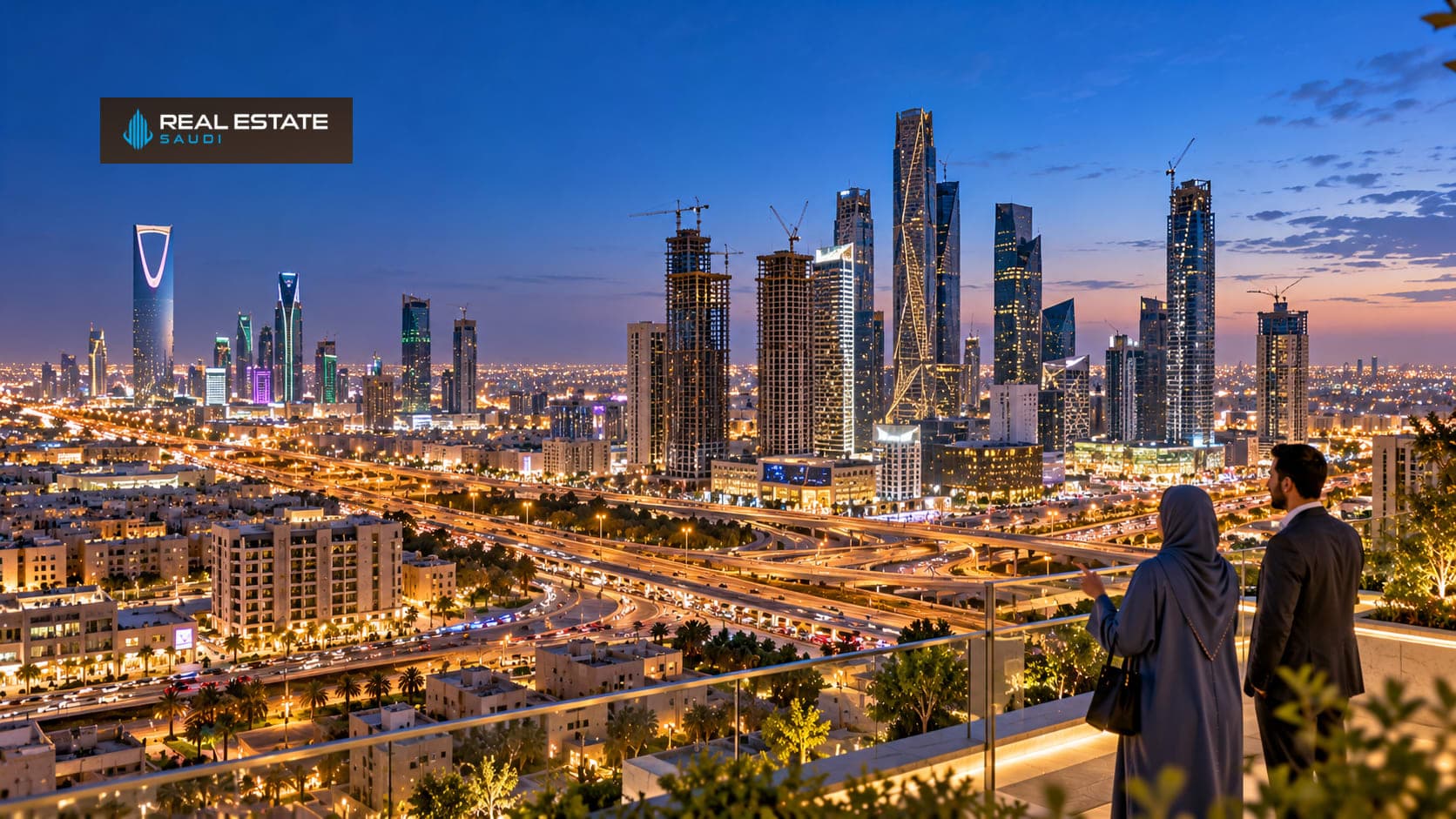
The Saudi Arabia Real Estate Outlook for the remainder of 2026 and into 2027 points to a property market becoming more selective rather than experiencing uniform nationwide growth. Residential property prices have returned to modest annual increases, but transaction volumes, apartment values, villa prices and commercial performance are moving in different directions. Meanwhile, Vision 2030 development, housing supply, foreign ownership reforms and rental regulations are changing how investors evaluate opportunities.
According to the latest third-quarter 2026 data from the General Authority for Statistics (GASTAT), Saudi Arabia's overall Real Estate Price Index increased 1.2% year on year. Residential prices rose 2.3%, while commercial property prices declined 2.0%. These figures demonstrate that national growth does not necessarily mean every property category is appreciating.
For homebuyers, developers and international investors, the central questions are now affordability, location, financing, actual development delivery and achievable rental income.
This market report examines the latest verified indicators, major city trends, investment opportunities, regulatory changes and potential scenarios for 2027.
Saudi Arabia Real Estate Outlook: What Is Happening in 2026?
Saudi Arabia's real estate sector remains supported by housing development, infrastructure investment, economic diversification and major urban projects. However, the latest figures point to a more balanced and fragmented market.
The national price index increased during Q3 2026 compared with the previous year, but declined compared with Q2. Transaction research also indicates weaker residential sales activity than a year earlier.
These developments suggest that financing affordability, the type of property being offered and local demand are becoming increasingly important.
For buyers, this creates a reason to examine comparable completed transactions rather than assume every asking price is justified.
For developers, successful projects are likely to require unit sizes, prices and delivery schedules that match household purchasing power.
For investors, rental income, maintenance expenses and resale liquidity deserve at least as much attention as possible appreciation.
A market can offer genuine long-term opportunities while experiencing short-term corrections in particular segments.
ما نوع العقار والمنطقة المناسبة؟
اختر نوع العقار والمدينة المستهدفة لاستعراض أنسب الخيارات.
Saudi Arabia Real Estate Market Performance: Latest 2026 Data
The official DataSaudi economic and real estate indicators report that the Kingdom's general Real Estate Price Index rose 1.2% year on year in Q3 2026.
The residential component increased 2.3%, while the commercial component declined 2.0%. Residential land prices rose 4.9% annually, apartments gained 1.7%, and villas declined 7.7%.
These are nationwide index movements rather than changes in the prices of individual homes.
Property market indicator | Q3 2026 annual change |
|---|---|
Overall real estate prices | +1.2% |
Residential property | +2.3% |
Residential land | +4.9% |
Apartments | +1.7% |
Villas | −7.7% |
Commercial property | −2.0% |
The figures reveal a sharp contrast between residential land and completed villas.
One possible explanation is that the different categories contain different transaction samples, locations, property characteristics and demand conditions. A national index cannot establish which factor dominated a particular sale.
Investors should also distinguish the index from average price-per-square-meter data. An increase of 2.3% does not mean the average Saudi apartment costs SAR 2,300 or that every region has the same pricing trend.
Why the Quarterly Trend Matters
Looking at annual growth alone can create a misleading impression of constant momentum.
In Q3 2026, the overall property price index fell approximately 1.2% compared with the previous quarter, even though it remained 1.2% above its Q3 2025 level.
Residential prices also weakened on a quarterly basis.
This difference is important because annual comparisons describe change over twelve months, while quarterly movements can reveal more recent shifts.
A buyer should not automatically interpret one quarter of decline as a prolonged market downturn. Equally, positive annual growth should not be treated as evidence that prices are rising every month.
The best assessment combines several reporting periods, transaction volumes, property type and city-level conditions.
A careful investor should review the current trends in Saudi Arabia's real estate market alongside newly published quarterly figures.
Residential Transactions: What the Sales Data Shows
Transaction activity provides another perspective on market conditions.
The Knight Frank Q2 2026 Saudi residential and office market review, published on September 15, reported 45,740 residential transactions nationally during the second quarter.
That represented a 12% decline from the same quarter in 2025, although activity increased 9% compared with Q1 2026.
Residential land accounted for approximately 51% of transaction numbers and 52% of transaction value.
The importance of this land share should not be overlooked.
Residential transactions include land parcels, not just completed apartments and houses. Therefore, 45,740 transactions cannot be described as 45,740 occupied homes sold.
The research also showed significant differences between cities.
Lower transaction volumes may reflect affordability constraints, financing conditions, a shortage of suitably priced homes or changing buyer expectations.
Investors should investigate these explanations locally rather than assuming that every decline in transactions means the same thing.
Riyadh Property Market Outlook
Riyadh remains central to Saudi Arabia's property economy because of government activity, corporate expansion, employment demand and major infrastructure investment.
However, the city's residential market is no longer appropriately described as rising uniformly.
Knight Frank reported that Riyadh completed 10,667 residential transactions in Q2 2026, approximately 2% below the previous year but 23% above the preceding quarter.
Transaction values reached SAR 14.3 billion, down 14% year on year.
Average apartment values rose 3.1% annually to approximately SAR 6,369 per square meter, while villa values declined 2.2%.
These different outcomes highlight the importance of household budgets and property specifications.
A well-located apartment serving a broad tenant or buyer group may perform differently from a large villa aimed at a narrower segment.
The Riyadh real estate market guide provides additional city-level context for evaluating neighborhoods, prices and investment decisions.
Riyadh Housing Affordability and Buyer Behavior
Affordability has become a central issue in the capital.
A buyer's purchasing decision depends on income, down payment, mortgage terms and the costs of maintaining the property.
Large homes may provide more space but require greater capital and higher operating expenses.
Apartments, townhouses and smaller villas can offer alternatives for households unwilling or unable to purchase expensive detached properties.
This does not mean demand for premium villas has disappeared.
Instead, the market increasingly requires developers to understand which households can purchase specific units at the proposed price.
Buyers should compare usable living area, parking, neighborhood services and commuting convenience rather than price alone.
The long-term appeal of Riyadh will remain influenced by employment and infrastructure, but sustained residential demand requires homes that residents can afford.
Jeddah Real Estate Market Outlook
Jeddah has different economic characteristics from Riyadh.
As a major commercial and logistics center on the Red Sea, its property market is influenced by local households, business activity, tourism, transport and the development of surrounding communities.
Knight Frank reported 6,669 residential transactions in Jeddah during Q2 2026, approximately 1% below the previous year.
However, total residential transaction value increased 31% to SAR 10.3 billion.
This difference suggests that changes in the composition or value of transactions can matter as much as the number of deals.
Apartment values increased 1.2% annually, while villa values declined 1.4%.
For buyers, waterfront proximity, access to employment, building condition and development quality remain important distinctions.
The Jeddah real estate market analysis provides more detail on the city's residential and investment landscape.
Dammam and the Eastern Province Outlook
The Eastern Province has a different demand base, influenced by energy, industrial production, logistics, professional employment and established residential communities.
Dammam, Al Khobar and Dhahran serve related but distinct property markets.
Knight Frank reported that the Dammam Metropolitan Area recorded 3,896 residential transactions in Q2 2026, up 21% year on year.
Transaction values increased 20% to approximately SAR 4.9 billion.
Apartment values rose 2.8%, while villas declined 0.9%.
The figures suggest that residential activity in the metropolitan area was stronger than in some other major cities during that quarter.
Nevertheless, a regional increase does not prove that every property is appreciating.
Corporate tenant demand, commuting routes, neighborhood quality and the availability of competing apartments should guide investment decisions.
Industrial and logistics properties require a separate assessment of business occupiers and operating infrastructure.
Makkah and Madinah Property Market Outlook
Makkah and Madinah have property markets influenced by religious tourism, permanent residents, hospitality development and transportation infrastructure.
Their characteristics are not identical to conventional commercial or residential districts in Riyadh.
Properties near major religious destinations may operate within specialized hospitality or mixed-use structures, while residential neighborhoods farther away serve local households.
Investment performance depends on the permitted use of the building, visitor demand, operating costs and the availability of competing accommodation.
The holy cities also have special restrictions under Saudi Arabia's updated non-Saudi ownership framework.
Investors should not assume that owning shares in a property company is equivalent to owning an individual apartment.
For a more detailed city comparison, review the Mecca property market overview and the Madinah real estate market analysis.
Housing Supply and Saudi Vision 2030
Increasing housing supply is a major component of Saudi Arabia's long-term development strategy.
The government has pursued housing programs, partnerships with private developers, financing support and master-planned residential communities.
According to the Ministry of Municipalities and Housing's 2026 housing-sector update, the Saudi household homeownership rate reached 66.24% by the end of 2025.
This represents progress toward the Vision 2030 target of 70%.
Housing policy affects the property market through several channels.
Additional completed homes can increase buyer choice and potentially reduce excessive price pressure in particular segments.
At the same time, construction supports employment, suppliers, professional services and associated commercial activity.
However, announced housing supply is not equivalent to completed, legally transferable and occupied units.
The actual market impact depends on which projects are delivered, their locations and whether buyers can afford them.
Sakani and Demand for Homeownership
The Sakani program supports eligible Saudi households through different housing solutions and associated financing arrangements.
The available products can include ready homes, properties under construction, residential land and self-construction options.
These programs contribute to demand but also shape the kinds of homes that developers bring to market.
For example, a developer may prioritize family housing configurations that meet the requirements of eligible buyers and financing institutions.
The effectiveness of supply programs should be evaluated through delivered units and actual household occupation, not only announced project totals.
Potential buyers should check current eligibility directly with the relevant program.
An international investor should not assume that benefits designed for eligible Saudi households are available to non-Saudi purchasers.
Mortgage Financing and Housing Demand
Mortgage availability influences demand for residential property.
When financing becomes more expensive or difficult to obtain, some households may delay purchases, reduce their budgets or seek smaller homes.
Developers can also face higher project-financing costs.
The Saudi Central Bank's residential mortgage disclosure requirements explain the information that lenders should provide, including annual percentage rate, financing amount, repayment term and monthly obligations.
A property's affordability depends on the full financing structure, not simply the advertised installment.
Borrowers should examine fixed or variable profit arrangements and potential future repayment changes.
They should also budget for transaction costs, property maintenance and emergency expenses.
The Saudi real estate financing guide provides further background for buyers considering different mortgage arrangements.
Riyadh Rental Regulations and Their Market Impact
Rental regulation has become an important consideration for landlords and investors.
On September 25, 2025, Saudi Arabia introduced special rules restricting annual rent increases for covered residential and commercial properties within Riyadh's urban boundaries for five years.
The official REGA announcement on Riyadh's landlord-tenant regulations describes the restrictions and the treatment of existing and previously rented properties.
The rules affect investment calculations because landlords cannot simply assume that rents will increase each year.
A property with attractive current rental income may still require significant maintenance and management expenses.
Investors should review the property's Ejar records, vacancy history and regulatory treatment.
For tenants, the measures can improve predictability within the applicable legal framework.
The impact on future supply and prices will depend on the market response and the delivery of additional housing.
Commercial Real Estate: Office Market Outlook
Commercial property does not follow the same economic cycle as residential homes.
Riyadh's office market is influenced by government institutions, professional services, international business activity and demand for modern corporate accommodation.
Knight Frank reported that Riyadh's Grade A office rents increased 3.4% year on year in Q2 2026, with citywide Grade A occupancy approximately 96%.
These figures demonstrate continued demand for quality office space despite softer residential transaction activity.
However, prime office performance should not be generalized to every office building in Saudi Arabia.
Location, fit-out quality, parking, building management, technology infrastructure and transport connectivity influence tenant decisions.
Older buildings may face greater competition from modern developments.
Investors should distinguish quoted rent from contracted rent and examine lease incentives, occupancy costs and expected capital expenditure.
Strong occupancy today does not eliminate the risk of additional supply entering the market later.
Retail Real Estate and Changing Consumer Demand
Retail investment depends on household spending, tourism, access and changing shopping behavior.
Traditional shopping centers remain relevant, but the performance of individual properties varies according to tenant mix, location and consumer demand.
Restaurants, entertainment, convenience retail and everyday services may support different leasing strategies.
A mixed-use development may benefit from surrounding residential or office activity, but the commercial units are not guaranteed to achieve high occupancy.
Developers should avoid relying exclusively on large retail floor areas without evaluating actual occupier demand.
Investors should examine signed leases, footfall evidence, service charges and the financial strength of tenants.
Online shopping also influences retail formats, potentially supporting convenience stores, collection points and fulfillment-related facilities.
A successful retail investment requires a credible operating model rather than simply proximity to a major announced project.
حدد ميزانيتك الاستثمارية
حدد ميزانيتك التقديرية لنقوم بتضييق خيارات العروض.
Industrial and Logistics Real Estate
Saudi Arabia's logistics ambitions create opportunities for industrial and warehouse property.
Demand can be linked to manufacturing, distribution, transportation, storage and the expansion of business supply chains.
However, warehouse investment requires a specialized evaluation.
Factors include truck accessibility, loading facilities, clear internal heights, fire-safety systems, electrical capacity and the property's approved industrial use.
A warehouse close to a major road may still be unsuitable if heavy vehicles cannot access the loading area safely.
Tenants may also require specialized temperature control, storage systems or security arrangements.
Industrial real estate performance is influenced by business activity and the financial health of occupiers.
Long-term investors should evaluate lease duration, maintenance responsibilities and the availability of alternative industrial facilities.
The sector offers different risks from conventional residential property and should not be assessed through apartment-price indicators.
Hospitality and Tourism-Related Property
Hospitality forms another important segment of the Saudi property economy.
Investment opportunities are associated with leisure destinations, business travel, Hajj, Umrah and major events.
However, hotel profitability depends on occupancy, achievable room rates, operating costs and the performance of management companies.
A high peak-season room price does not establish year-round profitability.
Similarly, a new tourism development cannot be assessed solely by the number of hotels announced.
Investors should investigate opening dates, completed transportation infrastructure and the destination's ability to attract visitors outside peak periods.
The Red Sea, Diriyah and other major destinations contain projects at different stages of development.
Each opportunity requires project-specific research, including licensing, ownership rights and realistic operating assumptions.
Foreign Ownership Reform and International Investment
The Saudi Arabia Real Estate Outlook is also influenced by regulatory changes affecting foreign participation.
Saudi Arabia's revised non-Saudi property ownership framework entered into force on January 22, 2026.
The system provides routes for eligible foreign individuals and entities to acquire specified property rights, subject to geographical and regulatory conditions.
Applications are handled through the official Saudi Properties process.
The regulations do not grant unrestricted ownership of every property nationwide.
Makkah and Madinah have special ownership restrictions, while the applicant's legal category matters in other locations.
The reform may broaden the potential investor base and encourage international developers to consider qualifying projects.
However, the actual effect on prices will depend on approved locations, buyer eligibility, financing and investment demand.
The foreign property ownership law explained provides more detailed information about the applicable framework.
Real Estate Taxes and Transaction Costs
Property investment returns are affected by transaction costs as well as prices and rental income.
Saudi Arabia generally imposes a 5% Real Estate Transaction Tax on taxable property disposals, subject to statutory exemptions and conditions.
The ZATCA Real Estate Transaction Tax Law entered into force on April 10, 2025.
The actual tax treatment depends on the transaction and relevant legal provisions.
Buyers should also consider brokerage, valuation, financing, legal documentation and property inspection expenses.
For investment property, operating costs may include service charges, insurance, repairs, maintenance and property management.
A purchase that appears attractive based on the advertised price can become significantly more expensive once these expenses are included.
Professional advice may be necessary for cross-border transactions, company ownership structures and specialized property rights.
Vision 2030 Megaprojects and Real Estate Demand
Large development initiatives continue to influence Saudi Arabia's property strategy.
Projects associated with NEOM, Diriyah, Qiddiya and Red Sea Global are intended to support economic diversification, tourism, employment and infrastructure development.
These initiatives can generate demand for construction, accommodation, offices, retail and supporting services.
However, investors should distinguish between announced project capacity and completed operational property.
A large master plan may require multiple phases of financing, construction, infrastructure and tenant or visitor acquisition.
Project delivery can also be affected by construction costs, commercial priorities and economic conditions.
Rather than assume that every nearby property will appreciate, investors should assess actual accessibility, employment creation and completed facilities.
The Vision 2030 real estate transformation guide explains how these initiatives relate to Saudi Arabia's broader urban development strategy.
Transport Infrastructure and Property Location
Transport improvements can change the attractiveness of individual districts.
Riyadh Metro's operating network provides an important example of expanded urban connectivity.
Residents may consider access to rail stations and connecting buses when choosing where to live.
However, a station's presence does not automatically establish a property-value premium.
The actual walking route, travel frequency, road crossings and journey to employment destinations determine usefulness.
For commercial properties, transport access can affect customer convenience and employee commuting.
Industrial properties may benefit from highway, port or airport connections, but they require different technical infrastructure.
Property buyers should distinguish operational transport facilities from planned future extensions.
A location-based investment case is stronger when existing infrastructure already supports demand rather than depending entirely on future announcements.
Construction Costs and Development Feasibility
Construction costs influence the financial feasibility of both new housing and commercial development.
Developers must consider building materials, labor, infrastructure, financing and project-management expenses.
When these costs increase, a development may require higher selling prices or adjustments to its design.
However, buyers may not have enough purchasing power to absorb every cost increase.
This creates a potential gap between technically feasible development and commercially viable housing.
Developers can respond by changing unit sizes, phasing construction or improving building efficiency.
Investors assessing off-plan opportunities should examine the developer's financial position, delivery history and contractual obligations.
Announced construction starts do not guarantee that every planned unit will reach completion on its original schedule.
The balance between future supply and actual household affordability will be important beyond 2026.
Sustainability and the Quality of New Buildings
Sustainability is increasingly relevant to the design and operation of Saudi real estate.
Energy efficiency, cooling performance, water management, insulation and building maintenance influence long-term property costs.
In a hot climate, cooling systems and the quality of a building envelope are particularly important.
A property with an attractive exterior may still have expensive operating requirements.
Developers can improve competitiveness through practical designs that reduce unnecessary energy consumption and provide suitable indoor comfort.
Buyers should request actual technical specifications rather than rely on general descriptions such as “green” or “smart.”
Property management also matters after handover.
Efficient equipment can perform poorly if it is not maintained correctly.
For investors, operating costs and tenant satisfaction may be more measurable indicators of building quality than sustainability claims in marketing materials.
Rental Yields: Why Net Returns Matter
Investors often compare properties using gross rental yield.
Gross yield is calculated by dividing annual rental income by the property's purchase price.
However, this calculation excludes expenses.
Consider a hypothetical apartment acquired for SAR 1,200,000 and rented for SAR 60,000 annually.
Its gross rental yield would be 5%.
If management, maintenance and vacancy expenses totaled SAR 15,000, annual net operating income would fall to SAR 45,000.
The simplified operating yield would then be 3.75% before financing and acquisition costs.
Illustrative metric | Amount |
|---|---|
Property purchase price | SAR 1,200,000 |
Annual rental income | SAR 60,000 |
Gross rental yield | 5.0% |
Illustrative annual expenses | SAR 15,000 |
Net operating income | SAR 45,000 |
Simplified net operating yield | 3.75% |
These figures are hypothetical and do not represent a verified national or citywide rental yield.
Key Risks Facing Saudi Real Estate Investors
The Saudi property market faces several risks that should be assessed alongside long-term opportunities.
Housing affordability may limit the price buyers can pay, particularly for large homes.
New supply may create competition in districts where many similar properties are delivered simultaneously.
Financing conditions can affect both purchasers and developers.
Rental regulations may influence income growth for landlords.
Construction delays and developer execution risk are important for off-plan investment.
Commercial buildings face tenant concentration, vacancy and refurbishment costs.
International investors must also consider ownership eligibility, currency exposure and potential exit restrictions.
An additional risk is overreliance on national averages.
The market performance of a specific villa, warehouse or hotel may differ materially from published indicators.
Risk management starts with accurate documentation, conservative assumptions and realistic exit plans.
Saudi Arabia Property Market Forecast for 2027
The Saudi Arabia Real Estate Outlook for 2027 is likely to depend on the balance between housing delivery, buyer affordability, financing, employment and regulatory implementation.
A single nationwide property-price growth forecast would conceal substantial differences between cities and asset classes.
Riyadh may continue to experience demand linked to corporate activity and employment, but new supply and rental restrictions could influence pricing and landlord returns.
Jeddah's performance will depend on its own residential supply, commerce and tourism-related development.
The Eastern Province will remain sensitive to business and industrial activity.
Makkah and Madinah will reflect local housing requirements and religious-tourism conditions.
Commercial office performance could remain stronger in certain premium districts than in older or less suitable buildings.
These are conditional market assessments, not guarantees of future prices.
Three Possible Market Scenarios for 2027
Scenario | Potential drivers | Possible market implications |
|---|---|---|
Stronger demand | Employment expansion, affordable financing, timely project delivery | Greater transaction activity in suitable segments |
Balanced adjustment | Housing supply improves while buyer budgets remain constrained | More selective pricing and negotiation |
Weaker conditions | Financing pressure, delayed investment or excess local supply | Slower transactions and potential price reductions |
These scenarios are qualitative and do not assign invented probabilities or guaranteed percentage changes.
In a stronger-demand environment, well-located and appropriately priced properties may attract more interest.
In a balanced market, buyers may have additional opportunities to compare alternatives and negotiate.
Under weaker conditions, developers and investors could face slower absorption, vacancy or refinancing challenges.
The actual result will vary across districts and property categories.
What Should Buyers and Investors Monitor?
The most useful indicators for the coming quarters are those that show what is happening in the market rather than what is merely being announced.
Monitor registered sale prices, transaction counts, rental agreements, new completions and mortgage conditions.
Also review the difference between asking prices and completed transactions.
For commercial property, examine occupancy, contracted rents and tenant incentives.
For off-plan developments, assess delivery progress, financing arrangements and project-specific licensing.
The Saudi Arabia Real Estate Outlook should be updated as new official indicators become available rather than relying indefinitely on figures from one reporting period.
Buyers should examine their own affordability, while investors should stress-test cash flows against vacancy, maintenance and slower-than-expected resale demand.
Reliable decisions are supported by current evidence and property-specific analysis.
كيف تفضل التواصل معك؟
اختر وسيلة التواصل الأكثر ملاءمة لك لمناقشة فرصك الاستثمارية.
Practical Due Diligence Checklist
Before purchasing or investing in Saudi property, follow a structured process:
Confirm the property's exact location, type and registered area.
Verify the seller's authority and legal ownership records.
Review comparable completed transactions.
Inspect the property and assess technical condition.
Check current rental agreements and applicable regulations.
Evaluate financing terms and total acquisition costs.
Confirm any foreign-ownership or project-licensing requirements.
Estimate sustainable income after vacancy and operating expenses.
Review future supply and competing developments nearby.
Understand the legal transfer and eventual resale process.
These checks matter whether the property is a family apartment, premium villa, commercial office or development investment.
A property that appears attractive in a national market report may not fit an individual buyer's objectives.
Conclusion
The Saudi Arabia Real Estate Outlook reflects a market supported by long-term economic diversification and housing development, but increasingly shaped by affordability, local supply and regulatory change.
The latest Q3 2026 figures show modest national price growth alongside very different results for apartments, villas, land and commercial property.
Transaction research also highlights the importance of looking beyond prices to understand actual buyer activity.
For 2027, opportunities are likely to depend more on asset quality, location, realistic financing and completed infrastructure than on broad expectations of a nationwide boom.
Investors and homebuyers should use official indicators, verified ownership records and conservative financial assumptions before making decisions.
تحدث معنا عبر قناتك المفضلة
استشارات عقارية مباشرة حول الاستثمار والسوق العقاري في المملكة العربية السعودية.
الأسئلة الشائعة
The Saudi Arabia real estate market outlook for 2026 and 2027 indicates continued long-term development, but property performance is becoming more selective. Housing supply, affordability, foreign investment regulations and Vision 2030 projects are influencing market conditions. In Q3 2026, the national real estate price index increased by 1.2% year on year, while residential transaction activity remained below previous-year levels. Growth prospects differ across cities, property types and individual developments, making location-specific research essential for buyers and investors.
Saudi Arabian property prices have shown mixed performance in 2026. According to the General Authority for Statistics, the national real estate price index increased by 1.2% year on year in Q3 2026, while residential property prices rose by 2.3%. However, these national averages do not mean every property became more expensive. Knight Frank reported that Riyadh apartment values increased by 3.1% year on year in Q2 2026, while villa values declined by 2.2%. Property performance depends on location, supply, affordability and housing type.
Riyadh, Jeddah, Dammam, Makkah and Madinah offer different investment opportunities. Riyadh has significant residential development and demand associated with employment and commercial activity. Jeddah combines housing demand with coastal and business-related development, while Dammam and the Eastern Province serve industrial and professional communities. Makkah and Madinah have distinctive hospitality and residential markets shaped partly by religious tourism. Investors should compare actual transaction prices, rental demand, infrastructure, regulations and property management costs rather than assume one city guarantees higher returns.
Saudi Arabian property prices could increase in selected locations during 2027, but a nationwide rise is not guaranteed. Future performance will depend on economic conditions, financing costs, housing affordability, construction activity and the pace of completed residential deliveries. Newly developed communities may attract buyers, while additional supply could limit price growth in some areas. Investors should monitor quarterly property-price indices, completed transactions, available housing inventory and achieved rental income. Forecasts are best treated as scenarios rather than precise predictions of future appreciation.
Yes. Saudi Arabia's revised non-Saudi real estate ownership law came into effect on January 22, 2026. Eligible foreign individuals and companies may acquire specified property rights subject to approved geographical zones and applicable regulatory requirements. The Saudi Properties platform supports the official application process. Makkah and Madinah have additional restrictions, including limitations on direct ownership by non-Saudi individuals. Foreign buyers should verify their eligibility, the property's precise location and the permitted ownership rights before signing an agreement or making a payment.
Vision 2030 is influencing Saudi Arabia's real estate sector through housing development, economic diversification, tourism infrastructure and major urban projects. Developments associated with NEOM, Diriyah, Qiddiya and the Red Sea are intended to support different economic and residential activities. The Housing Program also targets 70% homeownership among Saudi households by 2030. However, announced investment values and project master plans should not be confused with completed construction or guaranteed market demand. Actual delivery schedules, affordability and infrastructure accessibility will determine how individual property markets benefit.
Riyadh remains an important real estate market because of its employment base, commercial development and expanding residential supply. However, investors should consider affordability pressures and changing market conditions. Knight Frank reported 10,667 residential transactions in Riyadh during Q2 2026, representing a 2% year-on-year decline. Apartment values increased while villa prices softened during the same period. The five-year restrictions on covered residential and commercial rent increases, effective September 25, 2025, also influence income projections. Investors should prioritize realistic rental calculations and property-specific valuations.
Mortgage availability and financing costs have a significant effect on Saudi property demand because many households depend on residential financing. Higher borrowing costs can reduce purchasing power and increase monthly repayment obligations, potentially affecting transaction activity. Financing conditions also influence the types and prices of homes buyers can afford. Saudi banks assess borrower eligibility, income, creditworthiness and property suitability. Prospective buyers should compare annual percentage rates, repayment periods, total financing costs and down-payment requirements. Government housing-support programs may assist eligible Saudi households, subject to their individual conditions.
The main risks include housing affordability, construction-cost increases, project delays, changes in financing conditions, regional uncertainty and potential oversupply in individual markets. Knight Frank reported that Saudi residential transaction volumes declined by 12% year on year in Q2 2026, highlighting weaker purchasing activity despite continued development. Large announced construction pipelines may also face delivery challenges. Investors should distinguish planned projects from completed properties, examine actual rental demand and avoid relying on guaranteed appreciation assumptions. Careful financial planning and independent due diligence remain essential.
2026 may offer opportunities for investors who focus on appropriate locations, realistic valuations and long-term financial sustainability. The market benefits from ongoing residential development, infrastructure investment and changes to foreign ownership regulations. However, slower transactions and different price movements across apartments, villas and regions show that property selection matters. Before investing, review registered comparable sales, ownership eligibility, financing costs, taxes, rental income and maintenance obligations. A successful investment depends on the individual asset and purchase terms rather than general expectations of Saudi real estate market growth.
