
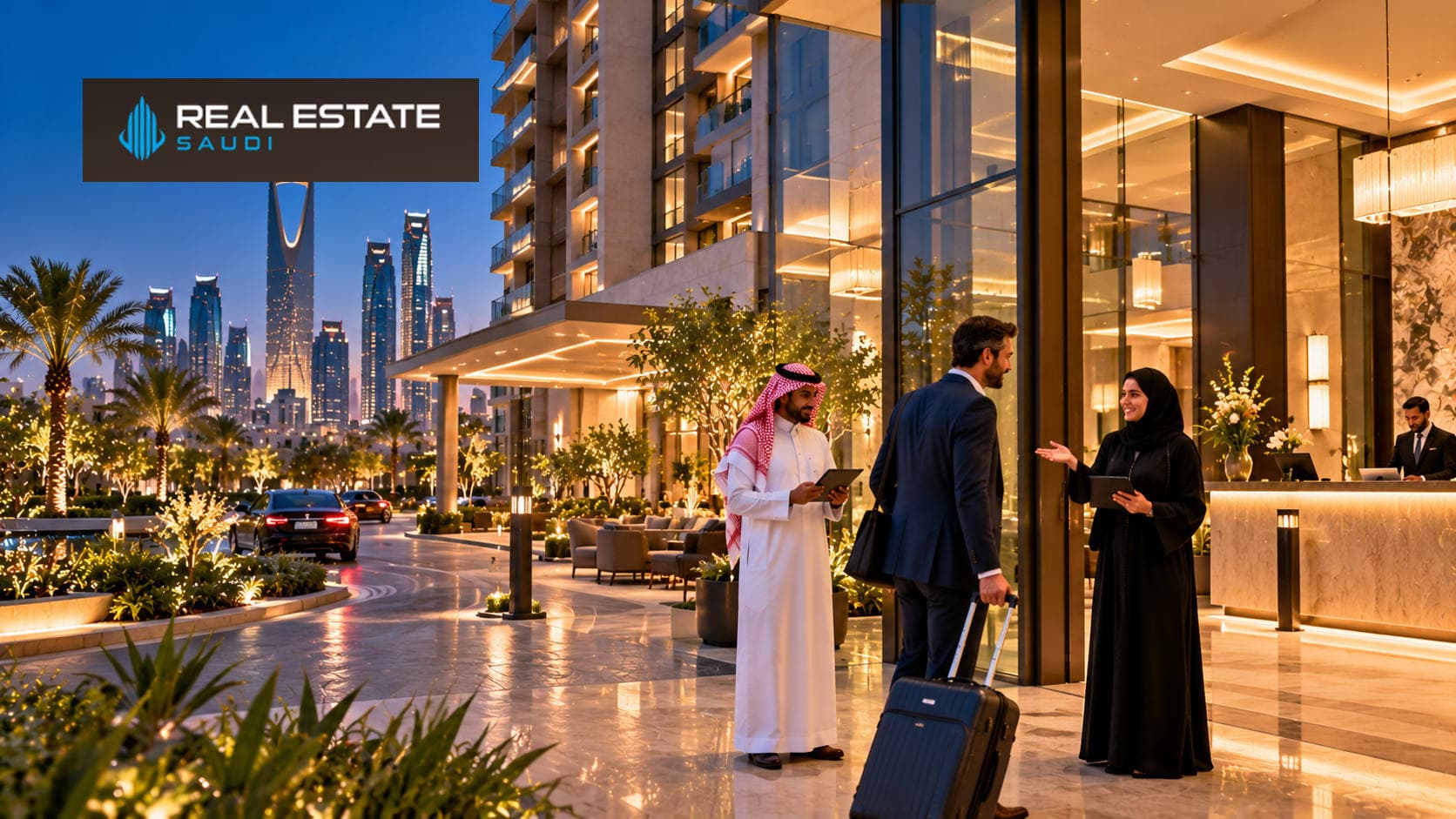
Serviced Apartments in Saudi Arabia offer an investment opportunity within the Kingdom's hospitality and accommodation market. These properties combine furnished residential space with services such as housekeeping, guest reception, maintenance and flexible stays. They can serve business travellers, relocating professionals, families and tourists who prefer more space than a conventional hotel room.
In 2026, Riyadh, Jeddah, Makkah, Madinah and the Eastern Province are important markets to investigate. However, occupancy, nightly rates, acquisition prices and operating expenses vary considerably. There is no reliable nationwide purchase price or guaranteed return that applies to every serviced apartment.
Investors must also distinguish purchasing a residential unit from acquiring a licensed hospitality business. Ownership rights, building permissions, tourism licensing and operating contracts can determine whether the proposed investment is legally and commercially viable.
This guide examines market performance, city selection, property pricing, investment returns, operating models, government regulations, taxes and the practical checks investors should complete before purchasing or developing serviced accommodation in Saudi Arabia.
Serviced Apartments in Saudi Arabia: 2026 Market Overview
Serviced apartments operate within a broader tourism accommodation industry that includes hotels, resorts, furnished accommodation and other licensed hospitality facilities.
Unlike conventional residential rentals, serviced accommodation generally provides temporary stays supported by an operating business. Guest services, booking management and recurring property maintenance form part of the commercial model.
According to the General Authority for Statistics tourism accommodation report for Q3 2025, serviced apartments and other hospitality facilities recorded 57.4% room occupancy during that quarter, compared with 58.0% in the corresponding quarter of 2024.
The same report recorded 5,622 licensed tourism hospitality facilities nationwide, of which 2,955 were serviced apartments and other hospitality establishments.
These statistics describe broader categories rather than individual buildings.
Investment Factor | What Investors Should Examine |
|---|---|
Guest demand | Business travel, tourism and extended stays |
Occupancy | Booked nights compared with available nights |
Room revenue | Achievable rates across different seasons |
Acquisition cost | Property price and total setup expenditure |
Operating costs | Staffing, utilities, cleaning and commissions |
Legal position | Ownership rights, land use and accommodation licensing |
Management | Operator experience and contractual responsibilities |
Exit strategy | Resale value and alternative permitted uses |
Successful investments require property-level research rather than assumptions about the national tourism market.
ما نوع العقار والمنطقة المناسبة؟
اختر نوع العقار والمدينة المستهدفة لاستعراض أنسب الخيارات.
What Is a Serviced Apartment?
A serviced apartment is furnished accommodation provided with hospitality-related services. It usually offers sleeping space, private bathrooms and some level of living or kitchen facilities.
Services may include housekeeping, guest support, internet connectivity, maintenance and professionally managed reservations.
Serviced apartments versus hotels
Hotels commonly provide standard guest rooms and centralised hospitality services. Serviced apartments may offer additional living space and facilities suitable for longer visits.
However, the distinction depends on the property's actual classification and services.
Serviced apartments versus ordinary rentals
A conventional residential apartment is normally leased as someone's home under a residential tenancy arrangement.
Serviced accommodation typically operates as temporary lodging and follows the applicable tourism regulatory framework.
Hotel apartments
The term hotel apartment is frequently used in marketing, but investors should rely on the facility's officially licensed classification rather than informal labels.
This distinction can affect taxation, operating permissions, furnishing requirements and ongoing compliance.
Why Investors Consider Serviced Accommodation
Saudi Arabia has several sources of accommodation demand that may support appropriately located hospitality properties.
Business travel can generate demand in commercial districts, while religious visitors require accommodation in and around major pilgrimage destinations.
Relocating professionals and project teams may also prefer furnished accommodation for temporary assignments.
Flexible booking periods
Operators may offer daily, weekly or longer bookings when permitted under their licence and contractual arrangements.
Multiple guest groups
Suitable facilities can attract business visitors, families and other travellers according to location and service level.
Managed operations
Professional management can handle reservations, housekeeping, guest communication and maintenance.
Additional revenue
Some businesses charge for authorised supplementary services, although these also create operating expenses.
Investment limitations
Hospitality income fluctuates with occupancy, competition and pricing.
A property generating substantial revenue during a busy month may produce significantly less income during quieter periods.
Investors should treat hospitality accommodation as an operating business, not simply a passive rental asset.
Saudi Arabia Serviced Apartment Market Statistics
Official accommodation data can help investors understand the industry's scale and seasonal performance.
GASTAT reported that serviced apartments and other hospitality facilities achieved approximately 50.7% room occupancy in Q1 2025.
Their average daily room rate was approximately SAR 209 during that quarter. The figure represented a broad statistical category, not a standard charge applicable to every licensed serviced apartment.
By Q3 2025, reported occupancy for the same wider category reached 57.4%.
What these figures show
Occupancy changes between quarters, demonstrating that demand is not uniform throughout the year.
What they do not show
A national occupancy rate cannot establish the profitability of an individual building in Riyadh, Jeddah or Makkah.
Supply growth
An increasing number of licensed establishments may expand customer choice and intensify competition.
Investor interpretation
Use official statistics for market context, then examine comparable facilities within the selected district.
The Saudi real estate investment guide provides additional guidance on evaluating income-generating property opportunities.
Types of Serviced Apartment Investments
Investors can enter this market through several structures, each involving different responsibilities.
Individually owned units
An investor may own a qualifying unit within a building operated by an authorised accommodation business.
This arrangement requires careful review of management rights, contractual income distribution and licensing.
Entire serviced apartment buildings
Buying an operating building can provide control over multiple accommodation units.
However, the acquisition may also involve employees, contracts, operating equipment and existing liabilities.
Newly developed accommodation
Investors may develop a suitable property and arrange the necessary approvals and operational setup.
Construction and commissioning create additional capital requirements and delays.
Long-lease operating models
Some businesses lease an entire building and operate accommodation without owning the underlying property.
The lease must permit the intended activity, and the operator must meet licensing requirements.
Management agreements
An owner can appoint a hospitality operator, usually under agreed fees or revenue-sharing conditions.
The legal and financial responsibilities should be documented before commencing operations.
Best Cities for Serviced Apartment Investment in 2026
The strongest location depends on the intended guest market and the property's particular financial characteristics.
City | Potential Guest Segments | Main Investment Consideration |
|---|---|---|
Riyadh | Corporate visitors and relocating professionals | Competition, licensing and business-district access |
Jeddah | Business and leisure travellers | Seasonal demand and neighbourhood selection |
Makkah | Religious visitors | Ownership restrictions and pilgrimage-related demand |
Madinah | Religious visitors and families | Location-specific prices and legal eligibility |
Dammam | Business and industrial visitors | Actual corporate booking demand |
Al Khobar | Business travellers and extended-stay guests | Operator competition and property positioning |
This comparison identifies markets to research, not an official ranking or promise of higher returns.
Investors should compare actual property acquisition costs, achievable room rates and comparable accommodation occupancy before deciding.
Riyadh Serviced Apartments: Corporate Accommodation Demand
Riyadh is Saudi Arabia's capital and an important commercial centre.
It attracts business visitors, consultants, professionals and people relocating for employment.
Serviced apartments near employment centres may appeal to guests who require furnished accommodation for several weeks or months.
Location selection
Business-district access, road connections and proximity to offices can influence booking decisions.
Guest requirements
Reliable internet, workspaces, parking and housekeeping may matter more to corporate visitors than luxury decoration.
Pricing considerations
High room rates must be supported by occupancy and customer demand.
Competition
Hotels, furnished apartments and professionally managed residences compete for overlapping guest segments.
Rental regulations
Investors should distinguish licensed tourism accommodation from ordinary residential leases, including applicable restrictions affecting Riyadh rentals.
The Riyadh property market and area guide provides a useful starting point for comparing districts.
Jeddah Serviced Apartments: Business and Coastal Tourism
Jeddah's accommodation market serves business visitors, families and leisure travellers.
Its location on the Red Sea creates different demand patterns from Riyadh.
Urban accommodation
Properties near business services and transport connections may appeal to visitors with professional commitments.
Coastal locations
Waterfront areas may attract leisure interest, but premium purchase prices can reduce investment returns.
Family stays
Larger serviced units with kitchens and living areas may suit families requiring additional space.
Operating expenses
Coastal environments can create additional maintenance requirements for buildings and equipment.
Investment assessment
Investors should compare the property's annual operating results rather than focus exclusively on holiday-season prices.
The Jeddah residential and investment location guide can help identify districts worth researching.
A prestigious address does not guarantee consistent occupancy.
Makkah and Madinah: Religious Tourism Accommodation
Makkah and Madinah have distinctive hospitality markets associated with religious travel.
Visitors may stay for different durations depending on pilgrimage arrangements and travel schedules.
Proximity to major destinations
Location can strongly influence guest preferences, especially where visitors prioritise convenient access.
Seasonal demand
Occupancy and room rates may vary around periods of concentrated religious travel.
Family accommodation
Larger units may appeal to visiting households, although requirements differ across customer groups.
Legal restrictions
Foreign property ownership in the holy cities is subject to additional requirements.
Business operations
Accommodation facilities must comply with the applicable tourism, safety and property-use regulations.
Investors should not assume that strong visitor numbers automatically produce attractive net returns.
A high purchase price, expensive operations or weak off-season occupancy can substantially reduce profitability.
Dammam and Al Khobar Serviced Apartments
The Eastern Province contains business, logistics and industrial activity that may support extended-stay accommodation.
However, Dammam and Al Khobar should be evaluated separately rather than treated as one uniform rental market.
Corporate visitors
Businesses may require temporary accommodation for consultants, technical staff and visiting professionals.
Extended stays
Furnished units can serve guests who prefer a more residential environment during temporary assignments.
Property selection
Parking, accessibility, reliable maintenance and room configuration are important considerations.
Pricing
Investors should compare actual rates offered by similar accommodation facilities.
Competition
Existing hotels, serviced residences and furnished units influence what customers are willing to pay.
The Dammam real estate market overview provides relevant location context.
Claims that the Eastern Province guarantees lower entry costs or higher returns require evidence from actual properties.
Serviced Apartment Prices in Saudi Arabia
There is no single verified national purchase price for serviced apartments in 2026.
Prices depend on the city, building type, size, operational status, location, construction quality and legal ownership arrangement.
Individual apartments
The cost of a unit may depend on whether it is sold as ordinary residential property or with a recognised hospitality operating arrangement.
Entire buildings
A building acquisition involves land, structure, facilities and potentially the value of an existing business.
Premium properties
Additional guest facilities and central locations may increase purchase prices and operating expenditure.
Development projects
Unfinished properties require separate budgets for construction, furnishing, licensing and pre-opening costs.
Reliable pricing evidence
Buyers should compare completed transactions, independent valuations and documented operating accounts.
The Saudi apartments for sale directory provides residential market context, although ordinary apartment listings are not proof of licensed hospitality availability.
Unsupported city-wide price ranges should not be used as investment benchmarks.
What Does It Cost to Set Up Serviced Apartments?
Acquisition or lease costs represent only part of the required capital.
An investor establishing a serviced accommodation business must consider building compliance, furnishings, technology, staffing and working capital.
Property preparation
Renovation, bathrooms, kitchens, fire safety and accessibility improvements may be required.
Furniture and equipment
Beds, appliances, furniture, televisions and guest amenities create initial expenses.
Booking systems
Professional operations may require reservation management, payment processing and guest-registration software.
Licensing
Government approvals and classification requirements depend on the establishment and operating model.
Staffing
Reception, housekeeping, maintenance and administration create ongoing commitments.
Working capital
Funds are needed to cover expenses during periods when revenue remains below expectations.
A business plan should separate one-time setup expenses from recurring operating costs.
How Tourism Accommodation Licensing Works
Serviced accommodation is regulated by Saudi Arabia's Ministry of Tourism.
The official Ministry of Tourism accommodation facility licensing service identifies requirements for obtaining an operational licence.
Commercial registration
The business must hold an appropriate commercial registration covering the accommodation activity.
Municipal approval
A valid municipal licence or relevant competent-authority permission may be required.
Civil Defense approval
Applicable safety requirements must be satisfied.
Guest registration
The operating business must comply with required guest registration and monitoring integrations.
Classification standards
Facilities must satisfy standards relevant to their licensed category.
Operating requirements
An issued licence does not eliminate continuing compliance obligations.
Investors should verify the correct licence category before purchasing or leasing a property intended for hospitality use.
Private Accommodation Versus Licensed Hotel Apartments
A private tourism accommodation unit and a serviced apartment establishment are not necessarily subject to identical licensing procedures.
The distinction matters because purchasing a residential apartment does not automatically authorise commercial guest stays.
Individual unit operation
A privately owned unit may follow the relevant private tourism accommodation licensing framework.
Multiple-unit hospitality business
Operating an entire building can require a tourism accommodation facility licence and associated business permissions.
Property-use rights
The owner or operator must possess legally valid rights to use the property for the proposed activity.
Shared buildings
Co-owner restrictions and building rules can affect short-term accommodation operations.
Practical consequences
Investors should obtain written clarification from the relevant authority when a proposed arrangement falls between residential leasing and hospitality accommodation.
Choosing an incorrect operating category can lead to compliance problems and unexpected expenses.
حدد ميزانيتك الاستثمارية
حدد ميزانيتك التقديرية لنقوم بتضييق خيارات العروض.
Understanding Occupancy and Average Daily Rates
Occupancy measures the proportion of available accommodation nights that are sold during a particular period.
Average daily rate, commonly abbreviated ADR, measures the average room revenue per sold accommodation night.
Occupancy alone is insufficient
A property can achieve high occupancy by charging low rates.
High rates can reduce bookings
Premium pricing may increase revenue per booking while reducing the number of occupied nights.
Revenue management
Operators often adjust prices according to demand, booking periods and competitive conditions.
Seasonal performance
Monthly results should be examined separately before producing annual forecasts.
Market averages
National accommodation statistics describe broader industry performance.
They cannot establish the expected revenue of a newly acquired property without local market analysis.
Investors should request at least a meaningful history of actual booking and income records when purchasing an operating business.
Serviced Apartments in Saudi Arabia: ROI Expectations
Investment returns depend on property cost, occupancy, achieved room rates and operating expenses.
There is no verified universal ROI for serviced apartments across Saudi Arabia.
A property with strong booking revenue may still generate modest profit after staffing, utilities, cleaning, maintenance and booking-platform commissions.
Gross revenue
Revenue includes payments received for accommodation and any authorised additional services.
Operating income
Actual operating profit reflects relevant expenses incurred to run the establishment.
Financing
Loan repayments or other funding costs can further reduce cash available to investors.
Capital investment
The total acquisition and establishment cost influences the eventual investment return.
Resale
An operating business may be valued differently from an ordinary residential unit.
Investors should review the Saudi property return-on-investment guide when comparing rental yield, operating profit and long-term investment performance.
Example of Serviced Apartment Investment Performance
Consider a hypothetical furnished accommodation unit with an annual operating budget and variable guest demand.
Suppose the unit records SAR 150,000 in annual accommodation revenue.
If operating expenses total SAR 60,000, the resulting operating income would be SAR 90,000 before financing and certain owner-level expenses.
These figures are illustrations, not actual Saudi market averages.
What investors must investigate
The acquisition price, furnishing budget, regulatory costs and financing structure would all affect the eventual return.
Operating volatility
Revenue could decline if occupancy falls or competitors reduce their prices.
Maintenance reserves
Furniture replacement and significant repairs should be included in financial planning.
Tax treatment
Accommodation revenue and property transactions may face different tax rules.
A meaningful investment analysis should test weak, moderate and strong operating scenarios before purchase.
VAT on Serviced Apartment Accommodation
Serviced accommodation has important VAT implications that differ from ordinary qualifying residential rental arrangements.
The official ZATCA guidance on hotels and serviced accommodation states that qualifying hotel and serviced accommodation supplies are subject to 15% VAT.
Accommodation charges
Taxable guest accommodation generally falls within the hospitality VAT treatment.
Additional services
Related charges may also be subject to VAT.
Residential rental distinction
Certain qualifying leases used as a tenant's regular residence receive different treatment.
Registration and compliance
Operators should review applicable VAT registration, invoicing and reporting requirements.
Investment impact
VAT must be considered when comparing customer prices and operating revenue.
Investors should not assume that calling a business an apartment rental automatically creates a residential VAT exemption.
Property Purchase Taxes and Other Charges
Saudi Arabia generally imposes a 5% Real Estate Transaction Tax on qualifying property disposals, subject to statutory exemptions.
The official ZATCA Real Estate Transaction Tax Law establishes the relevant framework.
Acquisition tax
The transaction's legal classification determines the applicable treatment.
Business acquisition
Purchasing a business and acquiring its underlying real estate can involve different contractual and tax considerations.
Legal costs
Independent legal and financial review can create additional expenses.
Financing costs
Commercial and real estate financing may involve different lending criteria.
Foreign ownership
Certain transactions involving non-Saudi real estate rights can carry additional prescribed charges.
Investors should obtain transaction-specific advice instead of assuming that one tax percentage represents every expense involved in acquiring a hospitality business.
Can Foreign Investors Own Serviced Apartments?
Saudi Arabia's updated foreign real estate ownership law entered into force on January 22, 2026.
The Real Estate General Authority's official foreign ownership framework explains the applicable geographical and eligibility rules.
Individual investors
Permitted ownership rights depend on the buyer's residency category and the property's location.
Non-resident purchasers
Qualifying overseas investors have an official application route.
Corporate investors
Companies follow separate registration and ownership requirements.
Holy cities
Makkah and Madinah remain subject to additional restrictions.
Hospitality activity
Legal property ownership does not automatically authorise the operation of a serviced accommodation business.
Foreign investors must confirm both ownership eligibility and any commercial or tourism permissions before acquiring an asset.
Financing Serviced Apartment Investments
Financing hospitality accommodation differs from financing a conventional owner-occupied home.
The available lending arrangements depend on the buyer, property and business model.
Residential financing
A standard home mortgage may not permit every commercial accommodation use.
Commercial financing
An operating accommodation business may require a different credit assessment.
Cash-flow evidence
Lenders may examine actual revenue, expenses and the operator's experience.
Security
Financing agreements may involve property security and other contractual protections.
Repayment capacity
Investors should ensure that debt obligations remain manageable when occupancy declines.
The Saudi mortgage assistance information offers broader context for property financing, although specific commercial accommodation eligibility requires lender confirmation.
Borrowing can amplify both positive returns and financial losses.
Off-Plan Serviced Apartments and Developer Risks
Some investors consider acquiring units within accommodation developments before construction is completed.
This introduces risks beyond those associated with operating properties.
Project licensing
Buyers should verify that the developer holds the necessary authorisation for the proposed sales arrangement.
Contractual ownership
The agreement must clarify the exact property right being acquired.
Operator arrangements
Any proposed hospitality management contract should identify the parties and responsibilities.
Construction delays
Late delivery can postpone the commencement of revenue.
Furnishing and commissioning
A completed building may still require additional work before accepting guests.
Marketing claims
Projected occupancy and guaranteed income claims should be checked against enforceable contract terms.
Investors should not treat a branded development announcement as proof that a unit is licensed, saleable or operational.
Choosing a Serviced Apartment Operator
The operator can materially influence property performance.
A recognised hospitality brand may offer marketing and distribution capabilities, but branding alone does not guarantee profitability.
Operating experience
Review the operator's relevant management history.
Fee structure
Identify fixed fees, percentage-based charges and additional operating expenses.
Revenue distribution
Understand how room revenue and ancillary income are allocated.
Reporting
Require regular financial statements and measurable performance information.
Contract termination
Examine circumstances under which either party can end the arrangement.
Maintenance responsibility
Clarify who pays for routine servicing, major repairs and furniture replacement.
The property management services offered in Saudi Arabia provide broader property-management context, although hospitality management requires specialist operational capabilities.
How to Evaluate a Serviced Apartment Investment
A disciplined purchasing process can reduce avoidable legal and financial risks.
Confirm the business model
Determine whether the investment involves an individual unit, building, operating company or contractual income right.
Check legal ownership
Verify the seller's rights and the proposed purchaser's eligibility.
Review licensing
Confirm that the property is authorised for the intended accommodation activity.
Examine financial records
Request documented revenue, occupancy and operating expenses.
Inspect the building
Assess construction condition, guest facilities and maintenance liabilities.
Analyse competition
Compare nearby accommodation with similar amenities and customer groups.
Calculate the full capital requirement
Include acquisition, furnishing, fees and sufficient operating reserves.
Review the exit strategy
Consider whether the property could be resold or used differently if hospitality performance disappoints.
Each stage should be supported by evidence rather than marketing forecasts.
Major Risks of Serviced Apartment Investment
Hospitality investments face several risks that ordinary residential landlords may encounter less frequently.
Occupancy fluctuations
Guest demand can change between seasons and economic conditions.
Operating expenses
Staffing, utilities, cleaning and maintenance can reduce profitability.
Competition
New hotels and serviced accommodation can affect achievable rates.
Management disputes
Poorly drafted operator agreements may create conflicts over revenue or responsibilities.
Licensing risks
Failure to meet ongoing tourism requirements can disrupt operations.
Property condition
Delayed maintenance can damage guest satisfaction and increase repair costs.
Liquidity
A specialised hospitality unit may attract fewer buyers than a conventional apartment.
Investors should maintain financial reserves and avoid relying on guaranteed-return claims that cannot be independently substantiated.
كيف تفضل التواصل معك؟
اختر وسيلة التواصل الأكثر ملاءمة لك لمناقشة فرصك الاستثمارية.
Serviced Apartment Investment Outlook Beyond 2026
The Saudi accommodation market will continue to be influenced by business travel, religious tourism, leisure demand and hospitality supply.
New infrastructure and development projects may create additional demand in some locations, but they can also introduce competing accommodation.
Operators may increasingly rely on online reservations, digital guest services and efficient building management.
However, advanced technology cannot compensate for weak location selection or excessive acquisition costs.
Future performance will depend on customer preferences, operating efficiency and achievable accommodation prices.
Investors should monitor tourism statistics, licence requirements and financial results of comparable properties.
A long-term investment strategy should prioritise legal compliance, sustainable operating income and conservative assumptions rather than speculative appreciation.
Conclusion: Investing in Serviced Apartments in Saudi Arabia
Serviced Apartments in Saudi Arabia provide opportunities connected to the Kingdom's hospitality market, including business accommodation, extended stays and religious tourism.
Riyadh, Jeddah, Makkah, Madinah and the Eastern Province serve different guest segments, making local research essential.
Official accommodation statistics demonstrate that occupancy fluctuates, while increasing facility numbers highlight the importance of competition and operating efficiency.
Investors should avoid relying on unsupported city-wide property prices or guaranteed ROI estimates.
A successful investment requires legally permitted ownership, appropriate hospitality licensing, realistic revenue forecasts and a clear understanding of tax obligations.
تحدث معنا عبر قناتك المفضلة
استشارات عقارية مباشرة حول الاستثمار والسوق العقاري في المملكة العربية السعودية.
الأسئلة الشائعة
Serviced apartments are furnished accommodation units offering hospitality-related services such as housekeeping, guest assistance and managed reservations. They may cater to short-term visitors or people requiring extended stays. Their operating requirements depend on the applicable Ministry of Tourism classification and licensing arrangements.
Serviced apartments can generate operating income, but profitability depends on acquisition costs, occupancy, average room rates and expenses. No reliable nationwide return applies to every establishment. Investors should examine actual financial records and operating obligations before purchasing or relying on promotional profit projections.
GASTAT reported 57.4% occupancy for the combined category of serviced apartments and other hospitality facilities in Q3 2025. This is a broader industry statistic, not a guaranteed occupancy rate for an individual property. Location, management quality and seasonality can produce substantially different outcomes.
Purchase prices vary by city, neighbourhood, property size, building condition, licensing and ownership structure. There is no verified universal price list covering the entire country. Buyers should distinguish the acquisition cost of an ordinary apartment from the value of a functioning hospitality unit or operating building.
Riyadh, Jeddah, Makkah, Madinah, Dammam and Al Khobar offer different guest markets. Riyadh attracts business-related interest, while Makkah and Madinah have distinctive religious travel patterns. The most suitable city depends on acquisition cost, verified booking demand, legal permissions and operating expenses.
Operating serviced accommodation may require an applicable Ministry of Tourism licence or permit, depending on the facility and operating model. The relevant requirements can include commercial registration, municipal permissions, safety compliance and guest registration integrations. Owning an apartment does not automatically authorise hospitality operations.
ZATCA guidance states that qualifying hotel and serviced accommodation supplies are subject to 15% VAT. Ordinary qualifying residential leases may receive different treatment. Operators should verify the legal classification of their accommodation, taxable services and applicable registration obligations before setting customer prices.
Eligible non-Saudi individuals and companies may acquire qualifying property rights under the updated ownership system effective January 22, 2026. Geographical and applicant-category restrictions apply. Foreign investors must also verify whether the property can legally operate as serviced accommodation under relevant tourism and commercial regulations.
Hotel apartments can generate flexible accommodation revenue but require hospitality operations, services and potentially higher costs. Ordinary residential apartments generally follow different tenancy and tax arrangements. Neither investment model is automatically superior. Investors should compare net returns, operating risks, regulations and resale prospects.
Investors should verify ownership rights, accommodation licensing, building condition and the operator's financial history. They should review genuine occupancy and revenue records, compare nearby competitors and calculate all acquisition and operating costs. Independent legal, technical and financial advice can help identify risks before substantial commitments.
