
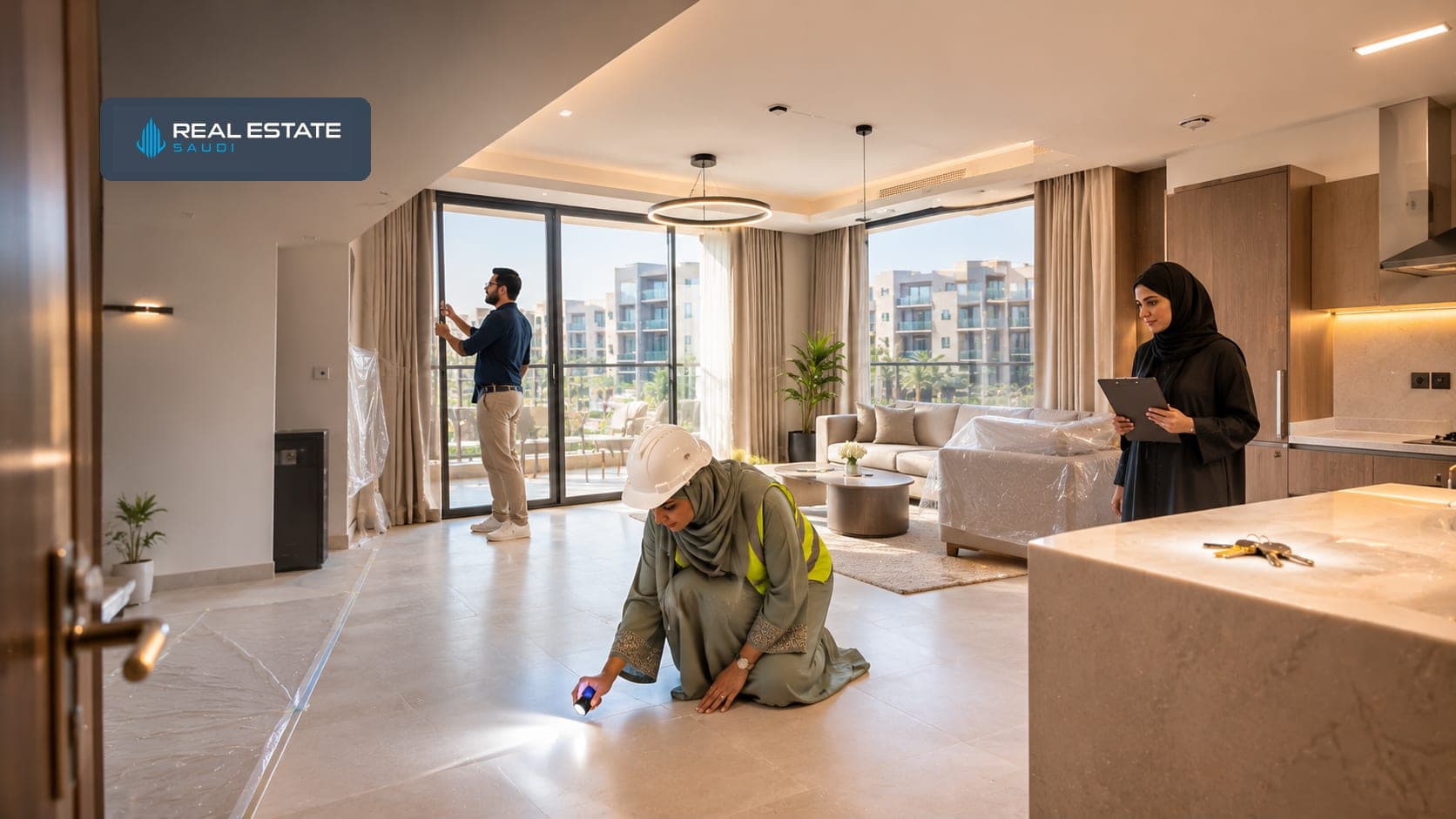
A property handover checklist in Saudi Arabia helps buyers identify construction defects, verify ownership documentation, test essential services and confirm that an apartment or villa is ready for possession. Before accepting keys, purchasers should inspect the property against the signed agreement, obtain the relevant occupancy certificate, document unfinished work and clarify responsibilities for repairs.
Property handover is different from property ownership registration. A buyer may receive physical possession while certain legal or administrative processes remain incomplete. Similarly, an occupancy certificate establishes an important level of regulatory compliance but does not guarantee that every fixture, appliance or interior finish is defect-free.
These distinctions matter particularly for off-plan purchases, where buyers may have committed funds before construction began.
This 2027 guide explains the necessary documents, room-by-room inspections, electrical and plumbing checks, Wafi project requirements, warranties, snagging reports and steps to complete a secure handover.
What Is Property Handover in Saudi Arabia?
Property handover is the formal process through which a developer or seller delivers possession of a residential or commercial property to the purchaser in accordance with the sale agreement. It normally includes a physical inspection, confirmation of included fixtures, recording of defects and delivery of keys or access devices.
For newly constructed properties, the buyer should compare the completed unit with the approved drawings and contractual specifications. Resale buyers must also check its condition, occupancy arrangements and agreed inclusions.
The exact procedures depend on the purchase agreement, property type and applicable laws.
A key collection appointment should not be treated as a substitute for technical inspection or verification of legal ownership.
Why the Final Inspection Matters
Construction defects can be expensive to correct after furniture has been installed and the property is occupied. Water leakage, inadequate air conditioning, damaged finishes or electrical problems may also create inconvenience or safety risks.
Inspecting before handover provides an opportunity to record existing conditions objectively.
The Real Estate Saudi buying guide explains the broader purchase process, including contractual and ownership checks that should be completed alongside the physical inspection.
Buyers should retain written evidence of any problems and the seller's agreed response rather than relying on verbal promises.
ما نوع العقار والمنطقة المناسبة؟
اختر نوع العقار والمدينة المستهدفة لاستعراض أنسب الخيارات.
Property Handover Checklist in Saudi Arabia: Essential Documents
Document verification should begin before the scheduled inspection. Request sufficient time to review the records and clarify discrepancies.
The necessary documents will differ between completed homes, resale apartments and off-plan properties.
Purchase Agreement and Approved Floor Plan
Compare the final unit with the signed purchase contract, approved floor plan and finishing specifications.
Confirm the property address, building identification, unit number, floor, rooms, agreed area and included facilities.
Check whether the contract includes kitchen appliances, air-conditioning equipment, wardrobes, parking or storage.
Developers sometimes introduce authorised changes during construction. Request the written approvals and confirm that variations are consistent with the agreement.
A showroom display or marketing brochure should not automatically be regarded as the final contractual specification.
Title Deed and Property Registration
Confirm the seller's authority and the relevant title or registry information.
Saudi Arabia's Real Estate Registry records property ownership, descriptions, associated rights, restrictions and obligations within its applicable registration framework.
The REGA Real Estate Registry platform explains how registration records help identify the property and its legal status.
Physical handover and legal registration should be checked separately.
Buyers can use the property document verification guide to understand important checks relating to seller authority, title information and property identification.
Occupancy Certificate and Building Completion
A building permit authorises construction under specified conditions, while an occupancy certificate confirms that the applicable requirements for occupation have been addressed.
The Ministry of Municipalities and Housing's September 2026 occupancy certificate announcement confirms that certificates are issued electronically following technical and municipal verification.
The ministry reported more than 38,000 certificates issued in the first half of 2026, approximately 55% above the corresponding period in 2025.
Buyers should confirm the certificate's relevance to their building and not assume that general project approval replaces individual completion requirements.
How to Prepare Before Your Inspection Appointment
A successful inspection requires appropriate access, operating utilities and the correct reference documents.
Arrange the visit during daylight if possible. Natural light makes cracks, uneven paintwork and water stains easier to identify.
Ask the developer or seller to ensure electricity, water and relevant mechanical equipment can be demonstrated.
If essential services remain disconnected, identify the tests that cannot be completed and request a follow-up inspection.
Equipment and Inspection Records
Bring a mobile phone, measuring tape, approved plans, a written checklist and a method for recording observations.
A simple torch can help inspect cupboards, corners and accessible service areas.
Use consistent room names and defect reference numbers so contractors can identify each issue.
A professional inspector may use specialised equipment, but buyers should not attempt hazardous electrical testing, climb unsafe roofs or open concealed mechanical systems.
Where technical conditions are uncertain, request assessment by qualified personnel.
Who Should Attend the Handover?
Ideally, the purchaser or authorised representative should attend with a developer or seller representative.
An independent building inspector can provide additional assistance for newly constructed homes, large villas or properties with complicated mechanical systems.
Real Estate Saudi's real estate services overview includes property handover and snagging assistance for purchasers requiring professional support.
Confirm the scope of the appointment and whether parking, storage and common facilities can be inspected.
Room-by-Room Inspection: Walls, Floors and Ceilings
Start at the entrance and follow a consistent route through every room. Inspect visual quality and functional performance separately.
A newly painted wall may look attractive while concealing moisture or poorly finished surfaces.
Walls and Interior Paint
Check for cracks, peeling paint, stains, uneven plaster and incomplete finishing around switches, sockets and windows.
Small cosmetic imperfections may be straightforward to repair, but substantial cracks or recurring dampness can require professional investigation.
Record the location of each defect rather than simply noting that a room has poor paintwork.
Photographs should show both the problem and its surrounding wall.
This makes reinspection more reliable and reduces disagreement about which surface requires repair.
Flooring and Tiles
Inspect floor finishes for cracks, scratches, loose tiles, uneven installation and incomplete joints.
Check transitions between rooms and around door frames.
Bathrooms and balconies should drain towards the intended outlets rather than retain significant standing water.
A hollow-sounding tile may deserve further assessment, but the sound alone does not establish a structural defect.
Where flooring defects appear widespread, a professional should evaluate the installation before the buyer accepts a proposed repair method.
Ceilings and Dampness
Look for water stains, cracks, unfinished joints, loose ceiling panels and damage around recessed lighting.
Inspect areas beneath bathrooms, roof spaces or mechanical equipment where accessible.
Unusual discoloration may indicate an earlier leak, but a visual inspection cannot always establish the underlying cause.
Request evidence that any identified water problem has been investigated and corrected.
A cosmetic repaint should not automatically be accepted as proof that the original defect has been resolved.
Doors, Windows and Glass Installation
Doors and windows influence security, insulation, ventilation and convenience. Every accessible item should be operated individually.
Doors, Hinges and Locks
Open and close each door. Check hinges, handles, locks, door stops and frame alignment.
A door should not scrape against flooring or require excessive force to close.
Inspect entrance-door security and confirm that the supplied keys operate the relevant locks.
Electronic access devices should also be demonstrated.
Record damage to frames or doors, particularly where poor installation affects security or daily use.
Windows and Glazing
Check window operation, locks, seals, frames and visible glazing.
Scratches, damaged seals and gaps may affect appearance and weather protection.
In Riyadh, poor sealing can contribute to dust infiltration and unwanted heat. In coastal Jeddah, humidity and exposure to salt-laden air can influence maintenance needs.
Do not attempt to test high-level glazing or external fixtures from unsafe positions.
Specialist concerns should be reported for competent assessment.
Balconies and Terraces
Inspect balcony flooring, drainage and visible barriers.
Look for damaged waterproofing, cracks and incomplete finishes.
If railings appear insecure, avoid applying force or leaning against them.
Request professional evaluation instead.
Confirm that private balconies, terraces and outdoor areas correspond with the purchase documents.
A landscaped terrace shown in an advertisement should not automatically be assumed to be included unless supported by the agreement.
Electrical Systems and Building Safety
Electrical defects can create significant risks, making them a priority during handover.
Buyers should perform ordinary non-invasive checks only. Electrical panels, live wiring and concealed installations require qualified electricians.
The Saudi Building Code's official requirements establish a technical framework covering building safety, electrical systems, fire protection and other construction disciplines.
Lighting and Accessible Sockets
Operate accessible light switches and confirm that each controls the intended fitting.
Check installed fixtures for visible damage, looseness or missing covers.
A suitable socket tester may be used by a competent inspector, but improvised testing should be avoided.
Record flickering lights, repeated circuit trips and damaged outlets.
These problems should not be classified as cosmetic until the cause has been assessed.
Distribution Board and Safety Equipment
Ask for an explanation of the electrical distribution board, circuit labels and installed protective devices.
The relevant technical professional should confirm that required testing has been completed.
In apartments, also check available information concerning common-area fire detection, emergency lighting, exits and firefighting arrangements.
Building-safety documents should be requested where applicable.
An attractive interior finish is not evidence of electrical compliance.
Plumbing, Bathrooms and Drainage
Plumbing defects may remain unnoticed during a short property viewing. Test all accessible fixtures when water is available.
Water Pressure and Leaks
Run taps and showers and observe water pressure, temperature control and any visible leakage.
Check beneath sinks, around exposed connections and near toilets.
Flush each toilet to confirm that it operates and stops filling normally.
A visible drip should be documented even when the immediate amount of water appears minor.
Repeated leakage can damage cupboards, flooring and neighbouring units.
Drainage and Waterproofing
Observe whether water drains correctly from showers, sinks and floor outlets.
Inspect seals around sanitary fittings and areas where water could penetrate walls or flooring.
Unpleasant odours or persistent standing water may require further investigation.
A qualified technician should carry out specialised waterproofing tests where appropriate.
Avoid flooding a room to test drainage without the owner's permission and suitable technical supervision.
Tanks, Pumps and Water Heaters
Villas and some residential buildings may contain private or shared water tanks, pressure pumps and heaters.
Request information about equipment operation, maintenance and servicing.
Listen for abnormal noise and note visible moisture around accessible equipment.
Clarify which systems belong to the private unit and which fall under building management.
This distinction can affect warranty claims and future maintenance responsibilities.
Air Conditioning and Ventilation Checks
Saudi Arabia's climate makes air-conditioning performance a major consideration for property buyers.
Operate each available unit and verify that air reaches the intended rooms.
Check for abnormal sounds, vibration, dripping condensation and unusual smells.
Cooling Performance and Controls
Test the thermostat and ensure the system responds to normal adjustments.
Check that accessible vents are installed correctly and that airflow is not obviously obstructed.
A short functional demonstration cannot prove performance under every summer temperature.
If cooling appears weak, arrange technical testing rather than make assumptions about compressor capacity or installation quality.
Condensate Drainage and Access
Inspect visible condensation drainage and surrounding surfaces for dampness.
Ask how filters are serviced, how outdoor units can be reached and who is responsible for routine maintenance.
Where equipment is concealed above ceilings, suitable access panels should be available.
Request equipment manuals and warranty details before accepting the operating file.
Kitchen, Appliances and Fixtures
Kitchen inspection should cover both the quality of installation and the items included in the contract.
Open every cupboard and drawer, checking hinges, alignment, handles and damaged edges.
Inspect countertops, sink fittings and the visible joints around backsplashes.
Included Appliances
Confirm the make and model of appliances supplied with the property.
Test basic operation where safe and possible.
Cooking equipment requiring gas or specialist electrical connections should be verified by competent installers.
Request relevant manuals and warranty information.
If an advertised appliance has been substituted, obtain the developer's written explanation and check the contractual terms.
Bathroom Fittings
Inspect toilets, shower screens, mirrors, basins, storage units and exhaust fans.
Check that fixtures are securely attached and that the finishing around wet areas appears complete.
Water leakage or loose sanitary fittings should be recorded clearly.
A fully fitted bathroom should be usable without requiring major corrective work after occupation.
Property Handover Checklist in Saudi Arabia for Villas and Apartments
Different property types require additional inspections beyond ordinary interior finishes.
A villa owner may be responsible for private roofs, gates, external drainage and landscaping. An apartment owner may depend on shared elevators, parking, fire systems and mechanical equipment.
Villa-Specific Inspection
Check the visible condition of exterior walls, boundary gates, roofing and drainage routes.
Inspect accessible outdoor lighting, irrigation systems and private facilities included in the contract.
Large roofs, swimming pools and structural elements should be evaluated by suitable specialists where necessary.
Confirm that all private outdoor areas correspond with the legal property description.
Apartment and Common-Area Inspection
Apartment buyers should review entrances, corridors, elevators, stairways, parking and other accessible shared spaces.
Ask which amenities are operational and which remain scheduled for later development phases.
The REGA Law of Ownership, Subdivision, and Management of Real Estate Units addresses disclosure of unit specifications, associated rights and obligations, common parts and relevant ownership arrangements.
The Saudi property service charges guide explains how shared facilities can affect recurring ownership costs.
حدد ميزانيتك الاستثمارية
حدد ميزانيتك التقديرية لنقوم بتضييق خيارات العروض.
Practical Property Handover Inspection Table
The following summary can be used to record essential checks during a property visit.
Inspection Category | What to Verify | Required Record |
|---|---|---|
Legal documents | Purchase contract, property identification, registration | Document reference |
Occupancy | Relevant certificate and completion status | Certificate details |
Walls and floors | Cracks, dampness, finishes, tiles | Photos and locations |
Doors and windows | Locks, alignment, glazing, seals | Defect description |
Electrical | Lights, sockets, safety concerns | Test results or limitations |
Plumbing | Leaks, pressure, drainage, toilets | Fixture and location |
Air conditioning | Cooling response, drainage, noise | Equipment and findings |
Kitchen and bathrooms | Fixtures, appliances, waterproofing | Missing or defective items |
Outdoor areas | Drainage, barriers, gates, finishes | Photos and locations |
Common facilities | Elevators, parking, security, amenities | Completion status |
Final delivery | Keys, meters, warranties, manuals | Signed inventory |
This table supports documentation but does not replace a qualified technical inspection or the legal requirements applying to the transaction.
Off-Plan Property Handover and Wafi Requirements
Off-plan purchases require careful comparison between the completed unit and the original contractual commitments.
Saudi Arabia regulates qualifying off-plan property sales through REGA's Wafi framework.
The official Wafi Off-Plan Sales and Lease platform describes project licensing requirements, including approved plans, escrow arrangements and sales contracts specifying handover dates.
Buyers should verify the development's licence and avoid treating marketing approval as evidence that construction is complete.
Changes to Plans or Specifications
Compare the delivered floor plan, room configuration and finishes with the signed contract.
If substitutions have been made, request supporting written documentation.
A change may be acceptable under the agreement, but buyers should not assume every substitution is permitted.
Significant differences in floor area or essential specifications may require independent legal and technical assessment.
Construction Delays
Review the agreed delivery date and the contract's procedures for delay notices and remedies.
The consequences of late handover depend on the governing agreement and applicable regulations.
Avoid relying on an assumed nationwide compensation percentage without verifying the precise legal basis.
Maintain records of payment milestones, developer communications and revised completion notices.
How to Create a Professional Snagging Report
A snagging report is a structured record of defects, incomplete work and deviations from agreed specifications.
It should identify the property, inspection date, affected room and precise nature of each problem.
For example, “water visible below the kitchen sink after the tap runs” is more useful than “poor kitchen plumbing.”
How to Use a Property Handover Checklist in Saudi Arabia
Assign a unique reference number to every defect.
Include photographs showing both its exact location and surrounding context.
Record whether the issue involves safety, functionality or cosmetic finishing.
Where specialist testing is required, identify the limitation rather than record an unsupported diagnosis.
The report should also include the developer's proposed remedy, responsible contact and agreed follow-up date.
Do not mark an issue resolved solely because the contractor reports that work has been completed.
Reinspection After Repairs
Arrange a second inspection for corrected defects.
Compare the repaired work with the original photographs and descriptions.
If problems remain, retain the original record and add updated observations.
Significant defects should be reviewed by qualified inspectors before final acceptance where their consequences are uncertain.
Warranties and Latent Defects
Buyers should collect the relevant construction and equipment warranties before possession.
These may include warranty records for air conditioning, water heaters, appliances, pumps, waterproofing and other installed systems.
Coverage periods and exclusions can differ by product and contract.
Latent defects involve problems that may not be visible during an ordinary inspection, including certain concealed construction defects.
Buyers should obtain details of any applicable latent-defects insurance, including the insured property, coverage, exclusions and claims procedure.
Do not assume that one policy covers every problem arising after handover.
An occupancy certificate, equipment warranty and defects-insurance policy serve different purposes.
Understanding the Final Acceptance Document
A handover form may acknowledge attendance, receipt of keys, acceptance of the property's condition or satisfaction of specific contractual obligations.
These statements can have different consequences.
Review the document before signing, particularly where unresolved defects remain.
Should Buyers Accept a Property With Defects?
The answer depends on defect severity, the purchase agreement and applicable law.
Minor cosmetic issues may be capable of resolution through a documented repair schedule.
Serious safety defects, major leakage or significant functional problems may justify further technical and legal review before occupation or acceptance.
Do not assume that every defect automatically permits cancellation or withholding payment.
Seek appropriate advice before taking steps that may affect contractual rights.
Keys, Access Cards and Utility Readings
Record every key, remote control, access card and other item delivered.
Confirm how access codes and smart-home permissions will be transferred.
Record available utility meter numbers and readings.
Obtain building-management details, emergency contacts and operating instructions.
These records help prevent later disagreements about missing access devices or utility consumption.
What Happens After Property Handover?
After possession, buyers should organise their property file, arrange applicable utility account changes and confirm building-management procedures.
The Real Estate Saudi move-in guide provides practical guidance on preparing a newly acquired property for occupation.
Retain the signed acceptance document, snagging report, repair correspondence and warranties.
Ownership Registration and Legal Completion
Confirm that the legal transfer or registration process has been completed through the appropriate channel.
The physical delivery of keys does not independently establish registered ownership.
Foreign purchasers should also review the foreign buyer property registration guide to understand the separate identity, eligibility and registration requirements applying to their transactions.
Monitoring Defects After Moving In
Some problems only become apparent during regular occupation.
Monitor plumbing, air conditioning, drainage and other essential systems, especially during the initial period of use.
Report defects promptly through the procedure established in the contract or applicable warranty.
Keep written records of reported problems, inspection appointments and completed repairs.
Common Property Handover Mistakes to Avoid
A frequent mistake is treating the key collection appointment as a short ceremonial visit instead of a structured inspection.
Buyers sometimes focus on paintwork while overlooking electricity, drainage and cooling.
Others rely on verbal promises that defects will be repaired after occupation.
Another serious mistake is assuming that an occupancy certificate establishes completion of ownership registration or guarantees the quality of every interior fitting.
Unverified service charges, missing warranties and incomplete shared facilities can also create unexpected costs.
The guide to buying property in Saudi Arabia provides broader due-diligence advice for avoiding preventable purchasing mistakes.
كيف تفضل التواصل معك؟
اختر وسيلة التواصل الأكثر ملاءمة لك لمناقشة فرصك الاستثمارية.
Property Handover Requirements for 2027
Buyers planning handover in 2027 should follow the currently applicable Saudi Building Code, occupancy certification process, property registration requirements and contractual delivery conditions.
The 2024 edition of the Saudi Building Code applies to new projects with relevant building permits issued from June 30, 2025, according to the Saudi Building Code Center.
However, buyers should establish which requirements apply to the specific project's permit and construction history.
Government procedures may evolve during 2027, so the final documentation should be verified before the handover appointment.
The safest sequence remains document review, technical inspection, defect reporting, reinspection where needed and appropriately documented acceptance.
Conclusion
A comprehensive property handover checklist in Saudi Arabia helps buyers confirm that a home is delivered according to its contractual specifications, identify defects and collect essential documents before taking possession.
The inspection should address construction finishes, electrical safety, plumbing, air conditioning, common areas, warranties and occupancy requirements.
For off-plan property, buyers should also verify Wafi licensing and contractual delivery obligations.
Record unresolved defects carefully, obtain written responses and understand the legal effect of the final acceptance form.
A systematic inspection cannot guarantee that no future problems will arise, but it provides a stronger foundation for protecting the property and the buyer's contractual interests.
تحدث معنا عبر قناتك المفضلة
استشارات عقارية مباشرة حول الاستثمار والسوق العقاري في المملكة العربية السعودية.
الأسئلة الشائعة
Buyers should review the purchase contract, approved plans, property identification, occupancy certificate and relevant ownership documents. The physical inspection should cover finishes, windows, doors, electrical systems, plumbing, air conditioning and included equipment. Apartments also require checks of shared facilities and service-charge arrangements. Defects should be photographed and documented with the developer or seller before signing final acceptance records.
The Saudi Building Code framework requires the relevant occupancy certificate before building occupation under applicable rules. The municipal process verifies important construction and regulatory requirements. However, an occupancy certificate does not establish that every individual apartment fitting is free from defects. Buyers should check the document's validity and continue with a detailed inspection of the unit.
Snagging inspection is the systematic identification and documentation of construction defects, incomplete work and differences from agreed specifications. The inspector records each issue with its location, description and photographs. The developer or contractor can then arrange appropriate repairs. Serious technical defects should be assessed by qualified professionals rather than through unsafe testing by an untrained buyer.
The buyer's options depend on the nature of the defects, the sale agreement and applicable Saudi law. Significant safety concerns or major functional failures may require rectification before occupation. However, not every defect creates an automatic right to reject the property or cancel the contract. Buyers should obtain technical evidence and appropriate legal advice before withholding payments or refusing a contractual handover.
Relevant documents may include the signed agreement, approved plans, occupancy certificate, applicable ownership records, warranty information, equipment manuals and a record of keys and access devices. Off-plan purchasers should also review project-specific Wafi documentation and any approved changes to specifications. The exact documents required depend on the property and contract, so buyers should request the final documentation list in advance.
Responsibility depends on the purchase contract, applicable warranties, governing regulations and the nature of the defect. Newly constructed property buyers should notify the developer or seller promptly and retain a written record of the problem. The responsible party should be identified in the rectification schedule. Technical responsibility may differ for private unit fittings and common building systems.
No. Property handover usually concerns physical possession, including keys and access arrangements. Ownership transfer concerns the legal recognition and registration of property rights. These processes may occur at different stages. Buyers should confirm that the appropriate title or Real Estate Registry procedures are completed rather than assume that holding the keys proves legal ownership.
A professional inspector can be valuable for new apartments, villas, high-value homes and properties with complicated mechanical systems. An inspector may identify problems involving construction finishes, plumbing, waterproofing, electrical installations or cooling equipment. Buyers should verify the inspector's qualifications and scope of work. A technical inspection does not replace legal verification of ownership.
Off-plan buyers must compare the completed unit with the signed agreement, approved drawings and promised specifications. The relevant Wafi licensing and project documentation should also be verified. Particular attention should be given to delivery dates, construction changes, common facilities and outstanding work. A project's regulatory licence does not eliminate the need to inspect the individual unit.
Buyers should retain all signed handover documents, photographs, warranties and defect correspondence. They should confirm the property registration status, utility accounts, meter readings and building-management contacts. Any unresolved repairs should be monitored through a written schedule. Problems discovered after occupation should be reported promptly under the applicable contractual or warranty procedure.
