
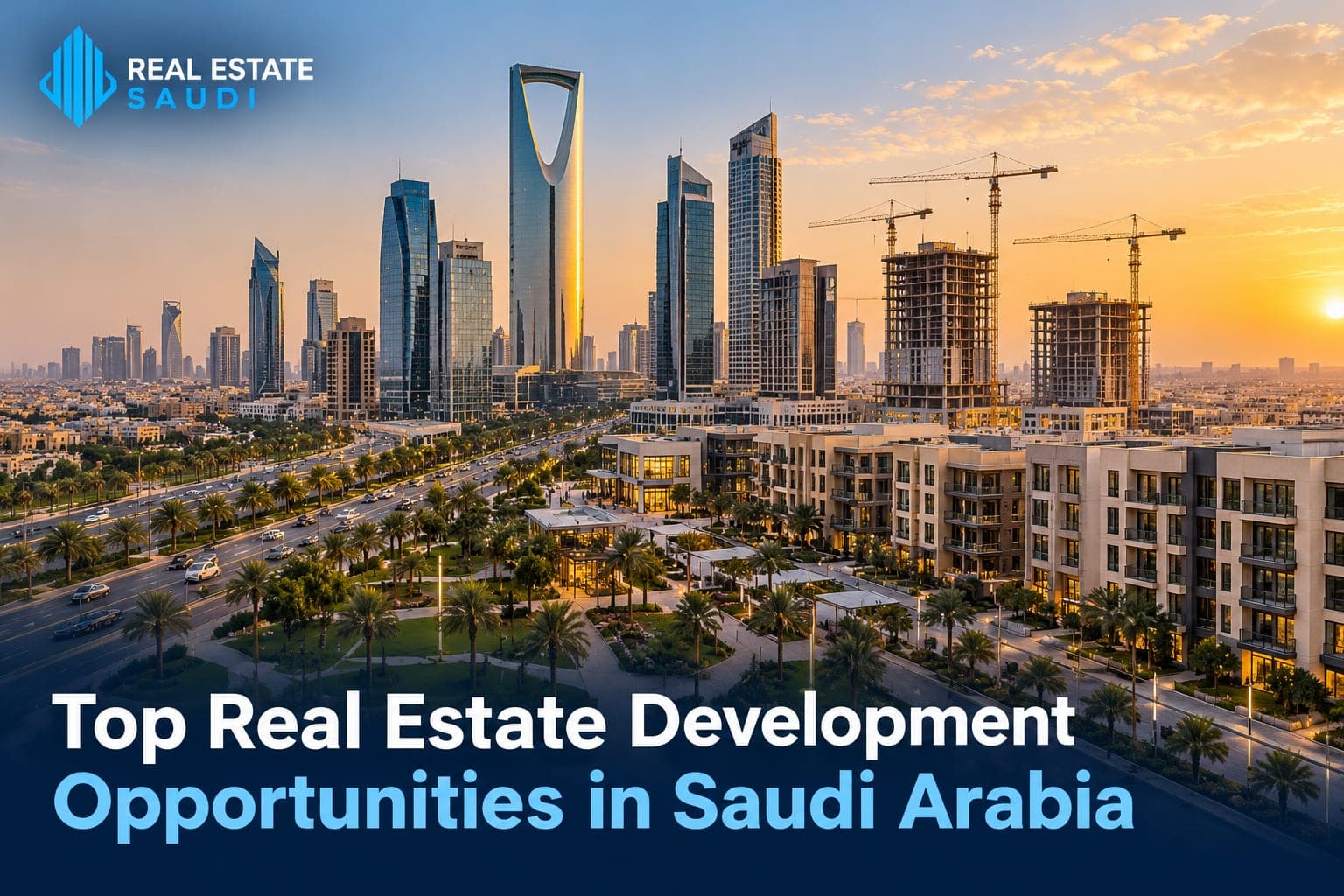
Saudi Arabia is undergoing one of the most significant urban development transformations in the Middle East. The Kingdom is expanding residential communities, commercial districts, hospitality destinations, logistics infrastructure, and mixed-use developments as part of its long-term economic diversification strategy.
For property developers, institutional investors, construction companies, and international real estate businesses, these changes are creating new opportunities across multiple regions and asset classes.
However, identifying the best real estate development opportunities in Saudi Arabia requires more than following announcements about large projects. Successful development depends on genuine demand, land availability, construction economics, planning approvals, financing arrangements, and the ability to deliver properties that buyers or tenants can afford.
Saudi Arabia's Vision 2030 strategy provides a framework for understanding the market. National housing objectives, tourism expansion, infrastructure investment, and private-sector participation are influencing where future development may become commercially viable.
This guide examines the strongest development sectors, leading locations, major projects, foreign participation rules, financial considerations, and risks shaping Saudi Arabia's property development landscape.
Why Saudi Arabia Is Attracting Real Estate Developers
Saudi Arabia's development market is supported by several structural changes occurring simultaneously.
Economic diversification is encouraging investment in activities beyond traditional oil-related industries. New business districts, tourism destinations, manufacturing facilities, and entertainment projects require extensive supporting real estate.
Population growth, household formation, internal migration, and changing residential preferences also influence the demand for housing.
One important indicator comes from the Saudi Vision 2030 Annual Report 2025, which reported that Saudi family homeownership reached 66.24% in 2025, exceeding the annual target of 65%. The long-term Vision 2030 objective remains 70%.
This progress demonstrates the importance of residential development within national policy. Nevertheless, growing homeownership does not automatically mean that every housing project will be profitable.
Developers must consider local purchasing power, mortgage affordability, competing housing supply, infrastructure readiness, and customer preferences.
How Vision 2030 Supports Property Development
Vision 2030 creates development opportunities through several interconnected channels:
Housing programs that support new residential communities.
Tourism initiatives requiring hotels, resorts, and visitor facilities.
Infrastructure investment improving access to emerging districts.
Economic diversification supporting offices and industrial properties.
Urban regeneration creating opportunities to redevelop established locations.
Regulatory reforms designed to improve transparency and participation.
These factors can strengthen long-term demand, but individual projects must still demonstrate financial feasibility.
1. Residential Housing Development Opportunities
Residential property development remains one of Saudi Arabia's most important real estate sectors.
Demand exists for affordable apartments, family villas, townhouses, gated communities, and integrated residential neighborhoods. However, the most appropriate product varies significantly between cities.
In Riyadh, developers may find opportunities in apartments and well-connected communities serving working households. In Jeddah, demand may be influenced by employment centers, coastal lifestyles, and established residential districts.
Secondary cities may offer opportunities for appropriately priced housing where local supply does not meet household requirements.
Affordable and Mid-Market Housing
Affordable and mid-market residential projects can provide a broader potential buyer base than exclusive luxury developments.
Developers can improve market suitability by offering efficient floor plans, manageable maintenance charges, practical parking, and access to schools, healthcare, and retail services.
An economically successful housing development must balance construction quality against the final selling price.
For example, a project offering attractive architectural features but exceeding local mortgage affordability may struggle to achieve its sales targets.
Developers should therefore begin with household income research and comparable completed sales rather than selecting a selling price solely from construction costs.
Master-Planned Residential Communities
Integrated communities bring residential properties together with neighborhood amenities, roads, utilities, green spaces, and commercial facilities.
Saudi Arabia's National Housing Company is an important participant in this sector. The official NHC residential development platform highlights projects and integrated destinations across the Kingdom.
Master-planned communities can create opportunities for residential developers, infrastructure contractors, retail operators, and specialized property management companies.
Smaller private developers may also participate through serviced land development, construction partnerships, or designated commercial plots, subject to contractual eligibility and approvals.
Readers exploring this sector can find additional context in our guide to government housing projects in Saudi Arabia.
Which property type & region do you prefer?
Select property type and preferred city in Saudi Arabia.
2. Mixed-Use Real Estate Development in Riyadh
Riyadh presents an important opportunity for developers because residential, commercial, hospitality, and institutional demand interact within the same metropolitan market.
Mixed-use developments combine multiple property functions, often including apartments, offices, retail outlets, restaurants, and leisure facilities.
This model can support diversified income streams while improving convenience for occupants.
Why Mixed-Use Projects Are Attractive
A development combining residential accommodation and neighborhood retail may generate demand throughout different periods of the day.
Office tenants can support restaurants and convenience stores, while residents provide regular demand for essential services.
Nevertheless, each component must be evaluated independently.
A strong residential market does not guarantee demand for premium office space, and a successful office location does not necessarily justify a large shopping center.
Developers should assess tenant requirements, pedestrian access, parking capacity, and the surrounding competitive environment.
Diriyah and Cultural Urban Development
Diriyah illustrates the growing importance of heritage-led mixed-use development.
The broader development program includes cultural attractions, hospitality, residential properties, commercial facilities, and leisure infrastructure.
In August 2026, Diriyah Company announced a SAR 2 billion financing agreement supporting branded residences in Diriyah and Wadi Safar.
The official Diriyah Company financing announcement demonstrates continued capital allocation to residential components of major destinations.
For developers, this trend highlights opportunities involving culturally sensitive architecture, branded residences, hospitality services, and supporting commercial facilities.
However, participation in major masterplans generally depends on the project's procurement arrangements, land ownership structure, and developer selection processes.
Our detailed guide to real estate development in Riyadh provides additional city-specific market context.
3. Commercial Office and Business District Development
Saudi Arabia's economic diversification is supporting demand for modern business premises, particularly in locations attracting corporate activity.
Commercial real estate development opportunities include headquarters offices, flexible workplaces, neighborhood business centers, and specialized professional facilities.
Riyadh is a prominent market for these uses, although commercial demand is uneven across districts and building grades.
Grade-A Office Development
Premium office buildings generally emphasize modern infrastructure, reliable building management, accessibility, security, and energy-efficient operations.
Corporations may prioritize telecommunications connectivity, floor-plate flexibility, transport access, and employee amenities.
Developers considering new office projects should investigate signed leasing commitments and the volume of competing space scheduled for completion.
Pre-leasing can substantially reduce speculative development risk.
Flexible and Smaller Office Spaces
Not every business requires a large corporate headquarters.
Small businesses, consultancies, startups, and professional service providers may prefer flexible offices with manageable lease commitments.
This creates potential demand for smaller offices, serviced workplaces, and business facilities within mixed-use neighborhoods.
However, flexible office models require active management and reliable occupancy rather than merely constructing attractive buildings.
For deeper analysis, see our guide to commercial real estate in Riyadh.
4. Tourism and Hospitality Real Estate Development
Tourism is creating a distinct category of development opportunities in Saudi Arabia.
Hospitality projects include hotels, serviced apartments, resorts, branded residences, entertainment facilities, and tourism-supporting retail spaces.
Unlike conventional residential development, these assets depend heavily on visitor demand, operating performance, and destination accessibility.
Red Sea Tourism Development
The Red Sea destination is an important example of tourism-led real estate development.
Red Sea Global has progressively opened resorts, visitor infrastructure, and leisure facilities as its destinations enter operational phases.
Its official Red Sea destination overview outlines the destination's hospitality, residential, and environmental development strategy.
The expansion can create opportunities across hotel development, tourism services, staff accommodation, destination retail, and construction supply chains.
However, developers should distinguish between investment in a destination's broader economy and direct ownership opportunities within the master development itself.
Land and project participation may remain subject to specific partnership structures.
Hospitality Development Beyond Luxury Resorts
Luxury coastal destinations attract substantial attention, but other hospitality segments also deserve consideration.
Business hotels near commercial districts, mid-market accommodation, and serviced apartments may serve different customer groups.
Regional tourism destinations can create demand for smaller hotels and specialized accommodation where transport access and visitor volumes justify the investment.
Feasibility studies should consider seasonal occupancy, average room rates, operating expenses, management fees, and capital replacement requirements.
Hotel development is operationally more complex than selling completed residential units, making professional hospitality expertise particularly valuable.
5. Jeddah Waterfront and Urban Regeneration Projects
Jeddah combines commercial activity, housing demand, tourism potential, and connectivity to western Saudi Arabia's wider economic region.
These characteristics make the city relevant for residential communities, hospitality properties, mixed-use developments, and urban regeneration.
Waterfront and Lifestyle Developments
Coastal locations can support premium residential properties, hotels, restaurants, and recreational facilities.
However, waterfront development involves additional technical considerations.
These include coastal planning restrictions, environmental requirements, corrosion-resistant construction materials, infrastructure capacity, and long-term maintenance expenses.
A coastal location alone does not guarantee premium selling prices.
Developers must evaluate accessibility, the surrounding urban environment, customer demand, and comparable completed projects.
Redevelopment Within Existing Districts
Opportunities are not limited to large, undeveloped land parcels.
Older properties in established neighborhoods may provide opportunities for refurbishment, redevelopment, or conversion into more commercially useful spaces.
Urban regeneration can be attractive when existing infrastructure and nearby amenities reduce the need to create an entirely new destination.
However, redevelopment requires careful examination of existing titles, building conditions, occupancy agreements, demolition restrictions, and municipal approvals.
For further market context, explore our analysis of real estate investment in Jeddah.
6. Industrial, Logistics, and Warehouse Development
Industrial and logistics real estate is another important segment of Saudi Arabia's development market.
Manufacturing expansion, distribution networks, e-commerce activity, and improvements in transport infrastructure can support demand for specialized facilities.
Potential developments include warehouses, distribution centers, light-industrial units, temperature-controlled storage, and manufacturing-support properties.
Modern Warehouse Development
Modern warehouses are increasingly designed around operational efficiency.
Important design considerations include suitable ceiling heights, loading access, floor load capacity, fire protection systems, circulation space, and convenient connections to freight routes.
A facility built for general storage may not meet the needs of a specialized logistics operator.
Developers should therefore identify target occupiers before finalizing building specifications.
Opportunities in the Eastern Province
Dammam, Al Khobar, and surrounding industrial areas benefit from established economic activity and transport connections.
Industrial demand can create opportunities for warehouses, employee accommodation, business facilities, and logistics-supporting properties.
Nevertheless, industrial land may have different zoning, environmental, utility, and licensing requirements from conventional residential sites.
Developers should also investigate industrial-zone incentives and restrictions instead of assuming that every land parcel can support the intended use.
Our guide to real estate investment in Dammam explains the region's broader property market.
7. Development Opportunities in Makkah and Madinah
Makkah and Madinah have specialized real estate markets influenced by religious visitation, local housing requirements, and service infrastructure.
Potential development categories include hotels, serviced accommodation, retail premises, residential buildings, and facilities supporting visitor activity.
The commercial attractiveness of a site depends on its location, transport access, operating restrictions, and demand characteristics.
Hospitality and Pilgrim Accommodation
Hotels and visitor accommodation may benefit from pilgrimage-related demand.
However, developers must evaluate seasonal fluctuations, transportation access, room pricing, operational efficiency, and competition.
Properties serving visitors may require different designs, management systems, and accessibility arrangements from conventional hotels.
High occupancy during peak periods does not necessarily translate into strong annual profitability.
Special Ownership Restrictions
Makkah and Madinah require particular attention to legal eligibility.
Foreign investors must not assume that all property ownership or development structures available elsewhere in Saudi Arabia automatically apply to the two holy cities.
Developers should obtain current regulatory guidance and legal advice before entering land acquisitions or project partnerships.
What is your approximate budget?
Narrow down property options based on your target budget.
8. Sustainable and Smart Building Development
Sustainability and building technology are becoming increasingly relevant to long-term development competitiveness.
A sustainable development may reduce resource consumption while improving indoor comfort, operating performance, and maintenance efficiency.
Opportunities include energy-efficient residential buildings, water-saving systems, solar-ready infrastructure, smart building management, and improved construction materials.
Energy and Water Efficiency
Saudi Arabia's climate makes cooling efficiency an important design consideration.
Appropriate insulation, glazing, shading, ventilation, and mechanical systems can reduce building operating costs.
Water-efficient landscaping and plumbing can also improve resource performance.
However, sustainability upgrades should be assessed through their lifecycle economics.
A more expensive system is not necessarily the best choice unless its performance, durability, and operating savings justify the additional capital cost.
Smart Property Infrastructure
Digital building management can improve maintenance planning, utility monitoring, security, and tenant communication.
For large communities, technology may also support centralized facility management and more efficient service delivery.
Developers should prioritize reliable systems that occupants can use and property managers can maintain.
Technology that increases maintenance complexity without delivering measurable benefits may reduce rather than improve investment performance.
Best Saudi Cities for Real Estate Development
Saudi Arabia's development opportunities differ by local economic structure, population characteristics, infrastructure, and land availability.
Location | Potential Development Focus | Main Consideration |
|---|---|---|
Riyadh | Housing, offices, mixed-use communities | Land costs and competing supply |
Jeddah | Housing, waterfront, hospitality | Location and infrastructure |
Dammam | Logistics, industrial, residential | Industrial demand and zoning |
Al Khobar | Residential and commercial projects | Tenant demand and competition |
Makkah | Hospitality and residential services | Ownership and operating restrictions |
Madinah | Hospitality and community development | Location-specific visitor demand |
Red Sea region | Tourism and destination services | Project access and operational demand |
Asir | Tourism and regional housing | Connectivity and seasonality |
This comparison is an opportunity-screening framework rather than a ranking based on projected returns.
The strongest city for a development depends on its intended customers, available capital, land costs, and execution capabilities.
How Foreign Developers Can Participate
Saudi Arabia's regulatory environment has evolved to accommodate wider real estate participation.
The revised Law of Real Estate Ownership by Non-Saudis entered into force on January 22, 2026.
According to the Real Estate General Authority's official ownership guidance, foreign ownership is governed by eligibility criteria, designated geographical parameters, and applicable regulatory requirements.
The Saudi Properties portal provides the official channel for relevant ownership procedures.
International developers may explore partnerships, qualifying property acquisitions, joint ventures, or locally established investment structures, depending on their legal status and the proposed activity.
However, holding a property ownership right is not equivalent to receiving permission to undertake every category of development.
Additional corporate, investment, planning, construction, and operating approvals may apply.
Before committing capital, foreign developers should establish whether their proposed ownership structure, geographic location, and development activity are legally permitted.
Financing Real Estate Development Projects
Development financing is among the most important factors determining project feasibility.
A profitable-looking project may become unattractive when borrowing costs, construction delays, taxes, and selling expenses are included.
Common Financing Structures
Developers may use shareholder equity, bank construction finance, joint ventures, phased development arrangements, and qualifying investment vehicles.
The appropriate structure depends on the project's scale, security arrangements, developer experience, and expected repayment source.
Bank lenders may examine project approvals, land ownership, developer financial strength, pre-sales, and construction contracts.
Relevant capital-market structures must also meet their applicable regulatory requirements.
For example, the Capital Market Authority's real estate ownership controls address eligible listed companies, investment funds, and special-purpose entities.
Developers should evaluate financing structures alongside their broader real estate financing options in Saudi Arabia.
How to Evaluate a Real Estate Development Opportunity
Before acquiring land or entering a construction partnership, developers should complete a structured feasibility study.
Step 1: Establish Local Market Demand
Identify the target customer and assess actual purchasing or leasing activity.
Use completed transactions, comparable rental evidence, household affordability, and absorption rates where reliable information is available.
Avoid depending exclusively on advertised property prices.
Step 2: Verify Land and Planning Conditions
Confirm legal title, permitted land use, development density, road access, infrastructure connections, and building restrictions.
Any assumptions about rezoning or infrastructure expansion should be supported by documented approvals.
Step 3: Estimate Total Development Costs
Project budgets should cover land, design, construction, permits, utilities, professional fees, financing, marketing, taxes, and contingencies.
The initial construction quotation rarely represents the complete project cost.
Step 4: Test Financial Feasibility
Prepare base-case, optimistic, and downside scenarios.
Evaluate selling prices, construction escalation, delays, financing costs, and changes in occupancy.
For income-generating property, assess net operating income and realistic capitalization assumptions.
Step 5: Assess the Exit Strategy
Determine whether the project will generate returns through unit sales, long-term leasing, refinancing, or a completed-asset sale.
The exit strategy influences project design, capital requirements, and financing risk.
A development suitable for long-term institutional ownership may differ substantially from one intended for immediate individual unit sales.
Major Risks Facing Real Estate Developers
Saudi Arabia offers significant development potential, but investors should avoid treating national development expenditure as a guarantee of individual project success.
Construction Cost Inflation
Changes in labor costs, building materials, logistics, and contractor availability may increase total project expenditure.
Developers should establish contingencies and carefully negotiate construction contracts.
Oversupply in Selected Segments
Rapid construction activity can increase competition.
A district with multiple similar projects may experience slower sales, higher incentives, or weaker rental performance.
Supply pipelines must be considered alongside demand forecasts.
Financing and Interest-Rate Risk
Financing expenses can reduce development margins and increase pressure on project cash flows.
Interest-rate movements and tighter lending conditions may also affect buyer affordability.
Delivery and Regulatory Risk
Permitting delays, utility connections, land issues, contractor disputes, and changing regulatory requirements can affect development timelines.
Projects should maintain appropriate legal review, independent engineering oversight, and documented risk management procedures.
Liquidity and Exit Risk
Real estate development is capital intensive.
Even where the completed project has market value, finding a buyer at the expected price may take longer than planned.
Developers should avoid depending on uninterrupted price appreciation or rapid sales.
How would you like to be contacted?
Choose your preferred channel for a private consultation.
Future Outlook for Saudi Real Estate Development
Saudi Arabia's real estate development market is likely to remain shaped by housing requirements, economic diversification, tourism infrastructure, business activity, and changing investment regulations.
However, different property segments may perform differently.
Residential developers may benefit from targeting genuine affordability gaps. Commercial developers should focus on demonstrable tenant demand. Hospitality projects require robust operating forecasts, while industrial developments must match occupier specifications and logistics requirements.
The next stage of development is likely to place increasing emphasis on execution quality, capital discipline, sustainability, and completed infrastructure rather than project announcements alone.
Developers capable of combining accurate market research, appropriate product design, responsible financing, and regulatory compliance will be better positioned to identify commercially sustainable projects.
Conclusion
The top real estate development opportunities in Saudi Arabia extend across residential communities, mixed-use districts, commercial offices, hospitality destinations, industrial facilities, and sustainable buildings.
Riyadh offers extensive opportunities associated with urban and corporate demand. Jeddah combines residential, commercial, and tourism-related potential. The Eastern Province provides exposure to logistics and industrial activity, while Makkah, Madinah, and major tourism destinations require specialized approaches.
Saudi Arabia's development transformation creates meaningful possibilities for domestic and international participants, but successful projects must be based on verified demand, realistic costs, appropriate legal structures, and achievable timelines.
Investors and developers should prioritize feasibility over promotional projections and evaluate every project according to its individual financial and regulatory characteristics.
Disclaimer: This article is intended for general informational purposes and does not constitute legal, financial, tax, or investment advice. Property regulations, project timelines, ownership rules, and market conditions may change. Developers and investors should consult qualified professionals and relevant Saudi authorities before making investment decisions.
Talk to Our Real Estate Experts
Get real-time insights on investment options, commercial properties, and market guidelines.
Frequently Asked Questions
Important opportunities include affordable residential housing, mixed-use communities, commercial offices, tourism accommodation, logistics warehouses, and sustainable buildings. The best option depends on location, demand, construction costs, regulatory approvals, and investor objectives.
Saudi Arabia offers substantial development activity supported by housing objectives, economic diversification, and infrastructure projects. However, profitability varies by location and asset class. Developers should conduct independent market research and project-level feasibility analysis before investing.
Riyadh has a broad range of residential and commercial opportunities, while Jeddah offers housing, hospitality, and mixed-use development potential. Dammam and Al Khobar may be attractive for industrial and logistics-related properties. No single city is best for every development strategy.
Foreign companies may participate through qualifying legal and investment structures, subject to ownership eligibility, geographical rules, business licensing, and project approvals. The updated ownership framework took effect in January 2026, but permissions vary according to the investor and project.
Vision 2030 supports housing availability, economic diversification, tourism expansion, urban infrastructure, and private-sector participation. These initiatives create demand drivers for real estate, although they do not guarantee returns for specific projects.
Residential development can be profitable when land acquisition, construction costs, financing, selling prices, and buyer demand are appropriately balanced. Poorly located or overpriced housing projects may experience low margins even in expanding markets.
Major risks include construction cost increases, financing expenses, permitting delays, oversupply, weak market demand, contractor performance, and difficulties selling completed assets. Regulatory and ownership compliance are particularly important for international developers.
Hotels, resorts, serviced apartments, and tourism-related facilities can benefit from destination development and visitor demand. However, hospitality investments require careful evaluation of occupancy, operating costs, seasonality, management arrangements, and competition.
Capital requirements vary widely depending on land location, development type, building size, infrastructure needs, and financing structure. A small residential project and a major mixed-use development have fundamentally different budgets. A detailed feasibility study is required to estimate realistic capital needs.
Investors should begin with market demand, legal ownership eligibility, land-use approval, construction costs, financing requirements, project cash flow, and exit strategy. Comparing realistic downside scenarios is essential before entering development partnerships or purchasing land.
