
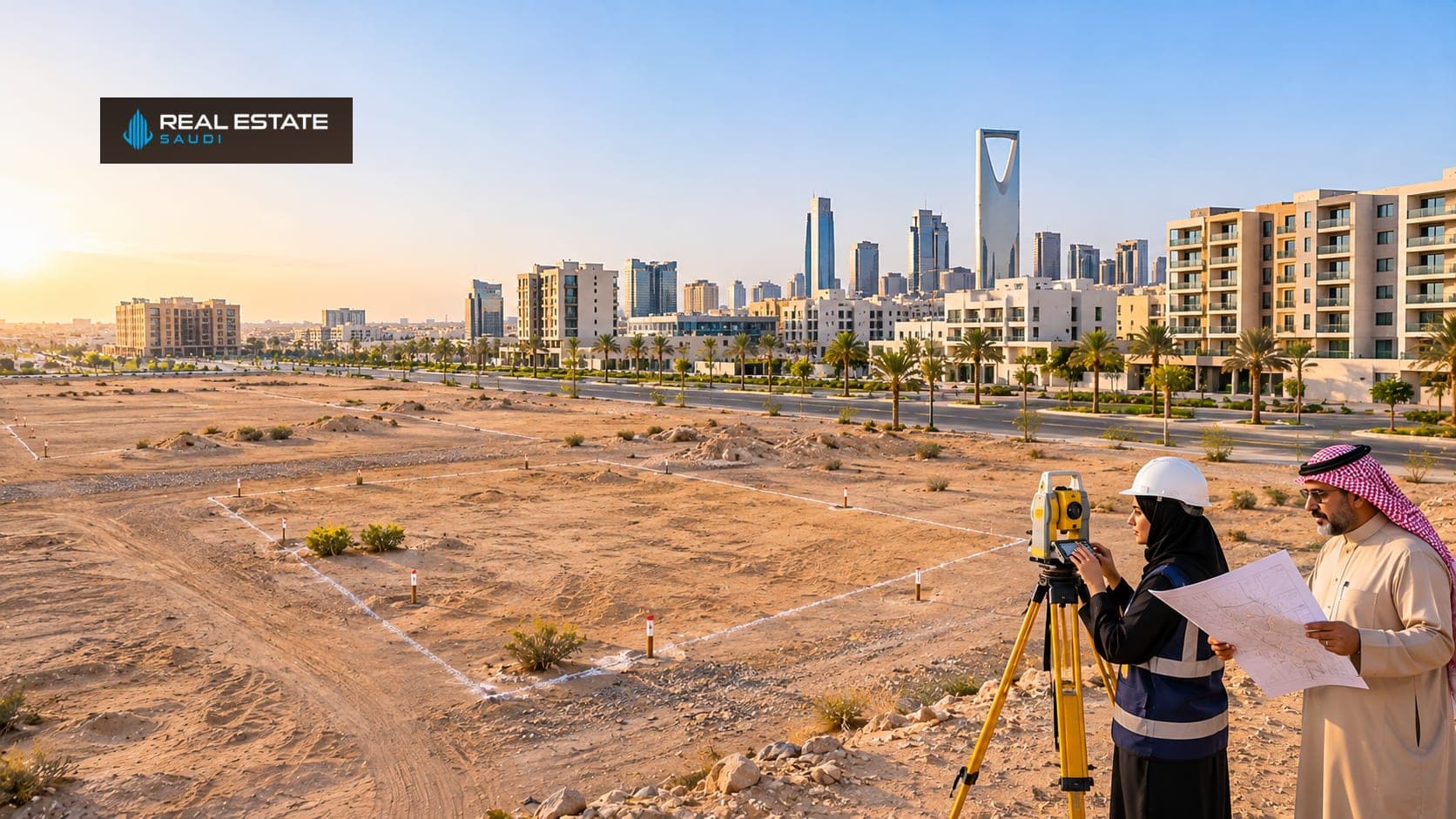
Saudi white land fees are annual charges imposed on qualifying undeveloped urban land to encourage development, increase property supply and discourage long-term land hoarding. Under Saudi Arabia's amended White Land and Vacant Properties Fees Law, the annual rate can reach 10% of the assessed land value in designated high-priority development areas.
A major regulatory development in 2026 also changed how land transactions are completed. Cabinet Decision No. 263, published on 4 September 2026, requires authorities to verify payment of outstanding fees before officially documenting an ownership transfer involving land covered by the law.
For landowners, developers and investors planning transactions in 2027, these requirements affect holding costs, property due diligence and the timing of sales. However, the rules do not mean that every vacant plot automatically incurs a 10% fee or that every Saudi property sale requires white-land clearance.
This guide explains the current annual rates, eligibility conditions, geographical implementation, transfer restrictions, exemptions, payment procedures and practical compliance steps for 2027.
What Are Saudi White Land Fees?
Saudi white land fees are recurring regulatory charges imposed on qualifying undeveloped land within designated urban areas. Their purpose is to encourage owners to develop or make land available for development, supporting a more balanced relationship between housing demand and the supply of usable property.
The programme is administered under the Ministry of Municipalities and Housing and operates through designated geographical areas and official assessments.
The Ministry of Municipalities and Housing's updated implementing-regulations announcement explains that the framework allows annual charges of up to 10% of the assessed land value, depending on the development-priority classification.
The regulations establish conditions concerning location, land area, ownership and development status. Consequently, the fee is not an ordinary nationwide annual property tax imposed simply because someone owns real estate.
Why Does Saudi Arabia Charge Fees on Undeveloped Land?
Large undeveloped plots within established urban areas can limit the availability of land suitable for housing and commercial construction. When owners retain developable plots without bringing them into productive use, this may constrain market supply.
The programme seeks to encourage construction, development and the release of land into the market.
Fee revenue can also support housing-related projects and infrastructure according to the applicable legal framework.
However, the economic impact should not be overstated. Higher fees do not guarantee that every affected plot will be developed or that land prices will decline immediately.
Actual results depend on infrastructure, financing, planning permissions and demand.
Saudi White Land Fees: What Changed Under the 2025–2026 Reforms?
The most significant legislative change was Royal Decree No. M/244, which amended the existing framework in May 2025 and expanded it into the White Land and Vacant Properties Fees Law.
The amendments increased the potential annual charge on qualifying white land from the earlier 2.5% framework to a maximum of 10%.
They also introduced a separate regulatory framework for qualifying vacant properties.
The amended regime was followed by updated white-land implementing regulations in August 2025 and separate vacant-property implementing regulations published in May 2026.
Updated White Land Fee Rates
The revised system classifies geographical areas according to urban development priorities.
Areas considered most important for development can attract higher annual rates, while other areas may receive lower rates or fall outside the fee obligation.
The applicable percentage is determined through official geographical announcements, not by the individual owner's preference.
Property investors should therefore identify the relevant classification before applying a fee percentage to a particular parcel.
Expanded Scope Beyond Residential Land
The amended regime covers qualifying developable vacant land within urban boundaries under the relevant legal conditions.
It is no longer appropriate to assume that only conventional residential plots can fall within the framework.
Permitted land use, geographical designation and development potential are important factors.
A plot intended for commercial activity may require assessment if it falls within the applicable scope.
However, legal or physical constraints affecting development can be relevant to exemptions or adjustments.
Which property type & region do you prefer?
Select property type and preferred city in Saudi Arabia.
Which Land Is Subject to White Land Fees?
A central eligibility condition is the land-area threshold. The updated framework generally requires the qualifying land, or the combined qualifying landholdings of a single owner within the relevant city, to reach at least 5,000 square metres.
This does not mean every privately owned 5,000-square-metre plot automatically attracts a fee.
The land must also satisfy the geographical, development-status and other statutory conditions.
Ownership structure, applicable announcements and potential exclusions should be reviewed.
Individual Plots and Combined Holdings
The programme can consider multiple qualifying parcels owned by the same person when evaluating the relevant area threshold.
Consequently, dividing land into several smaller plots does not necessarily remove the overall holding from assessment.
Where land is jointly owned, the regulations address the allocation of obligations according to the owners' respective interests.
Investors should obtain a complete picture of the applicable holdings instead of examining each parcel in isolation.
Land That Cannot Legally Be Developed
The implementing regulations recognise circumstances in which owners face legal impediments or obstacles preventing necessary development permissions.
Where the owner did not cause the restriction, the circumstances may affect the fee obligation.
However, an exemption should not be assumed merely because development would be expensive or commercially unattractive.
Owners must establish the relevant facts and submit supporting evidence through the applicable procedure.
Riyadh White Land Fee Rates and Development Priority Zones
Riyadh provides one of the clearest examples of how the revised fee structure operates.
In August 2025, the Ministry announced geographical priority zones for white-land charges within the capital.
The Saudi Press Agency's official Riyadh implementation announcement confirms that the first invoices under the revised system began on 1 January 2026 and identifies the applicable development-priority categories.
The rates are linked to the location and priority classification of qualifying land, rather than applying one percentage across the entire city.
Quick Facts: Riyadh White Land Fee Structure
Geographical Classification | Annual Fee Rate | General Treatment |
|---|---|---|
Highest development priority | 10% | Qualifying land in designated highest-priority areas |
High development priority | 7.5% | Qualifying land in designated high-priority areas |
Medium development priority | 5% | Qualifying land in designated medium-priority areas |
Lower development priority | 2.5% | Qualifying land in designated lower-priority areas |
Outside designated priority tiers | 0% | No fee under that tier, subject to applicable area-assessment rules |
These percentages describe Riyadh's announced implementation categories. They should not be applied automatically to every plot in Jeddah, Dammam or another Saudi city.
How Land Location Affects Annual Liability
A plot within a designated highest-priority area can face substantially higher holding costs than a comparable parcel within a lower-priority zone.
For example, consider a hypothetical qualifying parcel assessed at SAR 10 million.
At 10%, the annual charge would be SAR 1 million. At 5%, it would be SAR 500,000, assuming the same assessment value and full-year applicability.
These are arithmetic illustrations, not actual invoices or independent valuations.
Investors researching real estate investment opportunities in Riyadh should assess whether holding undeveloped land creates substantial annual expenses compared with developing or selling it.
How Saudi White Land Fees Are Calculated
The fee calculation generally combines the land's officially assessed value with the percentage applicable to its designated geographical category.
The basic calculation is:
Annual White Land Fee = Assessed Land Value × Applicable Annual Fee Rate
The assessment value is not necessarily the amount originally paid for the land or the current asking price in a property advertisement.
The competent authority determines values and applies the statutory assessment procedures.
Landowners should review the official assessment before using it for financial planning.
Why Official Valuation Matters
Property values can vary considerably according to location, plot size, permitted development and infrastructure.
A seller may advertise land for a price that differs from its official assessment.
The fee liability must therefore be based on the amount and classification determined through the applicable regulatory process.
Where owners dispute the assessment, the relevant objection procedure should be followed.
An informal valuation prepared for a sale cannot automatically replace the competent authority's assessment.
New Property Transfer Rules Under Cabinet Decision No. 263
A major legal development occurred when Saudi Arabia introduced an additional requirement affecting ownership transfers of fee-liable land.
Cabinet Decision No. 263 was adopted on 25 August 2026 and published in the Official Gazette on 4 September 2026.
The official Umm Al-Qura publication of Cabinet Decision No. 263 states that ownership-transferring transactions involving land subject to the White Land and Vacant Properties Fees Law cannot be officially documented until payment of the fees due has been verified.
This is a property-transfer clearance requirement rather than a new annual fee percentage.
What Transactions Are Affected?
The clearest example is the sale of fee-liable land from one owner to another.
Other transactions that legally transfer ownership may also require the relevant payment verification.
The rule concerns land subject to the law where fees are due. It does not impose the same requirement automatically on ordinary apartments or every residential sale.
For an affected transaction, outstanding liability may delay the official documentation of ownership transfer.
Buyers should therefore investigate the fee position before agreeing to a fixed completion date.
Does an Unpaid Fee Cancel the Sale?
The published Cabinet decision prevents documentation of the relevant ownership transfer until payment is verified.
It does not establish that every underlying private purchase agreement automatically becomes invalid.
Contractual remedies, termination rights and liability for delay depend on the agreement and applicable Saudi law.
A buyer should not release the full purchase price without appropriate protections when a transfer cannot yet be documented.
The existing Real Estate Saudi analysis of the property-transfer clearance decision explains the decision's specific consequences for buyers, sellers and transaction professionals.
What Happens to Mortgages and Other Non-Ownership Transfers?
Cabinet Decision No. 263 also addresses transactions involving affected land that do not themselves transfer ownership.
These transactions must preserve the government's ability to collect outstanding fees and must not obstruct development.
The precise procedures are to be governed by the relevant ministerial committee.
A mortgage or security arrangement should therefore not automatically be treated in the same way as a completed sale.
The classification depends on the legal nature of the transaction and the applicable procedures.
Banks and developers should establish the current verification requirements before advancing a financed transaction involving potentially fee-liable land.
Why Lenders Need Additional Due Diligence
Outstanding land charges may affect financing timelines, registration arrangements and the lender's assessment of transaction risk.
The Real Estate General Authority's ownership transfer service describes the documentation, registration and applicable tax requirements for eligible registered-property transfers.
White-land fee clearance is a separate compliance issue that may affect the transaction where Cabinet Decision No. 263 applies.
Lenders should request suitable evidence rather than assume that a conventional title check resolves every fee-related concern.
Seller Responsibilities Before Transferring Land
A seller preparing to transfer land should determine its fee status well before negotiating the closing date.
The process begins by identifying the relevant land parcel and confirming whether it falls within an announced fee area.
The owner should then review any official invoice, assessment, exemption or pending objection.
Where fees are payable, the seller should establish the amount due and the payment position.
The parties should identify who will bear the relevant costs under their contractual arrangements, without assuming that a private agreement can override statutory liability.
Evidence Buyers Should Request
Buyers should ask for the latest available fee records and evidence of payment where relevant.
The records should correspond to the precise parcel, title details and applicable assessment period.
If the owner claims an exemption, supporting official documentation should be requested.
A seller's informal statement that the land is free from charges is insufficient for a high-value transaction.
The Saudi property-document verification guide explains the broader importance of examining title information, ownership authority and outstanding property obligations.
What is your approximate budget?
Narrow down property options based on your target budget.
How to Check White Land Fees Before Buying Property
Saudi authorities provide electronic services that assist owners and prospective purchasers in investigating whether land is subject to outstanding charges.
The official programme has provided deed-number-based inquiry services for fee-related checks.
The exact documentation used for transfer clearance must comply with the applicable official procedures.
A portal inquiry is useful but should not automatically be described as a final government clearance certificate.
Check the Land's Registered Details
Begin by obtaining the correct title deed number and property identification information.
Confirm that the seller's documents refer to the same parcel being offered for sale.
Next, investigate whether the land falls within an applicable geographic fee area.
The Ministry's official White Land Registration Requests service explains how landowners and authorised representatives can register qualifying land through the electronic system.
Registration is not the same as confirmation that every assessed obligation has been paid.
Review the Latest Official Assessment
Where a fee invoice exists, examine the assessment period, amount and payment deadline.
Ask whether the owner has filed an objection or received an exemption decision.
These details can influence the proposed completion timetable.
For a financed transaction, coordinate with the lender and legal adviser before finalising the purchase agreement.
Do not assume that a pending objection automatically permits an otherwise restricted transfer.
Exemptions and Development Obstacles
The regulations recognise that some landowners may be unable to develop their property because of restrictions beyond their control.
Legal impediments affecting development permits can be relevant where the owner did not create the obstacle.
However, exemptions and adjustments depend on the statutory conditions and required evidence.
When Development Is Legally Prevented
An owner experiencing a genuine regulatory obstacle should collect relevant correspondence, planning documents and permit records.
The Etmam service for investigating obstacles to developing white land assists applicants by reviewing supporting documents and coordinating with relevant authorities where appropriate.
This service can help establish whether the obstacle may justify reconsideration of the fee assessment.
A request for assistance does not automatically guarantee exemption.
Completing Development Within the Permitted Period
Under the implementing framework, qualifying completion of development or construction within the statutory period may affect the application of fees.
Owners should identify the relevant regulatory deadline and maintain documentary evidence of completion.
A preliminary concept plan or unimplemented construction proposal should not automatically be treated as completed development.
Where an extension is available, the applicant must follow the authorised procedure and provide the required justification.
Vacant Property Fees Versus White Land Fees
Saudi Arabia's amended law also addresses qualifying buildings that remain unused for extended periods.
This is a distinct category from undeveloped land.
The official vacant-property implementing regulations, published in May 2026, establish the framework for identifying vacant buildings, relevant geographical areas and assessment procedures.
Vacant-property fees can reach up to 5% of the assessed equivalent rental value under the applicable framework.
However, the adoption of implementing regulations does not mean that every empty building nationwide is automatically subject to a fee.
The competent authority must determine the relevant locations and conditions.
What Counts as a Vacant Building?
The framework considers whether a building has remained unused for a qualifying period without acceptable justification.
The implementing rules address vacancy lasting six consecutive or non-consecutive months within the relevant reference year, subject to the applicable conditions.
Occupancy evidence, approved use and local geographical announcements can affect an assessment.
Owners should not assume that temporary vacancy during ordinary tenant turnover automatically establishes liability.
The relevant statutory criteria must be applied to the individual property.
White Land Fees Compared with Real Estate Transaction Tax
White-land fees and Real Estate Transaction Tax are separate obligations.
White-land fees are recurring charges connected with qualifying undeveloped land, while Real Estate Transaction Tax generally applies when taxable real estate is transferred.
The Zakat, Tax and Customs Authority's Real Estate Transaction Tax Law establishes a general 5% RETT rate, subject to exemptions and transaction-specific provisions.
A sale involving fee-liable land may therefore require consideration of both unpaid white-land fees and the applicable transfer tax.
Investors reviewing the Saudi real estate taxes guide should distinguish recurring land charges from transaction expenses and any separate regulatory fees.
Impact on Property Investors and Developers
The revised rules can materially influence the cost of retaining large undeveloped urban landholdings.
A high annual fee may reduce the financial attractiveness of waiting indefinitely for land values to appreciate.
Developers may instead reassess construction timing, infrastructure requirements or disposal opportunities.
However, the practical response varies by location, financing availability and the viability of development.
A parcel with substantial planning obstacles may require a different strategy from a fully serviced residential site.
Land Supply and Housing Development
The programme is intended to encourage productive land use and increase developed property supply.
In October 2026, authorities reported progress involving land in Tabuk, Hail and Jazan.
Real Estate Saudi's report on white-land development across three Saudi regions examines approximately seven million square metres entering development or trading pathways.
However, land entering trading should not automatically be counted as completed housing.
The effect on residential prices depends on how much land is actually developed, the availability of infrastructure and final housing demand.
Common Mistakes Landowners and Buyers Should Avoid
One frequent mistake is assuming that the highest annual rate applies to every undeveloped parcel.
Another is overlooking combined landholdings when evaluating the applicable area threshold.
Buyers may also fail to ask about outstanding invoices until the scheduled ownership transfer date.
This can create avoidable delays and contractual disputes.
Landowners should not assume that a claimed development obstacle will be accepted without supporting evidence.
The guide to real estate investment risks in Saudi Arabia provides broader context on legal, financial and project-related risks.
Before closing, the parties should verify the property, identify relevant liabilities and ensure that the agreement addresses delays or outstanding obligations.
How would you like to be contacted?
Choose your preferred channel for a private consultation.
Saudi White Land Fees: Compliance Priorities for 2027
For 2027 transactions, owners and investors should prioritise accurate information about geographical coverage, official assessments, outstanding payments and the requirements governing ownership documentation.
The most important change is that qualifying unpaid fees can affect the ability to document a transfer, not merely the cost of holding land.
Owners should maintain current land records, monitor official announcements and respond to assessment notices within the applicable deadlines.
Buyers should obtain appropriate evidence before committing substantial funds, while developers should assess how annual fees affect project economics.
Any newly issued implementation procedures should be reviewed before closing because the detailed verification mechanism may evolve.
Conclusion
Saudi white land fees represent an important part of the Kingdom's efforts to encourage urban land development and improve real estate supply. Under the amended framework, annual charges can reach 10% of assessed land value in designated high-priority areas, while eligibility depends on location, land area, ownership and development conditions.
Cabinet Decision No. 263 adds a significant property-transfer requirement by making payment verification necessary before documenting qualifying ownership transfers.
For 2027, buyers and sellers should investigate official assessments, unpaid amounts, applicable exemptions and the contractual consequences of delay.
Careful due diligence, accurate documentation and appropriate professional advice are essential when purchasing or disposing of land potentially subject to these rules.
Talk to Our Real Estate Experts
Get real-time insights on investment options, commercial properties, and market guidelines.
Frequently Asked Questions
Saudi white land fees are annual regulatory charges imposed on qualifying undeveloped land within designated urban areas. The amended law allows rates of up to 10% of assessed land value, depending on the geographical development-priority classification. The applicable rate and liability depend on official assessments, land area and statutory conditions. Not every vacant plot is automatically subject to the charge.
The amended framework allows an annual rate of up to 10% of the assessed land value. Riyadh's announced categories include 10%, 7.5%, 5% and 2.5%, with another category outside the applicable priority tiers. The highest rate should not be applied to every property nationwide. The actual charge depends on geographical implementation and the relevant assessment.
A plot smaller than 5,000 square metres is not automatically exempt in every circumstance because the regulations may consider the combined qualifying landholdings of the same owner within the relevant area. Owners should assess the applicable aggregate threshold, geographical coverage and statutory conditions. An individual plot's size alone may not establish whether the owner has a fee obligation.
Cabinet Decision No. 263 requires verification that fees due on covered land have been paid before an ownership-transferring transaction can be officially documented. The rule applies to land within the relevant legal framework where fees are outstanding. It does not establish that every ordinary property transfer in Saudi Arabia requires white-land fee clearance.
No. Cabinet Decision No. 263 establishes a national legal requirement concerning qualifying land transfers. However, whether a specific parcel owes fees depends on the applicable geographical designation, implementation stage and statutory conditions. Riyadh has announced detailed priority zones, but the same rates and geographical classifications should not automatically be applied to every other Saudi city.
The legal framework provides procedures for challenging qualifying assessments. For Riyadh's January 2026 invoices, the Ministry announced an objection period of 60 days from notification, subject to the applicable procedural requirements. Owners should examine their assessment notice and submit supporting evidence within the correct deadline. A pending objection should not automatically be treated as payment clearance.
Saudi Arabia introduced a separate regulatory framework for qualifying vacant buildings under the amended law. The charge can reach up to 5% of the assessed equivalent rental value, subject to geographical implementation and other conditions. A property is not automatically liable simply because it is temporarily empty. Owners must review the applicable vacancy criteria and official announcements.
Statutory liability depends on the applicable law, assessment and ownership circumstances. Buyers and sellers may allocate certain financial responsibilities through their purchase contract, but contractual terms do not automatically override statutory obligations. Since unpaid fees can prevent documentation of a qualifying transfer, the parties should establish the payment position and resolve outstanding liabilities before closing.
No. White-land fees are recurring charges affecting qualifying undeveloped urban land, while Real Estate Transaction Tax generally applies at 5% to taxable real estate transactions. A sale of fee-liable land may involve both obligations. Buyers should calculate them separately and verify any applicable exemptions, additional charges and transaction-specific requirements.
Buyers should obtain the correct title deed details and investigate the parcel through the official White Land Fees programme. They should also request the latest assessment, payment evidence and exemption or objection records from the seller. The final transfer-clearance procedure must follow the applicable official requirements. A preliminary portal inquiry alone should not be treated as unconditional approval to complete the transaction.
