
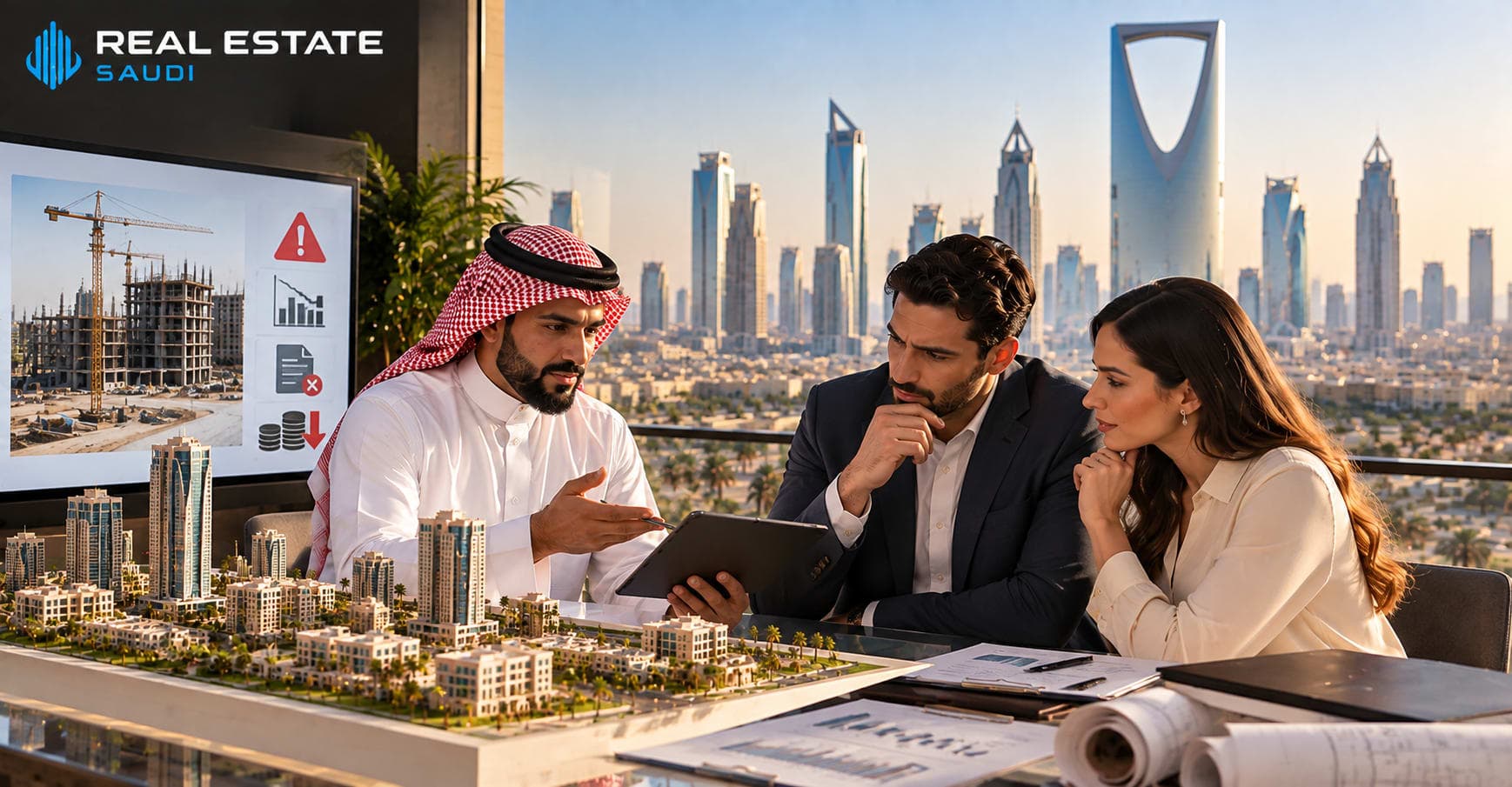
While the Saudi Arabian real estate sector presents extraordinary investment opportunities underpinned by sovereign Vision 2030 spending, no real estate market is free of risk. Intelligent property investment requires identifying, evaluating, and mitigating structural risks before capital is committed.
This authoritative guide details the 5 primary risks facing property investors in Saudi Arabia and outlines practical legal, financial, and operational safeguards to mitigate each.
1. Off-Plan Construction Delays & Developer Insolvency
Historically, off-plan projects in emerging markets have faced execution delays and capital mismanagement. In Saudi Arabia, this risk is mitigated through comprehensive state regulation:
- The Risk: Unlicensed private developers failing to complete construction milestones, resulting in frozen capital and missed rental revenue.
- The Mitigation: Never invest in off-plan developments without verifying the project's active Wafi accreditation from the Ministry of Housing. Under Wafi regulations, buyer funds must sit in an audited project-specific escrow account released only upon independent engineering sign-offs. Always review the developer's historical delivery record and balance sheet before signing.
Which property type & region do you prefer?
Select property type and preferred city in Saudi Arabia.
2. Market Liquidity & Secondary Resale Disparities
- The Risk: Purchasing assets in speculative, remote peripheral suburbs where infrastructure (schools, paved roads, sewage, commercial plazas) has not arrived, resulting in poor tenant demand and illiquidity on exit.
- The Mitigation: Focus capital within proven urban growth corridors with active municipal services. In Riyadh, focus on North Riyadh transit corridors (Hittin, Al Malqa, Al Narjis); in Jeddah, focus on North Obhur and the Corniche. Prioritize standard 2-bedroom configurations which boast the highest liquidity in both resale and rental markets.
3. Interest Rate & SAIBOR Volatility on Mortgages
- The Risk: Floating-rate Islamic financing structures (such as variable-rate Ijara) expose borrowers to escalating monthly installments if benchmark rates (SAIBOR) rise.
- The Mitigation: Secure fixed-rate Murabaha financing where the profit margin and monthly payment are locked for the entire tenure of the loan (up to 25 or 30 years). Maintain a conservative Debt Burden Ratio (DBR) well below SAMA's maximum 55% cap.
What is your approximate budget?
Narrow down property options based on your target budget.
4. Regulatory & Foreign Ownership Compliance Risks
- The Risk: Non-Saudi buyers attempting to purchase property through informal "nominee" agreements or in restricted non-freehold zones, risking severe legal forfeiture under Anti-Commercial Concealment (Tasattur) legislation.
- The Mitigation: Operate exclusively through certified legal channels: REGA digital verification for Iqama residents, the Premium Residency Real Estate Owner route (SAR 4M+ ready property), or licensed MISA foreign investment corporate entities. Always engage an independent, licensed Saudi legal advisor to review acquisition structures.
5. White Land Tax & Hidden Municipal Encumbrances
| Potential Property Risk | Financial & Legal Impact | Required Pre-Purchase Verification |
|---|---|---|
| Unpaid White Land Fees (Rusum) | Deed transfer frozen until seller or buyer pays multi-year municipal land tax arrears. | Demand official Ministry of Housing White Land Tax clearance certificate prior to signing. |
| Latent Structural Defects | Costly foundation repairs, MEP failures, water leakage. | Commission an independent Taqaweem-certified building inspector and verify the 10-year decennial structural warranty. |
| Unregistered Lease Contracts | Inability to evict defaulting tenants or enforce rent collection in court. | Mandate that all tenant contracts are formally registered on the government's Ejar platform. |
For complete verification workflows, see our step-by-step guide on How to Verify Property Ownership Before Buying and review our Real Estate Law in Saudi Arabia.
How would you like to be contacted?
Choose your preferred channel for a private consultation.
Frequently Asked Questions
The main risks include price changes, developer delays, construction problems, oversupply, weak rental demand, financing costs, legal restrictions, taxes, limited liquidity and poor due diligence. Risk varies by property type, location, project stage and buyer status.
New projects can carry additional execution, timing and market risks because the final property and community may not yet exist. Off-plan rules provide licensing, escrow and disclosure mechanisms, but investors still need to assess the developer, contract, progress, financing and exit.
A major risk is a mismatch between expected performance and actual delivery or market demand. Delays, specification changes or weaker resale conditions can affect the investment timeline. Review licensed project information, escrow arrangements, contract terms and progress reports before paying.
Yes, non-Saudis can own permitted real estate or acquire permitted real rights under the updated system, subject to buyer category, geographical zones, property rights and other conditions. The system entered into force on 22 January 2026, and applicants should verify eligibility through the official Saudi Properties process before purchasing.
No. Property values and rental income can rise or fall, and performance differs by location, asset type and market conditions. Q2 2026 GASTAT data shows different annual movements for residential land, apartments, villas and commercial property. Investors should treat returns as uncertain and test multiple scenarios.
Check the developer, project licence, land and title documentation, feasibility information, funding sources, delivery schedule, escrow arrangements, approved plans, contract terms and current construction progress. Also compare the project’s pricing and expected rent with completed properties in the same local market.
Real Estate Transaction Tax is generally 5% on taxable real estate transactions, subject to applicable exclusions and exemptions. Investors should also check transaction-specific fees and recurring ownership costs. Non-Saudi investors should review the additional rules that can apply to certain dispositions.
Risk can be reduced through property-level due diligence, developer verification, legal review, conservative rental assumptions, financing stress tests, realistic exit planning and diversification. No process eliminates market risk.
There is no single answer for every property. Compare the specific project’s price, rental demand, supply, infrastructure, ownership eligibility and exit liquidity rather than judging an entire city by its name.
Start with official property, project, ownership and licensing information. Verify the broker and advertisement where applicable, review title and registration records, examine project documentation, and compare financial assumptions with independent market evidence. For significant transactions, obtain professional legal, tax or financial advice before signing.
