
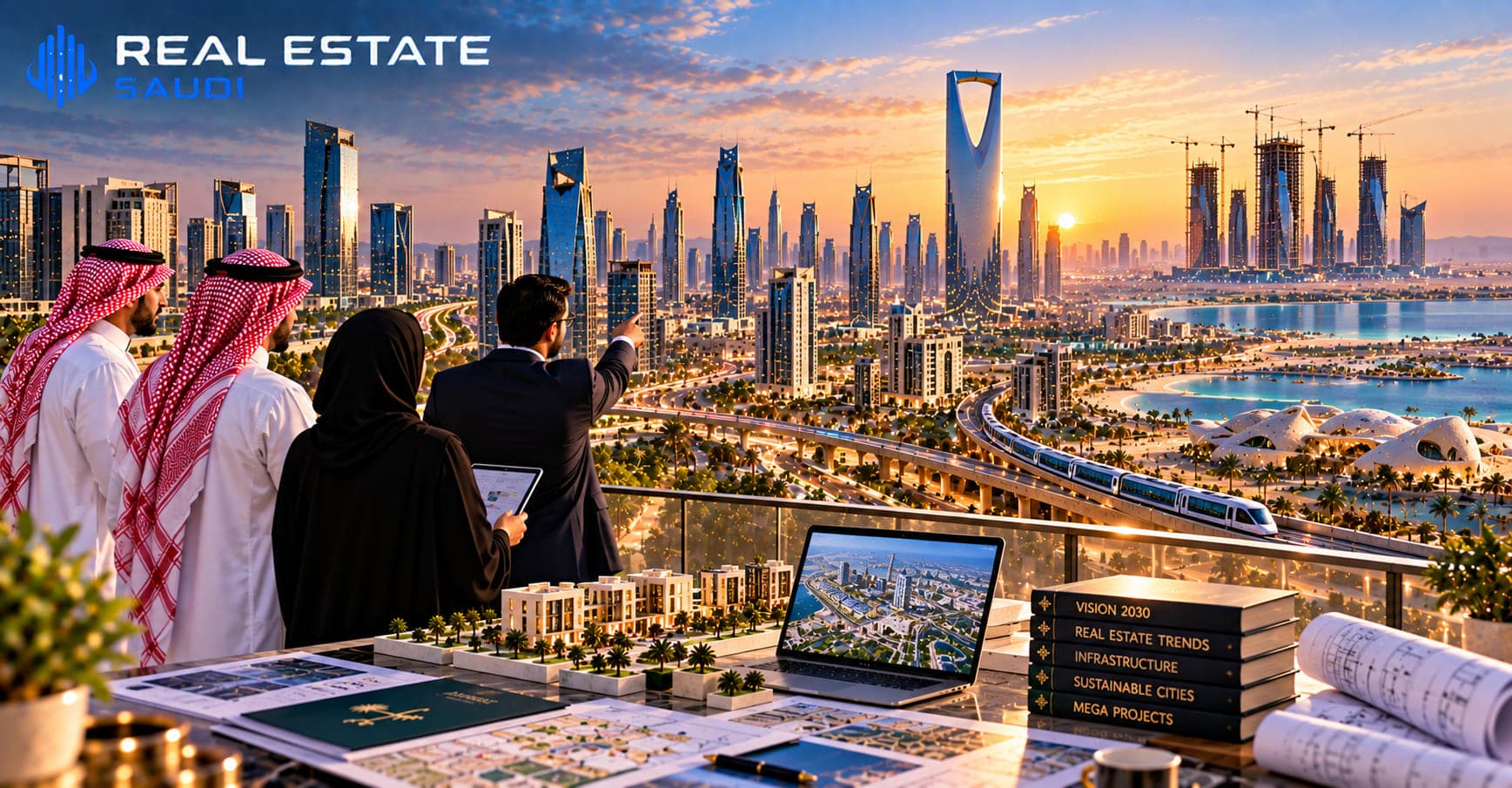
The Future of Real Estate in Saudi Arabia is likely to be shaped less by one continuous nationwide property boom and more by a combination of policy reform, new supply, foreign ownership, infrastructure, housing affordability, technology and city-specific demand. Saudi property is becoming more institutional, more regulated and more data-driven, but the performance of land, apartments, villas, offices, hotels and off-plan developments will not necessarily move in the same direction.
For buyers and investors, that distinction matters. Saudi Arabia is still delivering major urban-development programs under Vision 2030, while new ownership rules and digital property systems are widening access to the market. At the same time, policies such as Riyadh's rent controls show that authorities are also prepared to intervene when affordability and supply conditions require it.
The most useful way to understand the market beyond 2026 is therefore to follow the structural trends rather than assume that every Saudi property will rise in value.
What Does the Future of Saudi Real Estate Look Like?
The Saudi property market is moving toward a more diversified structure in which residential demand, institutional investment, tourism, logistics, commercial development and master-planned communities each have separate drivers.
Official market data already shows why investors should avoid broad conclusions. The General Authority for Statistics' Real Estate Price Index for Q2 2026 reported a 1.3% year-on-year increase in the national real estate price index, but performance varied by property category.
This matters because a national index can rise even while certain segments weaken.
The longer-term picture is being influenced by five broad forces:
continued urban development under Vision 2030;
housing supply and affordability policies;
expanded foreign participation;
digital regulation and property-registration systems;
large-scale tourism, commercial and infrastructure projects.
Investors researching those forces in detail can also use our Saudi real estate investment guide to connect macro trends with practical property-investment decisions.
1. Real Estate Growth Will Become More Selective
One of the most important trends for the next phase of Saudi real estate is market differentiation.
Earlier narratives often treated Saudi property as one national market. In practice, Riyadh residential land, Jeddah apartments, Eastern Province commercial property, Red Sea hospitality and Makkah accommodation each respond to different economic and demand conditions.
The official Q2 2026 index confirms that property types can move differently even during the same quarter. That makes city, asset type and individual project quality increasingly important.
Going forward, investors are likely to pay closer attention to:
actual transaction activity rather than asking prices;
new supply entering individual districts;
infrastructure completion;
employment growth;
tenant demand;
property-management costs;
developer delivery records;
the depth of the resale market.
This shift should improve market discipline. Properties will increasingly need a clear reason for demand rather than benefiting simply from a national growth story.
ما نوع العقار والمنطقة المناسبة؟
اختر نوع العقار والمدينة المستهدفة لاستعراض أنسب الخيارات.
2. Vision 2030 Will Continue to Reshape Housing and Urban Development
Vision 2030 remains central to the Future of Real Estate in Saudi Arabia, particularly through housing, quality-of-life initiatives, infrastructure and economic diversification.
The official Vision 2030 Housing Program Annual Report states that the program continues to work toward a 70% homeownership rate by 2030.
That goal has implications beyond the number of homes sold.
Higher homeownership requires:
more residential supply;
financing access;
community infrastructure;
developer participation;
land availability;
more efficient construction;
services around new residential districts.
The result is likely to be a continuing shift from isolated housing projects toward larger integrated communities that combine homes with schools, parks, retail, healthcare and transport connections.
Our detailed guide to how Vision 2030 is transforming real estate in Saudi Arabia explains how these national policies connect with property development and investment.
3. Riyadh Will Remain a Core Market, but Affordability Will Matter More
Riyadh remains central to Saudi Arabia's business, government and corporate expansion. Population growth, new employment, infrastructure investment and the development of major business districts continue to support housing and commercial demand.
However, future Riyadh growth cannot be analysed through demand alone.
Housing affordability and rental pressure became important regulatory issues. On 25 September 2025, REGA introduced provisions suspending annual rental increases for residential and commercial properties within Riyadh's urban boundaries for five years. The rules apply to both existing and new leases within the covered area.
This policy is significant for investors because it demonstrates that future returns will depend partly on regulation as well as market demand.
For landlords, projected rental growth should therefore be tested against:
the lease's regulatory treatment;
current Ejar records;
operating expenses;
vacancy risk;
tenant retention;
future supply.
Investors assessing the capital can compare districts through our Riyadh real estate area guide rather than relying on city-wide averages.
4. Foreign Ownership Is Now a Structural Market Factor
A major change in 2026 is the implementation of Saudi Arabia's updated non-Saudi property ownership framework.
REGA confirmed that the new system entered into force on 22 January 2026. Applications for eligible non-Saudi ownership are processed through the official Saudi Properties digital portal, with procedures differing for residents, non-residents and qualifying foreign entities.
This is one of the strongest structural changes affecting long-term property demand.
The reform can broaden the potential buyer base for eligible properties, particularly in areas and projects that appeal to international residents, investors and companies.
However, foreign ownership should not be described as unrestricted nationwide access. Eligibility depends on the ownership category, geographical rules and other legal conditions.
For developers, the change creates an incentive to improve:
multilingual sales processes;
legal transparency;
property documentation;
international-standard marketing;
buyer support;
post-sale property management.
For investors, it increases the importance of understanding the current ownership framework rather than relying on older rules.
5. Major Projects Will Create New Real Estate Markets, Not Just New Buildings
Saudi Arabia's development program includes destinations and urban projects that can create entirely new clusters of residential, hospitality, retail and commercial activity.
The opportunity is not limited to purchasing property inside a headline development.
A large project can influence nearby demand through:
employment;
transport upgrades;
hotels;
retail;
contractors and suppliers;
workforce housing;
tourism;
supporting services.
That creates a wider investment geography.
Projects associated with Riyadh, the Red Sea, NEOM, Diriyah and other destinations may therefore affect surrounding markets as infrastructure and economic activity develop.
Readers comparing this pipeline can explore new real estate projects across Saudi Arabia and the site's guide to the top mega projects transforming Saudi Arabia.
The key investor principle is timing. Announced investment value does not automatically equal short-term property appreciation. Investors should separate projects that are announced, under construction, operational and generating measurable demand.
6. Riyadh, Jeddah and Regional Markets Will Follow Different Paths
The next phase of Saudi real estate is unlikely to produce identical outcomes across major cities.
Riyadh
Riyadh's demand is closely linked with government, corporate activity, regional headquarters, employment and large urban-development programs.
Its challenges include affordability, land pricing, rental regulation and the need for continued supply.
Jeddah
Jeddah has a different mix of drivers, including established residential demand, commerce, tourism, coastal development and proximity to the western-region religious-tourism economy.
Investors comparing the western market should analyse individual neighbourhoods through the Jeddah real estate area guide.
Eastern Province
Dammam and Al Khobar remain tied to the broader Eastern Province economy, including energy, industrial activity, logistics and corporate employment.
Their demand pattern can be less dependent on the same factors that move central Riyadh.
Emerging destinations
Tourism-led areas may create opportunities in hospitality, branded residences and supporting residential markets, but these markets can depend heavily on project delivery and visitor growth.
This regional differentiation will make research more important than national averages.
7. Tourism Real Estate Will Become a Larger Investment Category
Saudi Arabia's economic-diversification strategy is creating more attention around hospitality and tourism property.
The expansion of destinations along the Red Sea, heritage tourism, entertainment and religious tourism can create demand for:
hotels;
serviced apartments;
branded residences;
retail;
restaurants;
staff accommodation;
logistics and supporting services.
The Red Sea area guide provides useful context for one of the Kingdom's major tourism-development corridors.
However, hospitality real estate should not be evaluated like a standard apartment.
Revenue can depend on:
occupancy;
seasonality;
operator quality;
management agreements;
tourism demand;
operating costs;
project completion.
A property marketed as a tourism investment should therefore be analysed as an operating asset, not merely as a building expected to appreciate.
8. PropTech and Digital Regulation Will Improve Market Transparency
Technology will play a major role in the Future of Real Estate in Saudi Arabia, but investors should focus on practical digital systems already operating rather than speculative claims about technologies that have not yet become standard.
Several parts of the transaction process are increasingly digital.
REGA provides digital licensing and regulatory services. Ejar supports the rental ecosystem. The Real Estate Registry provides services related to registered properties, property documents and ownership transactions. Foreign ownership applications now also have a digital pathway.
This digital infrastructure can gradually improve:
verification;
transaction records;
lease transparency;
property data;
regulatory compliance;
access to information.
For investors, more structured records can improve due diligence and make it easier to compare properties.
What should be avoided is assuming that every Saudi property transaction is already fully automated or blockchain-based. The important current trend is digitisation and formalisation, not speculative technology claims.
9. Off-Plan Property Will Continue to Grow, but Regulation Will Matter
Off-plan development is likely to remain important because Saudi Arabia needs significant new residential, hospitality and mixed-use supply.
For buyers, off-plan projects can offer access to new communities before completion. For developers, presales can support project financing and demand planning.
Yet off-plan investing introduces risks that ready-property buyers do not face.
These include:
construction delays;
specification changes;
developer execution risk;
payment-plan obligations;
handover timing;
future resale liquidity.
Saudi Arabia has a formal regulatory framework for off-plan sales and leasing. Investors should therefore verify the exact project and developer through the relevant REGA processes rather than relying exclusively on renders, brochures or sales presentations.
As supply expands, established delivery records may become an increasingly important competitive advantage for developers.
10. Mortgage and Real Estate Finance Will Remain Important to Residential Demand
Mortgage availability is another important long-term market factor.
Saudi Central Bank rules require real estate finance providers to assess a customer's financial circumstances and ability to meet obligations before offering financing. Providers must also explain the product, its risks and contractual terms.
The SAMA rulebook also shows an increasingly developed framework for real estate finance and mortgage-market infrastructure.
This matters because residential property demand does not depend only on household income. It also depends on:
financing eligibility;
borrowing costs;
down-payment requirements;
monthly affordability;
lender risk standards.
If financing becomes easier or more affordable, buyer capacity can increase. If financing costs rise, demand can shift toward smaller units or lower-priced areas.
Investors should therefore monitor credit conditions alongside property prices.
حدد ميزانيتك الاستثمارية
حدد ميزانيتك التقديرية لنقوم بتضييق خيارات العروض.
11. Smaller and More Efficient Homes May Gain Importance
The historic preference for large villas will remain relevant, especially for families, but future demand is likely to become more segmented.
Urbanisation, affordability pressure and new master-planned communities can increase the appeal of apartments, townhouses and smaller villas.
This does not mean large villas will disappear. Instead, the residential market may offer a wider range of unit sizes designed around different household budgets.
Developers that successfully balance:
usable space;
privacy;
parking;
community facilities;
energy efficiency;
access to jobs and transport
may be better positioned than projects that rely only on unit size.
The implication for investors is straightforward: larger does not automatically mean better investment performance.
A well-located two-bedroom apartment with deep tenant demand can be more liquid than a much larger property serving a narrower audience.
12. Sustainability Will Become More Relevant to Asset Quality
Sustainability in Saudi real estate is likely to become increasingly practical rather than simply promotional.
In a hot climate, building efficiency directly affects cooling demand and operating costs. Water efficiency, insulation, building orientation and efficient mechanical systems can therefore influence long-term property performance.
For large developments, sustainability also connects with public-realm design, walkability, landscaping and infrastructure.
Investors should not automatically pay a premium simply because a project uses terms such as “green,” “smart” or “sustainable.”
Instead, ask:
What certification applies?
Which features are actually installed?
Who operates and maintains the systems?
What are the service charges?
Is there measurable efficiency data?
Over time, buildings with stronger technical performance may become easier to operate and more attractive to institutional tenants.
13. Commercial Real Estate Will Become More Quality-Sensitive
Saudi commercial property should also become more segmented.
Corporate expansion can support demand for high-quality office space, particularly in Riyadh, but national commercial-property performance should not be assumed to move uniformly.
Location, building specification, parking, transport access, floor efficiency and tenant covenant quality can create large differences between two office assets in the same city.
The same principle applies to retail.
Traditional retail space faces different economics from destinations built around entertainment, hospitality or mixed-use communities.
Industrial and logistics property also has separate demand drivers, including e-commerce, manufacturing, regional distribution and supply-chain development.
Future commercial investors should therefore avoid relying on one national yield assumption.
14. Real Estate Data Will Become More Important for Investment Decisions
Official market data is improving, which can gradually reduce dependence on anecdotal market commentary.
GASTAT's quarterly Real Estate Price Index is one example. Investors can use such official indicators to compare national and regional trends rather than relying solely on advertisements.
As the market matures, professional investors are likely to place more weight on:
transaction evidence;
price indices;
lease data;
supply pipelines;
population and employment trends;
financing conditions.
This is positive for market maturity.
It also means that unsupported claims such as “guaranteed appreciation” or “fixed rental return” should receive more scrutiny.
The best opportunities may increasingly be identified through evidence rather than promotional language.
15. Policy Will Remain a Major Real Estate Driver
Saudi property is strongly influenced by regulation.
Foreign ownership reform has expanded participation. Riyadh rental regulation is addressing affordability. Housing initiatives aim to raise ownership rates. Real estate registration and digital systems are strengthening formal market infrastructure.
For investors, policy monitoring should therefore be part of normal due diligence.
Our guide to real estate law in Saudi Arabia provides additional background on the Kingdom's property regulatory structure.
The lesson is that regulation should not automatically be viewed as either positive or negative.
A policy may reduce near-term rent-growth expectations but improve market stability. Another reform may widen demand but introduce new compliance requirements.
Understanding the intended purpose of each policy is more useful than reacting only to headlines.
16. What Investors Should Watch Between 2026 and 2030
The Future of Real Estate in Saudi Arabia will depend on how several variables develop together.
Investors should track at least six indicators.
New housing supply
Large new completions can improve affordability but may also create oversupply in individual districts.
Interest and financing conditions
Financing costs affect both homebuyers and developers.
Foreign demand
The 2026 ownership framework could gradually deepen international participation, but the impact will vary by location and property type.
Major-project delivery
Infrastructure and operational openings matter more than announcements alone.
Rental regulation
The Riyadh framework shows that rental-market policy can directly affect landlord assumptions.
Official price data
Quarterly data can reveal whether appreciation is broad or concentrated.
Investors researching specific opportunities can compare these factors with our guide to top real estate investment opportunities in Saudi Arabia.
Which Areas Could Benefit Most from Future Growth?
There is no single “best” Saudi market.
Different areas suit different strategies.
Market | Key Long-Term Driver | Main Consideration |
|---|---|---|
Riyadh | Corporate and government growth | Affordability and rental regulation |
Jeddah | Commerce, population, tourism | District-level supply differences |
Eastern Province | Energy, industry, logistics | Corporate and industrial cycles |
Makkah/Madinah | Religious tourism | Ownership and location rules |
Red Sea destinations | Tourism and hospitality | Delivery and operating performance |
NEOM region | Long-term new-city development | Project timing and execution |
For investors with a long horizon, NEOM real estate and development information may be relevant, but long-term projects require especially careful attention to timelines and completed infrastructure.
Risks That Could Shape the Saudi Property Market
Strong long-term drivers do not remove risk.
Oversupply
A city can have strong population growth while an individual neighbourhood still receives too much competing inventory.
Project delays
Large developments can take many years. Investors should distinguish between masterplan ambition and completed assets.
Affordability pressure
Rapid price increases can reduce buyer capacity and trigger policy responses.
Financing risk
Changes in financing cost can affect mortgage affordability and developer economics.
Regulatory change
Rental rules, land policies and ownership rules can change investment assumptions.
Liquidity
A property may appear valuable but still be difficult to resell quickly.
These factors are why projected return should never be treated as guaranteed.
كيف تفضل التواصل معك؟
اختر وسيلة التواصل الأكثر ملاءمة لك لمناقشة فرصك الاستثمارية.
How to Prepare for the Next Phase of Saudi Real Estate
Investors considering Saudi property beyond 2026 should use a structured process.
First, decide the investment objective: rental income, long-term appreciation, personal use, tourism exposure or commercial income.
Second, choose a city and asset type based on measurable demand.
Third, investigate the developer, title, project licence and regulatory status.
Fourth, calculate total acquisition and holding costs rather than only the advertised price.
Fifth, test the exit strategy. Consider who could realistically purchase or rent the property from you later.
Finally, compare the opportunity with alternatives instead of evaluating it in isolation.
Saudi Arabia offers a wider range of property strategies than it did several years ago, but a larger market also requires more disciplined selection.
Conclusion
The Future of Real Estate in Saudi Arabia is likely to be defined by a more mature, regulated and differentiated market.
Vision 2030 housing and urban-development initiatives will continue to support construction and new communities. Foreign ownership reform can widen participation. Major tourism and infrastructure projects can create new property markets. Digital regulation and registration should improve transparency.
At the same time, Riyadh rental controls, differences between property types and the possibility of local oversupply show why investors should not assume that all Saudi real estate will move upward together.
The strongest opportunities beyond 2026 are likely to be properties supported by real demand, quality infrastructure, credible developers, appropriate financing and a clear exit market.
This article is general informational material, not legal, tax or financial advice. Property rules, financing conditions and investment outcomes depend on the specific buyer and transaction, so investors should verify current official requirements and obtain appropriate professional advice before committing capital.
تحدث معنا عبر قناتك المفضلة
استشارات عقارية مباشرة حول الاستثمار والسوق العقاري في المملكة العربية السعودية.
الأسئلة الشائعة
Saudi real estate is likely to become more diversified, regulated and data-driven through 2030. Vision 2030 programs, housing supply, foreign ownership, tourism developments, infrastructure and digital property systems are major drivers. However, performance will vary by city and asset type, so future growth should not be interpreted as guaranteed nationwide appreciation.
Not necessarily in every segment. GASTAT's Q2 2026 data showed overall annual growth in the national index, but different property categories performed differently. Future prices will depend on supply, location, financing, employment, regulations and project delivery. Investors should use city- and property-specific evidence rather than assuming every apartment, villa or plot will appreciate.
Vision 2030 continues to influence housing, tourism, transport, urban development and quality-of-life investment. The Housing Program targets a 70% Saudi homeownership rate by 2030, which supports continued efforts around residential supply and financing. Major projects can also generate new commercial, hospitality and residential demand in surrounding areas.
Eligible non-Saudis can acquire qualifying real estate rights under the ownership system that entered into force on 22 January 2026. The applicable process depends on whether the applicant is a resident, non-resident or foreign entity and on the location and property concerned. Buyers should confirm eligibility through official REGA channels before committing funds.
Riyadh remains one of the Kingdom's most important real estate markets because of employment, government activity, corporate expansion and large urban projects. However, it also faces affordability pressures and rental regulation. Investors should analyse individual districts, property types and lease conditions rather than assuming every Riyadh property offers the same outlook.
The five-year suspension of annual rental increases within Riyadh's urban boundaries limits assumptions about continuous rent growth on affected residential and commercial leases. Investors should evaluate a property using permitted rent, occupancy, expenses and purchase price rather than aggressive future rent projections. Long-term effects will vary according to supply and demand.
Mega projects can create employment, tourism, infrastructure and new demand, but they are not automatically profitable investments. Buyers should examine the project's delivery stage, developer, location, operating model, future supply and resale market. Projects that are operational and generating demand provide stronger evidence than developments that remain primarily at announcement or early-construction stage.
Technology is making more parts of the property ecosystem digital. Rental contracts, property registration, broker regulation, official data and foreign ownership processes increasingly use government-backed digital systems. This can improve transparency and access to information, although buyers should still conduct legal, technical and financial due diligence for individual transactions.
Riyadh and Jeddah remain core markets, while Dammam and Al Khobar have strong links to energy, industry and corporate activity. Makkah and Madinah have religious-tourism demand, while Red Sea and emerging destinations offer tourism-led exposure. The strongest market depends on the investor's strategy rather than a single nationwide ranking.
It can be attractive for investors who select assets carefully, but there is no universal answer. Foreign ownership reform, Vision 2030 development and new supply create opportunities, while rental regulation, financing conditions, oversupply and project-delivery risk require caution. Investors should prioritise location, regulatory verification, total cost and realistic exit demand rather than projected returns alone.
