
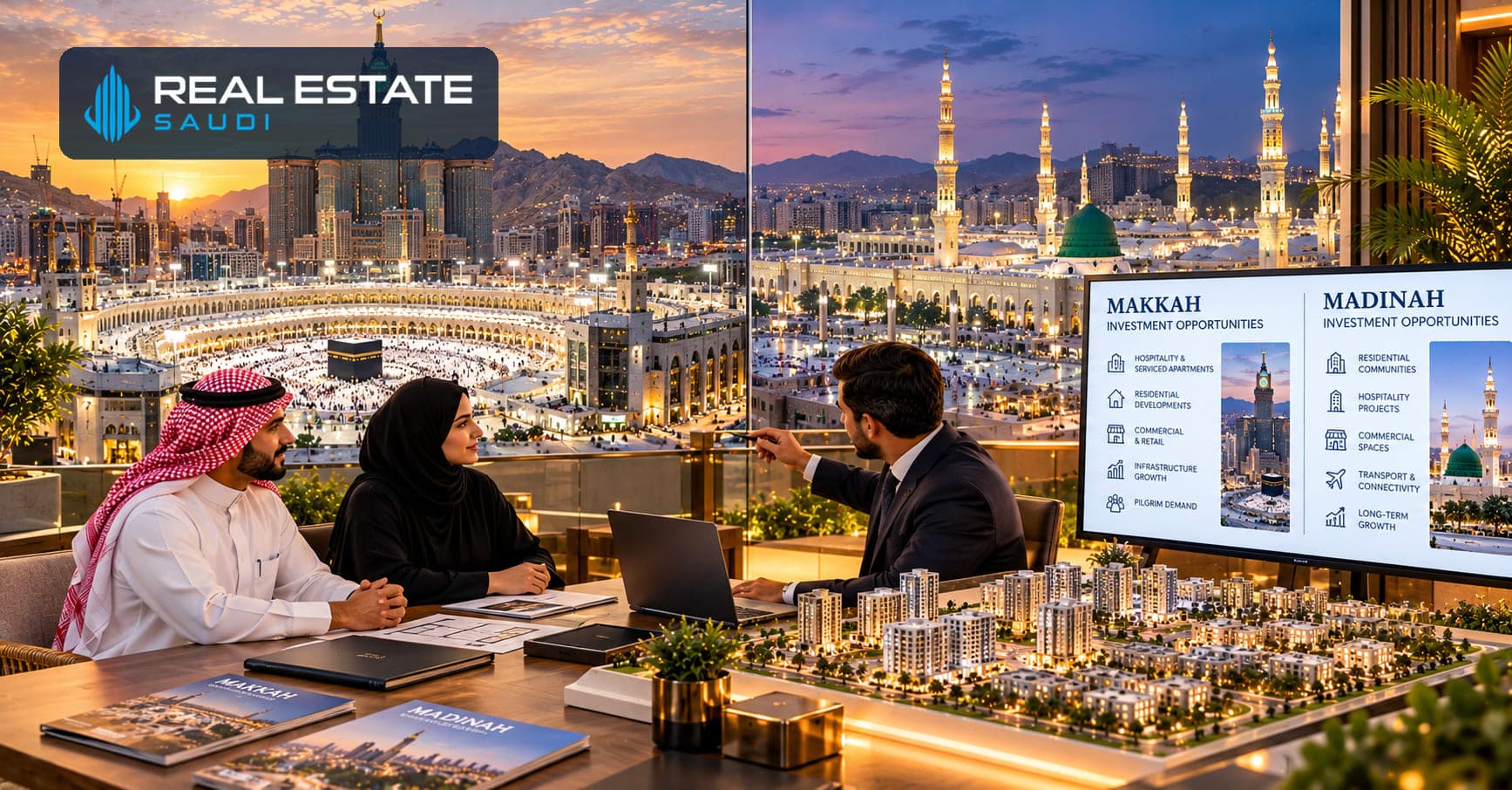
Makkah and Madinah Real Estate Investment starts with identifying a lawful investment route for your buyer category and the exact property. The 2026 framework provides conditional routes for eligible non-Saudi buyers, while the two holy cities retain special rules. Muslim identity alone does not establish that every advertised apartment, hotel unit or plot is available to purchase.
Before committing money, confirm the permitted location, the right being offered, the seller’s authority and the applicable registration process. Then assess whether the property supports personal use, long-term rental income or a hospitality business. These objectives require different contracts, operating arrangements and financial assumptions.
This guide explains individual and company routes, ownership versus usufruct, location selection, taxes, document checks and purchase preparation. It also distinguishes direct property acquisition from investment through listed companies or funds. Use it as general guidance alongside current official requirements and professional advice tailored to your proposed transaction.
Makkah and Madinah Real Estate Investment: What Foreign Buyers Must Establish
A foreign buyer should establish eligibility, confirm that the exact property falls within an applicable ownership route, verify the proposed right and complete the required official process. Property listings, reservations and private agreements do not replace these checks. Assess the investment’s income and expenses only after understanding what you can lawfully acquire.
There are several different routes to investigate:
Route | What the investor acquires | Essential check |
|---|---|---|
Direct property ownership | The documented ownership right in a specific asset | Buyer and property eligibility |
Usufruct | A documented right to use and benefit from property | Term, scope and transfer conditions |
Company acquisition | Property held by the acquiring company | Corporate capacity and applicable controls |
Listed-company investment | Shares or eligible securities | Current market and ownership conditions |
Real estate fund investment | Units in a fund | Offering terms and investor eligibility |
The routes are not interchangeable. Buying shares in a property-owning company does not give you title to one of its apartments. Similarly, a management contract or an income-sharing agreement should not be described as ownership without supporting documents.
Understand the 2026 Ownership Framework
REGA confirmed that the updated non-Saudi property ownership system entered into force on 22 January 2026. Its implementation announcement identifies Saudi Properties as the official application platform and explains that procedures vary across applicant categories.
The practical change is that buyers must use current requirements rather than assume an older restriction or permission still describes their circumstances. Avoid treating articles published before the updated framework as complete legal instructions for a 2026 transaction.
Muslim Individual Buyers
REGA’s official questions and answers on non-Saudi ownership explain that individual ownership in Makkah and Madinah is restricted to Muslims and subject to geographical and regulatory provisions. This establishes a category condition; it does not establish permission for an arbitrary property.
Ask for property-specific confirmation before accepting a reservation. Check the current official requirements for your application rather than relying on an agent’s informal description of acceptable identity or religious-status evidence.
Company Buyers
The Law of Real Estate Ownership and Investment by Non-Saudis provides a route for qualifying Saudi-incorporated companies with foreign shareholders within applicable geographical areas, including the holy cities. Listed companies, licensed funds and special-purpose entities are addressed separately under capital-market provisions.
For Makkah and Madinah Real Estate Investment through a company, obtain legal advice on the acquiring entity’s capacity, approvals and registration obligations. Setting up an entity should not be treated as a shortcut around the conditions governing the actual acquisition.
ما نوع العقار والمنطقة المناسبة؟
اختر نوع العقار والمدينة المستهدفة لاستعراض أنسب الخيارات.
Ownership, Usufruct and Other Agreements
Understand the legal right before comparing prices. Direct ownership, usufruct, ordinary tenancy and investment participation agreements can provide different rights, responsibilities and exit options.
Ownership concerns the documented title to the asset. Usufruct concerns use and benefit under the applicable legal and contractual provisions. A tenancy provides occupancy rights under its agreement. Their economic value depends partly on what the holder may do and for how long.
Do Not Assume a Standard 99-Year Term
The ownership law provides for authorised controls over the duration of usufruct rights. It does not justify describing every foreign buyer’s proposed arrangement as an automatic 99-year entitlement.
For a time-limited right, ask when it begins, when it ends and whether renewal is available. Review what happens to improvements and any outstanding obligations at expiry. A brochure stating “long-term ownership” does not resolve these questions.
Also check whether you may lease, assign, mortgage or otherwise dispose of the right. If consent is required, establish who grants it and under what conditions. Your exit plan depends on those provisions as much as your entry price.
Choose Between Personal Use and Rental Investment
A home for regular visits may be valuable to you without producing an attractive rental return. Conversely, a professionally operated accommodation unit may generate bookings while limiting when you can use it personally.
Write down the primary objective before choosing a property. Decide whether you need immediate use, future occupation, long-term tenants or managed hospitality income. Then evaluate the property and agreement against that objective.
For a family residence, consider accessibility, usable space, parking and everyday services. For a rental asset, establish the target tenant and the evidence supporting expected demand. For hospitality accommodation, investigate permissions, operator arrangements and operating expenses.
Avoid combining incompatible assumptions. You cannot calculate revenue as though a unit is available every day while also reserving extended periods for your own use. Personal-use periods and operating restrictions belong in the financial model.
Makkah: Evaluate Access and the Actual Property
Makkah investments should be evaluated through the specific location, property type and proposed use. A listing described as “near the Haram” can leave major questions about practical access unanswered.
Investigate the real route from the building to the intended destination. Consider walking conditions, gradients, road access and any transport arrangements. Straight-line distance is not a substitute for testing the journey.
The Makkah neighbourhood guide can help you compare locations before inspecting individual properties. Check facilities already operating and separate them from future amenities shown in marketing material.
Central and Outer Locations
For a central property, investigate the price premium alongside building management, lift capacity and occupancy arrangements. For a location farther out, examine whether access and services meet the intended household or guest’s needs.
Do not presume a central address automatically produces better net returns. Higher acquisition and operating costs may change the outcome. Compare alternatives using consistent assumptions rather than a proximity label.
If transport is offered as part of a managed arrangement, request its written scope. Ask about frequency, operating hours, charges and what happens if the service changes.
Madinah: Match the Area to Your Intended Occupant
Madinah properties should also be assessed at neighbourhood and building level. Personal-use homes, long-term rentals and visitor accommodation can serve different occupants even within the same district.
Use the Madinah area guide to structure your shortlist, then inspect access, parking, maintenance and nearby services. Ask how the unit’s layout meets the needs of the intended household or visitor.
For a long-term rental, investigate comparable occupied homes and actual leasing conditions. For visitor accommodation, assess the complete guest experience, including transport, arrival arrangements and building operations.
Compare Both Cities Consistently
Avoid ranking Makkah and Madinah through unsupported citywide price or yield ranges. Compare assets with similar rights, condition, size, management obligations and permitted use.
The best city for your investment is the one where an eligible property meets your purpose and financial limits. Spiritual preference can inform a personal decision, but the financial assessment should remain explicit.
Indirect Investment Through Listed Companies and Funds
Foreign investors should distinguish direct acquisition from capital-market exposure. The latter involves purchasing securities rather than receiving a deed to a particular property.
On 27 January 2025, the Capital Market Authority announced a controlled route for foreign investment in listed companies owning Makkah and Madinah property. The announcement also refers to non-Saudi participation in real estate funds investing in the two cities.
For a current investment, confirm the latest controls, investor eligibility and product documents with the authorised provider. A historical announcement explains the route’s background but should not replace current compliance checks.
Review the company’s or fund’s actual assets, debt, management costs and financial statements. A security associated with the holy cities may have other exposures, and its market price can change independently of an individual property’s rent.
This route may suit an investor who does not want to manage a building. However, regulatory approval is not a guarantee of performance, liquidity or distributions.
حدد ميزانيتك الاستثمارية
حدد ميزانيتك التقديرية لنقوم بتضييق خيارات العروض.
Model Rental Income Without Assuming Guaranteed Occupancy
Makkah and Madinah Real Estate Investment should be evaluated using collected income and realistic expenses, not only advertised room rates. Different rental models require different calculations.
For a long-term tenancy, estimate vacancy, collection risk and maintenance responsibilities. For managed hospitality accommodation, account for occupancy, seasonal pricing, operator fees and owner-use restrictions.
Ask whether revenue estimates describe gross bookings, revenue after platform commissions or cash distributed to the owner. These measures can differ significantly.
Use a Clear Financial Model
The Saudi property return calculation guide can help distinguish gross yield from net income. A transparent model should include:
The total acquisition and initial setup cost.
Expected collected revenue and vacancy assumptions.
Management and operator charges.
Maintenance, utilities and service charges.
Furnishing replacement and repair reserves.
Financing payments and anticipated exit expenses.
Consider a purely illustrative property with total initial costs of SAR 1,200,000. If annual collected revenue is SAR 90,000 and operating expenses are SAR 35,000, net operating income is SAR 55,000. The resulting yield on initial cost is approximately 4.58%, before financing and investor-specific obligations.
These inputs demonstrate arithmetic, not market prices or expected returns. Test lower income and higher expenses before deciding that the investment supports your requirements.
Confirm Tax, Fees and Recurring Charges
ZATCA’s Real Estate Transaction Tax Law guidance confirms a standard 5% RETT rate, subject to applicable provisions and exemptions. Determine the treatment of your particular transaction and clarify statutory responsibilities alongside the contract’s allocation of costs.
The non-Saudi ownership law also provides for a fee on specified dispositions of real rights by non-Saudis, capped at 5%. Confirm applicability rather than automatically describing every purchase as carrying an additional 5% charge.
Establish Ongoing Ownership Expenses
Request written information about service charges, management fees and planned maintenance. The property service charges guide explains questions to ask about shared-building expenditure.
For managed accommodation, request the operator’s full fee schedule and any mandatory refurbishment obligations. Check whether forecasts exclude costs that you will eventually bear.
Keep a reserve after acquisition. A property that uses your entire available budget may become difficult to maintain, particularly if income starts later than expected or significant equipment needs replacement.
Verify Ownership Records and the Seller’s Authority
Check that the seller can transfer the exact right being offered. Match the property identity, location, unit details and seller information across the records and agreement.
The Real Estate Registry’s property verification services provide ownership-document verification, property information and services for rights, restrictions and responsibilities. Confirm the applicable registration status and transaction route for the asset.
Use the guide to verifying Saudi property documents to organise your review. Where the seller acts through a representative or company, investigate the signatory’s authority rather than assuming that possession of documents establishes permission to sell.
Ask about mortgages, disputes, existing occupancy and restrictions that could affect completion. A property inspection does not resolve a legal discrepancy, and a record check does not establish the building’s physical condition.
Registration and Possession Are Different
The non-Saudi ownership law links validity of the acquired right to registration with the Real Estate Registry under the governing provisions. Confirm how that requirement will be completed for your transaction.
Receiving keys, paying a reservation amount or signing a private agreement should not be treated as proof that every legal step is finished. Keep copies of the final records and payment confirmations.
Check Completed and Off-Plan Properties Differently
For a completed home, inspect the unit and the shared building. Assess electrical systems, plumbing, air-conditioning, moisture, lifts, fire-safety arrangements and maintenance records with appropriate professionals.
For an off-plan unit, assess approved specifications and delivery commitments. REGA’s Wafi off-plan project platform provides project information for off-plan sales and leasing. Verify the relevant project and examine the proposed payment arrangements.
Ask for construction-stage information, unit plans and the agreement’s treatment of delay or material changes. Do not assume that every component of a masterplan will be available when your particular unit is delivered.
Review the Actual Contract
Check the parties, property description, right acquired, payments and completion conditions. Identify refund provisions, dispute arrangements and responsibilities for defects.
If the transaction depends on financing or eligibility approval, obtain advice on appropriate contractual conditions before making a binding payment. Verbal assurances should be reflected in the documents where they affect your decision.
Use the Saudi property handover checklist to prepare for inspection and acceptance. Record unresolved defects and collect warranties, keys, access devices and operational instructions.
كيف تفضل التواصل معك؟
اختر وسيلة التواصل الأكثر ملاءمة لك لمناقشة فرصك الاستثمارية.
A Practical Purchase Checklist for Foreign Buyers
Assessing Makkah and Madinah Real Estate Investment begins with confirming your legal route for the specific property. Ask the relevant authority or adviser to identify requirements that remain outstanding.
Next, define the intended use and complete the financial model. Compare alternatives using the same assumptions for expenses, vacancy and financing.
Then assemble a document pack covering seller authority, property records, the proposed agreement and any operating or management contracts. For off-plan purchases, include project information and delivery commitments.
Complete legal and technical checks before making irreversible commitments. Verify payment recipients and ensure that agreed changes appear in the final documents.
Finally, plan registration, possession and management. Establish who handles maintenance, tenant communication and reporting if you will be overseas. A property requires a workable management plan after the purchase process ends.
Conclusion
Makkah and Madinah Real Estate Investment requires a clear distinction between buyer eligibility, the property right acquired and the investment’s financial performance. Current rules provide conditional routes, but each transaction needs its own verification.
Compare locations through practical access and intended use. Review ownership records, contracts, operating expenses and the applicable registration process before committing funds.
A suitable purchase should match your legal position, personal objectives and ability to manage the asset. Careful preparation provides a stronger basis for investment than universal price ranges, guaranteed rental claims or assumptions about automatic ownership rights.
تحدث معنا عبر قناتك المفضلة
استشارات عقارية مباشرة حول الاستثمار والسوق العقاري في المملكة العربية السعودية.
الأسئلة الشائعة
An eligible foreign Muslim can investigate direct acquisition under the applicable framework, subject to geographical and regulatory conditions. Muslim identity alone does not establish approval for every property. Confirm the exact asset, proposed right and application requirements through the official process before paying a binding deposit.
REGA’s official guidance restricts individual ownership in Makkah and Madinah to Muslims. Indirect investment through eligible securities is a separate route governed by capital-market conditions. Do not confuse ownership of company shares or fund units with personal title to a property in either city.
Do not assume one universal arrangement. The relevant buyer category, geographical controls and actual agreement determine the permitted route and right. Ask for confirmation of what is offered and how it is registered. A marketing description cannot establish whether you acquire ownership, usufruct or contractual participation.
No blanket 99-year term should be assumed. Check the applicable rules and the actual agreement’s duration, expiry, renewal and transfer provisions. The value of a time-limited right depends partly on its remaining term and the activities permitted throughout that period.
Neither city guarantees better returns. Compare individual assets using evidenced revenue, total costs, vacancy and management obligations. A property’s access, condition and permitted use can matter more than the city name. Avoid citywide yield claims that do not identify their data and assumptions.
No. Confirm the permissions, building rules and operating requirements for the intended use. Ordinary residential ownership does not by itself establish that every hospitality model is allowed. Review management arrangements and their expenses before estimating booking income or advertising the unit to guests.
Check eligibility, the property identity, seller authority and the proposed right. Review deposit conditions, refund provisions and outstanding legal or financing requirements. For off-plan units, investigate the project and delivery agreement. Obtain professional review when important conditions remain uncertain before making a binding commitment.
No. Property acquisition and residency requirements should be assessed separately. If a residency programme forms part of your plan, investigate its current eligibility conditions independently. Do not rely on a seller’s promise that acquiring a particular property automatically allows you to live or work in Saudi Arabia.
Remote ownership requires reliable local arrangements. Establish who handles inspections, maintenance, tenant or guest communication, payments and reporting. Review management fees and authority carefully. A detailed service agreement and transparent accounts are more useful than a broad promise that all responsibilities will be handled.
Retain the registered property-right records, final agreement, payment confirmations and relevant tax documents. Also keep inspection reports, handover records, warranties and management agreements where applicable. Organised records help with operation, future financing enquiries and resale, especially when the owner is based outside Saudi Arabia.
