
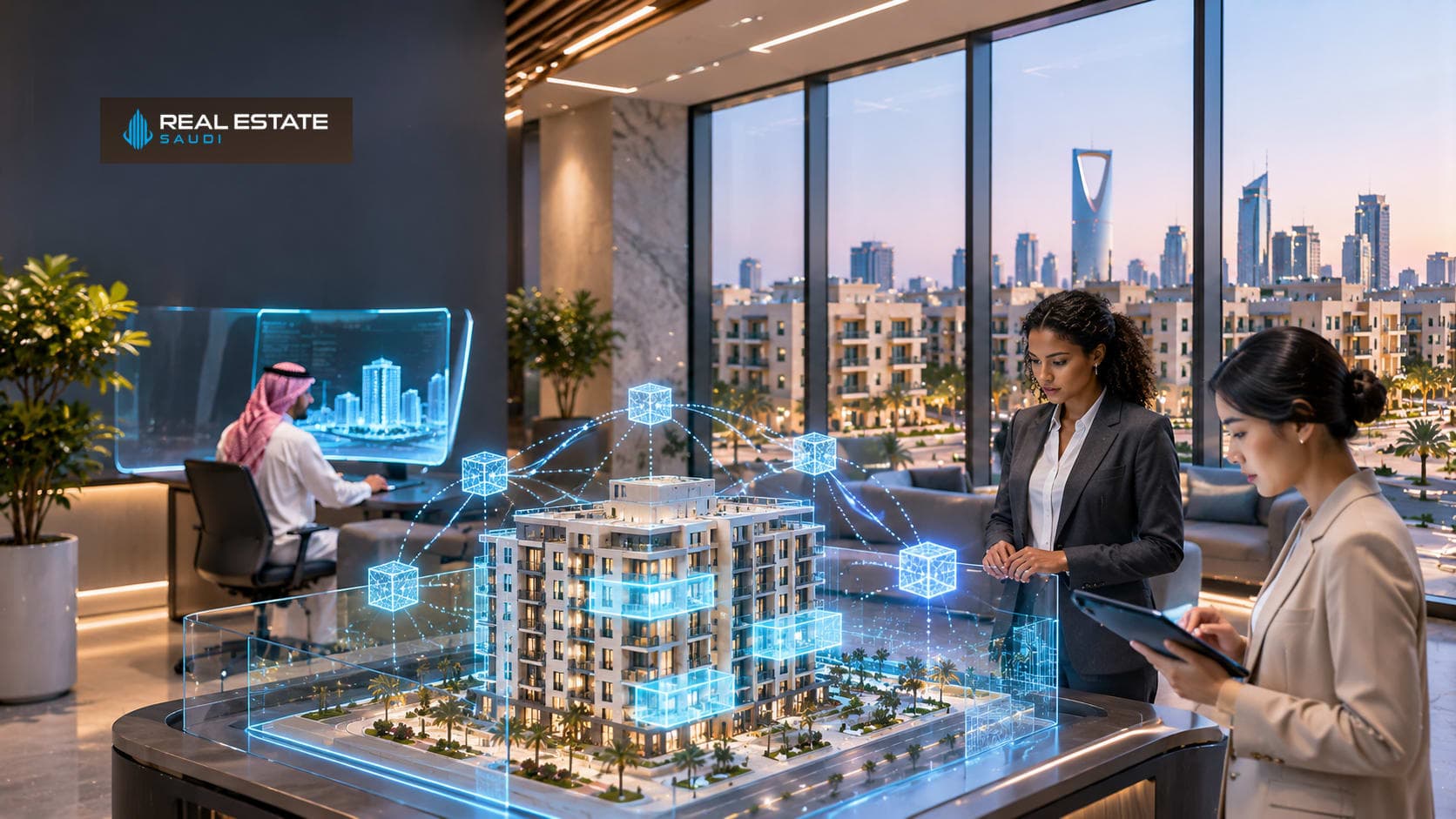
Real estate tokenization in Saudi Arabia is moving from a technical idea toward government-supervised experiments. On 19 November 2025, the Real Estate General Authority (REGA) announced that a Saudi title deed had been tokenized and the corresponding asset traded between NHC and several investors. The milestone matters because a token linked to an authoritative property record is different from an unverified digital promise. It does not, however, prove that anyone can already purchase Saudi property tokens through an unrestricted public exchange.
As of November 2026, the useful international comparison is about regulation and legal ownership, not headline predictions about blockchain growth. Dubai is testing controlled token resales; Singapore has emphasized tokenized financial-market infrastructure; the United Kingdom prioritizes secure land-registration systems; and the United States applies securities rules according to the instrument's underlying rights. This guide explains those differences and what Saudi investors, developers and overseas buyers should verify.
What Is Real Estate Tokenization and How Does It Work?
Tokenization represents a legal or economic interest in an asset through digitally recorded units, often using distributed-ledger technology. In a property transaction, the asset may be an apartment building, a commercial unit, an interest in a company holding the building, or a claim to income generated by that property. Those arrangements are not equivalent. The decisive question is what enforceable rights the token holder receives.
A credible structure identifies the underlying asset, verifies title, establishes who legally holds it, defines investor rights, creates the tokens and specifies how they are transferred or redeemed. The operator must also manage investor identification, payments, accounting, disputes and regulatory reporting. A blockchain record may help track transactions, but it cannot independently settle a defect in the original title or make an unlawful transfer lawful.
ما نوع العقار والمنطقة المناسبة؟
اختر نوع العقار والمدينة المستهدفة لاستعراض أنسب الخيارات.
Real Estate Tokenization in Saudi Arabia: What Is Confirmed by 2026?
The pivotal verified event is described in the Saudi Press Agency's announcement of the first government-supervised property tokenization. Published on 19 November 2025, it reported a completed title-deed tokenization involving NHC and several investors under REGA oversight. The announcement also described work by the Real Estate Registry to connect digital tokens with official ownership records and indicated plans to publish technical specifications in early 2026.
That statement establishes a completed supervised transaction, not the number of commercial token products available today. It does not confirm a nationwide retail exchange, unrestricted international sales, a specific minimum investment, or liquid trading in every tokenized property. The difference is essential for anyone comparing the Kingdom with platforms that already accept retail orders in another jurisdiction.
The Regulatory Sandbox and Its Practical Limits
REGA's official regulatory framework for its experimental real estate environment provides a controlled route for testing technologies that are not yet fully addressed by existing sector rules. Participants need an operational model, evidence of customer protection, risk controls, financial sustainability and an exit plan. The framework provides for temporary permits and supervised testing of specified models with defined customer groups.
Importantly, acceptance into the sandbox does not constitute proof of comprehensive compliance with all Saudi laws. Successful testing also does not automatically authorize nationwide commercial operations: further permits may be necessary. The framework expressly allows models to be modified, suspended or discontinued. For investors, a platform's announcement that it is participating in an experiment is therefore not the same as a regulator's endorsement of every advertised investment.
Real Estate Tokenization in Saudi Arabia and Official Title Records
An official property register records ownership, restrictions, mortgages and other rights attached to a particular parcel. This is the foundation on which a credible tokenized ownership model must operate. If tokens change hands but the legally authoritative register does not recognize the corresponding transfer, token holders may possess contractual claims rather than direct title to the property.
Saudi Arabia's real estate registration system identifies parcels and records the associated rights and obligations. The Real Estate Saudi report on the registry's two-million-record milestone provides useful background on the digitization effort. Investors should ask whether the token itself is recorded as an ownership right, represents an interest in an entity that holds title, or merely entitles its holder to contractual payments.
Four Ways a Property Token Can Be Structured
The same marketing word can conceal very different financial products. A title-linked fraction may represent recognized co-ownership where the legal system and registry support it. An equity token may represent shares in a company that owns a property. A fund token may correspond to interests in a collective investment vehicle. A debt token may entitle its holder to repayment from a borrower without conveying ownership of the underlying building.
Structure | What the holder might own | Principal issue to check |
|---|---|---|
Title-linked property fraction | Registered property interest, where legally supported | Registry recognition and transfer formalities |
Company equity token | Interest in a property-owning company | Corporate rights, liabilities and governance |
Fund unit token | Unit in an investment fund | Fund licensing, fees and redemption |
Property-backed debt token | Debt or financing claim | Credit risk, security and repayment priority |
A token is not automatically a deed, dividend, mortgage or guarantee. Read the actual legal instrument, not only the platform dashboard.
How Real Estate Tokenization in Saudi Arabia Compares with Dubai
Dubai offers the closest regional comparison because its land-registration authority has directly supervised a property-tokenization initiative. In February 2026, the Dubai Land Department announced a controlled second phase for token resales. It said resale activity would begin on 20 February and involve approximately 7.8 million tokens within a pilot framework. The initiative followed testing of title-deed tokenization and coordination with Dubai's Virtual Assets Regulatory Authority.
Dubai's experience demonstrates the difference between issuing tokens and supporting later sales. It also shows why a regulator may restrict a new secondary market while testing settlement, governance and consumer safeguards. Saudi Arabia's publicly confirmed milestone is its supervised title-deed transaction and sandbox architecture; it should not be described as operating an identically mature public resale venue without additional evidence.
Dubai's Liquidity Experiment Is Not Universal Liquidity
A secondary-market pilot allows selected token holders to attempt resales under defined conditions. It does not establish that buyers will always appear, that spreads will be narrow, or that a fraction of property can be sold immediately at a fair value. In a thinly traded market, the last quoted token price may differ substantially from the property's independent valuation.
Dubai's 2025 pilot also had participant and currency restrictions, illustrating that tokenization does not automatically remove investor-onboarding or cross-border controls. The transferable lesson is operational: establish a legally valid token, build credible pricing and settlement, then expand participation only when the system can protect users. Saudi projects should be evaluated on those concrete capabilities rather than a claim of instant liquidity.
Singapore: Financial-Market Tokenization Rather Than Direct Deeds
Singapore's approach is useful for a different reason. The Monetary Authority of Singapore's Project Guardian framework brings financial institutions and policymakers together to test asset tokenization, interoperability, settlement and risk controls. Its examples emphasize tokenized funds, bonds, bank liabilities and other capital-market products. It is not evidence that Singapore has converted its entire land registry into tradable apartment tokens.
For Saudi Arabia, the lesson is that asset issuance is only one part of market infrastructure. Custody, reliable cash settlement, investor disclosure and common technical standards affect whether a token can move safely between providers. A property product could combine a conventional legal holding structure with a digital security, but that would still need appropriate securities and real-estate oversight.
United Kingdom: Digitizing Land Rights Before Trading Them
The United Kingdom offers a land-registry-focused comparison. Its HM Land Registry Strategy 2025+ emphasizes verified digital property information, secure ownership records and simpler registration services for England and Wales. Earlier UK research explored blockchain-linked title tokens and fractional interests as prototypes, but a prototype is not proof of a nationwide tokenized-property marketplace.
This approach highlights a basic principle: property rights must remain clear even when technology changes. The land register, boundaries, lender interests and legally effective transfers matter more than the format of a token. Saudi developers considering a token product should therefore treat data quality and title certainty as prerequisites, not administrative details to resolve after issuing tokens.
United States: The Securities Law Follows the Economic Right
The United States offers a regulatory classification lesson. In January 2026, the US Securities and Exchange Commission staff explained how federal securities law applies to tokenized securities. Its statement distinguishes issuer-sponsored and third-party tokens and emphasizes that technological format alone does not remove securities-law obligations. The staff statement is explanatory, not a newly enacted law.
A US token associated with rental property might represent corporate shares, a fund interest or a different security. Investors must identify the issuer, disclosures, transfer restrictions and actual rights. This comparison matters in Saudi Arabia because a digital asset promising investment returns can raise financial-regulatory questions in addition to the rules that govern the property itself. Calling it a utility token does not answer those questions.
Global Comparison: Different Strengths, Different Stages
Jurisdiction | Demonstrated emphasis | What investors should not assume |
|---|---|---|
Saudi Arabia | Supervised tokenized-deed transaction and real estate sandbox | Open retail access or unrestricted secondary trading |
Dubai | Regulator-linked property tokens and controlled resale testing | Guaranteed liquidity or global eligibility |
Singapore | Institutional tokenized funds and market infrastructure | Universal tokenization of direct land titles |
United Kingdom | Digital land records and earlier prototypes | Deployed nationwide fractional deed trading |
United States | Securities classification and investor protections | A token avoids securities requirements |
The comparison is not a league table of market size or promised returns. It describes verified regulatory and operational approaches, each with different legal systems and products.
حدد ميزانيتك الاستثمارية
حدد ميزانيتك التقديرية لنقوم بتضييق خيارات العروض.
Can Small Investors Buy Saudi Property Tokens Today?
A confirmed pilot is not a public offer. As of this review, the official material verifies a supervised Saudi title-deed transaction and a regulated testing framework; it does not establish a general national token marketplace with a published minimum purchase amount available to everyone. Claims that any investor can buy Saudi real estate for SAR 1 should therefore be treated as unverified unless supported by a specific licensed offering and its actual terms.
Those researching smaller investment sizes can compare existing ways to invest in Saudi property with limited capital. Listed real estate funds, direct purchases and experimental tokens involve different rights and risk profiles. Do not use a minimum subscription figure from a foreign pilot as though it applies automatically to Saudi Arabia.
Foreign Ownership Laws Still Matter
The updated Saudi non-Saudi property ownership system took effect on 22 January 2026. It provides eligible categories of foreign buyers with rights under specified geographic and legal conditions, including special restrictions affecting Makkah and Madinah. Digitally dividing an asset does not necessarily override those conditions. Whether the rules apply directly to a token holder or to a property-owning company depends on the actual arrangement.
The site's guide to foreign property ownership rights in Saudi Arabia covers buyer categories and designated zones. A token issuer should disclose whether investors obtain direct title, indirect company exposure or another right. The site's guide to Saudi property ownership through foreign companies explains the corporate route, which does not eliminate investor-eligibility rules. Foreign investors should not assume a wallet can replace statutory eligibility checks.
What Developers Could Gain from Tokenized Property
Developers may use a compliant token structure to access a broader pool of capital, sell defined economic interests or manage investor records more efficiently. A completed rental building, a commercial property and a development project would require different disclosures. An investor in a development-stage project accepts construction and delivery risk that does not exist in the same form for an occupied building.
There is also a governance question. Who approves renovations, refinancing, the building manager or a sale of the property? A platform may use smart contracts for selected payments or record changes, but legal decisions still require enforceable governance procedures. The site's analysis of off-plan property investment advantages and risks offers a useful comparison with conventional developer-funded projects.
Fractional Ownership Does Not Guarantee Better Returns
Reducing the amount an investor must commit can improve access, yet it cannot make the underlying property more profitable. Rental income still depends on tenants, vacancies, repairs, management, taxes and financing. Fees for token issuance, administration, custody and a trading venue may reduce the amount available for distribution.
Consider an illustrative property producing SAR 120,000 in annual rent. If recurring expenses total SAR 40,000, the amount remaining before financing and investor-level charges is SAR 80,000. Tokenizing the ownership does not create additional rent. The site's guide to calculating property investment returns provides the broader financial framework. Buyers should request net cash-flow evidence rather than rely on a headline distribution percentage.
Custody, Smart Contracts and Operational Risk
Digital property investment introduces risks that conventional title buyers may rarely encounter. Private keys can be lost or stolen; custody providers can fail; poorly designed contracts can contain software defects; and platforms can be disrupted by cyberattacks. Even a technically correct ledger cannot determine whether a building was legally acquired, adequately insured or properly maintained.
A credible operator should explain who controls investor wallets, how tokens can be recovered, which transfers are blocked, and what happens during insolvency. It should also identify arrangements for audits, property servicing and disputes. The site's overview of risks in Saudi real estate projects supplies complementary guidance on ordinary property risks, which remain present after tokenization.
Valuation, Secondary Trading and Exit Rights
Token values may be based on appraisals, book values or the price achieved in occasional trades. Those measures are not interchangeable. A token quoting at a premium to independently appraised net asset value can still be difficult to sell, especially when few investors participate. Conversely, discounts can persist even when a building is fully occupied.
Before investing, ask whether there is a permitted trading venue, how buyers are matched, whether the token can be transferred outside the platform and whether redemption is possible. A lockup or restricted transfer mechanism may be legally necessary. The promise of twenty-four-hour trading is not a substitute for an actual market with reliable demand and legally effective settlement.
Compliance, Tax and Investor Disclosures
A legally credible offering should disclose the issuer, asset, title holder, investor rights, asset manager, fee schedule, dispute process and any restrictions on resale. It should explain whether the relevant authority supervises the real estate, the securities offering or both. Participation in an experimental sandbox should be described accurately rather than marketed as a permanent commercial license.
The tax treatment depends on what is transferred. A direct real estate disposition, a sale of company shares and a trade in regulated fund units may not follow identical rules. Saudi Arabia generally imposes a 5% Real Estate Transaction Tax on covered real estate disposals, subject to exemptions. The site's Saudi real estate tax guide explains the broader framework. Obtain product-specific advice rather than assigning a blanket tax rate to every token trade.
A Due-Diligence Checklist for Prospective Investors
Start with the legal character of the instrument. Identify the property, official title or registered holder, and exact rights represented by each token. Confirm who supervises the issuer and whether the product is in testing or commercially authorized. Read the terms covering distributions, voting, insolvency, custody, transfer restrictions and redemption.
Then verify the asset's valuation, actual rental income, leverage, maintenance obligations and all charges. Ask for independent audit arrangements and an explanation of how blockchain records reconcile with official property records. Finally, test the downside case: no liquid market, a major repair, a cyber incident or an issuer failure. If the operator cannot answer these questions clearly, the technology may be obscuring rather than reducing investment risk.
كيف تفضل التواصل معك؟
اختر وسيلة التواصل الأكثر ملاءمة لك لمناقشة فرصك الاستثمارية.
What Could Happen Next in Saudi Arabia?
Real estate tokenization in Saudi Arabia could expand to more types of assets if trials demonstrate enforceable ownership, secure settlement and reliable customer protection. Potential applications include income-producing commercial buildings, logistics assets and carefully structured property funds. These are possibilities rather than confirmed product launches or scheduled retail offerings.
The Saudi approach will be judged by what participants can legally own, how official records recognize transfers, whether risks are disclosed and whether investors can exit without excessive friction. Dubai's controlled trading tests, Singapore's institutional standards, British registration priorities and US securities classification all provide lessons. None supplies a shortcut around Saudi legal requirements or guarantees a timetable for broad adoption.
Conclusion
Real estate tokenization in Saudi Arabia has achieved a documented government-supervised milestone and now operates within an evolving framework for controlled innovation. Its strongest potential advantage is not the blockchain label; it is the possibility of combining smaller investment units with authoritative title data and enforceable investor rights. That possibility still requires proof at the level of each proposed product.
International comparisons show different priorities: Dubai is testing resale mechanics, Singapore is building institutional asset infrastructure, the UK emphasizes property-register certainty and the US focuses on the substance of securities rights. Investors should evaluate legal entitlement, underlying cash flow, fees, custody and liquidity before treating any token as a safer or cheaper substitute for conventional real estate.
تحدث معنا عبر قناتك المفضلة
استشارات عقارية مباشرة حول الاستثمار والسوق العقاري في المملكة العربية السعودية.
الأسئلة الشائعة
Saudi Arabia has confirmed a supervised tokenization milestone. REGA announced on 19 November 2025 that a title-deed-linked asset had been tokenized and traded between NHC and several investors. The authority also established a regulatory sandbox for new property technologies. These developments do not, by themselves, establish that a national public marketplace is available to all retail investors or that unrestricted secondary trading has been approved.
An official, generally available SAR 1 minimum investment has not been established by the verified Saudi regulatory material discussed here. A private pilot's promotional threshold is not evidence of a public offer. Anyone considering a small subscription should request the specific issuer's authorization, offering document, exact minimum order, fees and investor eligibility. Do not transfer money based solely on a social-media claim or an attractive token price.
Not necessarily. Some structures may represent legally recognized fractional title, while others grant shares in a company, units in a fund or a contractual right to income. A debt token can create a repayment claim without giving ownership of the property. The binding contracts and official property register determine the enforceable position. Investors should demand a clear explanation of their rights before subscribing.
Saudi Arabia has confirmed a government-supervised tokenized title-deed transaction and a sandbox regime. Dubai's Land Department has progressed through property-token pilots and announced controlled secondary-market resale activity beginning in February 2026. The key distinction is the stage and form of verified operational testing. Dubai's controlled resale experiment does not guarantee liquidity, and Saudi Arabia's official pilot should not be confused with unrestricted retail access.
Singapore's Project Guardian focuses on tokenized financial assets, including funds and bonds, and the infrastructure needed for institutional issuance, settlement and cross-border interoperability. It offers lessons in governance, investor protection and technical standards. It does not prove that all Singaporean real estate has been converted into tradable tokens. For Saudi property issuers, the transferable lesson is that legal structure and financial-market plumbing matter as much as blockchain code.
A token representing a security remains subject to applicable US federal securities laws even when its ownership records use blockchain, according to the SEC staff's January 2026 statement. The exact treatment depends on the instrument's substance and rights, not the name used by its promoter. This does not automatically dictate Saudi regulatory classification, but it shows why property tokens structured as shares, funds or investment claims need specialized legal analysis.
Tokenization does not automatically remove Saudi non-Saudi property ownership requirements. Eligibility may depend on whether a token conveys direct ownership, an interest in a property-owning company or another financial right. The underlying property and buyer category also matter. Overseas investors should verify the structure against the current foreign-ownership framework and obtain independent confirmation before assuming that holding a digital wallet makes them eligible.
No. A token may be easier to transfer technically, but real liquidity requires willing buyers, reliable pricing and a legally permitted trading process. Rental income depends on the property's tenants, operating costs and financing regardless of token technology. Additional custody, platform and management fees can reduce returns. The existence of a blockchain transaction record does not guarantee a profitable or immediate exit.
Major risks include unclear legal ownership, inadequate disclosures, illiquid resale markets, property vacancies, falling valuations, excessive fees and operational failures at the issuer or custodian. Smart-contract defects and lost wallet credentials add technology-specific risks. A controlled regulatory pilot reduces some uncertainty through supervision but is not a guarantee against losses. Investors should examine both the physical asset and the legal and digital infrastructure.
Developers should establish clear title, identify the legal rights being tokenized, assess REGA and any relevant financial-regulatory requirements, and prepare complete investor disclosures. They also need reliable custody, compliant onboarding, a credible valuation, property servicing and a practical exit or failure plan. A sandbox participation arrangement is not automatically a full public license. Independent legal, technical and financial review should precede any investor solicitation.
