
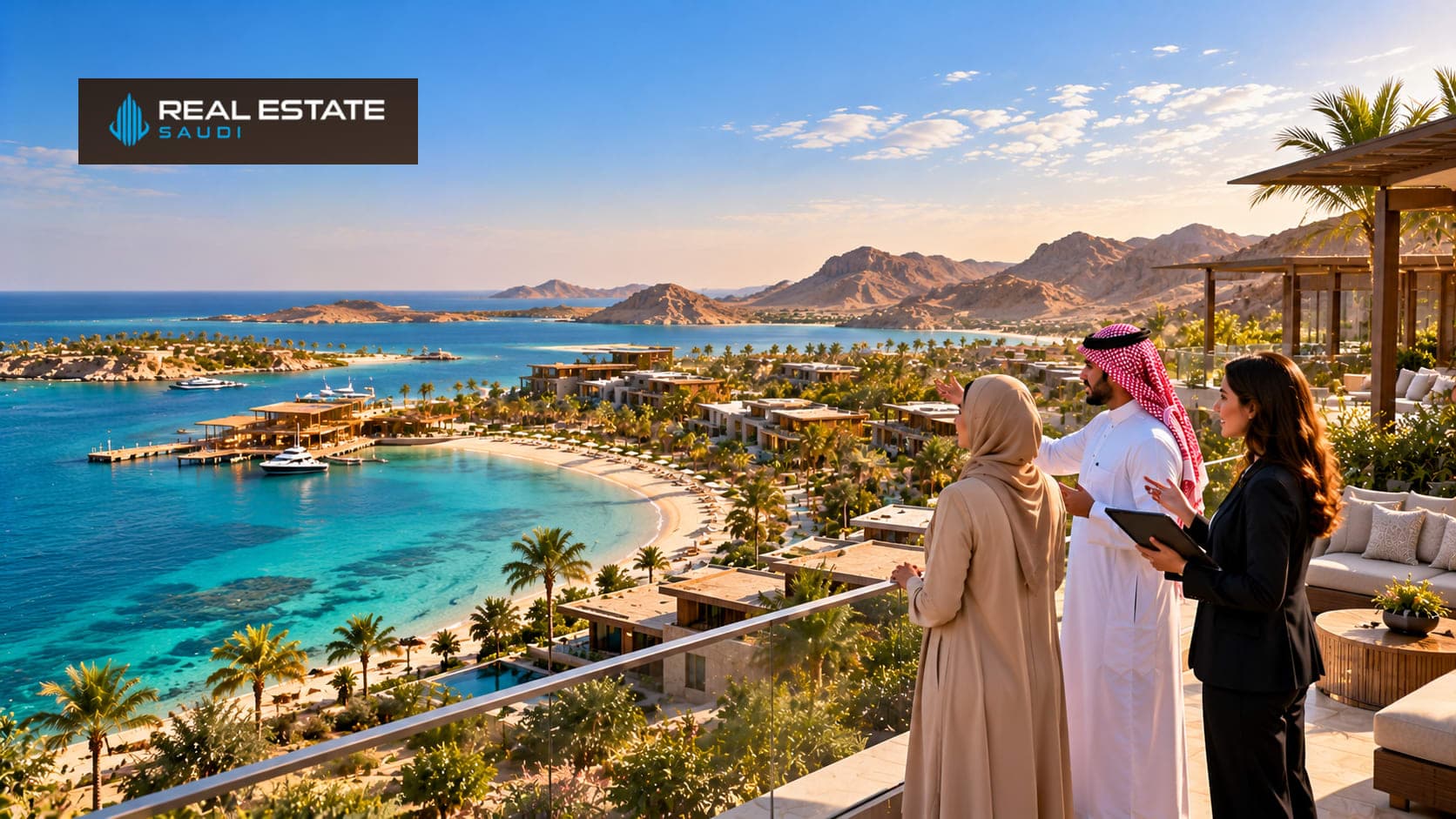
Tourism Real Estate in Saudi Arabia is attracting investors interested in hotels, luxury resorts, serviced apartments, holiday homes and hospitality developments. The opportunity is supported by growing domestic travel, religious tourism, business events and destination development. However, the performance of each property depends on its location, operating model, acquisition cost and compliance with Saudi regulations.
Saudi Arabia recorded approximately 123 million domestic and inbound tourists in 2025, according to official tourism statistics released in June 2026. This included around 29.3 million international visitors and 93.3 million domestic tourists. The figures demonstrate the scale of the country's travel market, although visitor numbers alone cannot establish whether an individual hotel or resort will generate attractive returns.
Investors entering this market in 2026 must understand tourism accommodation licensing, foreign ownership regulations, operating costs and the differences between established destinations and emerging developments.
This guide examines the property types, investment opportunities, major locations, financing considerations and practical risks shaping Saudi Arabia's tourism property sector.
What Is Tourism Real Estate in Saudi Arabia?
Tourism real estate refers to properties developed, acquired or operated to accommodate visitors or provide facilities supporting tourism activities. These assets can include hotels, resorts, serviced apartments, licensed holiday accommodation and specialised hospitality developments.
Unlike conventional residential property, tourism accommodation often generates revenue through shorter stays and depends heavily on professional operations.
A hotel's financial performance may be influenced by room occupancy, average daily rates, operating expenses and customer experience. Holiday accommodation faces similar considerations, although the management structure may be different.
Investors should distinguish ownership of a tourism-related asset from permission to operate a tourism business. A property purchase does not automatically grant the licences required to receive paying guests.
The broader Saudi real estate investment guide explains how different property categories fit into a diversified investment strategy.
ما نوع العقار والمنطقة المناسبة؟
اختر نوع العقار والمدينة المستهدفة لاستعراض أنسب الخيارات.
Why Saudi Tourism Property Investment Is Growing
Tourism has become an important component of Saudi Arabia's economic diversification programme. Investment in destinations, transport connections, cultural attractions and hospitality services is intended to support a broader visitor economy.
The Saudi tourism statistics published by DataSaudi show that the Kingdom received 29.3 million inbound tourists and 93.3 million domestic tourists in 2025.
Religious travel accounted for a substantial portion of international visitation, while leisure, business and visits to friends and relatives contributed to the broader market.
These visitor categories have different accommodation needs. Pilgrims may prioritise proximity to religious destinations, business travellers often value convenient transport and reliable services, and leisure visitors may seek distinctive experiences.
An investor should therefore analyse the demand generated by a particular location rather than treating all tourism growth as interchangeable.
New supply also matters. A destination attracting more visitors may still experience pressure on hotel prices if accommodation capacity expands faster than demand.
Types of Tourism Real Estate Investment Opportunities
Saudi Arabia's hospitality property market includes several formats, each requiring a different investment approach.
Hotels and Business Accommodation
Hotels serve business travellers, leisure visitors, pilgrims and people attending major events. Their appeal depends on accessibility, quality, pricing and relationships with booking channels or corporate customers.
Investors may acquire an existing hotel, participate in a development or provide capital through an appropriate investment structure.
Established properties offer operating history for evaluation, while new developments involve construction and opening risks.
Luxury Resorts
Resorts can attract higher-spending leisure guests seeking beaches, wellness facilities, recreation or secluded accommodation.
These assets generally require substantial investment in amenities, staffing and maintenance.
A premium design does not guarantee premium occupancy. Revenue depends on destination accessibility, market positioning and guest satisfaction.
Serviced Apartments
Serviced apartments combine accommodation facilities with residential-style convenience. They may appeal to families, extended-stay business visitors and travellers seeking additional living space.
Their operations can differ significantly from traditional apartment rentals because guest turnover, cleaning and hospitality compliance create recurring expenses.
Holiday Homes and Villas
Licensed holiday homes may cater to families, groups or leisure travellers seeking privacy.
Investors considering villa investment opportunities in Saudi Arabia should first determine whether their intended property can lawfully operate as short-stay accommodation.
Heritage and Nature-Based Accommodation
Heritage hotels, lodges and carefully planned nature-oriented properties can serve visitors interested in culture and distinctive destinations.
These projects require close attention to conservation, environmental conditions and location-specific development restrictions.
Tourism Real Estate in Saudi Arabia and Vision 2030
Vision 2030 connects tourism expansion with economic diversification, employment creation and improvements in destination infrastructure.
The national tourism strategy targets 150 million visitors annually by 2030, covering domestic and international tourism.
For property investors, this strategic direction creates a reason to research accommodation demand in multiple regions rather than focusing exclusively on established commercial centres.
However, national targets should not be interpreted as guarantees for individual property investments.
A tourism development may benefit from improved access roads, airport connectivity or nearby attractions. Its financial performance will still depend on whether guests choose to stay there and whether revenue exceeds operating costs.
Investors should study the opening schedules, infrastructure delivery and actual tourism activity surrounding each proposed development.
Projects in advanced operational stages generally provide more observable evidence than developments whose future timelines remain uncertain.
Best Locations for Tourism Property Investment in 2026
Location selection is one of the most important decisions in hospitality investment. Saudi cities and destinations serve different visitor markets, and their accommodation requirements should be assessed separately.
Riyadh: Business and Events Tourism
Riyadh attracts corporate travellers, government-related visitors and guests attending exhibitions, conferences and entertainment events.
Hotels and serviced apartments may benefit from proximity to employment centres, transport corridors and event venues.
Investors studying Riyadh's established and developing property districts should compare business-focused neighbourhoods with leisure-oriented areas.
Property performance may vary considerably between districts, even within the same city.
Jeddah: Coastal and Transit Demand
Jeddah combines business activity, domestic leisure demand and access to religious travel routes.
Its waterfront areas may interest hospitality investors targeting leisure visitors, while central business locations may support corporate accommodation.
The Jeddah property market and location guide provides useful geographical context when comparing investment areas.
Makkah and Madinah: Religious Tourism
Religious tourism creates specialised demand for accommodation in Makkah and Madinah.
Property economics depend heavily on accessibility, seasonal demand patterns, transport arrangements and operating efficiency.
Foreign ownership and investment structures in the holy cities are subject to particular legal requirements. Investors should not assume that a purchase structure permitted elsewhere in Saudi Arabia is automatically available in these locations.
AlUla: Heritage and Cultural Tourism
AlUla has attracted attention for its historical sites, cultural attractions and distinctive landscape.
Accommodation opportunities may include boutique hotels and carefully planned hospitality concepts, subject to applicable permissions.
The AlUla heritage tourism and property overview explains the destination's development context.
Red Sea Destinations
The Red Sea coastline is associated with new resort developments and premium leisure tourism.
However, individual investment opportunities vary in their ownership structure, project status and accessibility.
The website's Red Sea property development overview can help readers understand the regional project landscape without assuming every project is open to direct private investment.
Aseer and Taif
Aseer and Taif may appeal to domestic travellers interested in mountain landscapes, seasonal leisure and cultural experiences.
Investors should evaluate accessibility, peak travel periods and demand outside major holidays before committing to accommodation developments.
Major Tourism Developments Shaping Investment Interest
Large-scale developments influence investor expectations, but their commercial implications require careful interpretation.
The Red Sea
Red Sea developments combine hospitality, environmental considerations and destination infrastructure. Potential investment exposure may involve project companies, approved commercial arrangements or nearby independent assets where legally available.
Direct ownership opportunities should never be inferred simply because a destination is being developed.
AMAALA
AMAALA is associated with high-end tourism and wellness-oriented hospitality development.
Investors researching the AMAALA development and property context should distinguish publicly announced project features from independently available investment products.
NEOM
NEOM includes destination concepts that have received significant international attention.
Commercial feasibility depends on the status of individual projects, delivered infrastructure and legally available investment structures.
Promotional master plans are not substitutes for construction updates, licensed operations or verified transaction documentation.
Diriyah
Diriyah's cultural and heritage positioning creates potential interest in high-quality accommodation and complementary visitor services.
Such opportunities may be shaped by heritage requirements, approved development frameworks and the operational needs of specific hospitality assets.
Understanding Tourism Demand and Visitor Spending
Tourism demand should be analysed using both visitor numbers and spending behaviour.
The Ministry of Tourism's 2025 statistical report, released in June 2026, recorded nearly SAR 304 billion in combined domestic and inbound tourism spending.
Within that total, international tourism spending reached approximately SAR 176.6 billion, while domestic spending reached approximately SAR 127.1 billion.
These amounts cover tourism expenditure broadly. They should not be presented as hotel revenue or as a pool of income available to property investors.
A destination can attract large numbers of visitors who spend relatively little on accommodation. Another destination may receive fewer guests but support higher room rates.
Investors should therefore examine visitor purpose, length of stay, accommodation preferences and local competition.
The most useful market research combines national statistics with property-level information, including comparable room rates and achievable occupancy.
Hotel and Resort Investment Costs in Saudi Arabia
There is no single reliable investment amount for tourism real estate because costs vary according to property type, location, quality and development scale.
A small licensed accommodation operation has very different financial requirements from a full-service resort.
Acquisition and Construction
Investors must account for land or property acquisition, building works, interior fit-out and professional fees.
For new developments, infrastructure and engineering requirements may form a substantial portion of the overall budget.
Equipment and Furnishing
Hotels require furniture, guest-service systems, security infrastructure and other operational equipment.
Premium accommodation generally involves more extensive furnishing and maintenance commitments.
Staffing and Operations
Recurring expenses can include employee compensation, housekeeping, utilities, repairs, insurance and reservation platform commissions.
Marketing and Distribution
Hospitality businesses must attract customers through direct bookings, travel partners and other distribution channels.
The cost of acquiring guests should be included in revenue planning.
Investors should request a detailed development budget rather than relying on an advertised headline investment figure.
Saudi Tourism Accommodation Licensing Requirements
Operating accommodation for paying tourists requires attention to Ministry of Tourism regulations.
The Saudi Ministry of Tourism's tourism accommodation facility licensing service explains the requirements for applying for an operational licence.
These include a valid commercial registration covering the relevant activity, applicable municipal or competent-authority permissions and Civil Defense authorisation.
Additional requirements may involve guest-registration systems and technical integration with national tourism monitoring platforms.
Licensing conditions depend on accommodation category and circumstances. A hotel, resort or private accommodation unit should not be assumed to follow identical procedures.
Investors should confirm the required classification, permitted activity and operational permissions before finalising development plans.
Renovating a property or purchasing an apartment does not automatically make it eligible for tourist accommodation use.
Can Foreigners Invest in Saudi Tourism Property?
Foreign investors may participate in qualifying Saudi real estate investments, subject to ownership, registration and commercial activity rules.
The revised non-Saudi property ownership framework took effect on January 22, 2026.
The Real Estate General Authority's official non-Saudi ownership framework provides guidance on eligible applicants, geographical areas and ownership procedures.
Different rules can apply to resident individuals, overseas purchasers, Saudi companies with foreign shareholders and companies incorporated abroad.
An investor must also distinguish property ownership from operating a hospitality business.
Corporate registration, foreign investment requirements and sector licences may be necessary depending on the proposed activity.
Special restrictions apply in Makkah and Madinah.
Before signing contracts, investors should confirm the permitted property rights, geographic eligibility and any required corporate structure through qualified advisers and relevant authorities.
Tourism Investment Financing and Government Support
Some investors may be eligible for financing or development support through programmes serving the tourism sector.
The Saudi Tourism Development Fund's government agency profile explains the fund's role in facilitating tourism investment and access to financing.
The Tourism Development Fund was established to support investment in projects aligned with Saudi tourism development.
Its involvement does not mean that every hotel, resort or holiday-home proposal automatically qualifies for funding.
Applicants may need to demonstrate project feasibility, financial capacity, commercial demand and compliance with programme requirements.
Conventional bank financing, institutional investment and joint ventures may also be relevant depending on transaction scale.
Investors should compare financing costs, security requirements and repayment obligations before selecting a funding arrangement.
Debt can improve access to capital but may increase financial pressure during periods of weak occupancy.
حدد ميزانيتك الاستثمارية
حدد ميزانيتك التقديرية لنقوم بتضييق خيارات العروض.
Tourism Property Taxes and Transaction Expenses
Hospitality investors should distinguish taxes arising from property transactions from taxes and compliance obligations associated with ongoing business operations.
Saudi Arabia generally imposes Real Estate Transaction Tax at 5% on qualifying real estate disposals, subject to statutory exemptions.
The ZATCA Real Estate Transaction Tax Law establishes the relevant rules.
Additional costs may include legal advice, property registration procedures, valuation, financing and operational licences.
Business activities can involve further tax and accounting obligations depending on the entity and transaction.
Foreign-owned structures may face additional conditions or charges.
Investors should obtain transaction-specific advice rather than assume that the tax treatment of a residential purchase applies unchanged to a hospitality business or investment vehicle.
Understanding these obligations before acquisition is essential for accurate project budgeting.
How to Evaluate Tourism Property Returns
The financial attractiveness of a tourism property depends on its actual and expected cash flow.
Gross booking revenue alone does not reveal profitability.
An investor should examine occupancy, average daily room rate, staffing expenses, maintenance, distribution costs and financing obligations.
Occupancy and Pricing
High occupancy may indicate strong demand, but discounted rates can reduce profitability.
Conversely, a luxury resort may achieve a higher average rate while operating with lower occupancy.
Seasonal Demand
Religious tourism, events and domestic holiday periods can produce significant changes in visitor volumes.
A property's annual performance should be assessed across multiple seasons.
Operating Expenses
Properties offering restaurants, recreation facilities or extensive guest services may have substantial ongoing costs.
Management Quality
A capable operator can influence guest satisfaction, operating efficiency and repeat bookings.
Investors should review historical performance where available and use conservative projections for newly developed properties.
Choosing Between Direct Ownership and Partnership Structures
Investors can approach tourism property through several ownership and operating models.
Direct property ownership provides exposure to a specific asset but may also require direct responsibility for financing, compliance and management.
Joint ventures can combine investor capital with development or hospitality expertise.
Leasing a property to an established operator may offer a different risk profile from operating accommodation independently.
Some investors may consider regulated funds or other investment vehicles providing exposure to real estate assets.
Each arrangement has distinct legal, financial and liquidity implications.
The appropriate structure depends on available capital, risk tolerance and desired level of operational involvement.
An investor seeking passive exposure should not assume that owning a holiday villa will function like a conventional long-term residential lease.
Step-by-Step Guide to Investing in Tourism Property
Step 1: Define the Investment Objective
Decide whether the goal is capital appreciation, operating income, long-term leasing or participation in a hospitality development.
Step 2: Identify the Target Visitor Market
Choose the traveller category the property will serve, such as business visitors, pilgrims, families or leisure tourists.
Step 3: Research Locations
Compare destinations using tourism data, infrastructure, local competition and accommodation demand.
Step 4: Verify Ownership Eligibility
Confirm that the proposed purchaser can acquire the intended property rights.
Step 5: Check Property Permissions
Establish whether the asset may legally operate in the proposed accommodation category.
Step 6: Assess Financial Feasibility
Review acquisition costs, licensing, renovation, staffing and expected operating expenses.
Step 7: Evaluate the Operator
If a management company will operate the property, examine its experience and proposed contractual terms.
Step 8: Complete Legal Due Diligence
Verify ownership records, seller authority, restrictions and applicable liabilities.
Step 9: Arrange Financing
Confirm funding availability and understand repayment obligations before committing.
Step 10: Monitor Operational Performance
After acquisition, track costs, booking demand and the condition of the property.
Documents and Due Diligence Before Investing
Property due diligence is particularly important when hospitality operations depend on several legal and commercial approvals.
Investors should establish the property's title, ownership structure and authorised use.
A valid ownership record or legally enforceable interest is essential.
Planning records should confirm whether the proposed development or accommodation activity is permitted.
Where the property is already operating, investors should review tourism licences, commercial registration and relevant safety documentation.
Financial records can help establish the reliability of historical revenue claims.
Management agreements deserve careful examination because fees, performance obligations and termination conditions may influence returns.
The site's physical condition, maintenance requirements and outstanding commitments should also be investigated.
An independent legal and technical assessment can identify problems that may not be apparent from promotional documents.
Major Risks in Saudi Tourism Property Investment
Tourism accommodation is exposed to both property-market risk and hospitality-business risk.
Demand Volatility
Visitor activity may change because of economic conditions, travel patterns or competition.
Seasonality
Certain destinations experience stronger demand during specific periods, creating uneven cash flow.
Development Delays
Construction or infrastructure delays may postpone the opening of new accommodation facilities.
Operating Costs
Employee expenses, maintenance and utilities can reduce profitability.
Competition
New hotels or resorts may place pressure on room rates and occupancy.
Regulatory Compliance
Ownership permissions and accommodation licences must remain consistent with applicable requirements.
Limited Liquidity
Specialised hospitality properties may take longer to sell than conventional residential units.
Investors should maintain financial reserves and assess whether a project remains viable under conservative demand assumptions.
How Property Management Affects Hospitality Returns
Professional management can have a substantial influence on a tourism property's operating performance.
A well-maintained facility may attract repeat visitors and achieve better customer satisfaction.
Management responsibilities can include reservations, housekeeping, maintenance, guest relations and financial reporting.
The cost of these services must be balanced against the revenue they help generate.
Investors reviewing Saudi property management services should establish whether the proposed provider has relevant hospitality experience.
Conventional residential management and short-stay hospitality management are not identical services.
The management agreement should explain responsibilities, reporting obligations, performance measures and the treatment of unexpected expenses.
An investor should also understand whether revenue projections depend on assumptions that have not been independently verified.
Investment Strategies for Different Budget Levels
Tourism investment is not limited to large resort developments, although the appropriate entry route depends on legal eligibility and market availability.
Investors with relatively modest capital may investigate qualifying private accommodation units or participation through suitable investment arrangements.
Larger investors may consider hotel acquisitions, redevelopment projects or partnerships with established operators.
Institutional investors can evaluate more complex hospitality portfolios and development structures.
Capital requirements should be established from actual proposals and detailed financial assessments.
A low purchase price should not override concerns about poor access, limited tourism demand or licensing restrictions.
For every budget, the priority is to match the investment structure to the investor's available capital and capacity to absorb operating risks.
كيف تفضل التواصل معك؟
اختر وسيلة التواصل الأكثر ملاءمة لك لمناقشة فرصك الاستثمارية.
Future Outlook for Tourism Real Estate in 2026 and Beyond
Saudi Arabia's tourism strategy creates a substantial pipeline of destination development and hospitality activity.
The market's future performance will depend on delivered infrastructure, visitor demand and the ability of operators to manage growing accommodation supply.
Established urban destinations may offer clearer operating histories, while emerging tourism areas may provide development opportunities with greater uncertainty.
Religious tourism, domestic leisure travel and business events are likely to remain important segments, although their effects will vary by location.
Investors should monitor official tourism statistics, property transactions and project delivery announcements.
Future investment decisions should be based on current evidence rather than assuming that every destination will experience identical growth.
A disciplined approach to ownership, licensing, financing and management offers a stronger foundation than relying on speculative returns.
Conclusion
Tourism Real Estate in Saudi Arabia offers exposure to a visitor economy spanning religious travel, business events, cultural destinations and leisure tourism.
Hotels, resorts, serviced apartments and licensed holiday accommodation each offer different investment characteristics.
The country's tourism expansion and destination development programmes provide reasons to investigate the sector, but successful investment requires more than national growth figures.
Investors must understand ownership eligibility, accommodation licensing, total acquisition costs and realistic operating performance.
Established destinations may provide more comparable data, while emerging locations require careful evaluation of infrastructure and demand.
تحدث معنا عبر قناتك المفضلة
استشارات عقارية مباشرة حول الاستثمار والسوق العقاري في المملكة العربية السعودية.
الأسئلة الشائعة
Tourism real estate includes properties designed or operated to accommodate visitors or support tourism activities. Common examples include hotels, resorts, serviced apartments, holiday homes and specialised hospitality developments. These properties differ from conventional housing because their revenue often depends on guest bookings, tourism demand, operating standards and hospitality management.
Tourism property may be attractive when the asset serves genuine visitor demand and is acquired at a sustainable price. However, strong national tourism figures do not guarantee individual returns. Investors should review occupancy, operating expenses, licensing, competition and the property's long-term financial viability before making a decision.
Riyadh, Jeddah, Makkah, Madinah and AlUla serve different visitor markets. Riyadh has business and event demand, while Makkah and Madinah serve religious visitors. Coastal and heritage destinations may appeal to leisure tourists. The most suitable location depends on the accommodation model and legally available investment opportunities.
Eligible non-Saudi individuals and companies can acquire qualifying property rights under Saudi Arabia's updated ownership framework, subject to geographic and regulatory restrictions. The system took effect on January 22, 2026. Hospitality operations may require separate corporate and tourism licences, and special ownership rules apply in Makkah and Madinah.
Potential property categories include hotels, serviced apartments, resorts, holiday villas, boutique accommodation and heritage hospitality projects. Investment may take the form of direct ownership, development or participation through suitable legal structures. Availability and eligibility differ according to location, project status and applicable regulations.
Private accommodation offered to tourists may require authorisation from the Saudi Ministry of Tourism. Eligibility depends on the applicant, property rights and relevant regulatory requirements. Investors should confirm the correct licence category and property-use conditions before advertising accommodation or accepting paying guests.
Costs vary widely depending on the location, property size, construction quality, existing condition and operating model. Investors should budget for acquisition or development, furnishing, staffing, licensing, maintenance and marketing. There is no reliable universal investment amount that applies to every hotel or resort project.
Qualifying real estate transactions generally fall under the 5% Real Estate Transaction Tax, subject to statutory exemptions. Hospitality businesses may have additional tax and compliance obligations depending on their structure and operations. Foreign ownership arrangements may involve further requirements, making transaction-specific professional advice advisable.
No. The Tourism Development Fund supports qualifying tourism investment, but eligibility depends on the relevant programme, application conditions and project assessment. Investors should review current funding criteria and prepare a credible business plan rather than assuming financing is automatically available for any tourism property.
Major risks include changing visitor demand, seasonal revenue patterns, competition, development delays, high operating expenses, licensing requirements and limited resale liquidity. An attractive tourism destination does not necessarily produce a profitable accommodation business. Financial feasibility, legal verification and professional management remain essential.
