
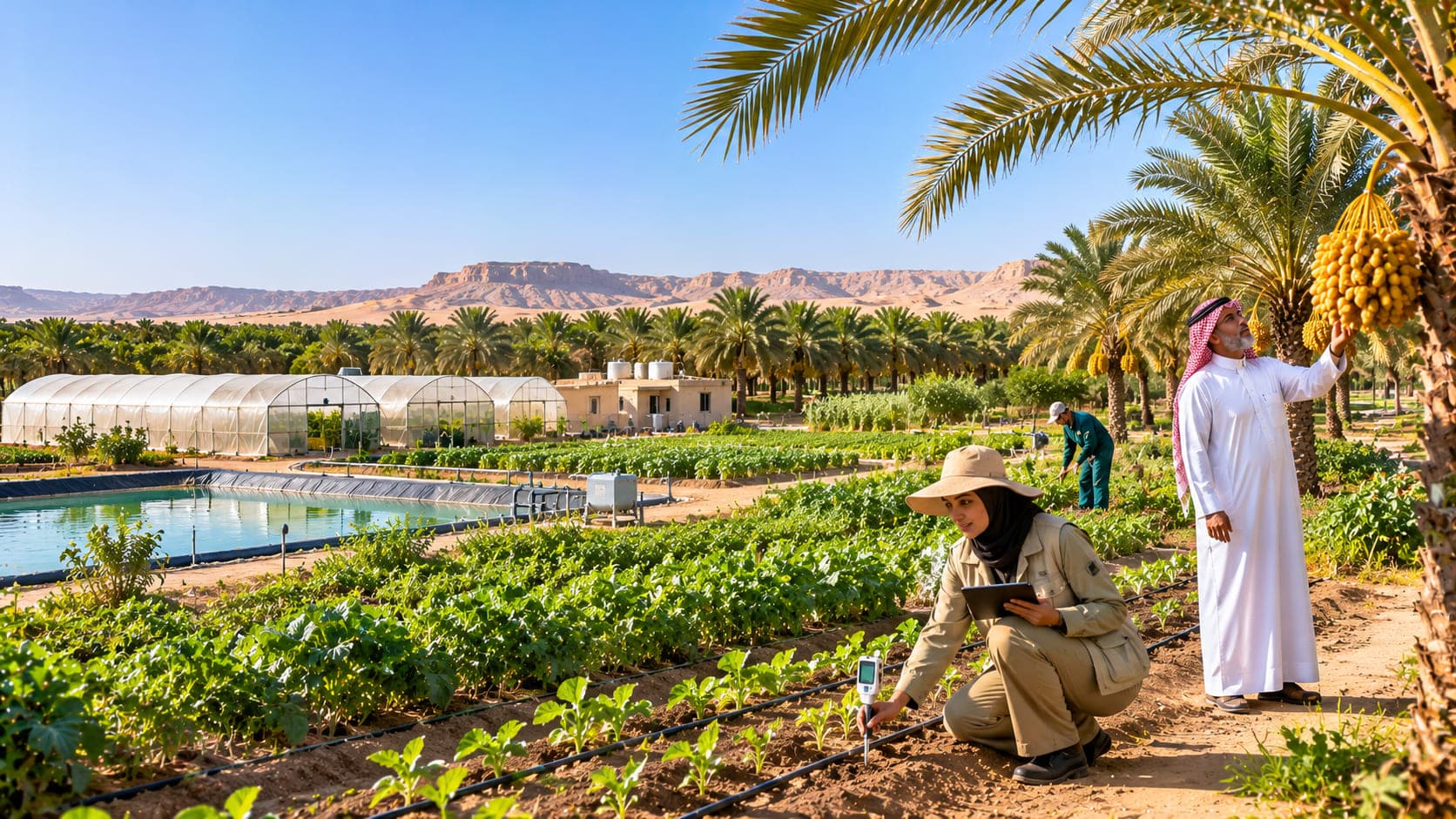
Agricultural Real Estate in Saudi Arabia includes farmland, orchards, greenhouses and property supporting livestock or other permitted farming activities. For investors, the central question is not simply whether a parcel is inexpensive. It is whether its legal use, reliable water access, soil, infrastructure and operating economics support a viable agricultural business. A well-located plot without lawful irrigation may be less useful than a smaller, more expensive holding with verified utilities and buyers for its produce.
This guide examines the agricultural property market, promising regions for different activities, licensing, foreign ownership, financing, transaction costs and realistic investment assessment. It uses current Saudi regulations and the most recent official agricultural statistics identified in this research, while avoiding invented land prices or guaranteed returns.
What Counts as Agricultural Real Estate in Saudi Arabia?
Agricultural property is land or associated real estate used, or lawfully designated for use, in agricultural production. It can include open-field cultivation, date-palm orchards, olive groves, protected greenhouses, livestock operations, storage and supporting facilities. The legal classification of the parcel is essential: land advertised as a farm may not automatically permit every crop, building, groundwater extraction activity or processing operation.
Investors should separate the land asset from the business operated on it. Buying a plot does not necessarily transfer equipment, livestock, crops, water-use permissions, employees or commercial contracts. Each should be listed in the transaction documents where relevant. A parcel may also be operated through a lease rather than outright ownership, with different capital requirements and renewal risks.
The wider guide to investment-suitable land in Saudi Arabia explains why zoning and infrastructure should be assessed before treating a low advertised land price as an investment advantage.
Saudi Agricultural Market: Evidence Rather Than Hype
Agriculture is a significant part of Saudi Arabia's food-security and resource-management agenda, but sector growth should not be mistaken for a guaranteed return on individual farmland. The General Authority for Statistics' 2024 agricultural statistics announcement reports approximately 1.923 million tonnes of dates produced in 2024, alongside around 2.745 million tonnes of open-field vegetables and 797,000 tonnes of greenhouse vegetables. These figures describe national output in 2024, not prices or yields available to a buyer in 2026.
The same statistics illustrate that production systems differ greatly. Date palms involve long-lived orchards and harvesting arrangements, while protected vegetable operations require equipment, climate management and repeated growing cycles. Neither can be evaluated solely by a price per square metre. National production data also cannot establish the profitability of one farm because operating costs and access to buyers vary.
The investment case starts with crop selection, market access and water efficiency. An experienced agronomist can estimate realistic production using local soil and climate evidence. A buyer should then test those assumptions against selling prices, spoilage, distribution costs and the time required before the first commercial harvest.
A farm's natural output also does not guarantee access to a paying customer. Fresh vegetables may require dependable cold-chain collection, while date marketing can depend on grading, storage and relationships with processors or wholesalers. Check whether any claimed purchase agreements are binding, who carries transport costs and whether the projected harvest volume can realistically be sold during peak supply.
ما نوع العقار والمنطقة المناسبة؟
اختر نوع العقار والمدينة المستهدفة لاستعراض أنسب الخيارات.
Main Agricultural Property Types and Their Economics
An established orchard may offer existing trees and operating records, but its value depends on tree age, productivity, irrigation and documented sales. A greenhouse holding can provide more controlled production, yet cooling, electricity, maintenance and replacement materials may make its operating costs substantial. Livestock facilities require appropriate land use and animal-health arrangements, while processing premises may require permissions beyond ordinary cultivation.
Property type | Core investment question | Major due-diligence issue |
|---|---|---|
Date or fruit orchard | What is the verified yield and tree condition? | Irrigation sustainability and harvest costs |
Open-field farm | Which crops are permitted and commercially suitable? | Soil, water allocation and weather exposure |
Greenhouse operation | Can production cover energy and maintenance costs? | Equipment life, cooling and operating licenses |
Livestock holding | Is the site authorized for the intended animals? | Biosecurity, feed supply and waste management |
Agricultural land lease | Do the lease terms support the business horizon? | Renewal, improvements and permitted use |
Where a site includes buildings or equipment, ask whether these assets are legally approved and included in the price. An expensive installation with no functioning utility connection can become a liability rather than a productive asset.
Best Regions to Research for Farmland
Different Saudi regions have different agricultural histories, markets and environmental conditions. Al-Qassim is an obvious research destination for date-related businesses and associated logistics. Al-Jouf is associated with olive cultivation, while Hail has agricultural activity that warrants project-specific examination. Madinah has a long history of dates, and Asir and parts of the southwest support different cultivation conditions from the central plateau.
These associations are not regional investment rankings. A site in a well-known farming region can still have poor soil, expensive transport or inadequate legally usable water. Equally, an unusual crop may be commercially feasible where an operator has the right technical system and a dependable buyer. No region should be described as having uniformly cheap land or assured groundwater reserves.
For each shortlist, compare proximity to wholesale markets, labor availability, refrigerated transport, electricity and the crop's actual suitability. The same evaluation helps distinguish farmland ownership from investments that may be better pursued through a farming operator or supply-chain business.
Water Rights and the Economics of Irrigation
Water is among the most consequential constraints on Saudi farmland. A seller's statement that a plot has a well does not establish that drilling, abstraction or ongoing water use is lawful. Ask for the relevant well documentation, use permissions, permitted activity and any recorded restrictions. Have a qualified professional assess water quality, pumping capacity and the likely cost of operation.
The Ministry of Environment, Water and Agriculture's official water-resources and well-licensing responsibilities confirm that water-well drilling and related permissions are regulated activities. Groundwater is not an unlimited entitlement attached to every agricultural plot. Future operating expenses may depend heavily on pumping depth, salinity, filtration, electricity and irrigation efficiency.
For Agricultural Real Estate in Saudi Arabia, a water budget should cover the expected demand of the selected crops, peak seasonal needs and potential restrictions. Efficient drip irrigation and monitored systems may reduce waste, but the technology cannot create a water supply that is unavailable or legally restricted. A purchase decision should be contingent on resolving this issue, not based on hopes that permission will follow later.
Farming Licenses, Land Use and Naama Services
Land ownership and permission to conduct a particular agricultural activity are separate questions. Depending on the proposed operation, the investor may require agricultural activity registration, an operating license, construction approval or permissions concerning livestock, veterinary services or food processing. A warehouse or visitor facility may need a different regulatory assessment from the farm itself.
In October 2025, the Ministry announced digital agricultural activity licensing through the Naama platform, including registration of activities carried out on agricultural holdings. The development supports more structured records and access to ministry services. It does not mean that every parcel can be used for any agricultural enterprise without additional authorizations.
Before paying a reservation amount, request written confirmation of the intended site's permitted use and the licensing path for the actual business. If a seller advertises a greenhouse or livestock complex as operational, examine its approvals and inspection history. It is also prudent to ask whether ownership or management changes require notifications or fresh applications.
Ownership Documents, Boundaries and Existing Obligations
A usable agricultural investment begins with a legally identifiable parcel. Verify the title or applicable registration record, plot boundaries, cadastral description, legal access and the seller's authority. Check for mortgages, restrictions, shared rights, boundary disputes or easements that might reduce the area available for cultivation.
Visit the site with a surveyor if boundaries are unclear. On large rural holdings, fences and cultivated rows are not necessarily legal boundaries. Ask whether access roads cross another person's land and whether utilities rely on informal arrangements. Where existing buildings are included, compare their physical condition with relevant permits and transfer records.
The site's practical Saudi property-purchase checklist provides additional questions for document review. Agricultural transactions add a crucial second layer: the legal ability to carry on the intended farming operation after the title changes hands.
Check whether possession is immediate or subject to an existing farm lease, crop-sharing arrangement or operator agreement. A purchaser who expects to run the holding personally could face a costly surprise if another party has enforceable occupation rights. The broader Saudi real estate law guide helps frame general title and contracting questions, but agricultural operation rights need their own document review.
Can Foreigners Own Agricultural Land in 2026?
The statement that all foreign individuals are categorically prohibited from owning any agricultural real estate is too broad. Equally, the updated ownership regime should not be presented as allowing unrestricted foreign purchases of farms. Saudi Arabia's non-Saudi ownership law entered into force on 22 January 2026 and provides for different classes of purchasers, geographical controls and property rights.
The Real Estate General Authority's current non-Saudi property ownership law explains the designated-area framework and requirements for individuals and corporate entities. Eligibility under that law is not a substitute for checking agricultural land-use restrictions, sector licensing and investment registration where applicable.
Foreign investors should therefore identify the intended ownership structure first, then obtain professional confirmation that the particular parcel and proposed activity are permitted. A lease, operating company, joint venture and direct land purchase are different legal arrangements, each with distinct costs and protections. Neither a Saudi partner nor an investment license automatically cures a land-title or land-use problem.
The site's guide to foreign-company property ownership can help frame the corporate-property questions, but case-specific legal review remains essential before commitment.
حدد ميزانيتك الاستثمارية
حدد ميزانيتك التقديرية لنقوم بتضييق خيارات العروض.
Financing and Agricultural Development Fund Support
Agricultural projects often involve financing two separate needs: the land or long-term lease and the business assets needed to generate revenue. These can include irrigation networks, greenhouses, machinery, livestock facilities, storage and working capital. A lender may view the underlying land and the commercial cash flow differently, especially where the crop takes years to mature.
The government's Agricultural Development Fund loan application service describes an official channel for requesting project-expense financing. Availability and terms depend on the applicant, project category, credit assessment, required documentation and the fund's current programmes. Government support must never be described as automatic, interest-free for every applicant or guaranteed to cover a fixed share of costs.
Prepare a feasibility study with realistic yields, capital expenditure, seasonal expenses, buyer agreements and debt-service assumptions. The Saudi real estate financing guide provides broader borrowing context, although farm-business finance needs specialized analysis beyond a conventional residential mortgage.
Purchase Costs, Tax and the Effective Land Price
The asking price is only one component of the acquisition budget. Buyers may also need surveying, title review, legal assistance, environmental and water testing, property valuation, licensing, infrastructure and equipment replacement. A remote plot requiring roads and power can cost much more to bring into production than a developed holding with a higher sticker price.
Saudi Arabia generally applies a 5% Real Estate Transaction Tax to covered real estate disposals, subject to statutory exemptions and other applicable rules. The Zakat, Tax and Customs Authority's current transaction-tax law is the appropriate reference for establishing how the specific transaction is treated. Other fees or taxes may apply depending on the buyer, asset structure and activity, so the full cost schedule should be checked professionally.
Compare the total acquisition and development cost with the area that is actually usable for the planned crop. A low price per square metre is meaningless if large portions cannot be irrigated or accessed. Ask for every expected expense before deciding that a parcel is affordable.
Tax treatment can differ between the transfer of land, the sale of equipment, ongoing trading activity and business ownership interests. The site's overview of Saudi real estate taxes offers broader context, while the authorities and a qualified tax adviser should determine the correct treatment for the planned transaction rather than applying a residential-property assumption to a farm.
How to Calculate Realistic Farm Returns
The claim that Saudi farmland reliably earns 6%–12% annually is not supported by a universal official benchmark. Revenue depends on crop yields, production cycles, water, labor, spoilage, market prices and management quality. A productive date orchard and an uncommissioned greenhouse may have entirely different cash-flow profiles, even if they occupy similar land areas.
Start with projected sales volume multiplied by a conservative selling price. Deduct production, labor, irrigation, electricity, packaging, logistics, maintenance, insurance where relevant, finance costs and replacements. Allow for crop failure or below-plan demand. Treat land appreciation as a separate scenario, not as annual operating income.
The guide to measuring real estate investment returns explains general return concepts, but a farm model must also include agricultural working capital and production risk. If an investment is marketed as passive income, establish who actually operates the farm, bears losses and pays for expensive equipment replacements.
Leasing Farmland Versus Buying It
A long lease can reduce the amount committed to acquiring land, but it introduces renewal, use and improvement risks. The lease should specify the permitted crops and activities, responsibility for water infrastructure, maintenance, access, buildings, early termination and ownership of improvements at expiry. It should also account for the time required to recover investment in long-lived orchard or greenhouse assets.
Buying may provide stronger long-term control where lawful, but it exposes the investor to capital tied up in a potentially illiquid rural property. A purchaser should not expect an easy resale merely because a farm has attractive photographs or productive trees. The buyer pool may be specialized and sensitive to water availability and operating records.
Agricultural Real Estate in Saudi Arabia should be compared using the same business horizon under both structures. A lease that expires before an orchard reaches its planned productivity can be commercially unsuitable even when annual rent initially looks attractive.
Agricultural Technology and Sustainable Production
Precision irrigation, greenhouse climate systems, crop monitoring and remote sensors can improve operational visibility. Their value depends on correct design, skilled maintenance and integration with the chosen crops. A technology investment is not automatically profitable because it reduces manual work; its capital and energy costs must be weighed against measurable gains.
The strongest opportunities are generally those with an appropriate crop, reliable inputs and an established route to market. Technologies for water reuse, protected cultivation or post-harvest handling may help, but a proposal should identify realistic savings rather than repeat broad claims about smart farming.
Investors exploring property diversification can compare the risks of farm operations with the alternatives in the site's Saudi real estate diversification guide. A working farm is partly an operating business, not simply land held in anticipation of resale.
A Step-by-Step Agricultural Property Due-Diligence Process
A disciplined buyer can follow a clear sequence before committing funds:
Define the venture. Identify crops, livestock or other permitted activities and the intended operating horizon.
Screen the site. Check region, road access, power, climate, buyers and logistics before spending heavily on investigations.
Verify legal rights. Examine the title or lease, boundaries, restrictions and purchaser eligibility.
Confirm water. Check well permissions, actual water availability, quality and sustainable operating costs.
Review licensing. Obtain written guidance about the intended agricultural activity, structures and related approvals.
Inspect assets. Have appropriate specialists examine soil, trees, equipment, buildings and irrigation systems.
Model the economics. Stress-test sales, yields, costs, financing and a delayed route to profitability.
Close conditionally. Ensure the contract addresses unresolved approvals, included assets and required transfer documents.
If an essential assumption cannot be checked, treat it as a risk to be priced or resolved. An independent agronomist, surveyor and Saudi legal adviser serve different purposes; none is a substitute for the others.
كيف تفضل التواصل معك؟
اختر وسيلة التواصل الأكثر ملاءمة لك لمناقشة فرصك الاستثمارية.
Common Mistakes That Make Farmland Investments Fail
A common error is purchasing before understanding the water situation. A second is assuming that a title deed authorizes any agricultural or industrial use. Another is valuing the site on the number of trees without examining their age, health or historical production. Sellers may also include irrigation equipment in photographs even when that equipment is excluded from the agreed sale.
Investors sometimes calculate gross crop sales and overlook harvesting, packaging, spoilage and collection delays. Others assume that a remote plot will quickly gain development value without evidence of a lawful change in land use. These assumptions can turn an apparently inexpensive property into a difficult long-term holding.
Be cautious of promises of guaranteed yields, certain land appreciation or assured government financing. Require evidence for every material representation and preserve it in the transaction file.
Conclusion
Agricultural Real Estate in Saudi Arabia has opportunities connected to food production, modern cultivation and specialized agricultural services, but the correct investment is determined at the parcel and project level. The latest available official figures reviewed here show substantial established agricultural production, not a guarantee that a new farm can reproduce national averages.
Investors should prioritize lawful land rights, usable water, an appropriate crop, documented operating assets and conservative cash-flow assumptions. Foreign buyers must check the current ownership rules and any activity-specific restrictions. A carefully verified farm with a realistic business plan offers a sounder basis for a decision than a low asking price or promotional return claim.
تحدث معنا عبر قناتك المفضلة
استشارات عقارية مباشرة حول الاستثمار والسوق العقاري في المملكة العربية السعودية.
الأسئلة الشائعة
It includes land and associated property used or legally permitted for cultivation, orchards, greenhouses, livestock or related farming operations. Ownership of a plot is separate from approval for particular activities, groundwater use and buildings. Investors should verify what is included in a sale and whether the site's authorized use matches their intended business before making a financial commitment.
Al-Qassim is associated with dates, Al-Jouf with olives, and agricultural activity can also be studied in Hail, Madinah and parts of the southwest, including Asir. No region is uniformly suitable for every crop. Investors should compare water permissions, soil tests, climate, logistics and nearby buyers for individual sites instead of relying on broad regional rankings.
Eligibility is conditional, not a simple universal yes or no. The updated non-Saudi property ownership law became effective in January 2026, but geographical permissions, applicant categories, investment arrangements and agricultural land-use rules still matter. A foreign investor must verify the specific parcel and proposed activity with the competent authorities and seek qualified Saudi legal advice before making a purchase.
No. The presence of a well or irrigation system is not proof of an unrestricted right to pump groundwater. Buyers should examine drilling and water-use documentation, the permitted activity, water quality and operating capacity. Those checks must be completed before assuming that a parcel can support the desired crop or that expensive irrigation equipment will be useful.
It can be suitable where lawful use, water availability, market access and the business model have been verified. A farm also brings operational risks that do not arise with a conventional apartment. Returns depend on yields, production costs, selling prices, equipment and management. There is no reliable nationwide guaranteed ROI for agricultural property, so a conservative feasibility study is essential.
The Agricultural Development Fund provides financing channels for agricultural activities, subject to project type, applicant eligibility, documentation and credit assessment. Investors may also consider financing through commercial lenders or partners where suitable. None of these options should be assumed approved in advance. Prepare a business plan and obtain written terms before committing to the land purchase.
Examine title or lease rights, parcel boundaries, seller authority, restrictions, access rights, agricultural permissions, water documentation and relevant building approvals. Request records for equipment and productive assets included in the price. A professional inspection should review soil, trees, irrigation infrastructure and utilities, with legal advice addressing any ownership or transfer issues.
Saudi Arabia generally imposes a 5% Real Estate Transaction Tax on covered real estate disposals, subject to applicable exemptions and legal conditions. Farmland should not be assumed automatically exempt because it is agricultural. Confirm the treatment of the proposed sale, the transaction structure and the parties' payment obligations with the current ZATCA rules and a qualified adviser.
Leasing may reduce upfront capital needs, but it creates contractual exposure around lease duration, permitted use, renewal and compensation for improvements. Buying gives different rights and risks, including resale illiquidity. The better choice depends on the business horizon, financing, agricultural permissions and ownership eligibility. Compare both options using a complete operating and cash-flow model.
Estimate realistic production using local agronomic evidence, then apply conservative selling prices and subtract all operating and financing costs. Include water, labor, energy, packaging, transport, spoilage, maintenance, replacement equipment and potential downtime. Model poor production seasons as well as normal conditions. Do not treat gross sales, land appreciation or a marketed percentage as guaranteed net profit.
