
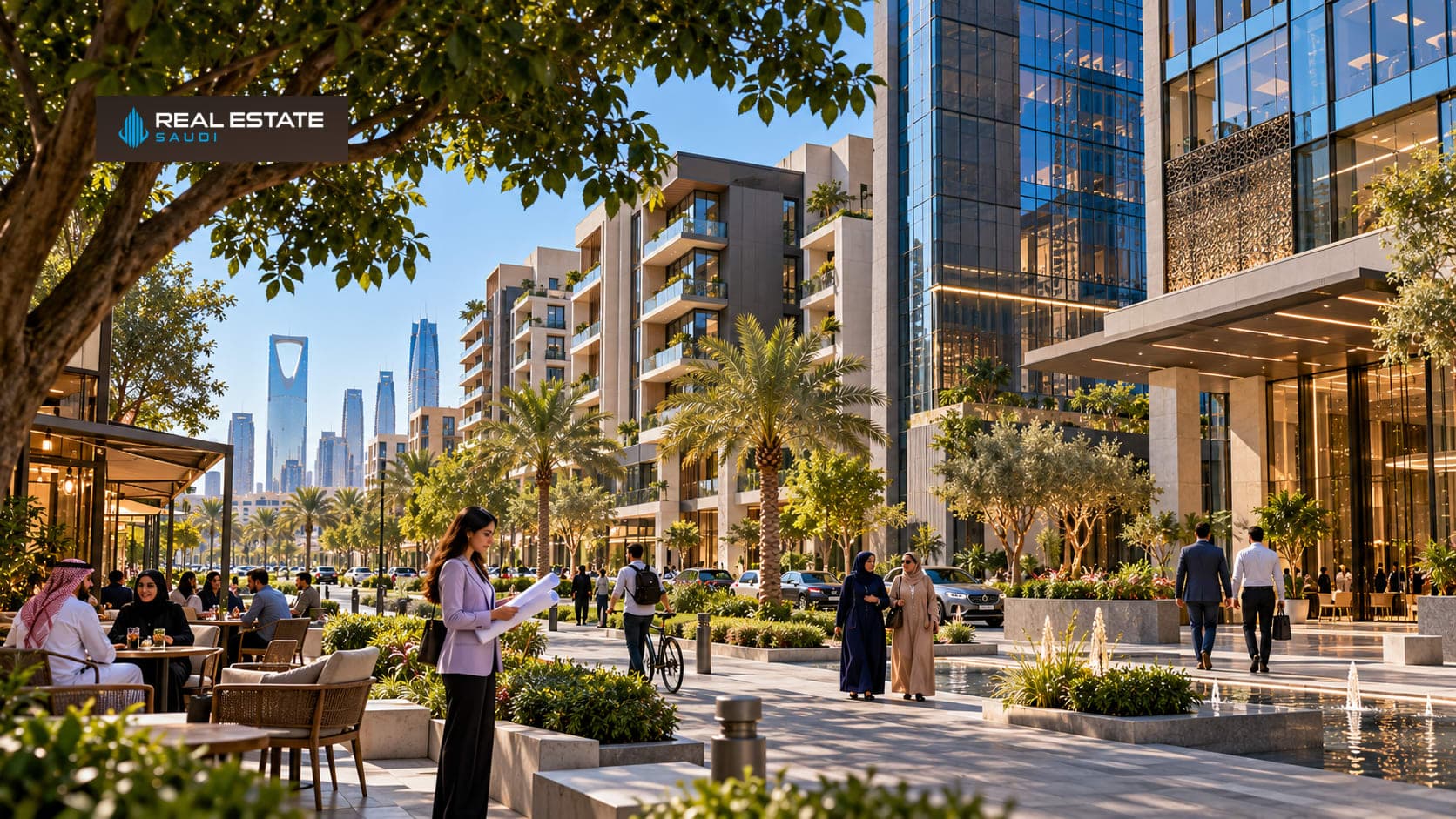
Commercial vs Residential Real Estate in Saudi Arabia is an important decision for investors comparing rental income, acquisition costs, tenant demand and long-term risk. Residential properties, including apartments and villas, may suit buyers seeking a familiar asset with demand from households. Commercial properties, such as offices, retail shops and warehouses, may offer different lease structures and income opportunities but require more specialised evaluation.
In 2026, neither category is automatically the better investment. Saudi Arabia's residential market has experienced differing apartment and villa price trends, while premium office buildings in Riyadh have maintained strong occupancy despite growing competition from new developments.
The right choice depends on your budget, investment experience, financing terms, target city and ability to manage vacancies.
This guide compares both sectors using current market research, explains their financial and regulatory differences, and provides a practical framework for choosing the most suitable investment.
Commercial vs Residential Real Estate in Saudi Arabia: Quick Comparison
Residential property is generally suitable for investors targeting households, while commercial property serves businesses requiring operational premises. The main differences involve tenant needs, lease structures, maintenance obligations and market sensitivity.
Investment Factor | Residential Property | Commercial Property |
|---|---|---|
Common asset types | Apartments, villas, townhouses | Offices, shops, warehouses |
Typical tenants | Individuals and families | Companies and business operators |
Main demand drivers | Employment, population, affordability | Business activity and location |
Lease assessment | Household needs and rental rules | Tenant business and permitted use |
Maintenance | Building and household systems | Potentially specialist systems |
Vacancy risk | Depends on housing supply | Can depend on a narrow tenant market |
Financing | Residential mortgage products may apply | Commercial lending terms vary |
Investment complexity | Often more familiar to individuals | Usually requires greater specialisation |
The comparison does not mean that residential investments are always safer or commercial investments always generate higher returns.
Property-level performance depends on acquisition costs, tenant quality, location and the terms of the transaction.
ما نوع العقار والمنطقة المناسبة؟
اختر نوع العقار والمدينة المستهدفة لاستعراض أنسب الخيارات.
What Is Residential Real Estate?
Residential real estate consists of property intended primarily for people to live in.
Common Saudi property types include apartments, villas, duplexes, townhouses and certain residential compound units.
Investors may purchase these properties for personal occupation, long-term rental income or future resale.
Apartments
Apartments can serve individuals, couples and families with different space requirements. Their investment performance depends on the building, neighbourhood, purchase price and management costs.
Villas
Villas may appeal to larger households seeking privacy and additional space. However, the purchase price and maintenance obligations can be substantial.
Residential compounds
Managed developments may provide security arrangements and shared recreational facilities. Buyers must understand whether units are individually owned or operated within a rental community.
The Saudi residential property buying guide provides additional context for evaluating homeownership options.
Residential investment is usually driven by household affordability and the availability of suitable accommodation.
What Is Commercial Real Estate?
Commercial real estate comprises properties used for business and income-generating activities rather than ordinary residential occupation.
Common examples include offices, retail units, warehouses, showrooms and certain mixed-use premises.
Office buildings
Offices serve businesses requiring workspaces, meeting facilities and access to employees or customers.
Retail premises
Shops depend on relevant customer traffic, surrounding businesses and suitable permitted activities.
Warehouses
Industrial and distribution users prioritise transport connections, loading facilities and reliable infrastructure.
Mixed-use property
Developments combining residential and commercial functions can create different income streams but may involve more complicated management.
Commercial property must meet the legal and technical requirements of the intended occupier.
The Saudi commercial property location guide explains how accessibility, tenant demand and zoning affect site selection.
Investors should never assume that every commercial unit is suitable for every business activity.
Saudi Real Estate Market Trends in 2026
Recent market evidence shows why investors should examine both sectors separately.
Knight Frank's September 15, 2026 research reported 45,740 residential transactions nationally during Q2 2026, representing a 12% annual decline.
Riyadh apartment values increased 3.1% year-on-year, while villa values declined 2.2%. Apartment prices also rose in Jeddah and the Dammam Metropolitan Area, although villa values softened in those markets.
Commercial offices displayed different trends.
Knight Frank reported Riyadh Grade A office rents rising 3.4% annually during Q2 2026, with Grade A occupancy at 97%.
These figures describe specific market categories and reporting periods. They do not establish guaranteed future returns.
The differing performance highlights the importance of asset selection, location and rental conditions.
Residential Property Performance in Riyadh
Riyadh's residential market includes apartments, villas and expanding housing communities serving different household groups.
Employment, housing supply and financing affordability influence demand.
Apartment demand
Apartments may appeal to buyers seeking a lower total purchase price than a large villa. However, pricing varies considerably between neighbourhoods.
Villa demand
Family villas generally require greater capital and can involve higher maintenance expenses.
Market evidence
Q2 2026 research reported average Riyadh apartment values of SAR 6,369 per square metre, alongside softer villa prices.
That average is not a valuation for a specific property.
The Riyadh real estate market analysis offers additional neighbourhood and investment context.
Investors should examine completed transactions, expected rental income, local housing supply and the building's condition before choosing an apartment or villa.
Commercial Property Performance in Riyadh
Riyadh's office sector serves government-related activities, professional services, financial businesses and corporate occupiers.
Demand for modern, well-connected buildings has remained relatively strong, but different building categories perform differently.
The JLL Saudi office market report for Q2 2026 describes continued demand for institutional-quality office space while noting increasing competition for older buildings.
Prime office buildings
Buildings with suitable specifications and convenient locations may attract corporate occupiers seeking modern premises.
Older office stock
Properties with outdated layouts or inefficient systems may require renovation or leasing incentives.
Future supply
Additional office developments could increase tenant choice over time.
Investment implications
High occupancy in one office category does not guarantee that an individual office unit will find a tenant.
The Riyadh commercial real estate investment guide provides more information about selecting suitable commercial locations.
Jeddah: Residential and Commercial Opportunities
Jeddah combines residential communities with trade, logistics, hospitality and professional services.
Its market differs from Riyadh because local employment, development activity and housing preferences are not identical.
Residential property
Apartments and villas serve households seeking access to workplaces, schools and community services.
Recent research recorded annual apartment price growth of 1.2% during Q2 2026, alongside a 1.4% decline in villa values.
Commercial property
Retail, offices and other business premises respond to tenant demand and the availability of suitable accommodation.
Location differences
A central apartment and a waterfront retail property serve different investment objectives.
Investors can explore the Jeddah commercial real estate guide to better understand business property opportunities.
Neither asset class should be selected solely because Jeddah has prominent tourism and urban development projects.
Dammam and Al Khobar Investment Considerations
The Eastern Province includes residential and commercial markets serving households, industrial companies and professional services.
Dammam and Al Khobar offer different accommodation environments, and their property categories should be evaluated individually.
Residential investment
Housing demand depends on local employment, household preferences and the supply of comparable units.
Commercial investment
Office and warehouse demand can be affected by corporate requirements, logistics activity and industrial operations.
Diversification
A property investor may wish to compare income opportunities across several sectors, but different assets require different levels of management.
Local pricing
National averages cannot accurately represent every Eastern Province neighbourhood.
Buyers should examine local rental contracts, completed sales, tenant quality and ongoing maintenance costs.
A warehouse located near an appropriate transport corridor may suit one investor, while a well-maintained family apartment may better suit another.
Which Property Type Offers Better Rental Income?
Commercial property can sometimes produce attractive income through business leases, while residential property may benefit from broad household demand.
However, neither category offers a fixed national rental yield.
The final return depends on the purchase price, achieved rent, occupancy, operating costs and financing.
Residential rent
Apartments and villas commonly generate income through household tenancy agreements.
Their rental performance depends on affordability, property condition and nearby housing alternatives.
Commercial rent
Offices, shops and warehouses may operate under different contract structures.
Some agreements allocate particular maintenance expenses to tenants, while others leave more responsibilities with landlords.
Comparing results
A commercial unit advertising higher annual rent can still produce a weaker investment outcome if acquisition expenses or vacancy periods are excessive.
Investors should compare net income rather than advertised rental rates alone.
How to Calculate Net Property Returns
Investment returns should be evaluated using income remaining after relevant operating expenses.
Gross rental yield compares scheduled annual rental income with the property's acquisition price.
Net operating yield considers vacancy, management, repairs and other operating expenses.
Residential example
Suppose an apartment costs SAR 1,000,000 and generates SAR 60,000 in scheduled annual rent.
Its gross rental yield is 6%.
If annual operating expenses and vacancy allowances total SAR 15,000, net operating income becomes SAR 45,000.
That represents a 4.5% net operating yield relative to the purchase price before financing and acquisition expenses.
Commercial example
Suppose an office unit costs SAR 2,000,000 and generates SAR 150,000 in scheduled annual rent.
Its gross rental yield is 7.5%.
If annual operating expenses and vacancy allowances total SAR 50,000, net operating income becomes SAR 100,000.
That represents a 5% net operating yield before financing and transaction costs.
These examples are hypothetical calculations, not verified Saudi market averages.
The Saudi real estate investment returns guide explains further considerations when evaluating property income.
Vacancy Risk: Residential Versus Commercial
Vacancy occurs when a property does not generate rental income because no suitable tenant occupies it.
Both residential and commercial owners face this risk, but the reasons can differ.
Residential vacancy
A landlord may struggle to find tenants when the apartment is overpriced, poorly maintained or located in an area with substantial competing supply.
Commercial vacancy
An office or retail property may remain empty if its layout, location or permitted use does not match business requirements.
A specialist commercial unit can also require additional refurbishment before another tenant can occupy it.
Tenant concentration
An investor with one commercial tenant may lose all rental income if that business vacates.
The same concentration risk applies to an owner with one residential property.
Practical protection
Maintain financial reserves, investigate local demand and evaluate how easily the premises can be re-let.
Lease Length and Tenant Responsibilities
Commercial leases may involve different contractual expectations from ordinary residential tenancies.
However, contract length and maintenance allocation depend on the actual agreement and applicable law.
Residential contracts
Tenants generally require clear arrangements covering rent, deposits, repairs and property use.
Commercial contracts
Business leases may address permitted activities, fit-out, signage, operating obligations and restoration at the end of the tenancy.
Maintenance
Investors should specify which party pays for equipment repairs, building systems and shared-area charges.
Renewal
Renewal arrangements and rent adjustments must comply with applicable rules.
Documentation
Property owners should use the required legal registration processes and retain signed contractual information.
A longer commercial lease is only valuable when the tenant is dependable and the financial terms remain sustainable.
Riyadh Rental Restrictions Affect Both Sectors
Riyadh introduced important regulations on September 25, 2025, suspending annual increases in total rental value for residential and commercial properties within the city's urban boundaries for five years.
The official Ejar announcement of Riyadh's rental restrictions explains the measure and its application to qualifying contracts.
Existing agreements
Relevant contractual terms and the effective date require careful review.
Previously rented vacant properties
The applicable rental amount is generally connected to the last registered Ejar contract, subject to the rules and exceptions.
Never-before-leased properties
Initial rent can be agreed between the parties.
Investor implications
Neither residential nor commercial landlords should assume unlimited annual rent increases.
Historical lease records and legal restrictions can influence projected income and valuation.
These Riyadh-specific measures should not automatically be applied to other Saudi cities without checking current regulations.
Residential Financing Versus Commercial Financing
Financing conditions can substantially affect the financial performance of an investment.
Residential purchasers may qualify for mortgage products designed for eligible homebuyers.
Commercial investors may need different lending arrangements, including business or investment financing.
Residential borrowers
Lenders generally assess income, existing financial commitments, credit history and property suitability.
Commercial borrowers
Financial institutions may also evaluate business cash flow, tenant arrangements, property valuation and the investor's experience.
Cost differences
Interest or financing charges, required equity contributions and repayment terms can vary.
Official data
The Saudi Central Bank's monthly financial statistics provide information about credit, banking and financing conditions.
Investors should compare actual loan offers rather than assume one universal financing rate applies to all property categories.
A higher rental yield may be insufficient if borrowing expenses consume most of the income.
حدد ميزانيتك الاستثمارية
حدد ميزانيتك التقديرية لنقوم بتضييق خيارات العروض.
Purchase Price and Maintenance Costs
Residential and commercial assets involve different maintenance requirements.
An apartment may require interior repairs and contributions toward shared-building expenses.
A villa can involve roofing, landscaping, cooling and extensive plumbing systems.
Commercial buildings may require specialised equipment, elevators, fire protection and building-management systems.
Acquisition costs
A buyer should consider the price, relevant taxes, professional services and financing.
Ongoing costs
Maintenance, insurance, management and utilities paid by the landlord affect net income.
Capital expenditure
Older offices may need refurbishment to remain competitive with modern buildings.
Building inspections
A detailed technical assessment can identify defects that are not apparent during a short viewing.
Investors should evaluate the property's condition before deciding that an apparently lower acquisition price represents better value.
Real Estate Taxes in Saudi Arabia
Saudi Arabia generally imposes a 5% Real Estate Transaction Tax on qualifying property disposals, subject to statutory exemptions.
The official ZATCA Real Estate Transaction Tax Law establishes the relevant framework.
This tax is not a simple annual charge on all owned property.
Residential transactions
Some qualifying transactions may benefit from specific exemptions or government support arrangements.
Eligibility must be verified.
Commercial transactions
Commercial disposals may also fall within the tax framework, depending on the structure and applicable provisions.
Other taxes
Rental operations, businesses and corporate ownership structures can involve separate tax considerations.
The Saudi property taxes and fees guide provides additional background.
Transaction-specific tax advice is appropriate for complex investments.
Foreign Ownership Rules in 2026
Saudi Arabia's updated real estate ownership framework for non-Saudis entered into force on January 22, 2026.
The Real Estate General Authority's official foreign ownership announcement explains the application process for eligible residents, non-residents and entities.
Individual buyers
Eligibility depends on the buyer's status, the property and applicable geographic controls.
Companies
Corporate ownership can involve additional registration and compliance requirements.
Residential versus commercial rights
Permission to acquire a particular residential property does not automatically establish permission to acquire every commercial asset.
Geographic restrictions
Certain locations have specific legal conditions, including Makkah and Madinah.
Foreign investors should confirm the exact permitted ownership structure before entering a purchase agreement.
Saudi Property Market Data: What to Compare
Reliable investment research requires more than advertised listings.
The Real Estate General Authority's digital property indicators platform provides information about sale and rental activity across Saudi Arabia.
Sales transactions
Completed transactions help investors evaluate the market price of comparable assets.
Rental indicators
Lease information provides context for rental demand and price levels.
Location data
Markets differ between Riyadh, Jeddah, Dammam and individual neighbourhoods.
Property classifications
Residential and commercial assets must be examined separately.
Research limitations
Official indicators do not necessarily capture every difference in maintenance, lease incentives or building specifications.
Professional valuation may be necessary when comparing specialist commercial assets with ordinary residential property.
Liquidity and Resale Potential
Liquidity refers to how readily an asset can be sold at an acceptable price.
Residential apartments may appeal to a broad range of buyers when they are affordable and located near employment and essential services.
However, demand can still weaken when financing becomes expensive or competing housing increases.
Commercial properties may appeal to a smaller group of buyers because their income depends on business tenants and specialised building requirements.
A well-located office with a strong lease may attract investment interest, while a vacant specialist building can be more difficult to sell.
Important factors
Review property condition, available buyers, achievable rent and alternative uses.
A property with fewer potential occupiers may require a longer holding period.
Investors should plan an exit strategy before buying rather than rely on quick resale during uncertain conditions.
Diversification Between Property Sectors
Some investors prefer to combine residential and commercial assets instead of selecting one category exclusively.
The objective is to avoid depending entirely on a single tenant market.
Residential exposure
Apartments and villas can provide exposure to household housing demand.
Commercial exposure
Offices, retail units and warehouses depend more directly on business activity.
Limits of diversification
Owning one apartment and one retail unit does not eliminate property-sector risks.
Both may be affected by financing conditions, economic uncertainty and local oversupply.
Budget considerations
Commercial investments may require substantial capital and specialist management.
Investors should diversify only when they understand each asset and can maintain adequate financial reserves.
The number of properties owned is less important than the quality and sustainability of their income.
Vision 2030 and Future Demand
Saudi Arabia's Vision 2030 programme supports housing access, economic diversification, tourism, logistics and private-sector development.
The official Vision 2030 annual report describes housing initiatives and changes in the broader economic environment.
Residential implications
Housing supply and financing initiatives can influence household purchasing opportunities.
Commercial implications
Business expansion and infrastructure can generate demand for offices, retail premises and logistics facilities.
Additional supply
New developments may also increase competition between existing and newly completed properties.
Investment uncertainty
Projects can experience schedule changes, and local demand may differ from national objectives.
Vision 2030 provides important economic context, but it should not be treated as proof that either property sector will generate guaranteed appreciation.
Which Investment Is Better for Beginners?
Commercial vs Residential Real Estate in Saudi Arabia is especially relevant to first-time investors choosing between familiar housing assets and specialist commercial premises.
Residential investments may be easier to understand because many buyers have personal experience with apartments and villas.
A small apartment can offer a straightforward investment structure, although financing, tenant management and maintenance still require attention.
Commercial investments often need more specialised knowledge of business locations, permitted activities and tenant requirements.
However, an investor with professional experience in commercial property may be better equipped to evaluate an office or warehouse.
The appropriate starting point is an asset the buyer can understand, afford and manage.
Investment experience matters more than choosing a category because it is described as fashionable or highly profitable.
Which Property Is Better for Long-Term Investors?
Long-term investors should consider how an asset may perform across changing economic and property-market conditions.
Residential assets
Demand for housing can remain important, but purchase affordability and new supply may affect values.
Commercial assets
Strong business locations can be attractive, although occupier requirements evolve with technology and workplace practices.
Capital expenditure
Buildings require periodic upgrades regardless of their intended use.
Income stability
Lease terms, tenant quality and occupancy are more informative than gross yield alone.
Exit planning
The property should remain marketable to future buyers or tenants.
A longer holding period may provide more flexibility, but it cannot eliminate investment losses.
Investors should choose properties supported by genuine demand and sustainable operating costs.
Step-by-Step Investment Decision Process
A structured comparison helps investors avoid decisions based on marketing claims.
Step 1: Define your objective
Determine whether you prioritise regular rental income, capital preservation or future resale.
Step 2: Establish your budget
Include acquisition charges, financing, inspections and reserves.
Step 3: Research locations
Compare employment, household demand, businesses and competing property supply.
Step 4: Analyse the asset
Check construction quality, permitted use and the condition of building systems.
Step 5: Verify achievable rent
Use current comparable lease evidence rather than optimistic advertisements.
Step 6: Assess vacancy
Estimate the financial impact of periods without a tenant.
Step 7: Confirm legal eligibility
Review ownership rights and applicable regulatory requirements.
Step 8: Calculate net income
Deduct reasonable expenses from expected rent.
Step 9: Plan your exit
Consider who might buy the property in the future.
Step 10: Obtain professional advice
Seek qualified assistance where legal, technical or financial issues are complex.
Common Investment Mistakes to Avoid
One mistake is assuming commercial property always provides higher returns than residential property.
Another is treating a residential apartment as risk-free simply because housing is an essential need.
Some buyers overestimate rental income while ignoring vacancy, maintenance or management expenses.
Commercial investors may also overlook zoning restrictions and specialist fit-out costs.
Residential purchasers can underestimate building repairs and financing obligations.
Both categories carry risks when the investor pays more than comparable market evidence supports.
Foreign buyers face additional complications if ownership eligibility is not established before committing funds.
A disciplined approach relies on verified contracts, appropriate inspections and realistic financial assumptions rather than guaranteed-yield promises.
كيف تفضل التواصل معك؟
اختر وسيلة التواصل الأكثر ملاءمة لك لمناقشة فرصك الاستثمارية.
Commercial vs Residential Real Estate in Saudi Arabia: Outlook Beyond 2026
Commercial vs Residential Real Estate in Saudi Arabia will remain influenced by different forms of demand.
Residential property depends on household formation, affordability, financing and housing supply.
Commercial property depends on occupier requirements, economic activity, infrastructure and the availability of suitable business premises.
The 2026 market shows why these sectors should not be viewed as interchangeable.
Riyadh's premium office market has experienced strong occupancy, but increasing office supply could provide tenants with more choice.
Residential prices have also moved differently between apartments and villas.
Future performance will depend on location, asset quality and broader economic conditions.
Investors should monitor official transaction and rental data, financing trends and local development delivery rather than rely on one national market forecast.
Conclusion
Commercial vs Residential Real Estate in Saudi Arabia does not have a universal winner.
Residential property may suit investors seeking familiar housing assets and demand from households. Commercial property may appeal to investors comfortable evaluating business tenants, specialist premises and more complex lease arrangements.
The best option depends on acquisition cost, net rental income, vacancy exposure, financing and long-term management requirements.
Current market evidence shows that property types and cities perform differently, making location and asset selection essential.
Investors should also account for Riyadh's rental restrictions, transaction taxes and foreign ownership conditions where applicable.
تحدث معنا عبر قناتك المفضلة
استشارات عقارية مباشرة حول الاستثمار والسوق العقاري في المملكة العربية السعودية.
الأسئلة الشائعة
Neither category is universally better. Residential property can suit investors seeking housing-related demand, while commercial property offers exposure to business occupiers and different lease structures. The best investment depends on location, acquisition price, achievable rent, financing, vacancy risk and the investor's ability to manage the asset.
Commercial property can sometimes offer attractive rental income, but there is no verified universal yield advantage across Saudi Arabia. Higher rents may be offset by larger acquisition costs, maintenance or vacancies. Investors should compare net income from actual properties rather than assume one asset category consistently outperforms another.
Residential property may be more familiar to first-time investors because apartments and villas serve everyday housing needs. However, values can decline and rental income can be interrupted. Beginners should examine financing, tenant demand, building condition and legal ownership before purchasing. Familiarity alone does not guarantee a low-risk investment.
Riyadh has significant corporate office activity, while Jeddah serves trade, services and retail businesses. Dammam and Al Khobar offer additional opportunities connected to industrial and professional activity. The best location depends on the property category, tenant requirements, purchase price and market evidence.
Riyadh introduced a five-year suspension of annual rental increases for qualifying residential and commercial properties within its urban boundaries on September 25, 2025. Additional provisions apply to previously rented vacant units and contractual arrangements. Investors should review registered lease history and applicable rules before forecasting future rental income.
Eligible foreign individuals and entities may acquire qualifying property rights under the updated ownership framework effective January 22, 2026. However, eligibility varies according to buyer status, geographic restrictions and property rights. Commercial and residential acquisitions should each be verified through the relevant official procedures.
Saudi Arabia generally imposes a 5% Real Estate Transaction Tax on qualifying real estate disposals, subject to statutory exemptions. Other expenses may include valuation, financing, brokerage and professional services. Specific residential support arrangements or corporate structures can affect the overall transaction, requiring appropriate verification.
Neither category always has lower vacancy risk. Residential properties depend on household demand and affordability, while commercial premises depend on business needs and tenant suitability. A well-located asset with realistic rent may be easier to lease than an overpriced property, regardless of its category.
Financing arrangements can differ. Residential lenders typically assess household income, borrower obligations and property eligibility. Commercial financing may also involve business income, tenant leases and asset cash flow. Investors should compare actual offers, repayment obligations and required equity rather than rely on standardised assumptions.
Yes, subject to legal eligibility, investors may hold different property categories as part of a wider strategy. Combining them can diversify tenant exposure, but it does not eliminate market risk. Each property requires separate analysis of cost, income, maintenance, financing and resale prospects.
