
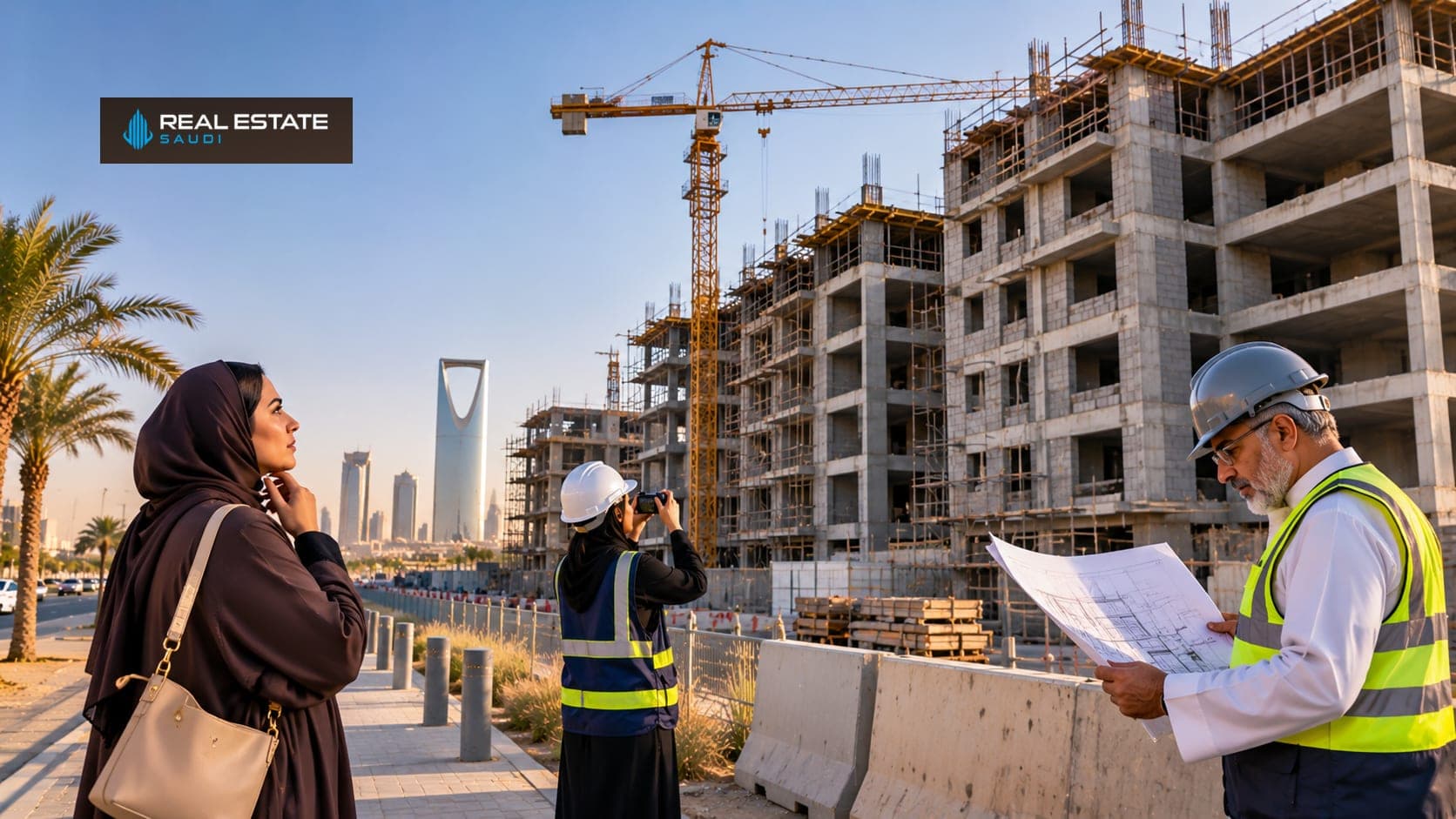
Real Estate Project Delays in Saudi Arabia can arise when construction schedules, permits, funding, contractors or infrastructure do not progress as planned. For buyers of off-plan homes, the immediate concern is usually a missed handover date; for developers and investors, a delay can affect cash flow, borrowing costs and project viability. Not every postponed milestone is a legal default, and the remedies depend on the licensed project, contract and applicable regulations.
Saudi Arabia has a specific framework for licensed off-plan sales and leases, including escrow controls and provisions addressing delayed delivery. This guide explains the leading causes, the warning signs purchasers should monitor, the difference between delay and default, and practical steps for protecting a transaction. It also separates official legal requirements from project-management recommendations.
Why Real Estate Project Delays in Saudi Arabia Need Accurate Diagnosis
A development schedule links design, approvals, excavation, structure, mechanical systems, finishing, inspections and handover. Problems in any critical activity can push back later tasks, even if other work continues. The root cause is not always the most visible one: a quiet construction site may reflect an unpaid subcontractor, an unresolved design decision or a utility connection that was planned too late.
The key is to ask what has changed on the critical path, who controls the affected decision and how the recovery timetable has been substantiated. A delay notice without an updated schedule, documented cause and financing explanation should prompt further questions. Readers considering off-plan property investment in Saudi Arabia should understand these dependencies before signing a reservation or purchase contract.
ما نوع العقار والمنطقة المناسبة؟
اختر نوع العقار والمدينة المستهدفة لاستعراض أنسب الخيارات.
Permits, Land Readiness and Regulatory Approvals
Some projects encounter problems before construction begins. A developer may need to resolve land documentation, planning conditions, approved engineering drawings, contractor assignments, insurance and utility requirements. Errors in a submission can trigger revisions, while an unexpected condition of approval can alter the design and procurement programme.
The Ministry of Municipalities and Housing describes the official building-permit issuance procedure, including engineering review, required approvals and the applicable Balady workflow. Digital submission can make the process clearer, but it does not remove the underlying technical checks. The project team should identify permit dependencies early and avoid advertising construction dates before the necessary authorizations are secured.
For owners or investors assessing regulatory risk, the site's guide to building permits and regulations in Saudi Arabia provides additional context. Always verify the project's current permit rather than relying on an old brochure or a generic assurance that approvals are underway.
Weak Scheduling and Contractor Coordination
An optimistic programme often assumes that every design, shipment and subcontractor will arrive on the earliest possible date. That approach leaves little room for inspection failures, sequencing conflicts or corrective work. A building may appear structurally advanced while essential mechanical and electrical systems are still under-designed.
Developers need an integrated master schedule that identifies dependencies and realistic completion criteria. Contractors should report the percentage of work genuinely finished, the remaining quantities and constraints on upcoming activities. Photographs can support a progress report, but they cannot replace a technically reviewed programme or certified milestones.
Poor coordination can also cause trades to work over one another. Late changes to air-conditioning routes, fire-safety installations or façade specifications may force finished areas to be reopened. Experienced project management is therefore not just an administrative expense; it protects construction productivity and reduces avoidable rework.
Early warning indicators include a growing backlog of design approvals, unexplained reductions in workforce numbers and milestones that are repeatedly marked as nearly complete. A credible monthly report should compare baseline and revised dates, identify the owner of each corrective action and distinguish genuine completed work from work awaiting inspection. This makes management weaknesses visible before the scheduled handover is threatened.
Funding Gaps, Escrow and Payment Disruptions
Developments require continuous funding for materials, contractors, consultants and utility connections. A project can stall when its financing plan depends on sales volumes that have not materialized, lender conditions are unmet, or the developer's cost estimate proves inadequate. These are possible risk factors, not evidence that any named project is insolvent.
For licensed off-plan projects, Saudi rules require project-specific escrow arrangements, with controlled disbursements and oversight. A buyer should confirm the correct licensed project and its designated account, not assume that paying a general corporate account provides the same protection. The Real Estate General Authority's implementing regulations for off-plan sales and leases set out financial supervision and the rules on delayed projects.
Developers should maintain a rolling cash-flow forecast that distinguishes committed funds from expected future reservations. Independent financing review is particularly valuable when project debt has staged drawdown conditions or the development relies on sales proceeds to unlock the next construction phase. For background on how property funding works, readers can consult the Saudi real estate financing guide.
A credible recovery plan must explain how remaining work will be financed. Buyers researching Saudi real estate projects with installment plans should verify when installments become due and whether the payment schedule corresponds to their signed agreement.
Construction Costs, Materials and Supply Chains
Cement, steel, imported equipment, façade products and specialist mechanical systems can introduce cost and delivery uncertainty. Price changes matter most where contracts do not allocate escalation risk clearly, suppliers cannot meet lead times, or a substitute material requires design approval. Delayed procurement can hold up work even when labor and financing are available.
For current context, the DataSaudi construction cost indicators track construction input costs across the Kingdom. The platform reported a general Construction Cost Index of 104.0 for September 2026 on its 2023-based series. This index indicates cost movements; it is not a measure of how many real estate projects are late.
A practical response is to order long-lead items early, assess supplier concentration, approve alternatives before a shortage and maintain realistic contingency allowances. Procurement reports should identify what has actually been ordered, paid for, manufactured and delivered—not merely what appears on a materials schedule.
A contractor proposing a cheaper substitute should demonstrate that it meets the approved specifications and any required technical approvals. Otherwise a short-term purchasing decision can produce inspection failures or a dispute over unit quality. The relevant question for investors is whether the replacement can be lawfully installed without creating more delay downstream.
Labor Availability, Design Changes and Site Conditions
Specialized technical trades may be needed at the same stage across several major developments. Delays can follow when the available workforce does not match the skills required, subcontractor productivity falls or work permits and mobilization are not aligned with the programme. Workforce figures should be assessed project by project; sweeping claims of a nationwide shortage do not explain an individual development.
Late design changes are another avoidable source of disruption. An additional basement feature, revised apartment layout or different façade system may require engineering rework and fresh approvals. In a licensed off-plan scheme, changes to approved drawings must be considered against the regulator's requirements and purchaser rights, rather than treated as unilateral marketing decisions.
Weather, difficult ground conditions and unexpected infrastructure discoveries can also interrupt activities. Their effect depends on site evidence, contractual allocation of risk and the length of the actual disruption. A developer should preserve records rather than label every difficulty a force-majeure event.
To reduce Real Estate Project Delays in Saudi Arabia, project teams should also review how much scheduling float remains after each disruption. A delay affecting a noncritical task may be absorbed without shifting handover; one affecting the final commissioning sequence may have an immediate impact. This distinction is essential when explaining updated deadlines to buyers.
When Does a Delay Become a Regulatory Default?
The distinction matters because not every missed internal milestone is a default under Saudi law. Article 34 of the off-plan implementing regulations treats a project as delayed when the completion period expires without a cause beyond the developer's control. REGA may grant an execution extension of up to one year beyond the original period.
The same article describes default where the project remains incomplete after its completion period and permitted extensions, or where work is suspended for more than 180 days, unless REGA accepts a valid reason. The 180-day provision is not permission to stop work for six months at will, nor does it mean that every temporary pause automatically triggers the same remedy.
The Saudi regulatory overview of the Real Estate General Authority helps buyers understand the institution overseeing these obligations. For an actual case, verify the latest approved completion date, any formally granted extension and the current regulatory classification before alleging a default.
What Compensation Can an Off-Plan Buyer Claim?
Article 35 of the implementing regulations addresses delivery delays without a cause beyond the developer's control. For a delayed developed plot, compensation is agreed by the parties subject to a statutory minimum of 2% of the sale value calculated annually. For a delayed real estate unit, the stated minimum is fair market rent determined by an approved valuer.
These standards apply within the relevant licensed off-plan framework and must be read with the contract, dates, regulatory findings and recognized exceptions. They should not be described as an automatic cash payment for every late private construction contract. A purchaser's legal adviser can assess the applicable provision and evidence of delay.
An approved valuer's fair-market-rent assessment is not necessarily the same as a buyer's temporary accommodation bill or the developer's advertised rental estimate. Buyers should preserve records of the promised specification, contractual handover date, extension notices and relevant correspondence. This evidence helps distinguish an enforceable contractual issue from a general dissatisfaction with construction speed.
Article 20 also requires key terms in the regulated standard contract, including delivery deadlines, permitted extensions, compensation, payment schedules and termination provisions. A buyer who has not read those clauses may miss the distinction between an announced target date and the contractual date that actually governs remedies.
حدد ميزانيتك الاستثمارية
حدد ميزانيتك التقديرية لنقوم بتضييق خيارات العروض.
What Can REGA Do About a Stalled Project?
Saudi regulation provides mechanisms beyond waiting indefinitely. Under Articles 36–38, REGA can apply technical guidelines and appoint a specialized committee to oversee delayed or defaulted licensed projects. Potential interventions include closer monitoring, requiring changes to parties causing the default, using permitted escrow funds to support completion and appointing an alternative developer.
Those options are regulatory powers, not remedies a purchaser can personally impose without a decision. The correct intervention depends on the project's financial and technical position. Where an amicable liquidation of a defaulted project fails, the regulations contemplate referral to the competent court.
Investors concerned about broader exposure can compare the risks of investing in Saudi real estate projects. Legal intervention may protect stakeholders, but it cannot eliminate uncertainty around timing, value or the recovery of every individual cost.
How Buyers Can Verify Progress Before Purchase
Before signing, request the licensed project name, registration particulars, developer identity, relevant off-plan authorization and approved handover schedule. Ask for the permitted payment account and written terms describing what happens if construction is delayed. Marketing renders and showroom models should be treated as representations to verify, not independent proof of progress.
The Saudi Real Estate Registry's property and off-plan services provide information about registration, property documents and related developer services, subject to the applicable coverage. Buyers should establish which record applies to the exact parcel or unit and verify ownership and restrictions through the competent channel.
Ask for recent, dated construction reports showing independently certified progress. A project that is 70% complete by expenditure is not necessarily 70% complete by time or usable floor area. Request a schedule of remaining structural, mechanical, finishing, testing and municipal handover work. People comparing off-plan project listings in Riyadh should use the same verification standards for each development, regardless of advertising or brand recognition. Material omissions in these areas can change the true completion outlook.
Warning Signs That Require More Questions
A late project does not automatically indicate misconduct, but several recurring signals justify closer scrutiny: repeated handover revisions without written explanation; large differences between photographs and reported completion percentages; a workforce that disappears for prolonged periods; unresolved contractor payment disputes; or requests for transfers outside the documented payment arrangements.
Another warning is a developer who refuses to identify the relevant licensed entity or explain which stage has been formally approved. Buyers should compare current marketing claims with contract documents and regulator-recognized information. A confident sales representative cannot substitute for technical certification or an auditable financial record.
If a development is advertised as substantially complete, ask what remains before occupancy. Construction completion, municipal clearance, connection of services and actual possession are separate milestones. A finished façade should not be mistaken for a unit ready for legal and practical occupation.
Steps to Take When Your Handover Date Is Missed
Start by confirming the contractual handover date and collecting the signed agreement, payment receipts, notices, approved changes and earlier progress updates. Ask the developer in writing to identify the cause of the delay, any formally authorized extension, work remaining and the updated completion programme.
Next, establish whether the project is covered by the off-plan sale and lease regime and whether its status can be verified with REGA. Maintain a clear record of all communications. If the developer proposes an amendment, do not sign a waiver of rights or accept a new date before understanding its legal consequences.
Where the response is inadequate, use the appropriate official complaint or dispute channel for the particular contract and project classification. Independent Saudi legal advice is especially useful before demanding compensation, terminating a contract or starting litigation. The site's practical tips for buying property in Saudi Arabia can help organize the underlying paperwork.
How Developers Can Prevent Repeated Delays
The most effective response is not an unrealistic promise to build faster. It is a controlled recovery programme that identifies the root cause, assigns responsibility and shows how remaining work will be funded. A well-prepared plan includes a verified baseline, critical-path analysis, a procurement register, realistic labor productivity and contingency for approvals and testing.
Independent engineers should test whether the revised completion dates are technically achievable. Finance teams should reconcile available cash, outstanding commitments and projected receipts. Where contractors are underperforming, the developer should document corrective actions, additional resources or lawful replacement options without compromising specifications.
Communication is part of risk control. Buyers and lenders need a dated statement of progress, material changes and expected handover. Inflating completion percentages to preserve confidence may create greater disputes later. Good governance also means keeping design changes, approvals, inspections and warranties in an accessible project record.
The Final Handover Can Be Delayed After Construction
A project may be physically advanced but still need testing, authority approvals, utility activation, defect rectification and documentation before occupants can move in. Developers should schedule these tasks well before the final construction week rather than assuming they can all be completed after contractors leave.
In July 2026, the Saudi Press Agency's update on electronic occupancy certificates explained Balady's digital process for post-construction occupancy certification. The certificate confirms that the building meets the applicable approved permit and regulatory requirements following the relevant checks. Digital issuance can simplify administration, but it cannot replace compliance on the ground.
Developers should distinguish practical completion, official occupancy clearance and contractual delivery in their reporting. Buyers should check each milestone before moving in, releasing final payments where applicable or advertising the finished unit for rent.
كيف تفضل التواصل معك؟
اختر وسيلة التواصل الأكثر ملاءمة لك لمناقشة فرصك الاستثمارية.
Economic Context and the 2026 Outlook
Saudi Arabia's ongoing development programme spans housing, commercial assets and major infrastructure. Their schedules vary greatly, so a change to one prominent development should not be generalized into a national project-delay rate. Real Estate Project Delays in Saudi Arabia should be assessed through verified project evidence and the type of development involved.
Project finance also matters at the macroeconomic level. National construction costs, housing supply and lending conditions help frame the market, but they cannot establish whether one developer has enough liquidity to finish a building. Project-specific evidence remains indispensable.
Buyers can independently investigate permitting through the Saudi government building permit inquiry service, which describes the Balady route for checking a permit and its current status. Such verification does not by itself confirm that the contractor is on schedule, but it reduces reliance on unsupported licensing claims. Read it alongside the project-specific disclosures and the signed contract.
For purchasers, the stronger 2026 approach is to prioritize licensed projects with verifiable records, realistic schedules and enforceable contracts. For developers, transparent reporting and credible recovery plans protect confidence better than unsupported completion forecasts. The result is not a guarantee of punctual delivery, but a more disciplined way to identify and manage risk.
Conclusion
Real Estate Project Delays in Saudi Arabia often reflect a combination of approval dependencies, financing gaps, procurement problems, design changes and construction management weaknesses. In licensed off-plan projects, the distinction between a scheduling setback and a legally recognized delay or default is especially important because specific regulations govern extensions, compensation and recovery mechanisms.
Buyers should verify the project license, escrow arrangements, contractual dates, official progress and handover requirements. Developers should maintain realistic programmes, reserve adequate funding and communicate changes with supporting evidence. When a deadline is missed, clear documentation and the appropriate regulatory process offer a sounder response than accepting vague assurances or making assumptions about automatic compensation.
تحدث معنا عبر قناتك المفضلة
استشارات عقارية مباشرة حول الاستثمار والسوق العقاري في المملكة العربية السعودية.
الأسئلة الشائعة
Common causes include incomplete permits, unrealistic construction schedules, funding gaps, delayed materials, shortage of appropriate specialist trades, design revisions and unforeseen site conditions. The cause of an individual delay should be supported by a current construction programme and documented evidence. Broad industry trends cannot establish why a particular project missed its handover date, and more than one cause may be operating simultaneously.
Under Article 34 of Saudi Arabia's off-plan implementing regulations, a project can be regarded as delayed if its completion period expires without a reason beyond the developer's control. Regulatory default can arise after the completion period and extensions or when work stops for more than 180 days, unless an acceptable reason applies. The project's official classification should be verified rather than inferred from photographs or rumors.
Potentially, yes, for qualifying cases under the licensed off-plan framework. Article 35 provides a minimum linked to fair market rent determined by an approved valuer for delayed real estate units, and a different formula for developed land. The contractual deadline, extensions, legally recognized causes and the nature of the property all matter. Buyers should have their agreement and evidence reviewed before asserting a particular entitlement.
The off-plan implementing regulations permit REGA to grant an extension of up to one year beyond the original completion period. That does not mean a developer can unilaterally add a year to every buyer's contract. Request written evidence of any granted extension and examine how it interacts with the actual contract. The consequences of a later handover are fact-specific.
The licensed off-plan framework requires a project-specific escrow arrangement and restrictions on how funds are disbursed. Its purpose is to direct payments toward the authorized development and support oversight. Purchasers should verify the project's licensed payment instructions before transferring money. Escrow reduces certain risks, but it does not guarantee that construction can never be delayed or that buyers will recover every indirect expense.
Preserve the signed contract, payment history, developer notices and progress reports. Confirm the legally relevant delivery date, request a written explanation and revised schedule, and ask whether a regulatory extension exists. Avoid signing an unconditional waiver or paying outside agreed arrangements without advice. If the response remains inadequate, use the appropriate regulatory or dispute mechanism and consult a qualified Saudi lawyer.
No. Higher input prices may strain budgets or procurement, but their effect depends on supplier contracts, contingencies, financing and the stage of work. Saudi construction cost indicators describe market-level movements, not the schedule of an individual project. Ask for evidence of secured materials, updated project forecasts and the remaining funding requirement before reaching a conclusion.
Saudi off-plan regulations provide for intervention by a specialized committee and, in appropriate cases, appointment of an alternative developer. The authority may also use permitted oversight and recovery measures to help complete a troubled licensed project. These are official powers exercised according to the circumstances, not an automatic right of any individual buyer to choose a replacement contractor or developer.
Not necessarily. A building can still require testing, utility connections, defect correction, occupancy certification and final documentation. Buyers should distinguish practical construction progress from lawful occupation and contractual delivery. Ask which certificates have been issued, which items remain incomplete and what handover conditions apply before accepting possession or treating the property as ready for tenants.
Verify the developer and project license, relevant land and registration documents, escrow instructions, contract protections and independently reported construction progress. Compare committed financing with remaining work and review the credibility of the schedule. Diversification and conservative cash-flow assumptions can reduce concentration risk, but no checklist eliminates the possibility of delays. Professional legal, engineering and financial review is advisable for significant investments.
