
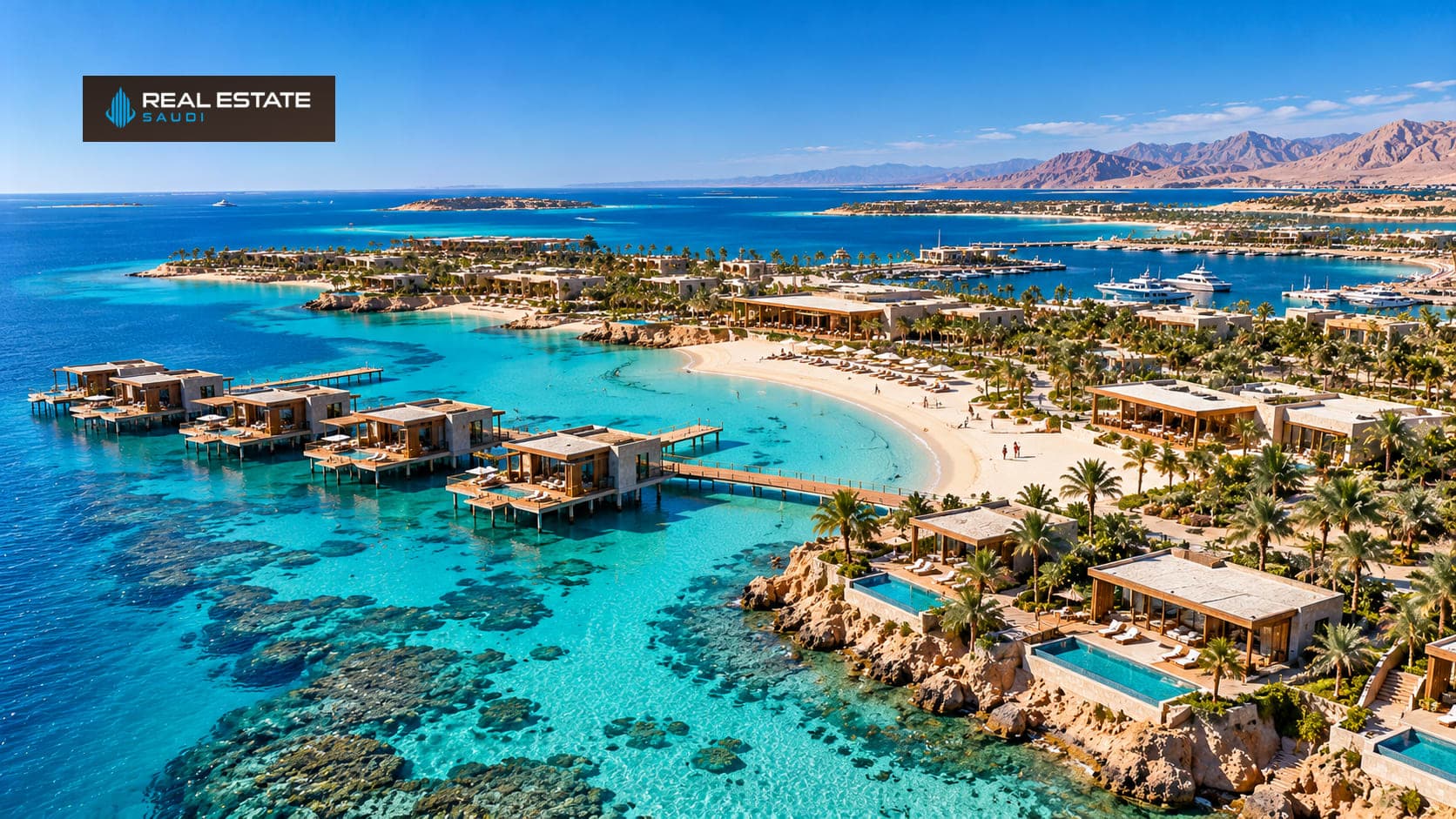
Red Sea Tourism Projects are reshaping Saudi Arabia's northwestern coastline through luxury resorts, branded residences, marinas, hospitality infrastructure and environmentally focused development. In 2026, the most important destinations to understand include The Red Sea, AMAALA and the wider NEOM coastal development area. Each has a different master plan, delivery schedule and approach to real estate investment.
The Red Sea destination began welcoming guests in 2023 and has continued opening hotels, recreational facilities and residential developments. AMAALA welcomed its first guests in June 2026, followed by additional resort openings. These milestones demonstrate operational progress, but they do not mean every planned property is completed or publicly available to purchase.
For investors, the opportunities may involve branded homes, hospitality assets, commercial facilities, development partnerships or property in surrounding established communities. Availability depends on the specific project and approved ownership structure.
This guide explains the major developments, investment locations, property pricing considerations, foreign ownership requirements, tourism licensing, financial returns and risks that buyers should evaluate before investing.
Red Sea Tourism Projects: Key Facts for 2026
Saudi Arabia's Red Sea development strategy combines tourism infrastructure with residential, commercial, leisure and environmental initiatives. Rather than representing one continuous building project, it includes multiple destinations developed through different companies and programmes.
Red Sea Global is responsible for the flagship destinations The Red Sea and AMAALA. NEOM is a separate major development with its own coastal tourism components.
Development | Primary Focus | 2026 Investment Context |
|---|---|---|
The Red Sea | Luxury island and coastal tourism | Operating resorts and developing residential communities |
AMAALA | Wellness, lifestyle and luxury hospitality | Operating resorts and branded residential offerings |
NEOM coastal destinations | Tourism, urban development and specialised experiences | Project-specific delivery and investment structures |
Shura Island | Hospitality, golf and waterfront living | Resort operations and residential development |
Laheq Island | Premium residential island living | Planned and developing residential opportunities |
Coastal communities | Housing and supporting commercial activity | Local demand requires separate verification |
These destinations are not interchangeable. Their legal arrangements, land rights, construction schedules and investment products can differ substantially.
Buyers can explore the Saudi Red Sea property and destination overview for broader regional context.
Why Saudi Arabia Is Developing Its Red Sea Coast
Saudi Arabia's tourism strategy is closely connected to Vision 2030, which aims to diversify the economy and expand non-oil sectors.
The Red Sea coastline provides opportunities for resort development, recreational activities, marine tourism and supporting businesses. Its geography includes islands, coral reefs, coastal landscapes and mountain environments.
The official Saudi Vision 2030 programme identifies tourism, economic diversification and improvements in quality of life as important national priorities.
Investment in destination infrastructure can create demand for construction, hospitality operations, transport, food services and professional employment.
However, the financial benefits of tourism development do not necessarily reach every property owner equally.
A resort may attract international visitors without creating equivalent demand for nearby private apartments. Similarly, a marina may support specialised commercial services while offering limited opportunities for ordinary residential investment.
Investors should identify the specific economic activity that could support their chosen property.
Which property type & region do you prefer?
Select property type and preferred city in Saudi Arabia.
The Red Sea Destination: Project Overview
The Red Sea is Red Sea Global's flagship regenerative tourism destination.
According to the developer's official project information, the destination covers approximately 28,000 square kilometres, including more than 90 islands.
The development includes luxury hotels, recreation, transport infrastructure and residential communities.
Resort development
The destination welcomed its first guests in 2023 with the opening of Six Senses Southern Dunes.
Subsequent openings included The St. Regis Red Sea Resort, Nujuma, Shebara and Desert Rock.
Shura Island began welcoming guests in 2025, expanding the destination's resort portfolio.
Residential opportunities
The master plan includes premium residential developments associated with Shura and Laheq islands.
Investors must check whether a particular unit is currently offered under an approved sales arrangement.
Supporting infrastructure
The destination includes airport connectivity, marine transport and visitor facilities.
The Red Sea development and project overview provides further context for its hospitality and residential components.
What Changed at The Red Sea in 2026?
The transition from construction to operating tourism facilities is a significant development milestone.
In early 2026, Red Sea Global expanded its recreational offering with Adrena, an adventure and entertainment district.
Additional resorts and destination services continued opening during the year.
Hospitality expansion
Resort openings create operational evidence that investors can examine, including accommodation offerings, services and competitive positioning.
However, the existence of an operating hotel does not reveal its profitability without financial records.
Marine infrastructure
Marinas and related facilities can support sailing, charter activity and premium visitor services.
Healthcare and community services
Supporting facilities become increasingly relevant as destinations develop beyond individual resorts.
Residential delivery
New homes and branded residences require separate verification of ownership rights, pricing and handover schedules.
The expansion of operational facilities helps establish the destination's commercial presence, but investors should evaluate each investment on its own financial merits.
Shura Island: Luxury Resorts and Waterfront Living
Shura Island is one of the central locations within The Red Sea destination.
Its development combines hospitality, recreation, golf and planned residential accommodation.
Hospitality attractions
International hotel brands can help position the island within the premium tourism market.
Their presence may influence visitor awareness and destination marketing.
Waterfront property
Coastal residences may appeal to buyers interested in privacy, design and access to resort amenities.
However, the quality of an investment also depends on maintenance obligations, ownership restrictions and achievable resale demand.
Community facilities
Golf, dining and recreational amenities can contribute to the overall lifestyle offering.
Investment considerations
Premium island properties may involve substantial service charges, specialised maintenance and different ownership arrangements from conventional urban apartments.
A branded residential property should never be evaluated solely by the reputation of its associated hospitality brand.
The purchase agreement must establish what the buyer actually owns and which services remain available.
Laheq Island: Residential Investment Potential
Laheq is a residential island development within The Red Sea destination.
Its positioning focuses on coastal lifestyle, privacy and access to the surrounding marine environment.
For investors, the most relevant questions concern actual sales availability, property specifications, ownership eligibility and financial obligations.
Planned housing
Island residential developments may include different home configurations and architectural styles.
The precise offering must be confirmed through current official sales information.
Environmental setting
Coastal architecture requires attention to climate, durability and maintenance.
Access and transportation
Travel between residential communities and mainland services can affect the convenience of daily life.
Ownership structure
Prospective buyers should distinguish full ownership rights from long leases or other contractual interests.
Financial planning
Premium lifestyle appeal does not automatically translate into high rental yield.
An investment should be assessed using documented acquisition costs and an appropriate long-term ownership strategy.
AMAALA: Saudi Arabia's Wellness Tourism Destination
AMAALA is a major Red Sea Global development focused on wellness, luxury hospitality, lifestyle experiences and marine recreation.
The destination is located on Saudi Arabia's northwestern coast and includes the Triple Bay development area.
On June 15, 2026, Red Sea Global announced the opening of Four Seasons Resort and Residences AMAALA, marking the beginning of guest operations at the destination.
Additional hospitality openings followed during 2026.
Wellness-led hospitality
AMAALA aims to attract travellers seeking experiences related to wellbeing, recreation and premium accommodation.
Branded residences
The destination also includes residential components associated with hospitality brands.
Marine tourism
Its marina and yacht club expand the types of services available to visitors.
The AMAALA residential and tourism development guide provides a useful introduction to the destination.
Its operational progress is meaningful, but not every planned residential or commercial asset should be assumed available for immediate purchase.
AMAALA Resort Openings in 2026
AMAALA experienced several important hospitality milestones during 2026.
Four Seasons Resort and Residences AMAALA opened in June, establishing the destination's initial guest offering.
Rosewood AMAALA followed in August.
In September, Red Sea Global announced additional openings involving Equinox, Nammos and Jayasom.
Equinox Resort AMAALA
The resort opened in September 2026 and includes 128 rooms and suites alongside 21 branded residences.
Its positioning centres on performance-focused luxury and wellbeing.
Jayasom Wellness Resort
Jayasom opened in September with 153 accommodation keys and 24 residences.
Its offering is centred on wellness and personalised experiences.
Nammos Resort AMAALA
The opening of Nammos added another premium hospitality concept to Triple Bay.
These milestones illustrate the destination's growing accommodation portfolio.
However, individual resort opening dates and room counts should not be confused with verified investment performance.
An operating resort may still require time to establish stable occupancy, pricing and profitability.
AMAALA Yacht Club and Marina Development
Marine tourism forms an important part of AMAALA's destination strategy.
The Red Sea Global announcement confirming AMAALA Yacht Club operations established that the club began welcoming members and visiting yachts in September 2026.
Marina operations can support several specialised business categories.
These may include marine services, food and beverage facilities, charter arrangements and other appropriately licensed activities.
Real estate considerations
Commercial property near a marina may have different demand patterns from traditional retail locations.
Businesses serving yacht owners and visitors require specific customer groups and operational expertise.
Residential considerations
Marina proximity can influence the appeal of certain branded residential units.
However, it does not establish guaranteed appreciation.
Investment structures
Participation in marina-related businesses may involve commercial leases or corporate arrangements rather than direct property ownership.
Investors should identify the precise legal and financial opportunity before committing capital.
NEOM and Saudi Arabia's Red Sea Tourism Strategy
NEOM is a separate major development whose geography includes parts of Saudi Arabia's northwestern coastline.
Its projects are frequently discussed alongside The Red Sea and AMAALA because of their shared regional tourism context.
However, NEOM should not be presented as a project developed by Red Sea Global.
Tourism concepts
NEOM has announced various tourism and destination initiatives, including coastal and island concepts.
Their current development status must be assessed individually.
Investment considerations
A project announcement does not necessarily mean that residential units or commercial premises are available for public purchase.
Infrastructure
Future access, utilities and visitor services are relevant to commercial feasibility.
The NEOM development area overview provides additional geographic and project context.
Investors comparing NEOM with Red Sea Global destinations should assess actual delivery, ownership arrangements and available transaction evidence rather than relying on marketing descriptions.
Real Estate Investment Opportunities Around the Red Sea
Red Sea Tourism Projects may create different opportunities for property owners, developers and businesses.
However, an opportunity should be described as available only when supported by an identifiable project or transaction.
Branded residences
Some destinations have introduced residential offerings connected to luxury hospitality brands.
Buyers must examine title rights, service obligations and management arrangements.
Hospitality assets
Hotels and resorts require considerable operational expertise and capital.
Commercial property
Retail and service facilities may support visitors and employees.
Supporting housing
Workers and business operators may require accommodation, although actual demand must be established through local evidence.
Development partnerships
Institutional investors may encounter joint ventures or other commercial structures.
The relevant Red Sea Global developer information helps distinguish the developer's role from individual property ownership opportunities.
Each investment category has different requirements and financial risks.
Can Individuals Buy Red Sea Branded Residences?
Certain Red Sea Global developments contain branded residential offerings, but the availability of individual homes depends on the particular project.
The developer's official AMAALA Residences information invites prospective purchasers to register their interest.
This indicates an identifiable residential offering, but registration of interest is not the same as a completed sale.
Confirm current availability
Request an official inventory of units available for purchase.
Verify the seller
Determine which legal entity holds the right to sell the property.
Understand ownership
Check whether the proposed arrangement involves registered ownership, usufruct or another legal interest.
Examine services
Branded residences may carry ongoing management and service obligations.
Review resale conditions
Restrictions can affect transfer rights, future buyers and operating arrangements.
A luxury brand may influence the appeal of a property, but investors should establish whether the total financial commitment is justified.
What is your approximate budget?
Narrow down property options based on your target budget.
Property Prices and Investment Costs in 2026
There is no verified single price range covering every residential, hospitality and commercial opportunity across Saudi Arabia's Red Sea destinations.
Property values depend on project, ownership structure, size, construction specifications and associated services.
Residential purchases
Prices may reflect waterfront positioning, architectural quality and access to destination facilities.
Hospitality developments
Hotel investments require assessment of acquisition or development cost alongside operating performance.
Commercial units
Retail premises must be evaluated according to achievable business demand and contractual lease conditions.
Service charges
Premium communities may involve recurring maintenance and management expenses.
Financing
Borrowing arrangements may differ substantially from standard residential mortgages.
Investors should obtain written quotations and detailed transaction documents rather than use speculative price-per-square-metre averages.
Without confirmed prices, it is not possible to calculate a reliable expected return for a specific investment.
Foreign Ownership Rules for Red Sea Properties
Foreign investors must determine whether the property and proposed ownership structure qualify under Saudi Arabia's updated non-Saudi property ownership system.
The revised framework came into force on January 22, 2026.
The Real Estate General Authority's foreign ownership implementation announcement explains the official application routes for eligible residents, non-residents and companies.
Geographic eligibility
Ownership permissions depend on designated areas and the relevant category of purchaser.
Individual investors
Foreign residents and overseas purchasers follow different procedural requirements.
Corporate investors
Companies may need additional registration and investment authorisation.
Project-specific conditions
A property marketed within a luxury destination may be subject to specific ownership terms.
Official registration
An investment's legal validity depends on compliance with the applicable registration process.
Foreign investors should verify the exact property right before signing contracts or making deposits.
Tourism Licensing and Hospitality Operations
Owning a property near a resort does not automatically permit its operation as tourist accommodation.
Hotels, serviced apartments and other hospitality facilities require the relevant approvals.
The Saudi Ministry of Tourism's accommodation facility licensing service explains requirements for obtaining operational permission.
These may include commercial registration, municipal or competent-authority licensing, Civil Defense approval and integration with required guest-registration systems.
Hotel operations
Hotels require compliance with the standards relevant to their licensed category.
Serviced accommodation
Furnished accommodation operating commercially must follow the applicable regulatory framework.
Private holiday accommodation
Private accommodation can be subject to different licensing requirements.
Property-use restrictions
Investors must confirm that the proposed commercial use is permitted.
Tourism licensing should be considered before buying a property intended to generate short-stay income.
Real Estate Taxes and Additional Transaction Expenses
Saudi Arabia generally applies a 5% Real Estate Transaction Tax to qualifying real estate disposals, subject to statutory exemptions.
The ZATCA Real Estate Transaction Tax Law establishes the applicable framework.
Acquisition costs
Buyers may incur legal, valuation, brokerage and registration-related expenses.
Foreign ownership
Certain transactions involving non-Saudi rights may attract additional prescribed charges.
Hospitality operations
Commercial accommodation can involve tax obligations distinct from ordinary residential ownership.
Management expenses
Branded property service charges and ongoing maintenance can be substantial.
Resale
Future disposal costs should be included when assessing overall investment profitability.
Investors should not assume that government-backed tourism development automatically creates a personal tax exemption.
Transaction-specific advice is important when ownership and commercial operations are combined.
How to Calculate Potential Investment Returns
A realistic return assessment starts with actual financial information.
Gross rental income, operating profit and capital appreciation represent different measures of investment performance.
Residential property
Investors should examine achievable rent, vacancy, service charges and total acquisition cost.
Hospitality investments
Hotels require detailed operating forecasts covering occupancy, average daily rates, staffing and maintenance.
Commercial property
Lease terms, tenant quality, vacancy periods and operating costs affect rental income.
Capital growth
A future resale price cannot be guaranteed.
Financing
Borrowing increases the financial obligations associated with an investment.
Reliable returns cannot be calculated using tourism forecasts alone.
An apparently successful destination may contain individual investments with disappointing results if their acquisition prices or operating expenses are excessive.
Conservative financial modelling is therefore essential.
Environmental Sustainability and Property Value
Environmental considerations are particularly relevant to Red Sea development because of the surrounding marine ecosystems.
Coral reefs, coastal habitats and island environments can be sensitive to intensive construction and visitor activity.
Development controls
Projects may require environmental assessments and adherence to approved conditions.
Construction choices
Materials, energy systems and water management can influence long-term operating costs.
Marine protection
Tourism operations must consider their effects on coastal ecosystems.
Investor implications
Environmental compliance can create additional expenditure but may also contribute to the durability and reputation of a destination.
Long-term considerations
Sustainability commitments should be evaluated through measurable project actions and outcomes.
Investors should distinguish verified environmental performance from promotional descriptions.
A premium development is not automatically environmentally sustainable because its marketing uses that term.
Coastal Infrastructure and Accessibility
The financial performance of a tourism destination depends partly on how easily visitors, workers and service providers can reach it.
Airports
Airport connectivity helps connect destinations to domestic and international travel markets.
Roads
Reliable road access is important for construction, logistics and visitors travelling from nearby communities.
Marine transport
Island properties may depend on boats and specialised transfer arrangements.
Utilities
Hotels and residential developments require dependable electricity, water, communications and waste-management systems.
Healthcare and community services
Supporting facilities become more important as a destination develops a permanent population.
The availability of infrastructure should be verified for each project.
An announced connection or proposed transport service should not be treated as operational before its opening is confirmed.
Economic Effects on Nearby Coastal Communities
Tourism development can influence nearby communities through employment, procurement, transport demand and supporting businesses.
These effects may extend beyond the resorts themselves.
Employment
Hotels, recreation facilities and maintenance services require different categories of workers.
Local businesses
Suppliers, restaurants and service providers may benefit from customer and commercial activity.
Housing demand
Workforce growth may affect residential accommodation requirements, but the location and scale of demand depend on employer arrangements.
Infrastructure
Improvements in transport and services can influence broader regional development.
Local considerations
Not every coastal community will experience equal economic benefits.
Investors researching neighbouring markets should use completed transactions, population information and relevant lease evidence.
Broad claims that property prices are rising everywhere along the coast are not a substitute for local research.
How to Choose the Right Red Sea Investment
A sound investment process should begin with the purchaser's objectives rather than the prestige of a destination.
Define the investment purpose
Determine whether the objective is personal use, rental income, business operation or long-term ownership.
Identify the actual asset
Confirm the exact property, development, lease or investment interest.
Verify project status
Distinguish operational facilities from under-construction or planned components.
Confirm eligibility
Check ownership permissions, commercial regulations and any buyer restrictions.
Examine costs
Include purchase price, taxes, financing, service charges and future maintenance.
Assess income
Use verified rent or operating information wherever available.
Review liquidity
Understand whether and how the investment can be resold.
Seek professional advice
Independent legal, financial and technical review can reduce preventable mistakes.
Investors should keep documentation supporting every material assumption.
Major Risks of Red Sea Property Investment
Red Sea destinations combine conventional real estate risk with the complexities of tourism development.
Development delays
Projects may open in phases, affecting the timing of commercial activity.
Revenue uncertainty
Visitor growth does not guarantee high hotel occupancy or rental income.
Acquisition costs
Premium real estate can involve substantial capital commitments.
Operating expenses
Coastal conditions, management and maintenance may increase costs.
Ownership restrictions
Some property rights may be available only to eligible purchasers or through specific legal structures.
Market liquidity
Specialised resort properties may attract a smaller pool of buyers.
Environmental obligations
Development and operations may require ongoing compliance expenditure.
Competition
Additional resorts can create more accommodation choices for visitors.
Investors should avoid relying on guaranteed appreciation claims and maintain adequate financial reserves.
How would you like to be contacted?
Choose your preferred channel for a private consultation.
Investment Outlook Beyond 2026
Red Sea Tourism Projects have moved from broad development announcements toward operating hospitality destinations and emerging residential communities.
The openings at The Red Sea and AMAALA provide measurable progress, while additional components continue through their delivery schedules.
Over time, the performance of these destinations will depend on repeat visitor demand, operational efficiency, international accessibility and sustainable management.
Branded residences may attract lifestyle-focused buyers, but their financial attractiveness will vary according to purchase price and ongoing obligations.
Nearby communities may also experience economic changes, although these should be evaluated using actual market evidence.
The most reliable approach is to monitor official project milestones and verify each available investment separately.
Long-term potential exists, but it should not be confused with guaranteed financial returns or unrestricted property availability.
Conclusion
Red Sea Tourism Projects are transforming parts of Saudi Arabia's coastline through luxury hospitality, wellness tourism, marine facilities and planned residential development.
The Red Sea destination has welcomed visitors since 2023, while AMAALA began operations in 2026 and introduced additional resorts, branded residences and marina facilities.
These developments provide reasons to research tourism-related property opportunities, but the investment case for each asset depends on legally available rights, acquisition costs and realistic financial performance.
Foreign investors must follow Saudi ownership regulations, while hospitality operators must meet applicable tourism licensing requirements.
Talk to Our Real Estate Experts
Get real-time insights on investment options, commercial properties, and market guidelines.
Frequently Asked Questions
Major developments include The Red Sea and AMAALA, which are developed by Red Sea Global, alongside coastal tourism initiatives associated with NEOM. The Red Sea includes resort and residential projects such as Shura and Laheq, while AMAALA focuses on wellness, lifestyle and premium hospitality. Their delivery schedules and ownership structures differ.
Yes. The Red Sea destination began welcoming guests in 2023 and has progressively opened additional resorts, recreational facilities and supporting infrastructure. Shura Island welcomed guests in 2025, while further hospitality and entertainment offerings expanded in 2026. The entire master plan should not be considered fully completed.
Yes. Red Sea Global announced the opening of Four Seasons Resort and Residences AMAALA on June 15, 2026. Additional resort openings followed, including Rosewood, Equinox, Nammos and Jayasom. These operational milestones do not mean every planned residential property or commercial development has been delivered.
Eligible foreign individuals and companies may acquire qualifying property rights under Saudi Arabia's updated foreign ownership framework, subject to geographical and legal requirements. The system became effective on January 22, 2026. Investors must confirm the precise ownership rights and buyer eligibility for each individual development.
Red Sea Global has introduced AMAALA Residences and published information allowing prospective buyers to register interest. Certain opened resorts also include branded residences. However, prices, current unit availability, ownership rights and contractual terms should be obtained directly from authorised sellers before a purchase decision.
Prices depend on the location, development, property category and associated services. A reliable uniform price per square metre does not exist for every Red Sea destination. Investors should seek official sales documentation and compare relevant completed transactions rather than rely on promotional estimates or unsupported regional averages.
No. Luxury branding and tourism growth do not guarantee rental income or capital appreciation. Actual returns depend on acquisition cost, occupancy, operating expenses, ownership conditions and future resale demand. Investors should review credible financial evidence and avoid assuming that every coastal development produces above-average yields.
Hotels, serviced accommodation and private tourism facilities may require different permissions from the Saudi Ministry of Tourism. Requirements can include commercial registration, appropriate municipal approvals, safety permits and guest-registration arrangements. Buying a property does not automatically authorise its operation as tourist accommodation.
Vision 2030 encourages economic diversification, tourism development and improvements in infrastructure and visitor experiences. Red Sea destinations contribute to these wider objectives through hospitality and related projects. However, national strategic support does not eliminate construction, operational or market risks associated with an individual investment.
Investors should verify seller authority, ownership eligibility, property identification, development status and all relevant contracts. They should also assess acquisition expenses, maintenance obligations, financing and any restrictions affecting rental or resale. Independent legal and financial review is particularly important for specialised resort properties and branded residences.
