
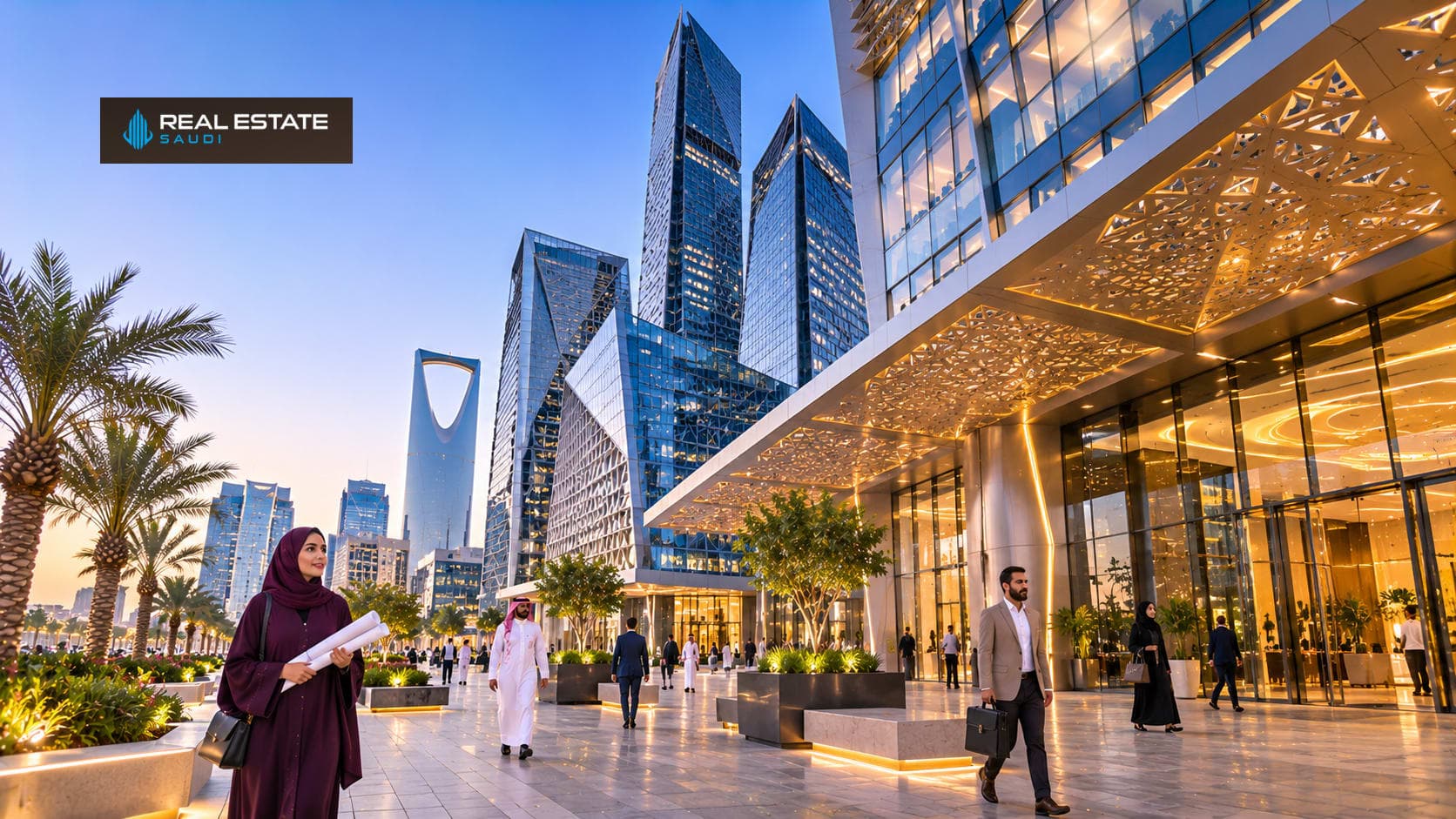
Commercial Real Estate in Riyadh offers opportunities in offices, shops, warehouses, showrooms and mixed-use buildings, but the right investment depends on more than the city's expansion. A successful purchase starts with a property suited to real occupiers, a supportable acquisition price, documented income and manageable ownership costs. An office near a financial district, a neighborhood retail unit and a logistics facility serve different tenants and cannot be judged by the same advertised yield.
This guide explains the benefits of Riyadh's commercial market, the areas worth comparing, how to calculate return on investment (ROI), and the legal checks that matter in 2026. It distinguishes verified market research from illustrative financial calculations, including the implications of rent restrictions and foreign-ownership rules. No district, tenant or property type can promise appreciation or uninterrupted rental income.
Why Invest in Commercial Real Estate in Riyadh?
Riyadh concentrates government institutions, corporate employers, professional services and a large resident customer base. These activities create different sources of demand: firms need offices, retailers need accessible storefronts, and distributors require suitable storage space. A landlord who understands an occupier's operational needs has a better starting point than one buying solely because a district is fashionable.
Commercial property may offer longer negotiated leases or greater scope to tailor premises for a business, depending on the transaction. The site's comparison of commercial and residential real estate investment helps clarify these differences. A commercial asset is not inherently more profitable or less risky than a residential one; suitability depends on the purchase and how it is managed.
What Does the Latest Riyadh Office Market Data Show?
According to Knight Frank's September 2026 Saudi office-market review, Grade A office occupancy reached 97% in Riyadh during the second quarter of 2026. Quoted Grade A rents averaged SAR 2,810 per square metre, up 3.4% year on year, while Grade B occupancy was 95%. These figures describe defined office-market segments; they are not commercial sale prices, guaranteed rents for an individual building or evidence of returns for shops and warehouses.
New supply could broaden choices for tenants, particularly where older buildings cannot match modern facilities. Investors should verify what is completed, leased and under construction near a target property rather than assume high citywide occupancy will persist indefinitely.
Which property type & region do you prefer?
Select property type and preferred city in Saudi Arabia.
Offices: The Benefits and Trade-Offs
Office investments can serve corporate headquarters, consulting practices, professional services and smaller businesses. Their value depends on fit-out flexibility, lift performance, parking, accessibility, cooling and the quality of building management. A recognizable address may help attract tenants, but a poorly maintained building can still struggle to retain them. Compare office properties listed for sale in Riyadh as an initial inventory, then confirm availability and ownership independently.
Request actual signed leases, rent-free periods, break clauses, deposits and evidence of payment. Ask who pays for replacing partitions, network cabling and mechanical systems when a tenant leaves. Build these costs into the valuation before treating the headline annual rent as sustainable profit.
Retail Shops and Showrooms: How to Test Demand
A shop's performance depends on customers reaching it conveniently, not simply on the number of vehicles passing its frontage. Assess safe entrances, pedestrian movement, parking, signage visibility, deliveries and competing businesses. Different trades need different premises: a pharmacy requires accessible local demand, while a furniture showroom needs display and loading space. Explore retail shops for sale in Riyadh to compare formats without assuming the listings reflect achieved sale prices.
If the unit has a tenant, inspect the contract and payment history. If it is vacant, estimate realistic leasing time, brokerage costs and potential fit-out contributions. A premium frontage can become an expensive mistake if access constraints prevent customers from stopping or deliveries from arriving.
Warehouses and Logistics Facilities
Warehouses serve storage, distribution and sometimes temperature-controlled operations. In logistics-oriented areas, the practical requirements include truck access, turning space, clear ceiling height, floor-loading capacity, fire systems, power and the correct operating permissions. A property close to a highway may be unusable for a tenant if trucks cannot legally reach its entrance or manoeuvre safely.
Consider whether the building could attract several different users. Highly specialized cold-storage equipment or automated systems may require costly replacement and limit the future tenant pool. Review utility consumption, roof condition, maintenance obligations and compliance documents. A lower purchase price per square metre does not compensate for a warehouse that must undergo major alterations before the intended business can operate.
Hotels and Mixed-Use Assets
Riyadh's business travel, events and hospitality activity can create interest in hotels and serviced accommodation. However, buying an operating hotel involves staffing, bookings, marketing, utilities, maintenance and potentially brand agreements. Gross room revenue is not equivalent to rent or operating profit. Request monthly statements and separate property ownership from any business assets included in the sale.
Mixed-use buildings may combine shops, offices and other permitted functions. Several tenants can spread vacancy exposure, but shared lifts, fire systems, parking and service charges add complexity. Review whether the building's layout and approvals allow each proposed use. An investor who lacks operating expertise may prefer a conventional leased asset over a hospitality business whose profitability depends heavily on management quality.
Al Olaya: An Established Business District
Al Olaya is an established office, retail and hospitality location with access to major urban corridors. Its value lies in the range of businesses and amenities in the surrounding area, although a well-known address does not automatically mean a building is modern or efficient. The Al Olaya neighborhood and property overview provides useful geographic context for comparing properties.
Inspect actual entrances, lift waiting times, nearby competing space and the availability of parking for visitors. Some older buildings may require substantial cooling or refurbishment expenditure. Retail buyers should evaluate ground-floor visibility and customer access rather than extrapolate a district-wide rent from a single prime unit.
King Abdullah Financial District and Northern Corridors
King Abdullah Financial District (KAFD) is an important focus of Riyadh's modern commercial landscape, particularly for companies seeking high-quality offices and services. Properties nearby may benefit from access to employment, transport and supporting businesses, but proximity alone does not establish equivalent leasing demand or pricing. Different towers can have different specifications, service costs and occupier profiles.
Check the actual walking route to public transport and the distance from parking to the unit. Compare existing income-producing assets with newly delivered or proposed supply. Investors should model both scenarios against achievable net rent, not prestige alone.
Al Sulimaniyah and Al Malaz: Different Commercial Uses
Al Sulimaniyah can be researched for customer-facing services, offices and retail along established commercial streets. Al Malaz offers another central-city comparison with a mix of residential, institutional and business activity. Neither district should be assigned a fixed investment yield or described as uniformly affordable. Performance changes across individual blocks and property types.
Visit each proposed unit during business hours and in the evening. Check adjacent uses, signage permission, parking, street access and whether the tenant's customers are likely to visit that location. A clinic, boutique or office may have entirely different space and compliance requirements. Selecting a tenant first, then testing the property against that tenant's needs, produces a more useful shortlist than a general ranking of neighborhoods.
King Fahd, Al Sahafah and Other Business Corridors
King Fahd district, Al Sahafah and commercial routes around King Abdullah Road can offer alternatives to the best-known office clusters. Opportunities may include smaller offices, neighborhood retail and service businesses. Verify each building's condition and the type of demand within walking or practical driving distance. A convenient road connection is valuable only if it works from the property's actual entrance.
Compare total rent per usable square metre, refurbishment needs and the likely time to secure a replacement tenant. These factors help distinguish a genuinely competitive property from one that is merely advertised as located in a fast-growing district.
Al Sulai and Southern Logistics Corridors
Al Sulai and southeastern routes toward Al Kharj Road warrant attention for logistics and industrial users. Site-specific access, approved activity and building specification are more relevant than a general claim about proximity to Riyadh's commercial center. Distribution operators may need dependable truck movements, separate staff parking, loading equipment and robust power supply.
Have a technical specialist review the structure, roof, fire systems and permitted storage categories. An incoming tenant may require alterations that create downtime and additional expenditure. For investors seeking long leases, the tenant's financial standing and the building's adaptability may matter more than the initial promised rental rate.
Is Riyadh Park an Investment District?
Riyadh Park is best understood as a prominent retail destination rather than a standalone administrative district offering a single class of commercial property. Its surrounding areas may interest businesses targeting households and shoppers, but the presence of a mall does not prove the desirability of every nearby retail unit. Location comparisons should use the actual address, not a marketing association with a landmark.
Observe the property's own catchment area, access routes, competing retail and pedestrian movement. A restaurant or café depends on appropriate licensing and operational requirements in addition to customer numbers.
What is your approximate budget?
Narrow down property options based on your target budget.
Comparing Riyadh Commercial Property Types
Asset | Potential advantage | Main underwriting risk |
|---|---|---|
Office | Corporate occupiers and contracted rent | Tenant exits, fit-out and competing supply |
Shop or showroom | Access to neighborhood or destination customers | Weak conversion, vacancy and activity restrictions |
Warehouse | Employment and distribution-related demand | Technical suitability and limited alternative users |
Mixed-use building | More than one tenant or income source | Shared expenses and management complexity |
Hotel or serviced asset | Exposure to business and visitor demand | Operating costs, seasonality and licensing |
The table describes common considerations, not a ranking of expected profitability. Investors should compare properties within the same asset class before judging whether one location deserves a price premium over another.
Pricing Commercial Real Estate in Riyadh Without False Averages
Commercial prices vary sharply by asset type, title, usable area, condition and income. An office advertisement may quote net internal floor space; a warehouse listing may use plot area; a hotel price may include furniture, equipment and contractual rights. Comparing the figures without adjusting the measurement basis creates misleading conclusions.
Collect recent completed transactions wherever reliable evidence is available. Record whether each example is an asking price or an actual sale. Adjust for tenancy, outstanding repairs, parking rights and restrictions on use. The original draft's precise district purchase ranges were not substantiated by dated transaction evidence and should not be repeated as present market averages.
Calculating Commercial Real Estate in Riyadh ROI
ROI is not a single universal percentage. A basic gross rental yield divides annual contractual rent by the total acquisition cost. Net operating income deducts vacancy, maintenance, nonrecoverable service charges, management and other operating costs. The site's Saudi property investment return guide explains related measures.
For a purely illustrative example, a property costing SAR 5 million and collecting SAR 350,000 annual rent has a 7% gross yield before expenses. If annual operating costs and vacancy allowance total SAR 100,000, the illustrative net operating yield falls to 5% before financing and other ownership-specific adjustments. These hypothetical figures are not reported Riyadh averages. The relevant calculation must use the actual property's costs and verified lease terms.
Riyadh's Five-Year Commercial Rent Restrictions
The official Ejar explanation of Riyadh's rental regulations confirms a five-year restriction on annual increases for covered residential and commercial leases within Riyadh's urban boundaries, beginning on 25 September 2025. It addresses existing contracts, previously rented vacant units, first-time rentals and specified objection procedures. The official guidance also describes relevant contract-duration and renewal conditions.
This changes how a buyer should model future rental income. Previously leased vacant premises may be tied to their last registered rent; first-time rentals have a different starting arrangement. Check the Ejar history and whether any recognized exception applies. Do not assume that a change of owner automatically resets the permitted rental amount or that every commercial lease can increase annually in 2026.
What Are the Risks of Commercial Property Investment?
Vacancy is the most obvious risk, but it is not the only one. Older buildings may require expensive lift, cooling or fire-system upgrades. Retail tenants can struggle with traffic restrictions and competition. Warehouses may lose their appeal if distribution patterns change, and hospitality assets can face variable operating margins. These risks should be reflected in price, reserves and exit planning.
A building dependent on one occupier may suffer a sharp cash-flow interruption when that tenant leaves. Check financial strength, remaining lease term and the ease of finding a replacement. Capital appreciation should be treated separately from operating income, especially when new office supply could alter market conditions.
Can Non-Saudis Buy Commercial Property in Riyadh?
The Real Estate General Authority's announcement of the non-Saudi ownership framework confirms that the revised system took effect on 22 January 2026. Eligibility depends on the purchaser category, geographically permitted rights and the precise property. Saudi Properties is the official application channel for qualifying residents, non-resident applicants and relevant entities.
This does not grant every overseas investor unrestricted access to every Riyadh commercial building. Company ownership, personal ownership and rights of use can involve different legal conditions. Buyers considering property ownership through a foreign company in Saudi Arabia should verify the acquiring entity, its permissions and the intended property before paying a nonrefundable deposit. Specialist Saudi legal advice is appropriate for complex corporate transactions.
Commercial Licenses and Zoning Approvals
Buying a unit described as commercial does not authorize any activity inside it. The Ministry of Municipalities and Housing's Balady commercial licensing service explains the procedures for checking and issuing permits for eligible businesses. Food service, medical premises, workshops and other specialized uses may require additional sector and safety approvals.
Before buying, ask whether the proposed activity is lawful at the exact address and whether any necessary fit-out is permitted. Review approved plans, fire access, loading requirements and shared-building rules. A previous occupant's licence should not be assumed to transfer unchanged.
Title Registration and Property Rights
The Saudi Real Estate Registry's official property services include ownership-document verification, registration and transfer-related services, subject to the procedures and registration coverage applicable to the parcel. Obtain the property identifier, current owner information and any records of mortgages, restrictions, easements or shared rights.
For a commercial unit, confirm what is included in the deed and related agreements. Parking, rooftop equipment, loading bays and common passages may not belong exclusively to the unit being sold. Compare the paperwork with the physical property and obtain both technical and legal review where appropriate.
Taxes, Financing and Full Acquisition Costs
The Real Estate Transaction Tax law published by ZATCA generally imposes a 5% tax on covered real estate transactions, subject to exemptions and the applicable statutory rules. Confirm the transaction's treatment and legal payment responsibility rather than assuming a promotional price includes all taxes. Commercial operating activities can have separate tax implications from the transfer of land or buildings.
Also budget for valuation, legal review, acquisition finance, brokerage where applicable, repairs, fit-out, insurance and building management. Review the site's guide to real estate financing in Saudi Arabia for wider funding context, then obtain commercial-specific terms from the lender. Stress-test a period without rent to determine whether debt obligations remain affordable.
Step-by-Step Due Diligence Before Buying
Begin with the intended occupier or operator and assess why this precise address suits the business. Compare relevant transactions and leases, then visit during normal operating hours. Confirm the property's legal classification, approved use, measured area and access. Request title documents and seller authority before making a binding offer.
Examine signed leases, receipts, service charges and any arrears. Commission a technical survey covering structure, cooling, electrical and safety systems. Check financing, the permitted rental treatment and projected net income under conservative scenarios. Finally, have the contract reviewed to identify included assets, payment stages, transfer conditions, handover and remedies. A sound process protects buyers from avoidable errors without implying that investment risk can be eliminated.
How would you like to be contacted?
Choose your preferred channel for a private consultation.
Choosing a Strategy for 2026 and Beyond
An investor prioritizing predictable income may prefer a completed asset with a solvent tenant and verifiable payment history. The broader Riyadh property investment market overview provides additional context for comparing commercial property with other asset types. Someone with development expertise may examine vacant premises suitable for lawful repositioning, accepting higher execution risk. A business owner may value occupancy savings and operational control more than an immediate rental yield. These objectives lead to different acceptable purchase prices.
Commercial Real Estate in Riyadh should be approached with particular attention to future office supply, rent controls and asset-specific quality. Current occupancy statistics are useful, but they are not permanent forecasts. Compare the downside case as carefully as the optimistic one and plan for financing, maintenance and eventual resale.
Conclusion
Commercial Real Estate in Riyadh provides access to corporate offices, retail premises, logistics facilities and specialized commercial assets. The benefits arise from matching a real business need with a legally sound property at a defensible cost, not from an assumption that every location will appreciate or deliver a fixed ROI. Al Olaya, KAFD, Al Sulimaniyah, Al Malaz and logistics-oriented corridors each serve different occupiers.
Before purchasing, verify current rent rules, foreign ownership eligibility, approved activity, title, actual tenant income and total acquisition expenses. Use independent valuation and professional legal or technical advice where appropriate.
Talk to Our Real Estate Experts
Get real-time insights on investment options, commercial properties, and market guidelines.
Frequently Asked Questions
Riyadh has varied demand from corporate employers, professional services, households and distribution businesses. Investors can choose offices, shops, warehouses or mixed-use buildings according to their experience and budget. The benefits depend on the particular occupier, lease, location and acquisition price. Commercial property also carries vacancy, maintenance and licensing risks, so strong citywide activity does not guarantee an individual building will perform well.
No reliable single ROI percentage applies to all Riyadh offices, shops, warehouses and hotels. Calculate gross yield from actual annual rent and the complete acquisition cost, then deduct vacancy, maintenance, management and other costs for a net estimate. Financing affects the investor's cash return. Market averages should not be inferred from sales brochures, and illustrative calculations should be distinguished from actual transaction evidence.
Al Olaya, the King Abdullah Financial District environment and selected northern business corridors are logical starting points. Smaller offices may also be compared in districts such as King Fahd and Al Sahafah. The strongest property depends on accessibility, parking, building systems, lease evidence and competition. Prime office-market occupancy data should not be applied automatically to an older or less efficient building.
Both can warrant research for customer-facing businesses, but suitability depends on the individual street and tenant. Check storefront access, parking, local spending patterns, deliveries and operating permits. A busy road may be commercially weak if customers cannot stop conveniently. Compare executed rents and similar nearby units rather than assuming either neighborhood always offers higher returns or lower prices.
Warehouse investors should verify lawful use, access for heavy vehicles, loading facilities, ceiling height, floor-loading capacity, electricity and fire-safety systems. The location should match the intended operator's distribution routes. A lower initial price can be offset by major fit-out expenses or poor road access. Technical inspection and a realistic estimate of replacement tenant demand are especially important.
Qualifying non-Saudis may acquire eligible property rights under the framework effective 22 January 2026. Permissions differ by buyer category, geography and the specific right being transferred. The Saudi Properties process is the official route for checking eligibility. A broker's claim that a property is open to international buyers does not establish legal approval. Independent advice is prudent for corporate acquisitions.
Yes. Official Ejar guidance confirms that covered commercial and residential leases within Riyadh's urban boundaries are subject to restrictions on annual increases for five years from 25 September 2025. Rules concerning previously rented vacant units, first-time leases, renewal and certain exceptions matter. Review the property's contract and Ejar history before projecting future income; purchasing a building does not automatically reset the permitted rent.
Start with the agreed purchase price and add applicable transaction tax, financing costs, valuation, legal advice, brokerage if relevant, technical surveys, necessary refurbishment and initial working capital. Saudi Real Estate Transaction Tax generally applies at 5% to covered disposals, subject to exemptions and legal conditions. A property with a low asking price can still be expensive once repairs and service obligations are included.
Check the seller's authority, official property identification, applicable title or registry records, mortgages and restrictions. Review approved construction plans, relevant commercial permissions and rights to parking or loading facilities. For an income-producing asset, obtain signed leases, rent receipts and service-charge records. Legal and engineering review can identify problems that do not appear in photographs or an agent's description.
No type is automatically safer. An office may benefit from corporate demand yet face competition from new buildings. A shop depends on customer access and tenant trading strength, while a warehouse depends on technical usability and distribution requirements. Compare income quality, tenancy concentration, maintenance liabilities and resale options. The better choice is the one whose risks are understood and reflected in the price.
