
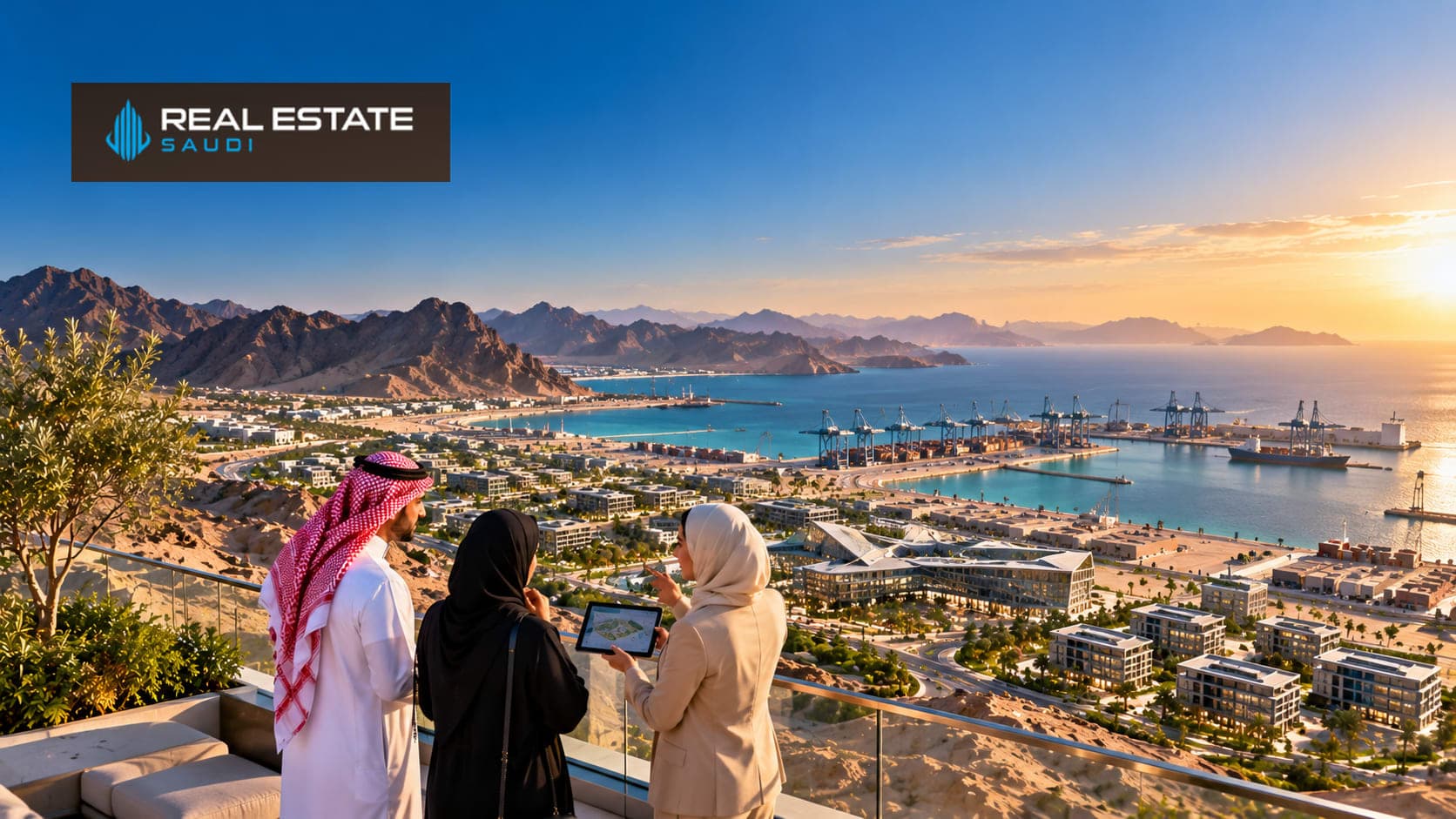
The NEOM Project in Saudi Arabia is a major development initiative in the Kingdom's northwest, designed to support economic diversification through industrial infrastructure, advanced technology, renewable energy, tourism and new models of urban living. In 2026, its most relevant developments include Oxagon's industrial expansion, the Port of NEOM, AI data centre investment, the green hydrogen initiative and the evolving plans for The Line and Trojena.
NEOM covers approximately 26,500 square kilometres along Saudi Arabia's northwestern Red Sea region. Although originally introduced through highly ambitious concepts, its development is progressing in phases, with different components at different stages of delivery.
For investors, understanding the difference between an announced development vision and an operational investment opportunity is essential. A proposed residential district does not automatically mean that apartments are available for purchase, just as an announced industrial agreement does not guarantee future returns.
This guide examines NEOM's current status, major regions, investment sectors, foreign property ownership requirements, funding considerations and risks that investors should evaluate in 2026.
NEOM Project in Saudi Arabia: Key Facts for 2026
NEOM is not a single completed city. It is a large development region comprising industrial, environmental, coastal, mountain and urban initiatives.
The project is associated with Saudi Arabia's Public Investment Fund and the national economic diversification programme.
The official NEOM regional overview describes a 26,500-square-kilometre development area with approximately 468 kilometres of Red Sea coastline.
Its principal development components have different purposes and timelines.
Development | Primary Focus | Investment Consideration |
|---|---|---|
Oxagon | Industry, logistics and advanced technology | Operational infrastructure and commercial agreements |
The Line | Phased urban development | No assumption of publicly available homes |
Trojena | Mountain tourism and recreation | Project delivery and hospitality demand |
Islands of NEOM | Coastal tourism and marine experiences | Actual operating and ownership arrangements |
Magna | Coastal hospitality and lifestyle concepts | Development status and contractual rights |
NEOM Green Hydrogen | Renewable energy and industrial production | Project structure and corporate participation |
These categories do not represent an official list of properties available for public investment.
Investors researching the region can also explore the NEOM real estate area overview while independently confirming any advertised price, property status or availability.
Which property type & region do you prefer?
Select property type and preferred city in Saudi Arabia.
What Is NEOM and Why Was It Created?
NEOM was introduced in 2017 as part of Saudi Arabia's economic transformation agenda.
Its purpose extends beyond constructing residential buildings. The region is intended to support new industries, economic activity, transport infrastructure, environmental initiatives and tourism destinations.
Saudi Arabia's official Vision 2030 programme provides the wider policy context, including efforts to expand non-oil economic activity and private-sector participation.
Economic diversification
Industrial development and new business activity can create demand for transport, utilities, accommodation and supporting services.
Technological development
NEOM has identified advanced manufacturing, digital infrastructure and artificial intelligence among its development priorities.
Renewable energy
The region's long-term plans incorporate renewable electricity and industrial applications of low-carbon technologies.
Environmental considerations
NEOM has established conservation initiatives associated with its desert, mountain and marine landscapes.
These objectives explain the project's direction, but individual construction schedules and investment opportunities must be verified separately.
NEOM's Development Status in October 2026
NEOM's current development status is more nuanced than its original promotional concepts.
Several important components have progressed into infrastructure development, commercial operations or construction, while others remain part of a longer-term programme.
Industrial progress
Oxagon has an operating port and is associated with active industrial infrastructure projects.
Digital infrastructure
The 2026 announcements concerning an AI data centre indicate construction and preliminary commercial activity.
Urban development
The Line is officially described as progressing through a phased, demand-led approach.
Tourism development
Mountain and coastal destination plans remain important, but availability and operating status differ between projects.
Investment implications
A development's official announcement date should not be confused with its completion date.
Likewise, a government-backed initiative may undergo changes in scope, sequencing or financing priorities.
Investors should base decisions on verified milestones and executed agreements rather than the assumption that every originally announced component will be delivered simultaneously.
The Line: What Has Changed in 2026?
The Line remains one of NEOM's best-known urban development concepts.
Earlier presentations described a linear city extending 170 kilometres, with an eventual population capacity of nine million people.
Those figures represent the original long-term concept, not a statement that the full development has been completed or will necessarily be delivered by 2030.
The official NEOM page describing The Line's phased development now emphasises a demand-led approach.
Long-term urban vision
The project remains associated with concepts involving compact urban design, proximity to services and integration with surrounding landscapes.
Development phasing
The official description does not establish that all originally proposed phases will be delivered on one fixed timetable.
Residential availability
There is no verified public inventory or standard purchase process for ordinary homes in The Line in the official material reviewed.
Buyer precautions
Prospective purchasers should distinguish concept imagery from completed buildings, registered units and legally authorised sales.
The 2026 guide to buying property in The Line examines these issues in greater detail.
Oxagon: NEOM's Industrial Investment Centre
Oxagon is increasingly important to the project's practical economic development.
Rather than focusing primarily on residential accommodation, it is designed around industrial activity, logistics, technology and supporting infrastructure.
The official Oxagon industrial development overview identifies a core development area of approximately 48 square kilometres and highlights the operating Port of NEOM.
Industrial activities
Oxagon is being developed to support advanced manufacturing and other industries requiring substantial infrastructure.
Logistics
Port connectivity can support imports, exports and industrial supply chains.
Renewable energy
Industrial businesses may require access to suitable energy resources and supporting utilities.
Workforce requirements
Operational facilities can create demand for employee services and accommodation, depending on their actual staffing levels.
Investment considerations
Business opportunities may arise through procurement, partnerships or qualifying commercial arrangements.
However, they should not be confused with unrestricted ownership of industrial land by every interested investor.
AI Data Centres: A Significant 2026 Development
One of the more concrete NEOM developments in 2026 concerns digital infrastructure at Oxagon.
On August 31, 2026, HUMAIN and DataVolt announced construction activity involving the initial 100 MW component of a planned AI data centre campus.
The broader first-phase plan was described as 360 MW.
On October 21, 2026, a further announcement outlined a preliminary framework involving Nebius as a potential purchaser of computing capacity.
The official October 2026 AI infrastructure agreement announcement describes a contemplated arrangement covering up to 50 MW.
Why the announcement matters
Data centres require substantial electricity, cooling, communications and physical infrastructure.
They may support demand for specialist contractors, technical services and related industrial activity.
What remains uncertain
A preliminary commercial framework is not identical to a final unconditional purchase agreement.
The announced capacity should not be described as fully operational unless subsequently confirmed.
Property implications
Demand for nearby industrial or supporting accommodation is possible, but must be established through actual leasing and employment evidence.
NEOM Green Hydrogen and Industrial Infrastructure
The green hydrogen initiative forms another major part of NEOM's industrial development.
Its purpose is to support hydrogen production using renewable energy sources and associated industrial infrastructure.
Project characteristics
Large energy facilities require substantial capital, construction expertise and coordination between technical partners.
Their economics depend on production costs, industrial customers and contractual arrangements.
Commercial opportunities
Qualified suppliers may investigate opportunities involving equipment, construction, maintenance and logistics.
These are distinct from purchasing residential property.
Development risk
Commissioning, operating performance and commercial production should be evaluated separately.
Investment access
Participation may occur through corporate investments, procurement contracts or other arrangements available to qualified entities.
Investors should not assume that a hydrogen project automatically creates a publicly accessible NEOM investment product.
Industrial announcements can provide evidence of development activity without establishing the profitability of unrelated real estate assets.
Trojena: Mountain Tourism and Hospitality Potential
Trojena is NEOM's mountain destination, situated in the Jabal Al-Lawz area.
Its landscape and climate distinguish it from Saudi Arabia's conventional coastal and desert tourism destinations.
The official Trojena mountain destination overview describes an area featuring elevations reaching approximately 2,600 metres.
Tourism concepts
The development is associated with accommodation, recreation, outdoor activities and hospitality services.
Potential business demand
Hotels and tourist facilities can require specialised construction, maintenance and operating services.
Seasonal conditions
Mountain tourism may experience demand patterns that differ from coastal destinations.
Financial considerations
Hotels require analysis of occupancy, staffing, operating expenses and competing accommodation supply.
Construction and delivery
A planned resort is not equivalent to a functioning hotel.
Investors should verify which facilities have been completed, what licences apply and whether any particular investment product is actually available.
Sindalah and the Islands of NEOM
NEOM's coastal initiatives include island and marine tourism destinations.
Sindalah is associated with luxury hospitality, marina facilities and visitor experiences.
Hospitality positioning
Island destinations may target travellers interested in marine recreation, premium accommodation and leisure services.
Operating requirements
Hospitality businesses must consider guest services, transport, utilities and maintenance.
Coastal property considerations
Marine environments can introduce additional construction and maintenance requirements.
Ownership versus hospitality access
The ability to book accommodation or visit an island does not establish a legal right to buy a villa or apartment there.
Investor assessment
Any offering described as a luxury residence should be supported by official sales documentation, an identifiable ownership structure and relevant regulatory approvals.
Buyers should not treat promotional descriptions of coastal projects as proof of publicly available freehold homes.
Magna and Other Coastal Development Concepts
Magna is another important component of NEOM's coastal development vision.
The initiative covers destinations along the Gulf of Aqaba, where landscape and environmental characteristics influence architectural and tourism concepts.
Hospitality opportunities
Planned destinations may involve hotels, recreation and visitor services.
Specialist construction
Coastal development can require distinctive engineering and environmental considerations.
Environmental limitations
Sensitive marine and mountainous landscapes can affect planning and project requirements.
Business participation
Contractors and service providers may evaluate opportunities when genuine procurement or partnership arrangements become available.
Residential investment
The existence of a planned coastal community should not be interpreted as confirmation of approved units or publicly available purchase contracts.
Investors need to distinguish regional master plans, development announcements and completed assets.
The NEOM developer and project profile provides a broader overview of the development's components.
NEOM Project in Saudi Arabia: Investment Opportunities
Investment opportunities associated with NEOM can be divided into direct commercial participation, corporate partnerships, industrial activity, hospitality development and potential future real estate transactions.
These categories involve different legal structures and levels of risk.
Industrial infrastructure
Companies with relevant expertise may explore eligible project contracts or industrial partnerships.
Technology services
Digital infrastructure development can create requirements for engineering, software and technical suppliers.
Renewable energy
Qualified businesses may participate in energy-related projects subject to commercial arrangements and approvals.
Hospitality
Tourism developments may eventually support hotels and related services when operating facilities are delivered.
Residential property
Potential residential acquisitions require an approved property, lawful ownership eligibility and a real sale process.
The NEOM property investment and foreign ownership guide explains why these requirements must be checked independently.
Investment potential should not be mistaken for a guarantee of publicly accessible products.
What is your approximate budget?
Narrow down property options based on your target budget.
Can You Buy Property in NEOM in 2026?
A central question for individual investors is whether ordinary homes can currently be purchased directly in NEOM.
The publicly available official material reviewed does not establish a general residential sales market with verified unit inventories, standard purchase prices and a defined process for purchasing homes in The Line or other NEOM destinations.
Property advertisements
A third-party listing should identify the exact building, developer, legal owner and contractual property right.
Sales authorisation
The buyer should verify that the property is legally approved for sale.
Ownership documents
Any proposed acquisition must be supported by appropriate title and registration evidence.
Financing
A lender's general willingness to finance Saudi property does not confirm eligibility for a particular NEOM unit.
Reservation payments
Buyers should avoid transferring money based solely on promotional brochures or informal messages.
Until an identifiable, authorised property is offered, investors cannot reasonably treat NEOM as an ordinary ready-home purchasing market.
Foreign Ownership Rules and NEOM
Saudi Arabia's updated non-Saudi property ownership framework entered into force on January 22, 2026.
The legislation creates pathways for qualifying foreign residents, overseas individuals and certain corporate entities.
However, it does not provide automatic, unrestricted ownership rights throughout the Kingdom.
The official Real Estate General Authority law governing ownership by non-Saudis establishes geographical and eligibility requirements.
Geographical permissions
Foreign ownership depends on applicable approved zones and rights.
Individual purchasers
An applicant's residency and other legal circumstances can influence eligibility.
Corporate buyers
Companies may follow different registration and ownership arrangements.
NEOM-specific checks
Investors should obtain official confirmation that the exact proposed property is available to their buyer category.
The Saudi foreign-company property ownership guide examines the distinction between individual and corporate transactions.
Foreign ownership reform is not evidence that every NEOM residential concept can already be purchased.
Property Prices in NEOM: What Can Be Verified?
Investors frequently search for apartment prices, villa prices and starting costs within NEOM.
However, an official, generally applicable public price list for residential units across The Line, Trojena and other planned destinations has not been established by the sources reviewed.
Indicative prices
Third-party websites may display estimated prices.
Such figures should not be treated as completed transaction evidence.
Project-specific pricing
Any genuine sales offering should disclose its unit identification, legal right, payment conditions and developer.
Future valuation
Construction progress, available supply and operating infrastructure could influence eventual market conditions.
Rental yield
Reliable yield estimates require verified purchase prices, lease evidence and operating expenses.
Without these inputs, numerical return claims are speculative.
Investment budgeting
Prospective purchasers should avoid setting financial expectations based on advertised figures that cannot be connected to a legally available property.
NEOM Investment Fund and Corporate Participation
The NEOM Investment Fund has been associated with efforts to support investment partnerships and business development.
However, its existence should not be interpreted as proof that retail investors can purchase publicly traded NEOM-specific shares or fund units.
Institutional investment
Large industrial and infrastructure projects may require corporate capital and specialist partnerships.
Strategic partnerships
Participating businesses should assess project economics, contractual responsibilities and delivery obligations.
Investment funds
Any financial product marketed to individual investors must be independently verified through the relevant regulatory framework.
Securities regulation
A commercial partnership announcement is not the same as a regulated public securities offering.
Buyer protection
Never send investment funds to an intermediary claiming to sell official NEOM investment certificates without verifying the issuer and legal authorisation.
Direct corporate participation and residential property ownership are separate investment activities.
Are There Special Tax Benefits for NEOM Investors?
NEOM-related promotional material sometimes refers to favourable business conditions and potential economic advantages.
However, investors should not assume that every property purchase or commercial transaction qualifies for zero tax.
Property disposals
Saudi Arabia's Real Estate Transaction Tax framework generally applies to qualifying disposals, subject to statutory exemptions.
Business taxation
Corporate tax obligations can depend on ownership, activity and business structure.
Value Added Tax
Certain taxable services and commercial activities may attract VAT.
Special arrangements
Any relief or incentive must be established under an applicable legal provision and verified for the specific entity and transaction.
Financial planning
Tax obligations can materially affect investment returns.
Professional advice is appropriate before establishing a corporate structure or completing a large transaction.
A project being associated with Vision 2030 does not automatically remove ordinary tax liabilities.
Off-Plan Property Licensing and Buyer Protection
Future residential sales within major developments require appropriate legal and regulatory analysis.
The official REGA WAFI off-plan sales and leasing platform explains Saudi Arabia's framework for licensing qualifying off-plan developments.
Developer registration
The relevant developer should possess the required qualifications.
Project licensing
A particular residential project must have the appropriate approval for its intended sales activity.
Sales contracts
Documentation should identify the unit, specifications, payment obligations and completion conditions.
Escrow arrangements
Where applicable, purchasers should verify the designated account and lawful handling of payments.
Marketing restrictions
Promotional activity and the collection of reservation funds can be subject to specific regulatory conditions.
A general development announcement does not replace evidence that the actual property sales programme is licensed.
How to Evaluate a Potential NEOM Investment
Investors should follow a structured process rather than begin with an advertised return or speculative sales price.
Step 1: Identify the investment type
Determine whether the opportunity concerns property, corporate participation, procurement or another financial arrangement.
Step 2: Verify the promoter
Confirm the legal identity and authority of the company making the offer.
Step 3: Check the actual asset
Establish whether the development or underlying property exists at the stated stage.
Step 4: Review ownership eligibility
Confirm geographical permissions and the exact right being offered.
Step 5: Examine contracts
Understand deposits, completion obligations, termination provisions and dispute procedures.
Step 6: Assess finances
Review financing costs, taxes, ongoing expenses and realistic revenue assumptions.
Step 7: Obtain independent advice
Legal and financial professionals may identify significant risks before money is committed.
The Saudi Arabia real estate investment guide provides broader due-diligence considerations.
Investment Risks Associated With NEOM
The NEOM Project in Saudi Arabia presents opportunities linked to large-scale economic development, but investors must assess substantial uncertainty.
Construction risk
Major projects can experience delays, design changes and delivery challenges.
Funding risk
Large infrastructure programmes depend on continuing financial commitments.
Commercial demand
Planned industries may develop at different speeds, affecting supporting property requirements.
Regulatory risk
Foreign ownership, land use and commercial licensing depend on applicable rules.
Valuation risk
Early-stage assets can be difficult to value when completed transactions are limited.
Liquidity risk
Specialised or unfinished assets may be difficult to sell.
Operational risk
Hotels, industrial premises and technology infrastructure require different operating capabilities.
Diversification and conservative financial assumptions can reduce some risks but cannot guarantee profitable outcomes.
NEOM Versus Established Saudi Property Markets
Investors may benefit from comparing NEOM's emerging opportunities with established property markets.
Riyadh
The capital provides an existing market with conventional residential and commercial transactions.
Jeddah
Jeddah combines urban housing, business services and coastal economic activity.
Dammam
The Eastern Province offers residential and commercial exposure linked to industry and logistics.
NEOM
The region is characterised by major development initiatives and specialist commercial projects rather than a mature open residential market.
Investment comparison
Established cities generally offer more observable comparable transactions and rental evidence.
NEOM may be relevant to investors with specialist expertise and a longer investment horizon.
The appropriate location depends on risk tolerance, legal eligibility and the availability of an identifiable investment asset.
How would you like to be contacted?
Choose your preferred channel for a private consultation.
NEOM Outlook Beyond 2026
NEOM's future development will depend on the delivery of infrastructure, industrial partnerships, financing and commercial demand.
Oxagon's industrial activity and digital infrastructure announcements provide tangible areas for monitoring.
The Line remains part of a phased urban vision rather than a fully delivered residential market.
Trojena and coastal destinations offer further potential, but their operational and investment conditions require project-by-project verification.
Investors should follow official progress reports and distinguish binding commercial agreements from preliminary frameworks.
Future announcements may alter development priorities, project scope or implementation schedules.
A credible long-term investment strategy should remain adaptable rather than depend on an assumed completion date or guaranteed appreciation.
Conclusion
The NEOM Project in Saudi Arabia remains a significant part of the Kingdom's long-term economic diversification programme.
In 2026, Oxagon's industrial infrastructure, port activity and AI data centre development provide some of the clearest examples of tangible progress.
The Line, Trojena and coastal destinations remain important components of the broader vision, but development status, commercial opportunities and residential availability must be verified separately.
Foreign ownership reform has established new legal pathways for qualifying investors, yet it does not create unrestricted rights to purchase any property within NEOM.
Investors should avoid relying on unverified pricing, guaranteed returns, automatic tax exemptions or fixed completion claims.
The most defensible strategy is to evaluate each opportunity according to official project information, legal eligibility, contractual protections and realistic financial assumptions.
NEOM's long-term potential is substantial in scope, but successful investment decisions require evidence rather than speculation.
Talk to Our Real Estate Experts
Get real-time insights on investment options, commercial properties, and market guidelines.
Frequently Asked Questions
NEOM is a major development region in northwest Saudi Arabia, covering approximately 26,500 square kilometres. It includes initiatives involving industry, renewable energy, technology, tourism and new urban environments. Major components include Oxagon, The Line, Trojena and coastal destinations. Different projects are at different development stages, and NEOM should not be treated as one completed city.
No. NEOM remains a developing region containing projects at different stages of planning, construction and operation. Certain industrial infrastructure and port activities have progressed, while other urban and tourism components remain under development. Investors should verify the current status of individual projects rather than assume the entire region is complete.
NEOM's current official description presents The Line as a phased, demand-led urban development. The original concept involved a much larger long-term city, but those plans should not be treated as a confirmed 2030 completion schedule. Official material reviewed does not establish generally available residential inventory or a standard public purchasing process.
Saudi Arabia's updated foreign ownership framework allows qualifying non-Saudis to acquire certain property rights, subject to geographical permissions and regulatory controls. However, this does not automatically authorise a purchase anywhere in NEOM. Buyers must confirm that the exact property is eligible, legally approved for sale and available under an appropriate ownership arrangement.
No official comprehensive public price list for ordinary residential units across NEOM's principal planned destinations was established by the sources reviewed. Third-party advertised prices should not be treated as verified transactions. Buyers should request identifiable unit documentation, approved sales information and independent valuation evidence before relying on any proposed price.
Oxagon is NEOM's emerging industrial city, anchored by the operating Port of NEOM. Its development focuses on advanced manufacturing, logistics, renewable energy and digital infrastructure. Recent announcements include AI data centre construction and commercial framework activity. Potential investment opportunities depend on qualifying business arrangements rather than unrestricted public ownership of industrial property.
Trojena is NEOM's mountain destination in the Jabal Al-Lawz area, featuring elevations reaching approximately 2,600 metres. It is associated with tourism, recreation and hospitality concepts. The actual availability of accommodation, facilities and investment products depends on construction and operating progress. Investors should verify completed assets before making commitments.
Investors should not assume that all NEOM investments qualify for zero taxes. Applicable taxes depend on the legal entity, transaction type, activity and any specific statutory relief. Saudi property disposals and taxable commercial services follow their respective tax frameworks. Claims about exemptions or incentives require confirmation from an authoritative source.
Qualified businesses may explore corporate partnerships, procurement contracts and other commercial opportunities associated with industrial infrastructure, technology and tourism. Each opportunity requires verification of the contracting entity, financial arrangements and necessary licences. Participating in a commercial project is different from purchasing residential property or acquiring publicly traded investment units.
NEOM's development may create opportunities for qualified investors, but no investment is risk-free. Major considerations include construction timelines, funding commitments, regulatory eligibility, commercial demand and limited price evidence for some assets. Investors should assess actual contracts and completed milestones, maintain financial reserves and obtain independent professional advice before committing capital.
