
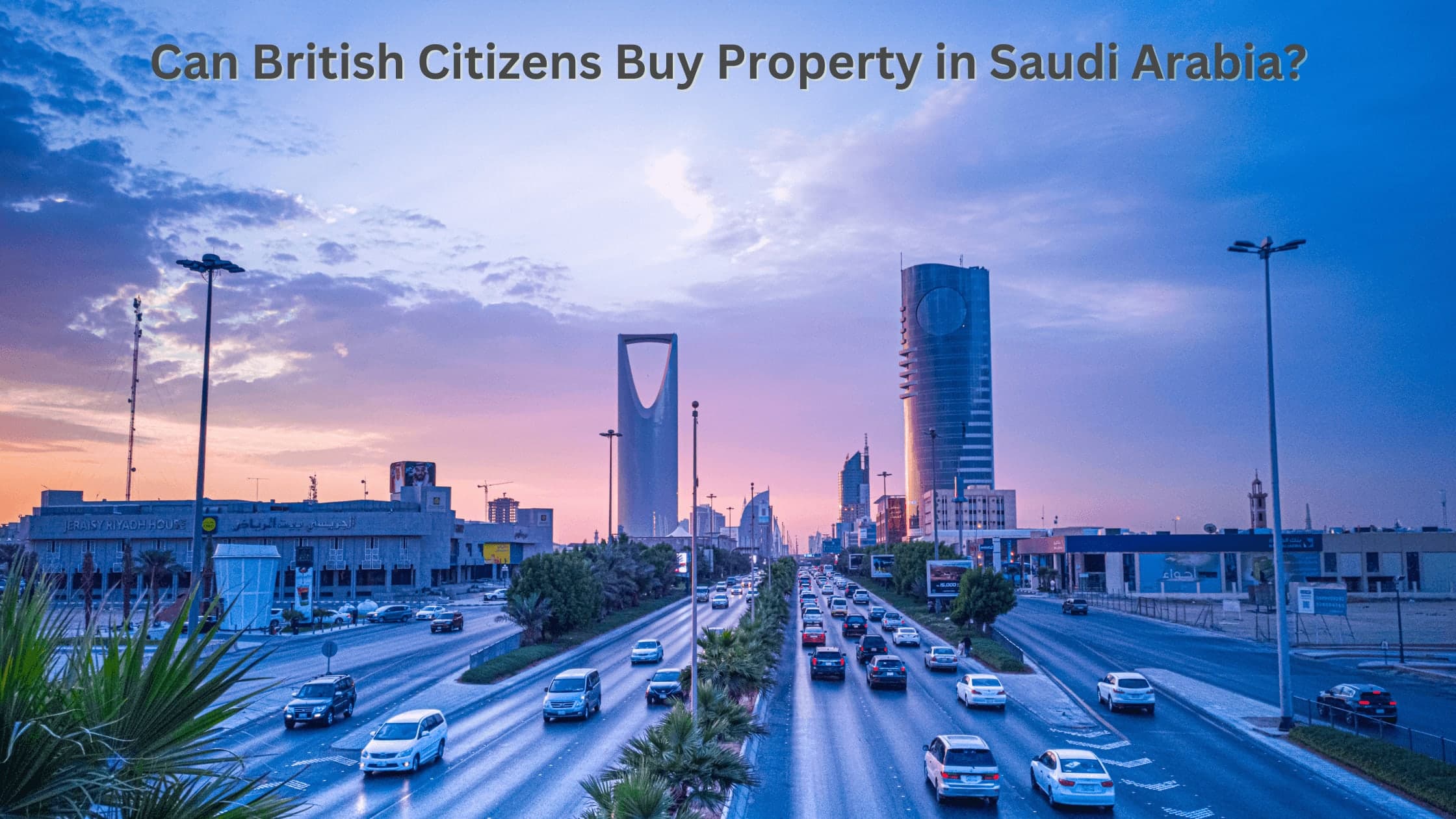
Yes. British citizens can buy property in Saudi Arabia, including registered freehold title, under the Law of Real Estate Ownership and Investment by Non-Saudis that came into force on 21 January 2026. Ownership is permitted inside designated geographic zones endorsed by the Council of Ministers on 23 June 2026. A British national holding Saudi residency may additionally own one home outside those zones. Makkah and Madinah remain restricted to Muslim buyers. Residency is not required to buy inside a designated zone.
The position described below is current as at 6 August 2026.
What Changed Under the Non-Saudi Property Ownership Law?
The previous regime was purpose-based. A foreign national or company had to justify each acquisition, usually by tying it to a licensed activity or a residency status, and approval came case by case. Two comparable buyers could receive different answers, and neither could plan against a published rule.
The 2025 law replaces that with geography. The Real Estate General Authority (REGA) is now the competent authority for non-Saudi ownership. If a property sits inside a designated zone and the buyer meets the eligibility conditions, ownership proceeds without prior Ministry of Investment clearance. Property outside the zones still needs advance approval.
The table below sets out the practical difference for a British buyer.
| Issue | Before 21 January 2026 | From 21 January 2026 |
|---|---|---|
| Basis of permission | Case-by-case approval tied to purpose | Zoning, published in advance |
| Competent authority | Fragmented across bodies | REGA |
| Makkah and Madinah | Generally leasehold only for non-Saudis | Registered title for Muslim individuals, in designated areas |
| Registration | Varied by transaction | Mandatory, one platform |
The gap between the two dates mattered: for five months the right existed but the map did not, so the June 2026 approval of the geographic scopes is what made the law usable.
Where Can British Citizens Buy Property in Saudi Arabia?
Ownership is confined to the approved geographic scope, covering roughly 170 zones across Riyadh, Jeddah, Makkah, Madinah and other cities and governorates. Each zone carries its own parameters: the maximum ownership percentage permitted, the type of right that can be acquired, and any duration limit where the right is a usufruct rather than outright ownership. Eligibility attaches to the zone, not to the city.
Designated Zones in Riyadh and Jeddah
In Riyadh the designated areas include King Abdullah Financial District, Diriyah Gate, New Murabba, Qiddiya, King Salman Park, the King Salman International Airport development, SEDRA and Sports Boulevard, together with transit-oriented development sites along the metro corridors. REGA publishes the zones as interactive maps on its Saudi Properties portal, and that map governs. A developer brochure does not. Our guide to foreign ownership zones in Saudi real estate covers how the scopes are structured.
Can British Buyers Own Property in Makkah or Madinah?
Only if they are Muslim. Ownership in the two holy cities is limited to Muslim individuals, resident or non-resident, and to Saudi-incorporated companies, and only within designated areas. The Royal Commission for Makkah City and Holy Sites and the Madinah Region Development Authority sit on the oversight committee for these regions.
For non-Saudi Muslims this is a genuine widening, since earlier practice generally allowed long leasehold interests rather than registered title. For a non-Muslim British buyer the position is closed, whatever the budget or structure.
Can British Residents Buy Outside the Designated Zones?
Yes, within limits. A non-Saudi holding legal residency may own one residential property outside the designated zones for personal use. It is a single-home entitlement rather than an investment allowance, but for a British family already working in the Kingdom and renting outside a zone, this is often the provision that applies.
Which property type & region do you prefer?
Select property type and preferred city in Saudi Arabia.
Do You Need Saudi Residency to Buy Property?
No. The law covers residents and non-resident investors alike, so a British buyer in London can acquire inside a designated zone without an Iqama. Residency matters for two things: the single home outside the zones, and access to mortgage finance.
What Documents Are Required?
The regulations set practical conditions for individuals rather than capital thresholds. A non-Saudi natural person needs:
- An electronic identity issued by the Ministry of Interior
- A Saudi bank account held in their own name
- A local contact number registered in their own name
None of these are difficult in isolation. Assembled from outside the Kingdom they are the most common reason a purchase timeline slips, because a buyer in the UK cannot open a Saudi account by correspondence as easily as expected.
Registration is mandatory. Every transaction creating or transferring a real right for a non-Saudi runs through REGA's central electronic platform, integrated with Saudi Central Bank payment infrastructure so registration, payment and title issuance sit in one process. Our explainer on the difference between the title deed and property transfer is worth reading before signing.
Rules for British Companies and Funds
A foreign entity must register with the Ministry of Investment, disclose direct and indirect owners, and hold a Saudi bank account in the company name. Changes in ownership or control of 5% or more carry a 15-day notification duty. Saudi-incorporated companies with foreign shareholders may own outside the designated zones for operations or staff accommodation, subject to Ministry of Investment approval.
Penalties are meaningful. False or misleading information can attract a charge of up to 5% of the value of the property right, and other breaches carry fines between 0.1% and 3% of property value.
How Much Does It Cost to Buy Property in Saudi Arabia?
Most published guidance goes wrong here in two directions: quoting charges that no longer exist, or quoting real charges but attaching them to the wrong party.
| Charge | Rate | Applies to | Who is legally liable |
|---|---|---|---|
| Real Estate Transaction Tax (RETT) | 5% | Disposal of real estate | The disposer (seller). A buyer can become jointly liable where they took part in avoiding the tax. |
| Non-Saudi disposal fee (REGA) | 2% at present, within a 5% statutory ceiling | Disposals involving non-Saudis in designated zones in Riyadh, Jeddah, Makkah and Madinah | Not specified in the law. Allocation is a contractual matter between the parties. |
| VAT | 15% | Commercial leases and professional services, not the property sale itself | The recipient of the supply |
| Brokerage and professional fees | Varies | Agency, legal and valuation work | The instructing party |
Who Legally Pays the 5% Real Estate Transaction Tax?
RETT is charged at 5% of the disposal value and is administered by the Zakat, Tax and Customs Authority under the Real Estate Transaction Tax Law, whose current implementing regulations took effect on 10 April 2025. It reaches completed, under-construction and off-plan property, partial interests, and transfers of shares in real estate companies measured at fair market value.
Legal liability sits with the transferor, meaning the seller, though a buyer who participated in avoiding the tax can be held jointly liable. The commercial allocation is negotiated and is frequently passed to the buyer in the contract of sale, but that is a matter of agreement rather than an automatic acquisition cost. Read the clause rather than assuming. Our breakdown of the 5% real estate transaction tax sets out the exemptions, which include inheritance between heirs, transfers to registered endowments, and gifts to a spouse or close relatives where the property is not sold within three years.
How the 2% Non-Saudi Fee Works
The Implementing Regulations introduced a separate fee payable to REGA on disposals involving non-Saudis, currently set at 2% for property in Riyadh, Jeddah, Makkah and Madinah. The law permits up to 5%, so the present rate reflects a policy choice rather than a ceiling.
Two points deserve care. The fee is additional to RETT, so a qualifying transfer can carry 7% in combined statutory charges. And the law does not state which party bears it, so any assumption that the buyer pays is exactly that. Treat it as a negotiated contract line and price it before offering. Certain transactions are zero-rated, including disposals under judicial orders, qualifying disposals by non-Saudi developers within licensed development periods, and transfers from an individual to a Kingdom company they wholly own.
Does VAT Apply to a Property Purchase?
No. Older articles still claim 15% VAT applies to property purchases. Real estate disposals were removed from the VAT net when the transaction tax was introduced and are subject to RETT instead. VAT at 15% still reaches commercial leases and related professional services, but it is not a line on a residential purchase.
What Are the Ongoing Costs of Owning?
There is no annual property tax and no council tax equivalent, which genuinely improves net yield against a UK comparator. The White Land Tax applies to undeveloped urban land, not occupied homes. Budget instead for service charges, maintenance, utilities and, for an absentee owner, letting and management fees.
Can British Citizens Get a Mortgage in Saudi Arabia?
This turns on residency rather than nationality. A British national resident in the Kingdom, holding an Iqama with salary paid into a Saudi account, is a conventional borrowing candidate, and the major banks compete for that business. Saudi Central Bank rules cap debt-burden ratios, and that cap is usually the binding constraint on borrowing capacity rather than the loan-to-value ratio.
A British national living in the UK is in a different position. Retail lending to non-residents remains limited and case by case rather than a mass-market product, so non-resident purchases are commonly funded with cash or developer payment plans on off-plan stock. Terms are commercial decisions by individual banks, not a published entitlement, so treat any quoted rate as indicative until a lender confirms it in writing. Our guide to getting a mortgage in Saudi Arabia covers what lenders ask for.
Two features surprise British buyers. Most Saudi home finance is Sharia-compliant, structured as murabaha or ijara rather than an interest-bearing loan, which changes the documentation and the early-settlement position. And because the riyal is pegged to the US dollar, the real currency exposure for a sterling investor is pound against dollar.
What is your approximate budget?
Narrow down property options based on your target budget.
Does Buying Property Give You Residency in Saudi Arabia?
Not automatically. Ownership and residency are separate systems, and the link between them runs through the Premium Residency programme rather than through the title deed itself.
The real estate owner category, introduced in January 2024 and updated under regulations issued in January 2026, requires a residential property valued at a minimum of SAR 4 million. The conditions are specific: residential rather than commercial, completed and habitable rather than off-plan at the point of qualification, free of mortgage or real estate financing, and appraised by a Taqeem-accredited valuer. The status is tied to the asset, so selling without replacing it ends the residency.
Terms have been revised more than once since launch, so confirm current criteria with the Premium Residency Center before buying on this basis. Our guide to Saudi Premium Residency sets out the categories and fees.
What Is Happening to Saudi Property Prices?
Headline enthusiasm and measured data have diverged. The General Authority for Statistics recorded the Real Estate Price Index up 1.3% year on year in the second quarter of 2026, and 3.0% quarter on quarter. The composition beneath that headline is uneven.
| Segment | Change, Q2 2026 vs Q2 2025 |
|---|---|
| Overall index | +1.3% |
| Residential | +2.6% |
| Commercial | -3.2% |
| Residential plots | +6.3% |
| Apartments | +1.1% |
| Villas | -9.7% |
| Riyadh region | +4.2% |
The villa figure runs against the story most marketing material tells. New supply has begun to affect the upper end of the market, and the segment British buyers are most often shown is the one that fell. These are index movements rather than achieved prices, and a gross yield quoted in a brochure is not a net yield after service charges, management and vacancy.
Saudi Arabia in 2026 therefore rewards selection rather than index exposure. Buying a specific asset class in a specific district, with a view on the supply pipeline around it, is a position. Buying the city is not. Our analysis of how foreigners can buy property in Riyadh looks at where returns have concentrated.
What UK Tax Do British Owners Pay on Saudi Property?
Saudi Arabia imposes no personal income tax on employment income and no annual property tax. That is not the end of the analysis for a British owner, because UK obligations continue regardless.
If you remain UK tax resident under the Statutory Residence Test, you are taxable in the UK on worldwide income, and HMRC requires you to report income from overseas property through Self Assessment. Foreign property profits are calculated across your overseas portfolio as a whole and shown separately from UK property income. Because Saudi Arabia levies no personal income tax on that rental income, there is generally no foreign tax credit available to reduce the UK charge.
Three further points are worth planning for. Capital gains on a Saudi property can fall within UK capital gains tax if you are UK resident at disposal. UK inheritance tax follows domicile and long-term residence rather than the location of the asset, so a Saudi property can sit inside a UK estate while being governed by Saudi succession rules on the ground. And the UK and Saudi Arabia have a double taxation convention allocating taxing rights between the two countries, which does not remove the UK reporting duty.
How would you like to be contacted?
Choose your preferred channel for a private consultation.
What Should British Buyers Check Before Signing?
Off-plan sales are governed by the WAFI programme, which licenses developers to sell before completion and requires proceeds to run through escrow. Confirm the project holds a valid WAFI licence and that payments go to the escrow account rather than a developer operating account. It is the single most effective check available to an off-plan buyer.
Alongside that:
- Verify the zone status of the specific title, not the district name, since zone boundaries do not always follow how a neighbourhood is described
- Check whether the zone grants ownership or a time-limited usufruct, and the maximum ownership percentage
- Use a broker licensed by REGA
- Read who bears RETT and the non-Saudi fee in the contract rather than assuming market practice
- Have Arabic documentation translated instead of relying on an English summary
- Allow six to eight weeks where identity, banking and telephone credentials are assembled from outside the Kingdom
Where to Start Your Property Search
Regulatory clarity has improved substantially, removing a category of risk that previously kept private British capital away. The market case remains selective. Combined statutory charges of up to 7% on a transfer make short holding periods unattractive, the villa segment has been falling, and non-resident financing is thin enough that most UK-based buyers will commit cash.
For readers shortlisting Saudi options, Real Estate Saudi provides property listings, off-plan project pages, developer profiles and city guides for Riyadh, Jeddah and other markets. These support the research stage. Eligibility for a specific title should be confirmed through the REGA Saudi Properties portal, and the tax and contractual position through qualified advisers.
Property ownership rules, geographical scopes, taxes, fees, mortgage conditions, Premium Residency criteria and tax treatment can change. This guide is for general information only. Before making a financial commitment, verify the current position through official sources and obtain qualified legal, tax and financial advice.
Talk to Our Real Estate Experts
Get real-time insights on investment options, commercial properties, and market guidelines.
Frequently Asked Questions
Yes. Under the Law of Real Estate Ownership and Investment by Non-Saudis, in force since 21 January 2026, British citizens may acquire registered title within designated geographic zones endorsed by the Council of Ministers on 23 June 2026. British nationals holding Saudi residency may additionally own one residential property outside those zones for personal use.
No. The law covers both residents and investors based outside the Kingdom, so an Iqama is not required to buy inside a designated zone. Residency is required to use the separate entitlement to own one home outside the zones, and it is effectively necessary to obtain mortgage finance from a Saudi bank.
Ownership is limited to roughly 170 designated zones across Riyadh, Jeddah, Makkah, Madinah and other cities and governorates. Riyadh zones include King Abdullah Financial District, Diriyah Gate, New Murabba, Qiddiya, King Salman Park, SEDRA and Sports Boulevard. Each zone sets its own maximum ownership percentage and the type of right granted, published on REGA's Saudi Properties portal.
Legal liability sits with the transferor, meaning the seller, although a buyer who took part in avoiding the tax can be held jointly liable. The commercial allocation is negotiated and is often passed to the buyer in the contract of sale, so the position should be read in the sale agreement rather than assumed.
The Implementing Regulations introduced a fee payable to REGA on disposals involving non-Saudis, currently 2% for property in Riyadh, Jeddah, Makkah and Madinah, within a statutory ceiling of 5%. It is charged in addition to the 5% transaction tax. The law does not state which party bears it, so allocation is a contractual matter.
No. Real estate disposals were removed from the VAT net when the Real Estate Transaction Tax was introduced and are subject to 5% RETT instead. VAT at 15% still applies to commercial leases and to related professional services, but it is not charged on a residential property purchase. Guidance stating otherwise is out of date.
Only Muslim individuals, whether resident or non-resident, and Saudi-incorporated companies may own within designated areas of the two holy cities. For non-Saudi Muslims this is a widening, since earlier practice generally permitted long leasehold interests rather than registered title. Non-Muslim British buyers cannot own property there.
Realistically only with Saudi residency. British nationals holding an Iqama with salary paid into a Saudi account are treated as conventional borrowers, subject to Saudi Central Bank debt-burden limits. Retail lending to non-residents remains limited and case by case, so UK-based buyers usually purchase with cash or use developer payment plans on off-plan stock.
Not automatically. Residency runs through the Premium Residency programme. The real estate owner category requires a completed, mortgage-free residential property valued at a minimum of SAR 4 million, appraised by a Taqeem-accredited valuer. The status is tied to continued ownership and the criteria have been revised since launch, so confirm current terms with the Premium Residency Center.
If you remain UK tax resident under the Statutory Residence Test, yes. UK residents are taxable on worldwide income, and HMRC requires overseas property income to be reported through Self Assessment, shown separately from UK property income. Because Saudi Arabia levies no personal income tax on that income, there is generally no foreign tax credit to offset the UK liability.
