
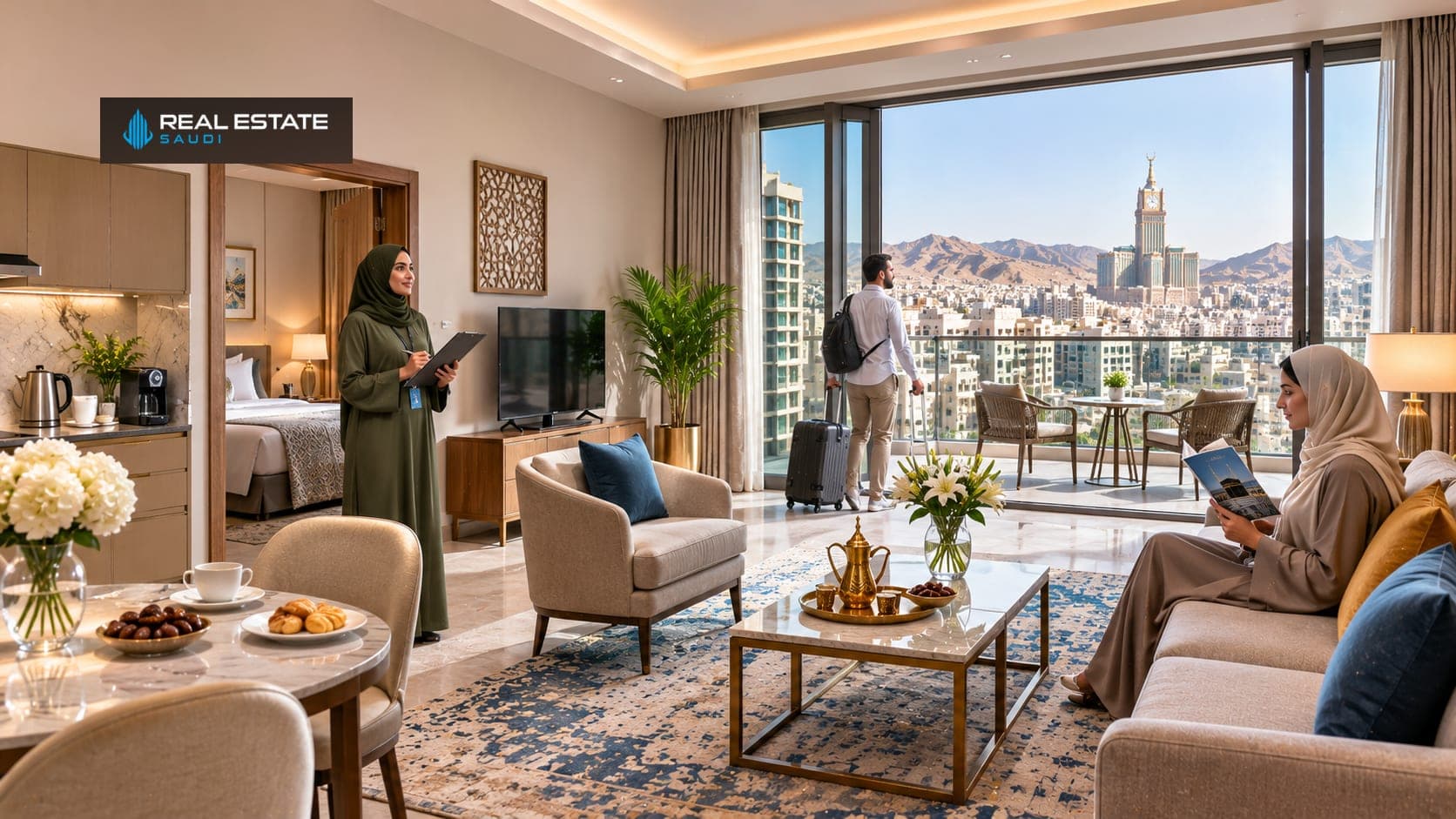
Investing in furnished apartments in Makkah can be profitable when a property combines an appropriate purchase price, suitable location, reliable rental demand and manageable operating expenses. However, Makkah's religious significance does not guarantee high occupancy or investment returns for every residential unit.
The city attracts religious visitors throughout the year, including people travelling for Umrah and Hajj. Some prefer apartments with separate bedrooms, kitchens and shared living areas, particularly when travelling with family members.
This creates potential opportunities for property owners, but there is an important distinction between conventional furnished residential leasing and licensed tourist accommodation.
Before purchasing, investors must understand the property's permitted use, ownership eligibility, financing costs and realistic income potential.
This guide explains how Makkah's furnished accommodation market operates, which neighbourhoods deserve investigation, how rental yields are calculated, and what Saudi regulations mean for domestic and international property investors.
Are Furnished Apartments in Makkah Profitable?
Furnished apartments can generate positive rental income when annual receipts exceed operating expenses and provide an acceptable return on the total capital invested. Their profitability depends on property acquisition costs, occupancy, achievable rental rates, licensing requirements and management efficiency rather than visitor numbers alone.
A property located near Al-Masjid Al-Haram may attract travellers who prioritise convenient access to religious destinations. However, a higher purchase price can reduce its percentage return.
An apartment farther from the Grand Mosque may be more affordable but require stronger transport arrangements or more competitive rental pricing.
Both properties could potentially generate income, yet their financial performance may differ significantly.
Investors should compare actual rental evidence and net operating income rather than relying on advertised nightly rates.
Why Are Furnished Apartments in Makkah Attractive?
Furnished accommodation can appeal to visitors seeking more privacy, space and flexibility than conventional hotel rooms.
Families may prefer apartments with multiple bedrooms, separate living spaces and facilities for preparing meals.
Other tenants may require temporary furnished housing while relocating, working on local projects or visiting relatives.
This diversity of accommodation requirements provides several possible rental markets.
However, each customer segment has different expectations. Accommodation designed for extended residential occupation may not be suitable for short-stay tourism without additional facilities or regulatory permissions.
A successful investment begins by identifying the intended tenant and selecting a property that meets their practical requirements.
Understanding the Furnished Apartment Market
Furnished apartments are residential units supplied with essential furniture and household equipment. These typically include beds, sofas, wardrobes, kitchen appliances, dining furniture and air conditioning.
The term can describe different types of accommodation, but their regulatory treatment is not necessarily the same.
A conventional residential apartment may be leased under a longer tenancy agreement. A serviced apartment or tourist accommodation facility may involve short bookings, guest services and additional licensing requirements.
According to the Saudi Ministry of Tourism's tourist accommodation licensing guidance, qualifying accommodation facilities must obtain the appropriate licence before receiving tourists, confirming reservations or providing units to guests.
Ministry of Tourism Saudi Arabia
An investor should therefore establish the property's operating category before preparing income projections.
Conventional Furnished Residential Leasing
Longer residential leases can provide relatively predictable rental receipts and fewer occupant changes.
They may also involve lower booking administration and housekeeping expenses.
However, landlords remain responsible for maintenance, contractual obligations and applicable tenancy requirements.
The rental income achieved under a longer lease may differ from the revenue available through short-stay bookings.
Neither arrangement is universally more profitable.
Serviced Apartments and Tourist Accommodation
Professionally operated accommodation may offer housekeeping, guest assistance, reservation management and other services.
These facilities can improve convenience for visitors but increase operational expenditure.
Licensing, facility standards, safety requirements and administrative obligations can also affect the financial feasibility of the business.
Owners should not assume that purchasing a residential apartment automatically permits them to operate it as a tourist accommodation facility.
Which property type & region do you prefer?
Select property type and preferred city in Saudi Arabia.
Why Religious Tourism Influences Rental Demand
Makkah is one of the world's most important religious destinations, with substantial visitor activity linked to Hajj and Umrah.
According to the General Authority for Statistics' official Hajj 2025 announcement, Saudi Arabia recorded 1,673,230 pilgrims during Hajj 2025, including 1,506,576 international pilgrims.
Saudi Statistics Authority
These figures demonstrate the scale of pilgrimage travel, but they do not establish the occupancy or profitability of individual privately owned apartments.
Ramadan and Umrah Visitors
Ramadan may create increased interest in accommodation as visitors travel to perform Umrah and spend time in Makkah.
Demand can also vary throughout the rest of the year according to travel arrangements, religious calendars and holidays.
An apartment performing strongly during Ramadan may still experience vacancies during other periods.
Investors should therefore research a complete annual demand cycle rather than calculating income using only peak-season rates.
Hajj Accommodation Restrictions
Hajj accommodation involves specialised regulations, organised travel arrangements and operational requirements.
Property owners should not assume that every privately owned apartment can automatically accommodate Hajj pilgrims.
Before projecting income from Hajj-related stays, investors must confirm that the property is legally eligible for the proposed activity.
This is particularly important when evaluating properties marketed using ambitious seasonal revenue forecasts.
Competition from Hotels and Serviced Residences
Private apartments compete with hotels, serviced accommodation and other authorised lodging providers.
Established hospitality businesses may offer organised transportation, reception facilities, housekeeping and online reservation systems.
Independent apartment owners must provide a competitive combination of accommodation quality, convenience, pricing and reliable service.
Higher visitor numbers can support demand, but they can also encourage additional accommodation development and competition.
Best Locations for Furnished Apartment Investment in Makkah
The suitability of an investment location depends on acquisition cost, guest requirements, accessibility and permitted property use.
A centrally located apartment may appeal to visitors seeking convenient mosque access, while a less central property may attract families who prefer larger accommodation at a lower price.
Investors should compare specific buildings instead of assuming that every property within a neighbourhood offers similar investment potential.
Ajyad: Central Accommodation Opportunities
Ajyad is associated with central Makkah and access towards Al-Masjid Al-Haram.
Its positioning may appeal to visitors who want convenient access to religious destinations.
However, investors should consider potentially higher acquisition costs and competition from established hospitality properties.
Building access also matters. A short distance on a map may involve crowded pedestrian routes, steep streets or restrictions on vehicle movement.
Before purchasing, investors should test practical accessibility from the actual building entrance.
Al Aziziyah: Family-Oriented Accommodation
Al Aziziyah may interest investors researching properties intended for families and visitors comfortable with using transport to reach central Makkah.
Larger apartments can provide practical advantages for groups requiring multiple bedrooms and shared living facilities.
However, achievable rental rates depend on the property's specific location, available transport and competition.
Investors should assess comparable accommodation and obtain actual rental evidence before estimating returns.
Al Misfalah: Established Residential Buildings
Al Misfalah includes established residential and accommodation properties around central Makkah.
Buildings can vary considerably in age, maintenance and accessibility.
An older apartment may initially appear affordable but require substantial expenditure on electrical systems, plumbing, air conditioning or interior refurbishment.
These costs should be included in the initial investment calculation.
Other Residential Neighbourhoods
Neighbourhoods farther from the Grand Mosque may offer opportunities for longer residential tenancies or comparatively affordable accommodation.
Their suitability depends on tenant preferences, transport connections and building conditions.
Investors researching apartments for sale in Saudi Arabia should narrow their comparison to relevant Makkah properties and verify current local transaction evidence.
The most suitable property is not necessarily the one with the highest rental rate. It is the property whose realistic income can justify its purchase price and ongoing expenses.
How Furnished Apartments in Makkah Generate Rental Income
Income depends on the rental arrangement, achievable prices, occupancy and management quality.
Some owners prefer longer contractual leases, while eligible accommodation operators may offer shorter stays.
The business model should be established before purchasing because it influences furnishing requirements, operating expenses and regulatory permissions.
Short-Term Rental Income
A permitted short-stay operation may allow accommodation prices to change with demand.
However, the advertised nightly rate does not represent the property's annual income.
Operators must account for unsold nights, cancellations, booking commissions and guest-service expenses.
Revenue can fluctuate significantly between busy and quieter periods.
Investors should analyse completed booking records rather than assuming that the property will remain occupied throughout the year.
Monthly and Long-Term Rentals
Longer furnished leases may offer more predictable income and reduce frequent guest turnover.
They can also lower certain expenses associated with housekeeping and booking administration.
However, longer contracts may limit an owner's ability to adjust pricing during temporary increases in visitor demand.
A financial comparison should therefore focus on annual net income rather than the highest achievable nightly rate.
Selecting the Right Rental Strategy
The appropriate operating model depends on the property's legal classification and intended occupants.
An apartment suitable for permanent residents may not satisfy the requirements for tourist accommodation.
Similarly, a property designed for short stays may involve unnecessary expenditure when operated under an ordinary residential lease.
Owners should verify legal feasibility and realistic revenue expectations before adopting a particular strategy.
Calculating Rental Yield and Return on Investment
Rental yield measures income relative to property value or acquisition cost.
Gross rental yield is useful for an initial comparison, but it does not account for operating expenses.
The formula is:
Gross Rental Yield = Annual Gross Rental Income ÷ Property Purchase Price × 100
Net operating income provides a more realistic indication of operational performance.
Net Operating Income = Annual Rental Revenue − Annual Operating Expenses
Investors can then compare annual net operating income with the total capital spent on acquisition and setup.
Example of a Furnished Apartment Investment
Consider a hypothetical apartment purchased for SAR 1,200,000.
Assume the investor spends another SAR 100,000 on transaction expenses, furnishing and initial preparation.
Total capital invested would therefore equal SAR 1,300,000.
Suppose annual gross rental receipts reach SAR 96,000, while annual operating expenses amount to SAR 42,000.
Financial Component | Illustrative Amount |
|---|---|
Property purchase price | SAR 1,200,000 |
Additional acquisition and setup costs | SAR 100,000 |
Total initial investment | SAR 1,300,000 |
Annual gross rental income | SAR 96,000 |
Annual operating expenses | SAR 42,000 |
Net operating income | SAR 54,000 |
Gross rental yield | 8% |
Operating return on total capital | Approximately 4.15% |
These figures are hypothetical calculations and do not represent confirmed Makkah property prices, market-average yields or occupancy rates.
They also exclude financing repayments and other investor-specific financial obligations.
Why Net Income Matters More Than Gross Revenue
A property may generate substantial gross receipts while producing limited profit after expenses.
Cleaning, maintenance, electricity, water, booking fees, management charges and furnishing replacements can all reduce income.
Owners should prepare realistic annual budgets and maintain sufficient cash reserves for unexpected expenditure.
A financially sustainable investment should remain manageable when actual revenue falls below initial expectations.
Testing Different Occupancy Scenarios
Investors should prepare conservative, expected and optimistic occupancy scenarios.
Each scenario should use realistic average rates, anticipated vacant periods and operating expenses.
The conservative scenario should include possible cancellations, seasonal weakness and unexpected repairs.
This process provides a stronger basis for decision-making than assuming uninterrupted occupancy.
Property Acquisition Costs and Taxes
The advertised selling price is only part of the capital required to purchase an investment property.
Additional expenses may include property transaction taxes, valuation, financing charges, legal documentation, refurbishment and furnishing.
According to the Zakat, Tax and Customs Authority's Real Estate Transaction Tax Law, a 5% Real Estate Transaction Tax generally applies to taxable real estate disposals, subject to applicable exemptions and transaction-specific provisions.
Zakat, Tax and Customs Authority
Buyers should establish how the tax applies to their particular transaction and review the contractual allocation of payment obligations.
Furnishing and Renovation Expenses
Preparation costs depend on the apartment's size, existing condition and intended accommodation standard.
Typical furnishing requirements may include beds, wardrobes, sofas, kitchen appliances, washing machines and air conditioning.
Accommodation intended for frequent guest turnover may also require additional linen, cleaning equipment and durable furnishings.
Owners considering interior design and furnishing services should establish a clear project budget before selecting materials and furniture.
Spending should prioritise functionality, durability and guest comfort rather than expensive features that do not improve rental competitiveness.
Maintenance and Replacement Costs
Furniture, appliances and building equipment require ongoing maintenance.
Properties used for short stays may experience frequent wear on mattresses, upholstery and kitchen facilities.
Investors should reserve funds for replacements, repairs and unexpected breakdowns.
These expenses should be incorporated into annual profitability projections instead of being treated as exceptional costs.
Mortgage Financing and Property Affordability
Mortgage financing can reduce the amount of upfront cash required, but borrowing introduces recurring repayment obligations.
These payments continue even when the property experiences vacancies or unexpected operating costs.
Banks generally assess income, creditworthiness, existing financial commitments and property eligibility when evaluating financing applications.
The Saudi Central Bank's responsible lending principles address lenders' assessment of repayment capacity and borrower obligations.
Applicants should examine repayment terms, total financing expenses and applicable early settlement conditions.
Investors reviewing mortgage assistance in Saudi Arabia should establish financing eligibility before entering binding purchase agreements.
Positive property operating income does not automatically mean positive cash flow after debt repayments.
Both figures should be calculated separately.
What is your approximate budget?
Narrow down property options based on your target budget.
Can Foreign Investors Buy Furnished Apartments in Makkah?
Foreign ownership in Makkah is subject to special legal conditions.
Saudi Arabia's updated real estate ownership system for non-Saudi nationals entered into force on 22 January 2026.
The Real Estate General Authority's official foreign ownership announcement explains that eligible applicants must follow the applicable ownership procedures, geographical restrictions and requirements through the Saudi Properties system.
Rega
For non-Saudi natural persons, ownership within Makkah and Madinah is restricted to Muslims, subject to applicable geographical zones and other legal requirements.
This does not mean every Muslim foreign buyer is eligible to purchase every property within Makkah.
The precise location, purchaser category and legal ownership right must be verified.
Different provisions may apply to corporate purchasers and other legal entities.
Foreign investors should also distinguish permission to acquire property from permission to operate tourist accommodation.
A legally valid purchase does not automatically establish the right to use the apartment for commercial hospitality activities.
Tourism Licensing and Rental Regulations
Rental regulations depend on the nature of the proposed activity.
Conventional residential leasing and tourist accommodation may follow different legal frameworks.
Owners planning a hospitality business should confirm the appropriate Ministry of Tourism licence or permit.
For conventional tenancy arrangements, the Real Estate General Authority's Ejar platform provides electronic services for documenting and regulating qualifying rental contracts.
EJAR
The requirements for tourism operations may additionally involve commercial registration, municipal permissions, safety approval and compliance with accommodation standards.
Building rules can create further restrictions on guest access or commercial use.
Before marketing a property for short stays, owners should confirm that all applicable permissions are available.
Investors considering ordinary residential leasing can review the Saudi Arabia landlord guide for additional information about tenancy arrangements and obligations.
Property Management and Guest Experience
Professional management can influence accommodation quality, operating costs and customer satisfaction.
Short-stay operations may require frequent cleaning, reservation management, maintenance and assistance with guest arrivals.
Owners residing outside Makkah may prefer appointing a qualified local management company.
However, management expenses should be incorporated into financial projections.
Improving Guest Satisfaction
Guests generally expect cleanliness, reliable air conditioning, comfortable bedding and accurate accommodation descriptions.
Practical facilities such as internet connectivity, accessible entrances and functioning kitchen equipment can influence the quality of the stay.
Clear information about transport arrangements may also be particularly valuable to visitors unfamiliar with Makkah.
Operators should establish procedures for responding to maintenance problems and guest concerns.
Monitoring Rental Performance
Property owners should maintain accurate records of revenue, vacancies and operating expenditure.
Important indicators include occupancy, average achieved rental rate, maintenance costs and net operating income.
Investors examining professional property management services should compare contracts, fees, service responsibilities and financial reporting standards.
Reliable information makes it easier to evaluate whether management changes could improve financial performance.
Common Risks and Mistakes in Furnished Apartment Investment
One common mistake is purchasing an apartment based only on its advertised nightly rental rate.
A high nightly price does not guarantee strong annual revenue if the property experiences substantial vacancies.
Another risk is underestimating operating expenses, particularly cleaning, management fees, utilities and furniture replacements.
Investors may also overlook restrictions affecting tourism accommodation or assume that all properties can legally accept short-term guests.
Property condition is another major consideration. Older buildings may require expensive repairs to elevators, electrical systems or plumbing.
Resale liquidity should also be evaluated. If an investor needs to sell during unfavourable market conditions, the achieved price may be lower than expected.
Careful due diligence helps identify these risks before capital is committed.
How to Evaluate an Apartment Before Purchasing
A structured purchasing process can help investors make more informed decisions.
First, verify the ownership documents and confirm that the seller has authority to transfer the property.
Second, inspect the apartment and common areas, paying particular attention to maintenance, accessibility and building safety.
Third, obtain evidence from comparable rental properties with similar facilities and locations.
Fourth, confirm the regulatory permissions required for the proposed rental activity.
Fifth, calculate the entire acquisition budget, including taxes, furnishing and financing.
Finally, prepare conservative financial projections incorporating vacant periods and unexpected expenses.
The Saudi property buying guide provides additional context on purchase procedures and documentation.
Buyers should also review contractual terms concerning existing tenants, service charges and responsibilities for major repairs.
How would you like to be contacted?
Choose your preferred channel for a private consultation.
Investment Outlook for 2026 and Beyond
Makkah's importance as a religious destination supports continued interest in accommodation, but future investment results will depend on supply, demand, financing costs and property management quality.
New hotels and serviced apartments may increase competition, while infrastructure improvements could influence which neighbourhoods visitors prefer.
Investors should monitor official tourism data, local property transactions and regulatory developments.
The Saudi real estate investment guide provides broader context for evaluating property investment opportunities.
Future capital appreciation should be treated as a possibility rather than a guaranteed outcome.
A long-term investment strategy should prioritise legal compliance, realistic cash flow, appropriate reserves and the property's ability to remain attractive to tenants.
Is Investing in Makkah's Furnished Apartments Worth It?
Investing in furnished apartments in Makkah may be financially worthwhile when the acquisition cost, permitted rental model, achievable occupancy and operating expenses support sustainable net income.
The city's religious significance creates a distinctive accommodation market, but it does not guarantee rental yields or property appreciation.
Investors should verify ownership eligibility, tourism licensing requirements, property condition and actual rental evidence before making a purchase.
A carefully selected apartment can form part of a long-term property investment strategy, provided the decision rests on documented financial information and realistic expectations.
Ultimately, the strongest investment is not necessarily the property advertising the highest rental rate. It is the property that combines manageable risk, sustainable demand and an acceptable return after costs.
Talk to Our Real Estate Experts
Get real-time insights on investment options, commercial properties, and market guidelines.
Frequently Asked Questions
Yes, they can be profitable when rental revenue exceeds operating expenses and produces an acceptable return on invested capital. Profitability depends on purchase price, property location, occupancy, licensing and maintenance costs. Investors should calculate net income rather than rely on advertised nightly rates or assumptions about religious tourism.
A reliable citywide average cannot be established from the official evidence reviewed. Rental yields vary depending on property type, location, purchase price and operating model. Buyers should use actual rental transactions and expense records to assess a specific investment rather than applying an unsupported percentage to every apartment.
Ajyad, Al Aziziyah and Al Misfalah are among the districts worth researching. Each offers different accessibility, property types and accommodation characteristics. The best location depends on the intended tenants, acquisition price, transport connections and legal operating permissions. Investors should compare individual buildings rather than relying solely on neighbourhood reputation.
Eligible Muslim foreign individuals may acquire qualifying property rights within approved geographical zones under Saudi Arabia's updated ownership framework. However, eligibility depends on the purchaser's status, the property's precise location and applicable regulations. A foreign buyer should obtain official confirmation before signing a purchase agreement.
A tourism licence or permit is required for activities falling under the relevant Ministry of Tourism accommodation regulations. Conventional residential leasing may be governed by different requirements. Owners must establish the correct legal category before accepting short-stay bookings or operating a tourist accommodation business.
Short-term accommodation may achieve higher gross revenue during strong demand periods, but it also involves greater operating costs, frequent guest turnover and potential vacancies. Longer leases may offer more predictable income. Investors should compare annual net returns, regulatory requirements and management responsibilities before selecting an operating model.
Hajj creates substantial accommodation requirements in Makkah, but private properties cannot automatically participate in this market. Specialised accommodation arrangements and regulatory conditions may apply. Investors should verify whether their particular property can legally accommodate Hajj pilgrims before including seasonal income in financial projections.
Common expenses include cleaning, maintenance, utilities, management fees, booking commissions, insurance and furniture replacement. Property acquisition taxes and financing costs can also affect overall investment performance. Owners should maintain an annual expense budget and reserve funds for unexpected repairs and vacancies.
Begin with annual gross rental receipts and subtract operating expenses to calculate net operating income. Compare this amount with the total acquisition and setup capital to estimate an unleveraged operating return. Investors using mortgages should separately calculate cash flow after financing repayments and evaluate conservative occupancy scenarios.
Investors should verify ownership documents, property condition, transfer eligibility, building regulations, licensing requirements and comparable rental evidence. They should also calculate acquisition costs, ongoing expenses and financing obligations. Independent legal and financial advice can help identify potential risks before a binding purchase commitment.
