
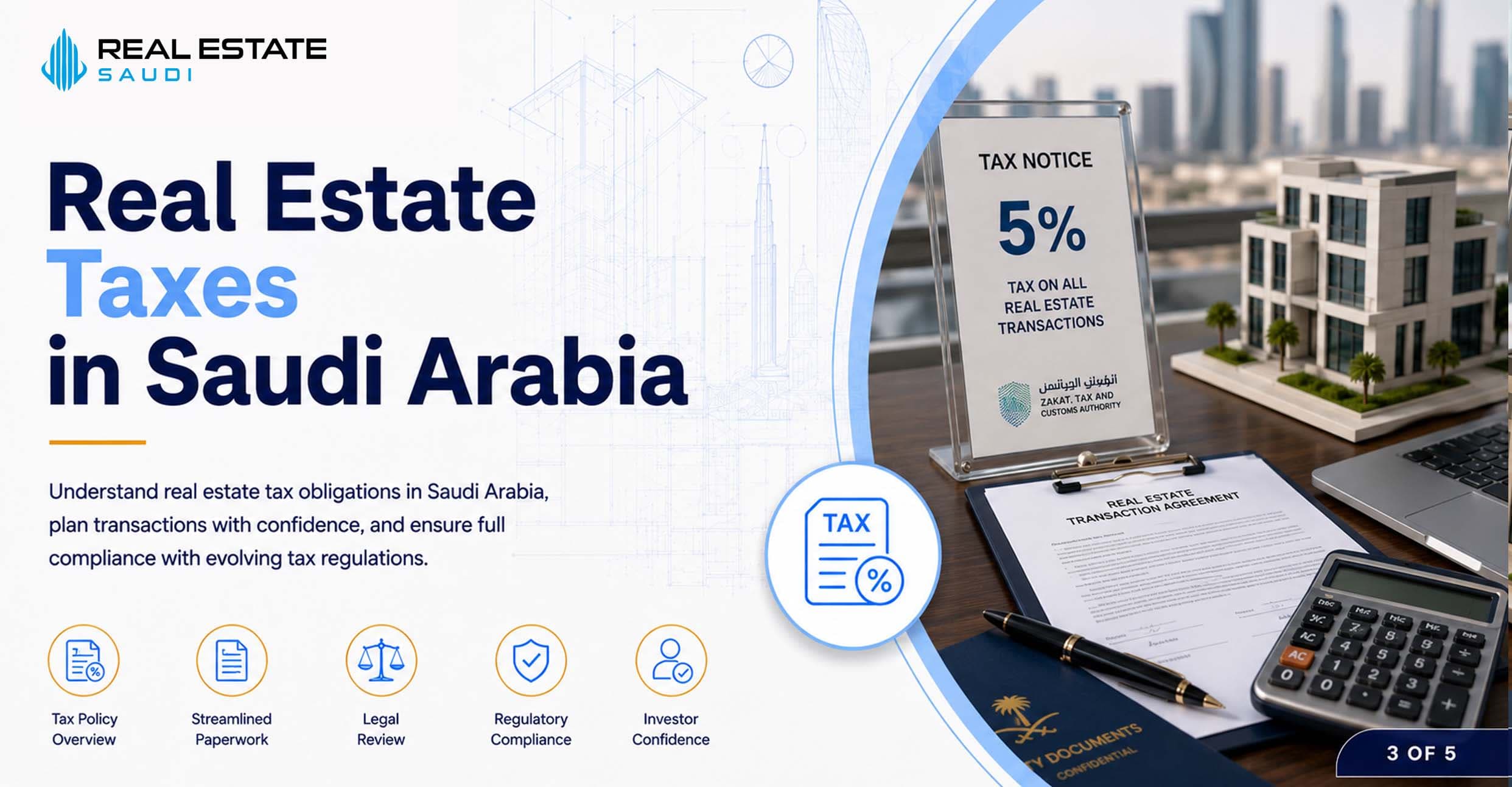
Real estate taxes play a significant role in the property market of every country, and Saudi Arabia is no exception. For both first-time homebuyers and seasoned investors, understanding the country’s taxation structure is essential. It can directly impact investment profitability, long-term returns, and compliance obligations. In this expanded guide from Real Estate Saudi, we will explore the various types of real estate taxes applicable in Saudi Arabia, how and where they are paid, and the consequences of failing to meet tax obligations. We also shed light on key government platforms, exemptions, and recent tax reforms that make Saudi Arabia an attractive destination for property investment.
Are There Real Estate Taxes in Saudi Arabia?
Yes, real estate taxes do exist in Saudi Arabia, but they are applied selectively. Unlike many global markets, Saudi Arabia does not levy an annual property tax on ownership, which enhances its appeal among property investors and expatriates. This tax-free ownership model boosts investor confidence and makes long-term property holding more financially viable. However, the government does impose certain taxes and fees during property transactions to promote market discipline and regulatory transparency.
These include:
- Taxes on property sales and transfers
- VAT on commercial property transactions
- Inheritance-related taxes
- Capital gains taxes on profitable real estate sales
Saudi Arabia’s approach is aimed at balancing investor incentives with fiscal responsibility. By taxing specific activities rather than ongoing ownership, the system attracts both local and international investors while generating government revenue needed for urban development and infrastructure.
ما نوع العقار والمنطقة المناسبة؟
اختر نوع العقار والمدينة المستهدفة لاستعراض أنسب الخيارات.
What Are the Types of Real Estate Taxes in Saudi Arabia?
1. Real Estate Disposal Tax
The Real Estate Disposal Tax (RETT) is levied on all property transactions involving the sale or transfer of ownership. It applies uniformly across both commercial and residential properties. The tax rate is 5% of the property's declared value and must be paid by the seller prior to the completion of the transaction.
Who pays?
- The seller is legally responsible for paying the RETT.
Exemptions include:
- Transfers between first-degree relatives (e.g., parents to children)
- Transfers to government entities or for public utility projects
- Specific charitable donations or endowments recognized by the state
This tax plays a critical role in tracking real estate activity, reducing speculation, and providing a transparent framework for ownership transitions.
2. Value Added Tax (VAT) on Commercial Properties
Saudi Arabia imposes a 15% Value Added Tax (VAT) on the sale or lease of commercial and industrial properties. This includes warehouses, office spaces, retail shops, and other business-related premises. Residential properties used solely for personal living purposes are exempt from this tax.
VAT is applicable in cases such as:
- Purchasing a commercial office
- Leasing a warehouse to a logistics company
- Selling a retail unit in a commercial plaza
The VAT system is administered through the Zakat, Tax and Customs Authority (ZATCA), and all commercial property transactions must be properly invoiced and documented for compliance.
3. Inheritance Tax on Real Estate
When a property owner passes away, the transfer of property to heirs may be subject to inheritance tax depending on the nature of the transfer, the relationship between the deceased and the beneficiaries, and the property value. The government’s objective is to ensure fair asset distribution and prevent ownership disputes.
Factors that affect this tax include:
- Closeness of the familial relationship
- Total value of the inherited estate
- Legal documentation supporting the claim
Properties passed to direct heirs, such as children or spouses, often receive favorable tax treatment or full exemption, provided all legal documentation is in order.
4. Capital Gains Tax on Real Estate Profits
Capital Gains Tax is applied when a property is sold at a profit over its original purchase price. This tax ensures that those benefiting financially from real estate investments contribute to public revenues. It also supports the government's broader goals of promoting stable and long-term investment strategies.
This tax is calculated as a percentage of the net gain and may vary depending on the transaction history, holding period, and nature of ownership. In some cases, RETT may also be applied simultaneously.
Investors must keep:
- Purchase and sale agreements
- Renovation and improvement receipts
- Evidence of any exemptions claimed
5. Other Real Estate-Related Fees
In addition to the primary taxes, Saudi Arabia’s real estate system includes several service-related fees to support public infrastructure and administrative oversight. These include:
- Title deed registration fees
- Permit charges for construction or renovation
- Service connection fees (electricity, water, sewage)
- Municipality certification or compliance fees
These fees are typically paid through municipal portals like Balady and can vary depending on property size, location, and type.
Where Are Real Estate Taxes Paid in Saudi Arabia?
Taxes and fees associated with real estate transactions are paid through official government portals to streamline processes and promote accountability.
Key platforms include:
- ZATCA (Zakat, Tax, and Customs Authority): Handles RETT and VAT payments
- Ehkaam: For legal settlement of unregistered or disputed properties
- Absher and Balady: For utility, municipal, and construction-related services
These platforms allow investors and property owners to calculate, report, and pay their dues digitally. Features include invoice generation, tax history tracking, and user-friendly dashboards in both Arabic and English.
What Are the Penalties for Not Complying with Real Estate Tax Obligations?
Non-compliance with real estate tax obligations can result in significant consequences, both financial and legal. The Saudi government enforces strict penalties to maintain order and encourage honest transactions.
Potential consequences include:
- Fines up to 200% of the unpaid tax
- Suspension of property transfers and ownership updates
- Denial of new construction permits or utility connections
- Legal investigations and possible court proceedings
These penalties apply to both citizens and foreign investors. Ensuring compliance not only protects your investment but also maintains your eligibility for future government services and approvals.
Consult Real Estate Saudi for Real Estate in Saudi Arabia
Navigating real estate taxes and legal procedures in Saudi Arabia can be complex, especially for foreign investors and first-time buyers. At Real Estate Saudi, our experienced consultants simplify the process for you. We offer in-depth market knowledge, legal support, and access to premium listings that align with your financial and investment goals.
Our services include:
- Personalized property tax planning
- Legal verification of documents
- Due diligence for commercial purchases
- Guidance on fee estimates and payment methods
Want help navigating Saudi Arabia’s property tax laws? Book your free consultation with Real Estate Saudi today and invest with confidence.
Certain FAQs
Is there a property tax on owning real estate in Saudi Arabia?
No, Saudi Arabia does not impose an annual property ownership tax. This makes the kingdom particularly attractive to both domestic and foreign investors looking for long-term real estate gains. With no recurring tax burden, owners enjoy greater net returns on their investments over time.
Who is responsible for paying the Real Estate Disposal Tax (RETT)?
The RETT is typically paid by the seller and amounts to 5% of the total sale value. It must be settled before the transaction can be legally registered. However, in some sale agreements, parties may mutually decide otherwise, but the law mandates the seller’s liability as default.
حدد ميزانيتك الاستثمارية
حدد ميزانيتك التقديرية لنقوم بتضييق خيارات العروض.
Are residential properties subject to VAT?
No, residential properties meant for personal use are exempt from the 15% VAT in Saudi Arabia. This exemption significantly reduces the acquisition cost for Saudi citizens and residents purchasing homes for non-commercial use. VAT only applies to commercial, investment, and industrial properties.
What happens if I don’t pay real estate taxes or fees?
Non-payment of real estate taxes and regulatory fees can lead to hefty penalties, often up to double the original amount. Authorities may also freeze your ability to sell or transfer property and suspend building permits or utility connections. Repeat violations can lead to legal investigations and prolonged delays in real estate processes.
Where can I pay my real estate taxes in Saudi Arabia?
Real estate-related taxes and fees can be paid via official online portals such as ZATCA for tax-related payments, Ehkaam for legal settlement of disputed land, and Balady or Absher for municipal and service-related charges. These platforms provide secure, streamlined services in Arabic and English, making it easy for both residents and international investors to stay compliant.
No, Saudi Arabia does not impose an annual property ownership tax. This makes the kingdom particularly attractive to both domestic and foreign investors looking for long-term real estate gains. With no recurring tax burden, owners enjoy greater net returns on their investments over time.
The RETT is typically paid by the seller and amounts to 5% of the total sale value. It must be settled before the transaction can be legally registered. However, in some sale agreements, parties may mutually decide otherwise, but the law mandates the seller’s liability as default.
No, residential properties meant for personal use are exempt from the 15% VAT in Saudi Arabia. This exemption significantly reduces the acquisition cost for Saudi citizens and residents purchasing homes for non-commercial use. VAT only applies to commercial, investment, and industrial properties.
Non-payment of real estate taxes and regulatory fees can lead to hefty penalties, often up to double the original amount. Authorities may also freeze your ability to sell or transfer property and suspend building permits or utility connections. Repeat violations can lead to legal investigations and prolonged delays in real estate processes.
Real estate-related taxes and fees can be paid via official online portals such as ZATCA for tax-related payments, Ehkaam for legal settlement of disputed land, and Balady or Absher for municipal and service-related charges. These platforms provide secure, streamlined services in Arabic and English, making it easy for both residents and international investors to stay compliant.
Real Estate Transaction Tax (RETT) vs. Value Added Tax (VAT) in 2026
Pursuant to Royal Order No. (A/84) and executive regulations published by the Zakat, Tax and Customs Authority (ZATCA), the taxation of real estate disposals in Saudi Arabia is governed by the Real Estate Transaction Tax (RETT) at a flat rate of 5%. Residential property sales are completely exempt from the standard 15% VAT, ensuring lower acquisition overheads for homeowners and real estate investors.
However, Value Added Tax (VAT) at 15% continues to apply in specific commercial contexts:
- Commercial Property Leasing: Rental contracts on commercial offices, warehouses, retail shops, and industrial plots are subject to 15% VAT, billed and remitted to ZATCA by the landlord.
- Construction & Fit-Out Services: Contractor fees, architectural consulting, and interior development services incur standard 15% VAT, which licensed real estate developers can recover as input tax credit.
- Licensed Brokerage Commissions: Real estate agency commissions (statutorily capped at 2.5% by the Real Estate General Authority - REGA) are subject to 15% VAT.
Income Tax and Capital Gains for Foreign Property Owners
One of the Kingdom's most compelling investment advantages is its personal tax regime:
- Individual Foreign Owners (Resident & Non-Resident): Pay 0% personal income tax on residential rental income and 0% personal capital gains tax on property disposals.
- Corporate Foreign Entities: Foreign companies operating under a Ministry of Investment (MISA) license pay standard 20% corporate income tax on net adjusted commercial profits generated within the Kingdom.
Official ZATCA Exemptions & Relief Programs
ZATCA grants statutory exemptions under defined legal scenarios:
- First-Time Saudi Homebuyer Relief: The Kingdom bears the RETT on residential home purchases up to SAR 1,000,000. For a property priced at SAR 1,500,000, tax is levied only on the remaining SAR 500,000 (SAR 25,000 instead of SAR 75,000).
- Family & Inheritance Transfers: Zero tax applies to property transferred via inheritance distribution or gifted between spouses and direct ascendants/descendants (parents to children).
- Waqf & Public Endowments: Transactions transferring property to charitable or public endowments are fully exempt.
- In-Kind Contributions to REIT Funds: Transfers of property into CMA-licensed Real Estate Investment Traded Funds (REITs) qualify for tax deferral/relief.
كيف تفضل التواصل معك؟
اختر وسيلة التواصل الأكثر ملاءمة لك لمناقشة فرصك الاستثمارية.
Worked Example: Full Acquisition Tax & Cost Calculation (SAR 2,500,000 Villa)
| Cost Component | Statutory Rate | Amount (SAR) | Authority / Payee |
|---|---|---|---|
| Agreed Property Purchase Price | Base Price | SAR 2,500,000 | Seller (Escrow) |
| Real Estate Transaction Tax (RETT) | 5.0% | SAR 125,000 | ZATCA (via SADAD invoice) |
| First-Time Homebuyer Relief (if qualified) | Credit on 1st SAR 1M | - SAR 50,000 | State Subsidy Credit |
| REGA Licensed Brokerage Commission | Max 2.5% | SAR 62,500 | Licensed Real Estate Broker |
| 15% VAT on Brokerage Commission | 15% on commission | SAR 9,375 | ZATCA |
| Electronic Title Deed Transfer (Najiz) | Nominal Service Fee | SAR 1,500 | Ministry of Justice (Najiz) |
| Total Outlay (Standard Buyer) | — | SAR 2,698,375 | — |
| Total Outlay (First-Time Buyer) | — | SAR 2,648,375 | — |
Step-by-Step: How to Register and Pay RETT via ZATCA
- Access the Portal: Log in to ZATCA Portal via Nafath (National Single Sign-On).
- Register Property Disposal: Select Services > Real Estate Transaction Tax > Register New Transaction.
- Input Details: Enter the electronic title deed number, real estate identification, sale price, and the national ID/Iqama of the buyer and seller.
- Generate SADAD Bill: ZATCA instantly generates a unique SADAD payment number.
- Payment & Verification: Pay via online banking or SADAD mobile. Once confirmed, the system issues a transaction certificate required by the notary or Najiz to execute the deed conveyance.
تحدث معنا عبر قناتك المفضلة
استشارات عقارية مباشرة حول الاستثمار والسوق العقاري في المملكة العربية السعودية.
الأسئلة الشائعة
The main property-related tax for sales and transfers is the 5% Real Estate Transaction Tax. Real-estate sales themselves are VAT-exempt, while qualifying commercial and non-residential leasing is generally subject to 15% VAT. Other potential costs include White Land Fees, taxpayer-specific income tax or withholding tax and, from 2026, a separate disposition fee for certain non-Saudi owners.
Saudi Arabia does not generally levy a recurring annual property tax simply for owning an ordinary residential or investment property. However, this should not be interpreted as “no real estate taxation.” RETT can apply when property is transferred, and qualifying undeveloped land can fall within the separate White Land Fees regime, whose highest-priority tier can reach 10% annually.
The current RETT rate is 5% on covered real-estate transactions. The current Real Estate Transaction Tax Law became effective on 10 April 2025. ZATCA's updated guidance explains that the tax applies to covered transactions regardless of whether the property is residential, commercial or another type, subject to statutory exemptions.
No 15% VAT is charged on the sale of real estate under the current property-supply rules. Since 4 October 2020, sales of residential, commercial and bare-land real estate have been VAT-exempt and covered transactions are instead subject to RETT. Commercial and other non-residential leasing, however, remains subject to 15% VAT.
Saudi Arabia currently has no general inheritance, estate or gift tax. A transfer made solely to divide a deceased person's estate among heirs within their legal shares may also qualify for a RETT exemption. But if the heirs later sell the inherited property, or sell it before distribution in order to divide the sale proceeds, that later transaction can be subject to RETT.
Foreigners are subject to applicable property transaction rules such as RETT, and their rental or business income can create additional tax obligations depending on their status. Since January 2026, Saudi Arabia's non-Saudi ownership framework also includes a separate disposition fee. Current implementing regulations specify a 2% fee for covered non-Saudi dispositions in Riyadh, Jeddah, Makkah and Madinah.
There is no single capital-gains-tax rate that should be applied to every private property seller. Property disposals are generally considered first under the RETT regime. Income-tax treatment can additionally arise for businesses, non-residents and other taxpayers covered by Saudi income-tax rules. ZATCA specifically treats capital gains under income-tax rules rather than as withholding tax.
Yes. The RETT law contains exemptions covering qualifying situations such as estate distribution, certain documented family gifts and specified charitable or endowment transfers. There is also state support for eligible Saudi citizens purchasing a first home, covering RETT on the qualifying portion up to SAR 1 million. Each exemption has conditions and should be verified before completion.
Certain documented gifts to spouses and qualifying relatives can be exempt from RETT, subject to statutory conditions. ZATCA applies anti-avoidance rules, so a gift used to pass property to someone who would not otherwise qualify can be challenged. Always confirm eligibility before registering the transfer.
ZATCA can recalculate RETT using fair market value if the declared price is artificially low. Deliberate tax evasion carries serious penalties, and fines can reach up to three times the tax involved. Declare the genuine transaction value and keep contracts and payment records to support it.
