
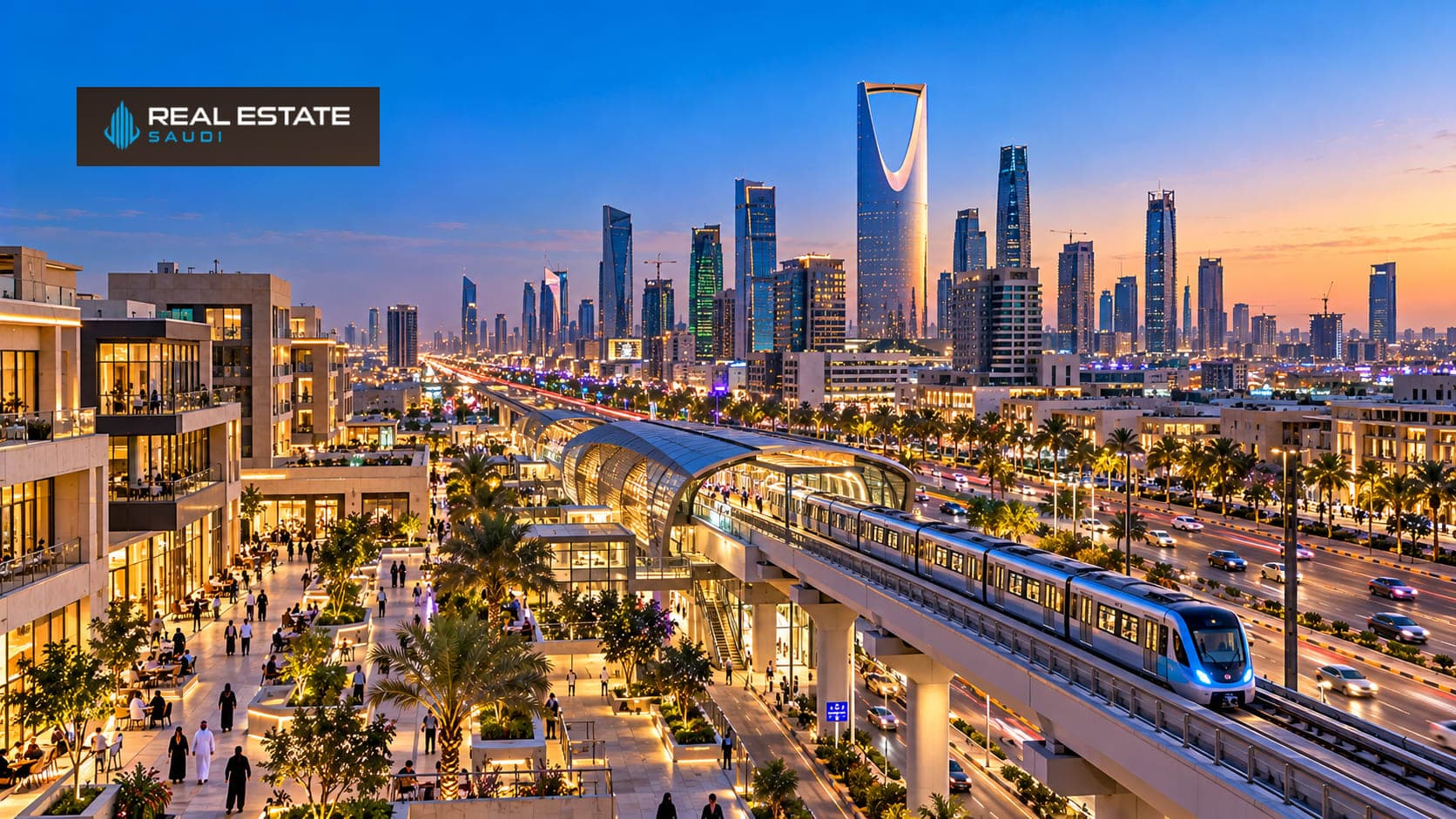
The Riyadh Real Estate Market in 2026 presents opportunities for homebuyers, landlords and commercial investors, but property performance differs considerably between apartments, villas, land and office buildings. Riyadh remains a major centre of employment, business activity and urban development, while affordability, new housing supply and regulatory changes are increasingly important to purchasing decisions.
Recent market evidence challenges the assumption that all Riyadh properties are becoming more expensive. Knight Frank's Q2 2026 research recorded higher average apartment values but lower villa values compared with the same period in 2025. Meanwhile, Saudi Arabia's rental regulations and updated foreign ownership law have introduced important considerations for both local and international buyers.
Choosing the right property requires understanding its neighbourhood, verified selling price, financing costs, legal eligibility and realistic rental income.
This guide examines current Riyadh property trends, housing prices, investment districts, major developments, mortgage considerations, rental rules and the practical steps buyers should follow before committing funds.
Riyadh Real Estate Market: Key Trends in 2026
Riyadh's residential sector is becoming increasingly differentiated. Apartments, villas and residential land no longer follow identical pricing patterns, while established neighbourhoods and developing suburbs attract different buyer groups.
Knight Frank's September 2026 analysis of Q2 market activity reported the following residential figures for Riyadh.
Market Indicator | Q2 2026 Finding |
|---|---|
Residential transactions | 10,667 |
Residential transaction value | SAR 14.3 billion |
Annual change in transaction volume | Down 2% |
Annual change in transaction value | Down 14% |
Average apartment price | SAR 6,369 per square metre |
Annual apartment price movement | Up 3.1% |
Annual villa price movement | Down 2.2% |
These figures describe a particular research methodology and reporting period. They are not official asking prices for every district or forecasts for the remainder of 2026.
Investors should combine market research with the official Riyadh real estate sales and rental indicators, which provide periodically updated transaction information.
Why Riyadh Remains an Important Property Market
Riyadh is Saudi Arabia's administrative capital and an important employment, financial and commercial centre.
Government institutions, private companies, universities and professional services contribute to demand for residential and business premises.
Several large urban development programmes are also reshaping transportation, recreation and the availability of new housing.
However, continued development does not mean that every property will increase in value. The relationship between housing demand and supply determines how individual neighbourhoods perform.
Employment and corporate activity
Employment opportunities influence demand for apartments and family housing. Some employees prioritise proximity to offices, while families may choose neighbourhoods based on schools and available services.
Housing expansion
New communities offer additional residential options, potentially improving affordability while increasing competition for existing sellers.
Urban infrastructure
Transportation improvements and public amenities can make certain locations more accessible.
The broader Saudi real estate investment guide provides useful context for evaluating these influences within a property investment strategy.
ما نوع العقار والمنطقة المناسبة؟
اختر نوع العقار والمدينة المستهدفة لاستعراض أنسب الخيارات.
Riyadh Property Prices in 2026
Riyadh property prices vary according to neighbourhood, building type, condition, land area and access to essential services.
There is no single city-wide price that accurately represents every apartment or villa.
The Knight Frank Q2 2026 figure of SAR 6,369 per square metre represents an average from its apartment market analysis. It should not be used as a direct valuation for a specific property without comparing similar completed transactions.
Apartment prices
Apartments appeal to different groups, including smaller households, families and professional residents.
Price differences can reflect building age, finishing quality, parking, shared facilities and location.
An apartment close to a major employment centre may have a higher acquisition price than a comparable unit in a developing suburb.
Villa prices
Villas usually involve larger properties, additional maintenance and different buyer preferences.
A decline in average villa values does not mean that every villa has become cheaper. Individual premium homes may perform differently from the overall market.
Residential land
Land values depend on zoning, infrastructure, street access and development potential.
Investors should compare recent sales of similar plots rather than relying on advertised price-per-square-metre averages.
Are Riyadh Property Prices Rising or Falling?
The most accurate answer is that price performance differs by property type.
Recent research shows apartment values increasing modestly while villa values have weakened.
This contrasts with older market commentary describing uninterrupted price growth.
Why apartments can perform differently
Apartments may offer a more accessible purchase price than large family villas, depending on the neighbourhood.
Their demand can also reflect changing household preferences and financing affordability.
Why villa prices can soften
Higher acquisition costs, maintenance expenses and additional supply may influence demand for larger homes.
However, these factors do not affect every district equally.
How investors should interpret market movements
Annual price changes describe historical performance. They do not guarantee that the same direction will continue.
A buyer should examine comparable completed transactions, the condition of the property and the seller's asking price.
Local evidence is more useful than general statements that the entire city is either rising or declining.
Best Residential Areas in Riyadh for Buyers
Neighbourhood selection depends on budget, household requirements, workplace location and property type.
Several northern and established central districts attract attention, but they serve different customer groups.
Al Malqa
Al Malqa includes premium apartments and villas. Buyers may value established services and access to northern Riyadh business locations.
Higher purchase prices require careful affordability analysis.
Al Yasmin
Al Yasmin offers residential accommodation suitable for different household sizes.
Potential buyers should compare individual streets, construction quality and commuting requirements.
Al Narjis
Al Narjis includes newer residential developments and expanding communities.
Infrastructure completion and available services can differ across locations.
Hittin
Hittin attracts buyers interested in premium residential accommodation and nearby lifestyle destinations.
Investors should distinguish lifestyle appeal from achievable rental yield.
Al Nakheel
Al Nakheel is an established neighbourhood with residential amenities and connections to major institutions.
Property condition deserves attention because available homes may differ considerably in age.
The guide to Riyadh's best residential neighbourhoods offers a more detailed comparison for buyers.
Emerging Residential Districts in Riyadh
Developing districts may interest buyers seeking newer properties, different price points or future community facilities.
However, an emerging location should not automatically be described as an inexpensive or high-return investment.
Al Aarid
Al Aarid contains newer residential developments and areas undergoing continued expansion.
Buyers should investigate road connections, nearby amenities and actual construction activity.
Al Janadriyah
Al Janadriyah includes residential projects in Riyadh's eastern development corridor.
The appeal of an individual property depends on accessibility, completed infrastructure and household demand.
Ar Rimal
Ar Rimal is another area attracting residential development activity.
Investors should compare individual projects rather than assume similar performance throughout the district.
Al Fursan
Large planned communities can increase residential choices.
However, future delivery schedules and the availability of supporting facilities matter when assessing suitability.
Developing areas should be evaluated through completed transactions, site visits and confirmed infrastructure rather than promotional growth forecasts.
Apartments Versus Villas: Which Offers Better Value?
Apartments and villas involve different ownership costs and customer markets.
The most suitable option depends on the intended use and available budget.
Consideration | Apartments | Villas |
|---|---|---|
Typical buyer priorities | Convenience and affordability | Space and family accommodation |
Maintenance | Individual unit and shared facilities | Larger building and exterior systems |
Rental market | Varies by size and location | Often family-oriented |
Purchase costs | Depends on unit and building | Often greater total capital requirement |
Resale | Demand varies by district | Buyer pool depends on price and property size |
An investor should not assume apartments always offer higher yields.
Likewise, villas do not automatically provide stronger capital appreciation.
The correct comparison considers actual acquisition prices, service charges, maintenance, rental income and future resale demand.
For buyers researching available properties, the Riyadh property directory and area overview provides a starting point for understanding local housing choices.
Riyadh Rental Market and the Five-Year Rent Restrictions
Riyadh's rental market experienced a significant regulatory change on September 25, 2025.
Saudi authorities introduced measures suspending annual increases in total rental value for residential and commercial properties within Riyadh's urban boundaries for five years.
The Real Estate General Authority's official announcement of the Riyadh rental restrictions explains the framework.
Existing rental agreements
Landlords cannot assume that they may increase annual rent during the restricted period.
Previously rented vacant properties
The applicable rental amount is generally linked to the last registered Ejar contract, subject to relevant exceptions and procedures.
Never-before-leased units
The initial rent may be agreed between the landlord and tenant.
Investment implications
Landlords should not build financial projections around unrestricted annual rental increases.
Existing lease history can materially influence the income potential of a property.
These measures make legal rental verification an essential part of investment analysis.
How to Calculate Rental Yield in Riyadh
Rental yield measures income from a property relative to its acquisition value.
Gross rental yield compares scheduled annual rent with the purchase price.
Net operating yield adjusts for relevant expenses such as maintenance, management and vacancy.
Illustrative example
Suppose an apartment is purchased for SAR 1,200,000 and generates SAR 72,000 in scheduled annual rent.
Its gross rental yield is 6%.
If annual vacancy and operating expenses total SAR 18,000, net operating income becomes SAR 54,000.
Measured against the purchase price, the net operating yield would be 4.5% before acquisition costs and financing.
These numbers are hypothetical and should not be mistaken for a verified Riyadh market average.
Why the distinction matters
A property with attractive gross rent can produce disappointing returns after expenses.
Investors should also consider whether applicable rental restrictions affect future cash flow.
A realistic projection includes periods without tenants and allowances for repairs.
Commercial Real Estate Opportunities in Riyadh
Riyadh's commercial market includes office premises, retail units, mixed-use buildings and other business properties.
Demand is influenced by employer requirements, corporate activity, accessibility and the supply of suitable buildings.
Office space
Businesses often require offices close to employees, customers and transport routes.
Some organisations prioritise modern premises with appropriate parking and building services.
Investors can compare commercial office opportunities in Saudi Arabia when researching suitable asset categories.
Retail premises
Retail performance depends on customer activity, neighbourhood population and the quality of surrounding commercial facilities.
A prominent address does not guarantee profitable tenants.
Mixed-use developments
Mixed-use projects combine residential and commercial functions, potentially supporting different customer groups.
However, operating expenses and property regulations can be more complex.
Commercial investments should be evaluated through lease terms, tenant financial strength and net operating income.
Riyadh Metro and Infrastructure Development
Public transport can influence property preferences by changing access to workplaces and neighbourhood services.
Riyadh Metro is an important component of the city's transport infrastructure.
Its development creates opportunities for buyers to evaluate residential areas based on actual station access rather than road distance alone.
Transit accessibility
A home near a functioning metro station may offer practical advantages to residents who regularly use public transportation.
However, the value of this convenience varies by household.
Road connectivity
Major roads remain important for families, deliveries and commercial properties.
Schools and healthcare
Access to schools and medical facilities can influence long-term residential demand.
Neighbourhood development
New infrastructure may increase a district's appeal, but it can also attract new competing housing supply.
Investors should compare travel times, available services and property prices before assigning a premium to infrastructure.
A planned connection should not be treated as operational until completed.
حدد ميزانيتك الاستثمارية
حدد ميزانيتك التقديرية لنقوم بتضييق خيارات العروض.
Vision 2030 and Riyadh's Major Developments
Riyadh's property market is influenced by major urban projects intended to improve housing, recreation, business activity and public spaces.
The official Vision 2030 overview identifies suitable homeownership and urban livability among its strategic objectives.
Important developments associated with the capital include King Salman Park, Sports Boulevard, Diriyah, New Murabba and the wider Qiddiya destination.
King Salman Park
The project aims to expand recreational and cultural facilities within Riyadh.
Its effect on surrounding property values depends on actual delivery and local demand.
Sports Boulevard
The development focuses on recreation and improved urban experiences.
Properties near delivered sections may have different appeal from those near planned future segments.
Diriyah
Diriyah combines cultural, hospitality and residential development.
Buyers should distinguish officially available property opportunities from the wider master plan.
New Murabba
The project is intended to create a new urban district.
Its long-term property-market influence cannot be quantified solely from design announcements.
The Riyadh real estate development and major projects guide examines these developments in greater detail.
Saudi Housing Supply and Homeownership Policy
Housing supply is central to understanding future price movements.
The Kingdom's housing programmes seek to expand access to suitable residential accommodation.
According to the 2025 Vision 2030 Annual Report, the Saudi family homeownership rate reached 66.24%, compared with a 2030 target of 70%.
The programme includes different housing pathways, such as ready units, off-plan properties and other eligible products.
Why supply matters
New housing can provide households with greater choice.
At the same time, an increase in available units may create additional competition between developers and existing owners.
Why affordability matters
Developers need to offer homes that prospective purchasers can finance.
Prices rising faster than household purchasing capacity may weaken transaction activity.
What investors should monitor
Relevant indicators include building completions, sales volumes, asking prices, mortgage activity and the number of similar homes available in the neighbourhood.
National housing targets provide context but do not guarantee returns from any individual property.
Mortgage Financing in Riyadh in 2026
Financing availability can influence both homebuyer demand and property prices.
Saudi banks assess mortgage applicants according to income, existing obligations, credit information and eligibility requirements.
The Saudi Central Bank's monthly banking and financial statistics provide official information relevant to mortgage activity and broader financing conditions.
Loan eligibility
Requirements vary according to the buyer, lender and property.
A Saudi citizen purchasing a first home may qualify under conditions different from those applying to a foreign investor or a second-property purchaser.
Down payments
Borrowers should confirm the required contribution directly with the lender.
Generic assumptions about one universal deposit percentage are unreliable.
Financing costs
Buyers should compare total repayment obligations, contractual pricing and early settlement provisions.
Affordability
A property should remain manageable if income or household expenses change.
The Saudi mortgage financing guide for buyers and investors provides additional background on the financing process.
Foreign Property Ownership in Riyadh in 2026
The Riyadh Real Estate Market is also affected by the updated foreign ownership framework that became effective on January 22, 2026.
The revised system establishes application routes for eligible foreign residents, non-residents and certain companies.
The Real Estate General Authority's official foreign property ownership guidance explains the governing rules and geographical controls.
Foreign residents
Eligible residents may submit applications using their Iqama identification, subject to the applicable requirements.
Non-resident individuals
Qualifying overseas purchasers have a separate application process.
Corporate buyers
Companies may need additional registration and compliance procedures.
Property-specific eligibility
An apartment being offered in Riyadh does not automatically mean that every foreign investor can purchase it.
The exact property, buyer category and available ownership rights must be verified.
The foreign property buying guide for Saudi Arabia discusses these requirements in greater detail.
Taxes and Transaction Costs for Riyadh Property
Property buyers should calculate the full acquisition cost rather than focus exclusively on the selling price.
Saudi Arabia generally applies a 5% Real Estate Transaction Tax to qualifying property disposals, subject to statutory exemptions.
The official ZATCA Real Estate Transaction Tax Law sets out the applicable framework.
Additional expenses
Depending on the transaction, buyers may incur brokerage, legal, valuation, financing and inspection costs.
Foreign ownership
Certain foreign ownership arrangements may involve additional requirements or charges.
Operating expenses
Apartment service charges, maintenance and property management affect long-term affordability.
Resale expenses
Future disposal costs should also be considered when calculating investment returns.
The Saudi real estate taxes and fees guide explains the broader tax context.
Investors should request a transaction-specific breakdown before signing a purchase agreement.
Step-by-Step Guide to Buying Riyadh Property
A structured purchasing process can reduce avoidable financial and legal mistakes.
Step 1: Define the purpose
Determine whether the property is intended as a family home, rental investment or commercial asset.
Step 2: Establish the budget
Consider the purchase price, financing, transaction charges and future operating expenses.
Step 3: Compare neighbourhoods
Review employment access, schools, amenities and local property supply.
Step 4: Examine market evidence
Use comparable completed transactions rather than relying only on advertised prices.
Step 5: Confirm legal eligibility
Verify the seller's rights and any restrictions affecting the purchaser.
Step 6: Inspect the property
Assess building condition, maintenance history and available facilities.
Step 7: Review contracts
Check payment terms, ownership arrangements and transfer requirements.
Step 8: Complete registration
Follow the prescribed legal procedures and retain the final ownership documentation.
Independent professional advice may be appropriate where financing, foreign ownership or complex contracts are involved.
Risks of Investing in Riyadh Property
Property investment in Riyadh involves several risks.
Acquisition-price risk
Buying above the value supported by comparable transactions may reduce future returns.
Financing risk
Borrowing creates ongoing obligations regardless of rental performance.
Rental restrictions
Riyadh's rent regulations affect assumptions about future income growth.
Construction risk
Off-plan projects can involve delays, defects and changing development conditions.
Liquidity risk
Expensive or highly specialised properties may take longer to sell.
Maintenance risk
Older buildings can require substantial repairs.
Regulatory risk
Ownership and operating requirements must be checked for the particular transaction.
Investors should test their financial assumptions against lower rent, longer vacancies and unexpected expenses.
A growing city does not eliminate investment risk.
Is 2026 a Good Time to Buy Property in Riyadh?
There is no single answer that applies to every buyer.
For an owner-occupier, purchasing may make sense when a suitable home is available at an affordable price and the intended holding period is sufficiently long.
For an investor, the decision depends on net rental income, transaction costs, financing and likely resale demand.
The mixed apartment and villa price movements seen in Q2 2026 demonstrate why market timing cannot be reduced to a simple recommendation to buy immediately.
Buyers should compare several suitable properties, obtain financing confirmation and examine official transaction evidence.
Waiting may be reasonable when prices exceed the available budget or when important documentation remains incomplete.
A carefully evaluated property can be preferable to a hurried purchase driven by fear of missing out.
كيف تفضل التواصل معك؟
اختر وسيلة التواصل الأكثر ملاءمة لك لمناقشة فرصك الاستثمارية.
Riyadh Property Market Outlook Beyond 2026
The Riyadh Real Estate Market will continue to reflect housing supply, affordability, financing conditions and the delivery of major urban projects.
Employment and corporate activity can support demand for accommodation, while additional residential construction may increase competition.
The rental market will also operate under restrictions introduced in September 2025, influencing how landlords assess future income.
Foreign ownership reforms may broaden participation among qualifying international buyers, but the impact will depend on the relevant geographical rules and actual property demand.
Future price movements cannot be reliably predicted for every neighbourhood.
Investors should monitor official sales and rental indicators, transaction volumes, financing conditions and completed infrastructure.
A sustainable investment strategy should remain financially viable without assuming uninterrupted price appreciation.
Conclusion
The Riyadh Real Estate Market offers a broad range of residential and commercial opportunities, but recent evidence shows that different property types are performing differently.
Apartments, villas, land and commercial premises should be analysed individually rather than treated as one uniform market.
The city's infrastructure programmes, employment base and housing development initiatives provide important context, while financing affordability, rental restrictions and ownership regulations shape actual investment decisions.
Buyers should evaluate neighbourhood characteristics, completed transaction prices, building condition and long-term financial obligations.
For investors, realistic net returns and regulatory compliance matter more than speculative appreciation forecasts.
تحدث معنا عبر قناتك المفضلة
استشارات عقارية مباشرة حول الاستثمار والسوق العقاري في المملكة العربية السعودية.
الأسئلة الشائعة
Riyadh's market shows mixed performance across property types. Knight Frank reported that average apartment values increased 3.1% year-on-year in Q2 2026, while villa values declined 2.2%. Transaction volumes also softened slightly compared with the previous year. Individual neighbourhoods and properties may perform differently from these market averages.
Not all property categories are rising. Recent research shows modest apartment price growth alongside a decline in villa values. Land and commercial property require separate evaluation. Buyers should investigate completed transactions, property condition and local supply instead of assuming that prices across the entire city are moving in one direction.
Knight Frank's Q2 2026 research reported an average apartment value of SAR 6,369 per square metre. This represents its surveyed market and should not be treated as the exact price for every neighbourhood. Apartments in premium areas, older buildings and developing communities can have substantially different prices.
Areas worth researching include Al Malqa, Al Yasmin, Al Narjis, Hittin, Al Nakheel and emerging districts such as Al Aarid. Their prices, tenant markets and infrastructure differ. The best investment depends on acquisition cost, legal eligibility, achievable rental income, maintenance and potential resale demand.
Riyadh's rental regulations suspend annual increases in total rental values for residential and commercial properties within the city's urban boundaries for five years from September 25, 2025. Additional provisions affect previously rented vacant premises, new leases and contract registration. Landlords should review applicable REGA and Ejar requirements before changing rental terms.
Eligible foreign residents, overseas individuals and companies may acquire qualifying property rights under the updated Saudi ownership framework effective January 22, 2026. Permissions depend on the buyer's category, the property's location and other legal conditions. Buyers must verify eligibility for the exact property before signing contracts.
Neither category is universally superior. Apartments may require less capital and serve different tenant groups, while villas may appeal to families seeking larger homes. Recent apartment and villa price trends also differ. Investors should compare net rental returns, maintenance costs, financing and resale liquidity before selecting a property type.
Saudi Arabia generally imposes a 5% Real Estate Transaction Tax on qualifying real estate disposals, subject to statutory exemptions. Additional expenses may include professional services, financing and charges applicable to some foreign ownership arrangements. Buyers should confirm the precise tax treatment and contractual cost allocation before completing a purchase.
Riyadh offers different rental markets associated with employment, residential communities and business activity. However, an attractive rental investment requires a suitable purchase price, reliable tenant demand and manageable expenses. The city's rental restrictions must also be reflected in income projections. No fixed or guaranteed rental yield applies to all properties.
The decision depends on financial readiness, purchase objectives and the availability of a suitable property. Buyers should compare transaction prices, financing offers, local supply and legal documentation. Waiting can be sensible when costs are excessive or important approvals remain uncertain. Purchasing should reflect long-term affordability rather than market speculation.
