
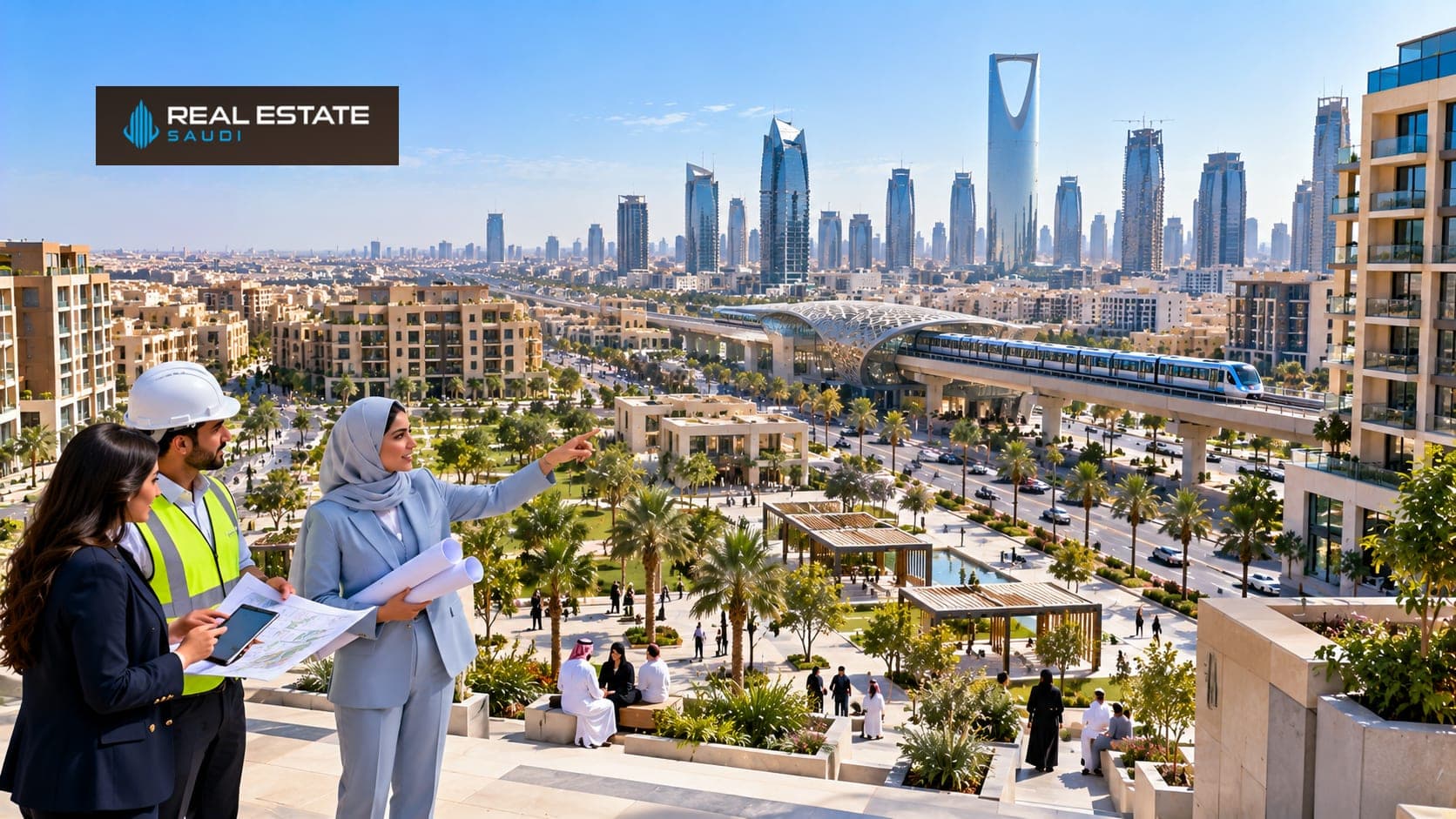
Property Prices in Riyadh are influenced by six interconnected factors: housing supply and demand, neighbourhood location, mortgage affordability, infrastructure development, construction costs, and government regulations. Understanding these influences helps buyers determine whether an apartment, villa or residential plot is fairly priced rather than relying on broad market predictions.
Riyadh's housing market showed mixed performance during the second quarter of 2026. Apartment values increased compared with the previous year, while villa values declined. This difference demonstrates why property type and local market conditions matter more than assumptions that prices rise uniformly across Saudi Arabia's capital.
Buyers also face changing financing conditions, new housing developments, rental restrictions and updated rules affecting foreign ownership.
This guide explains the six major pricing factors, compares important neighbourhoods, examines available 2026 statistics and provides practical steps for evaluating residential property before purchasing.
Property Prices in Riyadh: Current Market Overview
Riyadh's residential market includes apartments, villas, townhouses, residential land and master-planned communities. Prices differ according to construction quality, accessibility, building age and buyer demand.
According to Knight Frank's Q2 2026 Saudi residential market analysis, Riyadh recorded 10,667 residential transactions worth SAR 14.3 billion during the second quarter of 2026.
Apartment prices increased 3.1% year-on-year to an average of SAR 6,369 per square metre, while villa values declined 2.2%.
Market Indicator | Q2 2026 Finding |
|---|---|
Residential transactions | 10,667 |
Total transaction value | SAR 14.3 billion |
Annual change in transaction volume | Down 2% |
Annual change in transaction value | Down 14% |
Average apartment value | SAR 6,369/m² |
Annual apartment price change | Up 3.1% |
Annual villa price change | Down 2.2% |
These are research-based market indicators, not asking prices for every neighbourhood. Individual properties may be significantly more or less expensive.
ما نوع العقار والمنطقة المناسبة؟
اختر نوع العقار والمدينة المستهدفة لاستعراض أنسب الخيارات.
Factor 1: Housing Supply and Buyer Demand
Housing supply and demand influence the amount buyers are willing to pay for homes.
When many households compete for a limited number of suitable properties, sellers may have greater pricing flexibility. When more comparable homes become available, buyers can evaluate alternatives and negotiate.
Population and employment
Riyadh's employment market attracts workers and families with different housing needs.
Business expansion may create demand for rental apartments, while families seeking permanent homes may prefer larger residential units.
However, employment growth does not automatically increase property values in every district.
New housing supply
Master-planned communities and residential developments can introduce additional apartments and villas.
New housing provides choices that may reduce pressure on particular market segments.
Knight Frank forecasts Riyadh's housing stock could grow from approximately 2.81 million units in 2026 to 3.30 million by 2030. This remains a forecast, and actual delivery will depend on construction progress.
Why local supply matters
An established neighbourhood with limited comparable inventory can behave differently from an area where several new buildings are completing simultaneously.
Investors should examine available units, recent transactions and expected handovers before making price assumptions.
Understanding Apartment and Villa Demand
Apartments and villas serve different purchaser groups, explaining why their price movements may diverge.
Smaller households may favour apartments because of purchase affordability, convenient locations or reduced responsibility for external maintenance.
Villas may appeal to families seeking privacy, additional bedrooms and outdoor space.
However, larger properties often require more capital, and buyers may become more selective when borrowing costs or household expenses increase.
Apartment considerations
Floor area, parking, building services and nearby employment locations can influence demand.
Villa considerations
Plot dimensions, construction condition, floor layout and maintenance requirements affect attractiveness.
Investment differences
Rental demand may vary by neighbourhood and property size.
A strong market for compact apartments does not establish equivalent demand for expensive villas.
The Saudi apartment buying directory helps readers compare different residential property formats.
Buyers should evaluate each property category separately rather than apply the same growth expectations to all homes.
Factor 2: Neighbourhood Location and Amenities
Location is one of the strongest influences on residential property value.
Two apartments with similar floor areas can command different prices because one provides better access to employment centres, schools or everyday services.
Neighbourhood reputation may also influence buyer preferences, although prestige alone does not guarantee investment performance.
Employment accessibility
Properties near major commercial districts can appeal to households seeking shorter commutes.
However, central locations may also involve higher acquisition costs.
Schools and healthcare
Families often value convenient access to reliable educational and medical facilities.
Retail and recreation
Parks, supermarkets, restaurants and community facilities can make everyday life easier.
Building surroundings
Noise, traffic, nearby construction and street conditions also affect desirability.
The strongest location is not necessarily the most expensive. It is one that offers an appropriate balance between cost, convenience and the buyer's requirements.
Premium Neighbourhoods: Hittin and Al Malqa
Hittin and Al Malqa are among Riyadh's recognised premium residential neighbourhoods.
They attract interest from families and professionals seeking modern homes and access to northern Riyadh destinations.
Hittin
Hittin includes private villas, newer housing and selected high-end apartments.
Properties may command premiums for construction quality, privacy and convenient access to surrounding attractions.
However, highly customised villas may attract a narrower resale market.
Al Malqa
Al Malqa offers a mixture of established and modern accommodation.
Buyers should compare road access, building specifications, parking and nearby services.
The Al Malqa neighbourhood property guide provides additional context for the area's residential options.
Valuation considerations
A premium address should be evaluated alongside comparable sales.
An expensive property requiring major renovation may offer weaker value than a well-maintained alternative in a neighbouring district.
Developing Neighbourhoods: Al Narjis and Ar Rimal
Developing residential areas can offer different price points and housing choices.
Al Narjis and Ar Rimal are useful examples of why neighbourhood-level research matters.
Al Narjis
The district includes newer residential developments and different categories of family accommodation.
Road access, property finishing and the availability of completed services vary between locations.
Buyers can use the Al Narjis residential area guide to explore local characteristics.
Ar Rimal
Ar Rimal forms part of Riyadh's eastern development landscape.
Its residential opportunities may appeal to buyers prioritising newer homes and different budget ranges.
What to verify
New roads or community facilities shown in development plans should not be treated as operational.
Buyers should visit the exact property and assess commuting times, utilities and nearby construction.
Emerging neighbourhoods can offer opportunities, but future price appreciation remains uncertain.
Factor 3: Mortgage Rates and Housing Affordability
Mortgage affordability directly influences how much many households can spend on property.
When financing becomes more expensive, buyers may need to reduce their budgets, provide larger initial contributions or postpone purchases.
When financing conditions improve, eligible households may find a wider range of properties affordable.
The role of banks
Lenders assess income, existing commitments, creditworthiness and property eligibility.
Not every borrower receives identical financing terms.
Total repayment costs
A loan should be compared using its complete contractual cost rather than the initial advertised rate alone.
Monetary conditions
The Saudi Central Bank's monthly financial statistics publish information about banking activity, financing companies and interest-rate conditions.
These statistics help investors understand the financing environment without assuming that every market rate applies to an individual mortgage.
Household resilience
A purchase should remain manageable if living costs increase or income changes.
The right financing structure depends on the buyer's circumstances, not simply the size of the property.
How Mortgage Affordability Changes Demand
Financing affects residential market activity because many buyers plan purchases around monthly repayment capacity.
If two households earn similar incomes but face different borrowing terms, their affordable purchase budgets may differ considerably.
This influences the buyer pool for particular apartments or villas.
Entry-level housing
Price-sensitive buyers may seek smaller apartments or locations where total repayments remain manageable.
Family villas
Larger homes usually require higher capital commitments, making financing conditions particularly relevant.
Developer payment plans
Some off-plan projects offer staged payments, but buyers must evaluate contractual obligations and construction risk.
The Saudi real estate financing guide explains additional financing considerations.
Buyers should obtain lender confirmation before making substantial deposits.
A property that appears affordable based only on its listing price may become unsuitable once financing and transaction costs are included.
Factor 4: Infrastructure and Major Developments
Infrastructure changes how accessible and functional different locations are.
Roads, public transportation, healthcare services and public amenities can influence residential demand.
However, the effect depends on whether infrastructure is operational and how residents actually use it.
Riyadh Metro
Metro connectivity may improve commuting convenience for some households.
Properties within practical walking distance of operational stations may appeal to people who frequently use public transportation.
However, not all buyers value metro access equally.
The guide to Riyadh Metro and property values discusses the relationship between transport and residential locations.
Roads and accessibility
New connections can improve travel options but may also change local traffic patterns.
Community infrastructure
Schools, hospitals, parks and retail facilities can increase a neighbourhood's practical appeal.
An announced project should not be treated as completed infrastructure.
Vision 2030 and Riyadh's Housing Development
Vision 2030 provides the strategic context for housing development, urban improvements and economic diversification.
Its influence on property prices is indirect rather than automatic.
The official Vision 2030 Annual Report 2025 recorded a Saudi family homeownership rate of 66.24%, compared with the 2030 goal of 70%.
Housing initiatives may increase the availability of homes and support access to ownership.
Large urban developments can also influence employment and infrastructure requirements.
Major Riyadh projects
King Salman Park, Sports Boulevard, Diriyah and New Murabba represent different urban development priorities.
Each has its own delivery schedule and local economic effects.
Investment implications
A project can improve the appeal of nearby locations, but additional housing supply may also increase competition.
Investors should distinguish actual construction progress from speculative claims about future price increases.
National housing objectives do not guarantee appreciation for any individual property.
Factor 5: Construction Costs and Property Quality
Construction expenses affect how developers assess the financial feasibility of new housing projects.
Land acquisition, materials, labour, engineering and financing all contribute to development costs.
A substantial increase in one component can alter project pricing or delivery schedules.
Materials and labour
Steel, cement, finishing materials and specialised labour influence construction budgets.
Knight Frank's September 2026 analysis reported considerable pressure on construction material costs during the year.
These pressures can affect developers' decisions, although not every additional expense can necessarily be passed to purchasers.
Building specifications
Premium insulation, glazing, elevators and mechanical systems add cost.
Construction delays
Late delivery can increase financing and operational expenses.
Buyer implications
Higher construction costs do not prove that a particular asking price is fair.
Purchasers should compare delivered quality and similar completed homes.
A new building can be overpriced, while an older property may offer value if its condition and renovation costs are understood.
حدد ميزانيتك الاستثمارية
حدد ميزانيتك التقديرية لنقوم بتضييق خيارات العروض.
Why Property Condition Changes Market Value
Building condition matters even when two homes occupy comparable locations.
A recently renovated villa may initially look attractive, but the quality of the underlying work should be verified.
Structural systems
Visible cracks, water intrusion and construction defects may affect repair expenses.
Cooling and electrical installations
Poorly maintained equipment can produce substantial costs after purchase.
Apartment common areas
Elevators, security systems and shared facilities influence resident satisfaction.
Maintenance history
Records can reveal recurring problems.
Renovation costs
The effective acquisition price includes necessary repairs, not just the amount paid to the seller.
An independent inspection can help identify material defects.
Investors should not assume a home is worth more simply because it has smart technology or luxury finishes.
Functional design, sound construction and manageable expenses often matter more over the ownership period.
Factor 6: Government Regulations and Property Taxes
Government policy affects property market activity through ownership rights, transaction rules, leasing requirements and housing initiatives.
Some regulations influence the number of eligible buyers, while others change operating costs or investment assumptions.
Foreign ownership
Saudi Arabia's revised non-Saudi property ownership system entered into force on January 22, 2026.
According to the Saudi Press Agency's official ownership reform announcement, qualifying residents, non-residents and companies may follow the relevant application procedures.
Eligibility depends on applicant category and geographical regulations.
Transaction tax
Saudi Arabia generally imposes a 5% Real Estate Transaction Tax on qualifying disposals, subject to statutory exemptions.
The ZATCA Real Estate Transaction Tax Law provides the current legal framework.
Property-specific compliance
Buyers must establish ownership rights and relevant obligations before signing.
Regulatory change can influence demand, but it cannot guarantee higher property values.
Riyadh Rental Restrictions and Property Valuation
Rental policy is particularly relevant to investors who value properties according to expected lease income.
On September 25, 2025, Saudi Arabia introduced measures suspending annual rental increases for residential and commercial properties within Riyadh's urban boundaries for five years.
The framework also addresses previously rented vacant units and requirements associated with Ejar registration.
Why the rules matter
Investors cannot assume that rent will increase automatically every year.
An existing property's rental history may influence the amount legally payable under a new agreement.
Effect on valuations
A buyer expecting rapidly increasing rental income may need to revise the estimated return.
Practical checks
Review existing contracts, payment history and applicable leasing restrictions.
These measures affect income assumptions rather than establishing a fixed sale price for every property.
A credible valuation should reflect legally achievable rental income and recurring ownership expenses.
Comparing Prices Across Riyadh Neighbourhoods
Property Prices in Riyadh cannot be accurately compared without considering location and asset characteristics.
A villa in Hittin differs from an apartment in Al Narjis, while a residential plot in Ar Rimal requires another valuation approach.
Compare similar property types
Do not combine land, apartments and villas into a single price benchmark.
Match construction age
A newly completed home may have different maintenance requirements from an older property.
Adjust for usable space
Registered land area and interior floor area serve different valuation purposes.
Review accessibility
Consider actual commuting routes and available community services.
Verify recent transactions
The Real Estate General Authority's Riyadh indicators platform provides official transaction and rental information.
The strongest comparison uses nearby, recent and genuinely similar properties.
Advertised district-wide averages are useful starting points but cannot replace property-level evidence.
Asking Prices Versus Completed Transaction Prices
An asking price represents what a seller hopes to receive.
A completed transaction records what a buyer actually paid.
The two figures may differ because of negotiations, property defects, financing conditions or the seller's circumstances.
Why asking prices can mislead
Some listings remain available because the seller expects more than the market supports.
Other advertisements may omit service charges or renovation needs.
Why transaction evidence is useful
Completed sales demonstrate actual market activity.
However, unusually large or specialised transactions may distort simple averages.
Selecting comparisons
Buyers should consider the same district, similar size, property type and condition.
A recent transaction is usually more relevant than a sale completed several years earlier.
Professional valuation may be worthwhile when the property is expensive or unusual.
The objective is to establish a supportable price rather than predict the market's next movement.
How to Evaluate a Riyadh Apartment Price
Apartment valuation requires attention to both the individual unit and the wider building.
A lower price per square metre may not offer better value if the property has inadequate parking, poor maintenance or expensive shared services.
Unit characteristics
Compare floor area, bedroom count, layout, natural light and accessibility.
Building characteristics
Check elevators, common areas, security, parking and maintenance arrangements.
Legal and financial obligations
Review ownership records and any recurring charges.
Rental evidence
For an investment, confirm realistic rent and vacancy assumptions.
Resale appeal
Consider whether the apartment will attract future buyers with similar requirements.
A property should be evaluated according to the complete ownership experience, not simply its headline price.
Buyers can use available apartment listings as a starting point, while relying on official transaction evidence for valuation.
How to Evaluate a Riyadh Villa Price
Villa valuation places greater emphasis on land characteristics and building condition.
Two villas can have similar bedroom counts but very different values because of plot dimensions, architecture and maintenance.
Land and frontage
Street access, plot orientation and boundaries affect usability.
Built-up area
Confirm actual space rather than relying on marketing descriptions.
Structural condition
Waterproofing, roofing, plumbing and cooling systems should be examined carefully.
Lifestyle requirements
Privacy, parking and family facilities can influence buyer preferences.
Long-term costs
Larger properties may require substantial annual maintenance.
An attractive villa must remain affordable after purchase.
Buyers should avoid paying for costly personal design features that may have limited value to future purchasers.
Step-by-Step Guide to Checking Property Value
A practical price assessment should follow a consistent process.
Identify the exact property category and neighbourhood.
Confirm the legal area, floor space and property description.
Collect recent completed transactions involving similar homes.
Compare building age, condition and available amenities.
Examine competing properties currently offered for sale.
Estimate necessary repairs and recurring service expenses.
Obtain financing information and calculate total acquisition costs.
Verify legal title, seller authority and relevant restrictions.
Consider an independent valuation for complex transactions.
Negotiate using documented evidence rather than market rumours.
This approach cannot guarantee future appreciation, but it reduces the risk of relying on an unsupported asking price.
The most useful research combines official data, a physical inspection and realistic financial planning.
Common Mistakes Riyadh Property Buyers Make
One common mistake is treating a citywide apartment average as the correct price for every residential unit.
Another is comparing villas and apartments without accounting for land area and ownership expenses.
Some buyers purchase near announced infrastructure projects without verifying their delivery.
Others underestimate financing costs or fail to inspect the building.
Investors may also assume that rental income can rise indefinitely despite Riyadh's regulatory restrictions.
Foreign buyers face additional risks when eligibility is not established before signing contracts.
Finally, speculative predictions about rapid appreciation can encourage overpayment.
A disciplined buyer should prioritise legal certainty, comparable evidence and long-term affordability.
كيف تفضل التواصل معك؟
اختر وسيلة التواصل الأكثر ملاءمة لك لمناقشة فرصك الاستثمارية.
Property Prices in Riyadh: Market Outlook Beyond 2026
The direction of Riyadh's housing market will depend on the balance between demand, completed supply, financing affordability and economic activity.
Additional residential developments may broaden buyer choice.
Established neighbourhoods can remain attractive because of schools, employment access and infrastructure, while emerging areas may compete through newer designs and alternative price points.
The mixed apartment and villa performance seen during Q2 2026 illustrates the importance of property-type analysis.
Changes in ownership regulations could influence selected markets, but the size of that effect depends on actual buyer eligibility and demand.
Future prices cannot be predicted reliably for every district.
Buyers should monitor completed transactions, supply delivery, lending conditions and local rental activity instead of relying on guaranteed-growth forecasts.
Conclusion
Property Prices in Riyadh are primarily shaped by six factors: supply and demand, neighbourhood location, mortgage affordability, infrastructure, construction costs, and government regulations.
These influences interact differently across apartments, villas, residential land and individual districts.
The latest 2026 evidence shows that apartment and villa values can move in different directions, making citywide assumptions unreliable.
For homebuyers, the priority should be choosing a suitable property with manageable financing and ownership costs.
For investors, realistic income, resale liquidity and regulatory compliance are equally important.
A fair purchase price should be supported by completed transactions, verified documentation and an assessment of the property's condition.
تحدث معنا عبر قناتك المفضلة
استشارات عقارية مباشرة حول الاستثمار والسوق العقاري في المملكة العربية السعودية.
الأسئلة الشائعة
Six major factors influence Riyadh property prices: housing supply and demand, neighbourhood location, mortgage affordability, infrastructure development, construction costs and government regulations. Each affects different property types and districts differently. Buyers should combine these considerations with completed transaction data rather than rely on general market forecasts.
Knight Frank reported an average Riyadh apartment value of SAR 6,369 per square metre in Q2 2026, representing a 3.1% annual increase. This is a research-based citywide indicator, not the exact price for every apartment. Neighbourhood, floor area, construction age and building condition can significantly affect individual values.
Knight Frank's Q2 2026 research reported a 2.2% year-on-year decline in Riyadh villa values. However, that finding does not mean every villa in the city became cheaper. Prices vary according to location, land size, building quality and buyer demand. Comparable transactions remain essential for individual property valuation.
Premium areas such as Hittin, Al Malqa and other established northern neighbourhoods may include expensive residential properties. However, a neighbourhood's reputation does not establish a uniform price. Buyers should compare similar villas or apartments within the same district, accounting for age, size, services and location.
Metro accessibility can improve convenience and make some properties more attractive. However, the effect depends on walking distance, service reliability, buyer preferences and competing housing supply. There is no guaranteed percentage increase for every property near a station. Investors should verify completed transactions before assigning a transport-related premium.
Mortgage costs influence the amount households can afford to borrow. Higher financing costs can reduce purchasing capacity, while more favourable terms may support eligible buyers. Property prices also respond to employment, supply and location. Buyers should compare total financing obligations rather than assume a rate change causes an immediate price movement.
Eligible foreign residents, non-residents and companies may acquire qualifying property rights under the updated Saudi ownership system effective January 22, 2026. Permissions depend on purchaser category, geographical conditions and the particular property. Buyers should confirm legal eligibility through official channels before signing contracts.
Regulations introduced on September 25, 2025, suspend annual increases in residential and commercial rent within Riyadh's urban boundaries for five years. Additional provisions apply to previously rented vacant premises. Investors should review Ejar records and applicable restrictions rather than assume unrestricted annual rental income growth.
Saudi Arabia generally applies a 5% Real Estate Transaction Tax to qualifying property disposals, subject to statutory exemptions. Other expenses may include financing, inspection, professional services and relevant registration costs. The complete financial and legal position should be established before completing a transaction.
Buyers should compare recent completed sales of similar properties in the same neighbourhood. They should also evaluate registered area, construction condition, financing costs and future maintenance. A professional valuation can be useful for high-value or unusual homes. Advertised discounts do not independently establish that a property is fairly priced.
