
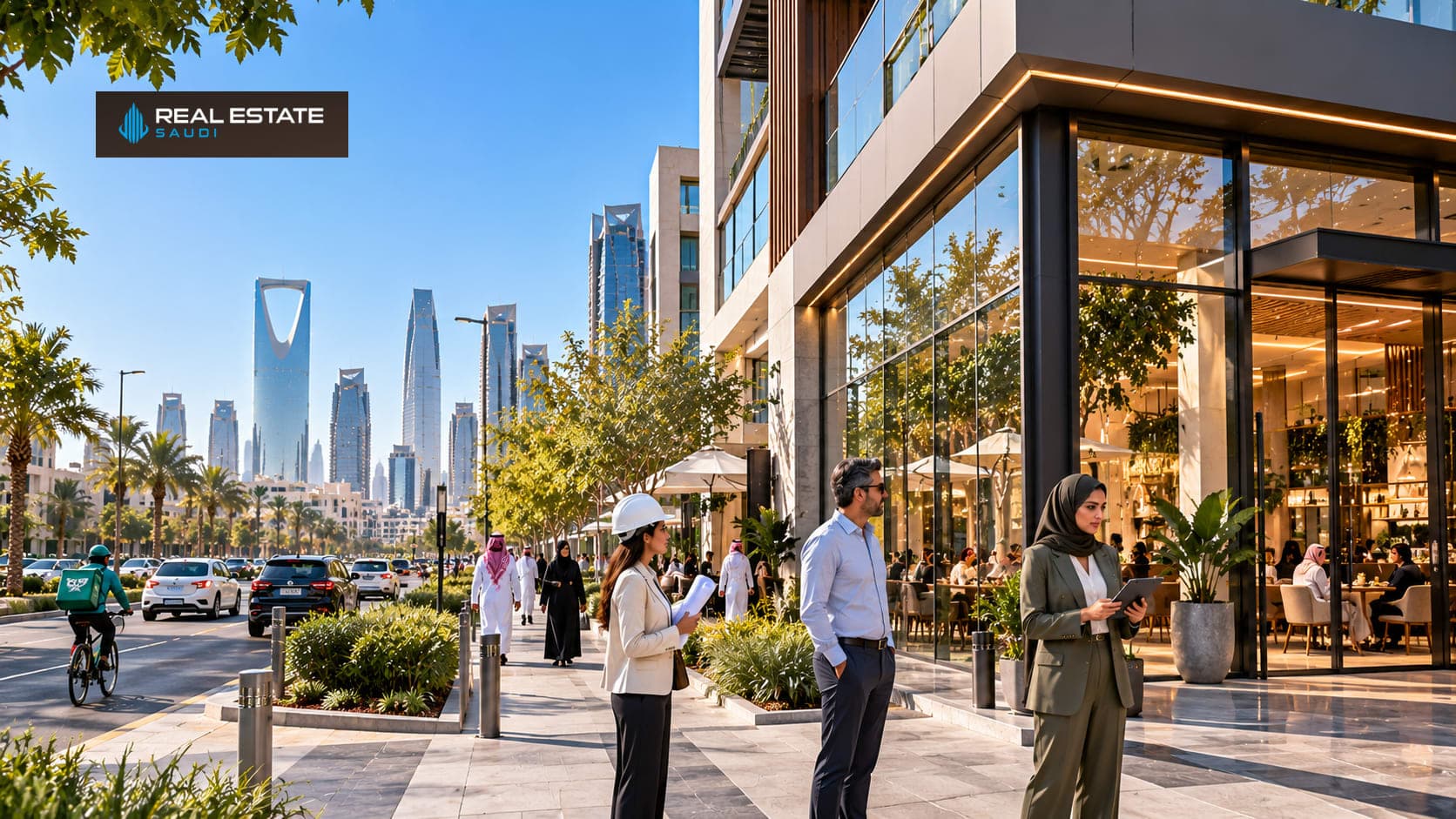
Choosing the right location for Commercial Property in Saudi Arabia starts with understanding who will use the building, how customers or employees will reach it, and whether the premises legally support the intended business activity. A retail shop needs visibility and suitable customer traffic, an office requires accessibility and professional facilities, while a warehouse depends on logistics connections and operational space.
Riyadh, Jeddah, Dammam, Al Khobar and Makkah offer different commercial opportunities. However, no single city or district is ideal for every business or investor. Tenant demand, local competition, infrastructure, acquisition costs and permitted land use all influence whether a property is financially suitable.
Saudi Arabia's 2026 commercial market also reflects changing office supply, new retail developments, updated foreign ownership regulations and continued investment under Vision 2030.
This guide explains how to compare locations, identify suitable property types, evaluate market evidence, understand regulatory requirements and avoid costly mistakes before purchasing or leasing commercial premises.
Commercial Property in Saudi Arabia: What Makes a Location Suitable?
The best commercial location is one where the property matches the intended activity, customers can reach it conveniently, operating costs are sustainable, and legal requirements can be satisfied.
A busy street is not necessarily a good location for every business. A café may benefit from nearby offices and residential buildings, while a distribution company may prefer an industrial area with direct highway access.
Property Type | Most Important Location Requirement | Main Financial Consideration |
|---|---|---|
Retail shop | Relevant customer traffic and visibility | Rent relative to achievable sales |
Office | Staff accessibility and building quality | Occupancy cost and tenant demand |
Warehouse | Freight access and loading facilities | Logistics efficiency |
Medical premises | Patient accessibility and permitted use | Fit-out and licensing costs |
Showroom | Visibility, parking and road access | Customer acquisition |
Restaurant | Suitable catchment area and operating approvals | Sales potential and fit-out |
Mixed-use property | Compatibility of different activities | Management and vacancy risk |
Investors should assess the intended use before selecting a city, neighbourhood or building.
Why Location Matters More Than a Prestigious Address
Commercial property performance depends on the economic activity the location can support.
A premium office address may help a professional services company attract corporate clients. However, that same address could be unnecessarily expensive for a business whose employees work mostly remotely.
A retail unit near a popular destination may attract visitors, but high footfall does not guarantee that those visitors match the retailer's target customers.
Location affects several important financial variables: sales potential, employee travel, delivery expenses, tenant demand, maintenance and future resale prospects.
For landlords, the objective is to select premises that a suitable business will want to occupy at a sustainable rent.
For owner-occupiers, the property should help the business operate efficiently.
A good commercial investment therefore begins with an understanding of the actual users of the space, not assumptions about which neighbourhood is most fashionable.
ما نوع العقار والمنطقة المناسبة؟
اختر نوع العقار والمدينة المستهدفة لاستعراض أنسب الخيارات.
Understand Your Business or Tenant Before Selecting a Site
Commercial investors should identify their target occupier before comparing properties.
Different business models place different demands on buildings and surrounding infrastructure.
Customer-facing businesses
Restaurants, cafés, pharmacies and shops usually benefit from convenient customer access. Parking, visibility and neighbouring businesses can influence customer decisions.
Professional offices
Consultancies, financial services and corporate teams may prioritise employee access, meeting facilities, telecommunications and proximity to clients.
Industrial and distribution operations
Warehouses require loading arrangements, reliable transport routes and appropriate infrastructure.
Specialist businesses
Healthcare, education and certain other activities can involve additional requirements for premises, safety and sector-specific licences.
Before making an offer, write down the intended activity, expected visitor numbers, staffing requirements and essential building specifications.
A location that cannot accommodate the business's operating needs is unsuitable regardless of its marketing appeal.
Riyadh: Best for Corporate Offices and Major Business Activity
Riyadh is an important location for corporate occupiers, government-related activities, professional services and commercial development.
The city offers different office and retail environments, ranging from established business districts to developing mixed-use areas.
Offices in established business districts
Areas such as Al Olaya and the King Abdullah Financial District attract attention from businesses seeking professional surroundings and access to corporate networks.
However, prime office buildings can involve substantial occupancy expenses.
Northern residential and commercial areas
Northern Riyadh contains a mixture of housing, retail services and emerging commercial premises.
Some businesses may prefer these locations when serving nearby households rather than customers across the entire city.
What 2026 market research indicates
The JLL Saudi office market report for Q2 2026 identified continued demand for premium institutional-grade offices in strategic locations. It also noted that increasing supply is creating greater competition for older buildings.
This makes building quality and occupier requirements important considerations.
The Riyadh commercial real estate guide provides additional local context for evaluating the capital's office and commercial sectors.
Choosing an Office Location in Riyadh
The best office location depends on the organisation's employees, clients and operating model.
A company with frequent customer meetings may benefit from a recognisable address and convenient visitor parking.
A back-office operation may prioritise affordability, transport access and flexibility.
Employee accessibility
Consider commuting routes, public transport options and parking availability.
A building with attractive interiors can become difficult to operate if employees regularly face excessive travel times.
Building specifications
Check telecommunications, elevators, air-conditioning, emergency systems and accessibility provisions.
Older buildings may require additional investment to meet modern office requirements.
Future expansion
A suitable office should allow the business to adjust its accommodation as staffing requirements change.
Investors interested in ownership opportunities can examine office properties for sale in Riyadh while using completed transaction and lease evidence to assess value.
Jeddah: Best for Trade, Services and Coastal Commerce
Jeddah has a diverse commercial economy connected to trade, logistics, tourism, retail and professional services.
Its location on the Red Sea makes transport and distribution relevant to some businesses, while established residential communities support neighbourhood retail and everyday services.
Retail opportunities
Businesses serving local households should research population characteristics, competing outlets and practical customer access.
A premium shopping location may justify higher occupancy expenses only when the intended business can generate sufficient revenue.
Office opportunities
Companies involved in trade, services and administration may require offices near their customers or commercial partners.
Logistics-related premises
Warehouse and distribution operators need to examine freight routes, operating permissions and suitable loading facilities.
The Jeddah commercial real estate investment guide discusses the city's commercial characteristics in greater detail.
Jeddah should not be evaluated solely as a tourism market. Its property opportunities depend on the activity and district being considered.
Dammam and Al Khobar: Industrial and Corporate Opportunities
Dammam and Al Khobar serve different but connected business communities in the Eastern Province.
Industrial activity, logistics and professional services help shape demand for commercial accommodation.
Warehousing and distribution
A logistics company may value highway connectivity, access for heavy vehicles and appropriately permitted storage space.
Central retail locations generally cannot provide the same operational advantages.
Offices for professional services
Businesses supporting industrial clients may prefer offices located near established commercial and employment centres.
Retail for residential communities
Shops serving households depend on local population, visibility and convenient access.
Property selection
Investors should investigate the exact industrial or commercial activity authorised for a building.
They should also assess available power, loading areas, road dimensions and maintenance requirements.
Eastern Province commercial property should be valued using relevant local transactions and lease agreements rather than assuming that energy-sector activity guarantees strong returns.
Makkah and Madinah: Specialised Commercial Demand
Makkah and Madinah have distinctive commercial markets associated with religious visitors, local residents and supporting businesses.
Hotels, retail services and other commercial premises may serve different customer groups and experience seasonal changes in demand.
Visitor-oriented premises
Businesses serving pilgrims may require convenient access to transport and relevant visitor routes.
Neighbourhood commercial activity
Properties serving permanent residents may experience different demand patterns from tourist-oriented locations.
Regulatory considerations
Land use, licensing and ownership conditions require careful verification.
Special restrictions apply to non-Saudi ownership in the holy cities.
The Makkah commercial real estate guide provides additional background, while shops for sale in Makkah can help buyers understand available property categories.
No investor should assume that proximity to a religious destination guarantees continuous high occupancy or unrestricted ownership rights.
How to Evaluate Retail Foot Traffic
Retail visibility is useful only when the passing population includes potential customers.
A street carrying substantial vehicle traffic may offer limited value to a business that depends on walk-in visits.
Similarly, a busy shopping area may not suit a specialist retailer whose customers prefer destination shopping.
Study customer behaviour
Observe the location during normal weekdays, weekends and relevant business hours.
Look at how customers arrive, where they park and whether nearby outlets serve similar needs.
Examine neighbouring businesses
Complementary businesses can sometimes create useful customer activity.
However, a large number of direct competitors may increase the difficulty of attracting customers.
Check visibility
Signage opportunities, entrances and surrounding buildings can influence how easily people notice the premises.
Consider accessibility
Pedestrian crossings, parking and convenient entry points may matter more than a prominent street name.
Investors should avoid paying a high rental premium based only on estimated passing traffic.
How to Choose a Warehouse or Logistics Location
Warehouse location decisions should focus on operational efficiency.
A suitable facility needs appropriate loading access, internal space and reliable transport connections.
Highway connectivity
Direct access to major transport corridors can reduce unnecessary travel and handling.
However, investors should assess actual routes for the intended vehicles.
Loading facilities
Check dock access, vehicle turning areas, floor loading specifications and suitable storage height.
Utilities and safety
Electricity, fire protection, ventilation and security systems should meet the needs of the operation.
Permitted activities
The property's zoning and licences must support the intended storage or logistics function.
Workforce access
Employees need practical routes to the facility, even when customers rarely visit.
A warehouse with an attractive purchase price may become expensive if inadequate access increases daily distribution costs.
Technical inspection is particularly important before acquiring specialist industrial premises.
Assess Accessibility, Parking and Public Transport
Accessibility affects businesses differently, but almost every commercial property requires dependable movement of people or goods.
Office occupiers may prioritise public transportation and employee parking.
Retailers often need convenient customer parking and straightforward entrances.
Distribution businesses may require truck access and loading arrangements that would be inappropriate in residential streets.
Review actual journeys
A location should be assessed during realistic operating hours rather than only during a quiet viewing appointment.
Confirm parking rights
Available parking spaces should be documented where relevant.
Consider accessibility requirements
Buildings may need to satisfy requirements applicable to people with disabilities and other users.
Separate current services from planned improvements
Proposed infrastructure can be relevant to long-term planning, but it should not be treated as operational.
For most businesses, dependable access today is more valuable than an unverified future transport promise.
Check Zoning and Permitted Commercial Use
Commercial Property in Saudi Arabia must be suitable for the activity the intended occupier plans to conduct.
A building described in advertising as a commercial unit may still have restrictions affecting the business.
For example, a property suitable for offices may not automatically permit a restaurant, medical facility or warehouse.
Confirm the property's classification
Obtain official information about permitted land use and building activities.
Check municipal requirements
The intended activity may require a municipal commercial licence and compliance with location-specific conditions.
Review building approvals
Alterations, signage, ventilation and other works may require authorisation.
Examine specialised regulations
Businesses such as food establishments, healthcare providers and hospitality operators may face additional approvals.
The correct approach is to confirm the required permissions with the competent authorities before signing a long lease or completing a purchase.
A legally unsuitable property can create significant losses even when its location appears commercially attractive.
Understand Saudi Real Estate Brokerage Regulations
Commercial property transactions often involve brokers and marketing companies.
Saudi Arabia regulates these activities through the Real Estate General Authority.
Under the official Saudi Real Estate Brokerage Law, brokers require appropriate licensing, and brokerage agreements are subject to statutory rules.
The law establishes a standard brokerage commission of 2.5% for sales and 2.5% of the first year's rent for leases unless parties agree otherwise in writing.
Verify the intermediary
Confirm that the broker or brokerage establishment holds appropriate authorisation.
Review the contract
The brokerage agreement should clarify responsibilities, remuneration and relevant transaction conditions.
Check advertised information
An advertisement is not a substitute for verifying ownership, building specifications or permitted use.
Avoid undocumented payments
Payments and deposits should follow the applicable legal and contractual procedures.
A professional intermediary can support the process, but investors remain responsible for carrying out appropriate due diligence.
حدد ميزانيتك الاستثمارية
حدد ميزانيتك التقديرية لنقوم بتضييق خيارات العروض.
Commercial Property Prices and Rental Costs in 2026
There is no reliable single price per square metre for every office, shop or warehouse in Saudi Arabia.
Rental and purchase costs vary by city, district, building class, size, specifications and contractual terms.
In its Q2 2026 research, JLL reported that office performance was becoming more city-specific. Riyadh maintained strong fundamentals, while Jeddah showed gradual recovery and the Dammam metropolitan area remained more subdued.
The JLL retail market report for Q2 2026 also described relatively stable rental and vacancy conditions across major cities while new retail developments were preparing to enter the market.
Compare like-for-like properties
A premium office tower should not be valued using the same assumptions as an older small office building.
Investigate incentives
Rent-free periods, fit-out contributions and other concessions can change the effective occupancy cost.
Evaluate future supply
Additional buildings may influence negotiating flexibility and vacancy.
Current market research should inform the decision, but it cannot replace property-specific quotations and transactions.
Use Official Transaction Data Before Investing
Investors should compare seller quotations with reliable evidence of actual market activity.
The Real Estate General Authority's official real estate indicators platform provides transaction and rental information across Saudi cities and regions.
The data can help users examine market conditions according to geographic area, property category and reporting period.
Completed transactions
Recorded sales provide evidence of what buyers have paid.
Rental indicators
Lease information can help investors understand market activity and compare locations.
Limitations
Official datasets do not necessarily reveal every detail of building condition, lease incentives or individual property specifications.
Independent valuation
Specialist commercial buildings may require professional valuation using rental income, comparable sales and asset condition.
An investor should not interpret an asking price as market value simply because the property is located in a prominent business district.
Ownership Versus Leasing: Which Is Better?
Buying and leasing commercial premises involve different financial responsibilities.
Ownership may offer long-term control and exposure to changes in property value, but it requires substantial capital and ongoing maintenance.
Leasing can provide flexibility for businesses uncertain about staffing, operational requirements or future expansion.
Ownership considerations
Buyers should evaluate acquisition costs, financing, taxes, maintenance and eventual resale possibilities.
Leasing considerations
Tenants should examine lease duration, rent adjustments, permitted alterations and restoration obligations.
Business stability
An established business with predictable requirements may place different value on ownership from a new company testing demand.
Investment objective
A property investor seeking tenants should assess rental income and vacancy, while an owner-occupier should prioritise operational suitability.
The comparison of commercial and residential real estate investment provides additional background on how these asset categories differ.
How Foreign Investors Can Acquire Commercial Property
Saudi Arabia's revised non-Saudi property ownership framework came into force on January 22, 2026.
Eligible individuals and companies may acquire qualifying rights subject to geographic and regulatory conditions.
The REGA announcement on non-Saudi ownership implementation explains the application process and official Saudi Properties platform.
Individual investors
Foreign residents and non-residents may follow different procedures and eligibility requirements.
Corporate investors
Companies may require registration and additional authorisation.
Property restrictions
Permission to acquire one property type does not automatically establish eligibility for every commercial asset.
The holy cities
Special rules affect ownership in Makkah and Madinah.
Investors should confirm the intended rights, geographical eligibility and legal structure before entering binding agreements.
Professional legal advice is particularly valuable when commercial operations and property acquisition form part of the same transaction.
Business Registration and Investment Compliance
Foreign investors operating businesses in Saudi Arabia must consider investment registration separately from real estate ownership.
The Saudi Ministry of Investment's updated Investment Law explains the registration framework and obligations relevant to foreign investment activities.
Certain activities may require additional approvals from the relevant regulatory authorities.
Commercial registration
The legal entity's registered activities should correspond to its intended business operations.
Additional licences
Municipal, professional or industry-specific permissions may be required.
Property use
The premises must satisfy the conditions applicable to the business activity.
Contractual planning
Landlords and tenants should identify which party is responsible for fit-out approvals and operational compliance.
The guide to commercial registration in Saudi Arabia offers supporting information for businesses preparing to establish operations.
Investment registration and property ownership should never be treated as interchangeable approvals.
Taxes and Acquisition Expenses
The purchase price is only one component of commercial property investment.
Saudi Arabia generally imposes a 5% Real Estate Transaction Tax on qualifying property disposals, subject to statutory exemptions.
The official ZATCA Real Estate Transaction Tax Law sets out the governing framework.
Purchase-related expenses
Potential additional costs include legal review, valuation, financing and brokerage.
Renovation and fit-out
Commercial units may require substantial alterations before a tenant can operate.
Operating expenses
Property management, maintenance, insurance and shared building charges affect returns.
Tax distinctions
Taxes associated with operating a business may differ from those arising on the sale or transfer of property.
Foreign ownership
Certain non-Saudi arrangements may involve additional prescribed requirements.
Investors should obtain a transaction-specific explanation of applicable charges before committing funds.
How to Evaluate Commercial Rental Returns
Commercial rental returns depend on the amount invested and the income remaining after ownership expenses.
Gross rent alone does not establish profitability.
Tenant quality
A stable tenant with a sustainable business model may be preferable to a higher-paying tenant whose operations are financially uncertain.
Lease duration
Longer contracts can provide income visibility but may reduce flexibility.
Vacancy
A property may remain empty while the owner searches for a suitable occupier.
Maintenance
Building repairs and shared facility costs affect net income.
Capital expenditure
An older property may require renovation to remain competitive.
Resale
Future purchasers may evaluate the property using different assumptions about rental income and market conditions.
Investors should use conservative forecasts supported by comparable leases rather than guarantees of particular rental yields.
How Vision 2030 Influences Commercial Locations
Saudi Arabia's economic diversification programme supports the development of tourism, logistics, business services and other non-oil industries.
These activities can create different requirements for commercial property.
The official Saudi Vision 2030 overview identifies private-sector growth, investment attraction and improved logistics connectivity among national priorities.
Corporate premises
Business expansion can support office demand in relevant locations.
Tourism services
Visitor destinations may create demand for suitable retail and hospitality premises.
Logistics
Investment in transport and distribution can affect demand for industrial property.
Additional supply
Large developments can also introduce competing commercial buildings.
Investors should distinguish an announced project from operational infrastructure.
A strategic national programme can support market research, but it does not guarantee rental growth or capital appreciation for individual properties.
Step-by-Step Process for Choosing Commercial Property
A structured selection process can help investors and businesses avoid expensive location mistakes.
Step 1: Identify the intended activity
Determine whether the property will accommodate retail, offices, warehousing or another approved use.
Step 2: Select suitable cities
Compare customer demand, employment, transport and business infrastructure.
Step 3: Shortlist districts
Investigate local competition, surrounding businesses and available premises.
Step 4: Verify permitted use
Confirm zoning and the licences required for the proposed activity.
Step 5: Inspect the building
Assess access, parking, utilities, safety systems and physical condition.
Step 6: Compare market evidence
Review similar lease agreements, transactions and professional valuations.
Step 7: Calculate full costs
Include taxes, brokerage, fit-out, maintenance, financing and vacancy.
Step 8: Confirm legal rights
Verify the seller's authority and the proposed buyer's eligibility.
Step 9: Review the contract
Ensure responsibilities, payment conditions and permitted uses are documented.
Step 10: Complete the transaction
Use applicable official processes and retain all documentation.
Documents to Check Before Signing
Commercial transactions should be supported by reliable legal, financial and technical information.
Buyers should examine ownership documentation, property identification and seller authority.
Tenants should verify that the landlord has the right to grant the proposed lease.
Planning and building documents should support the intended use.
Property inspections may identify maintenance obligations or construction defects.
Where existing tenants occupy the building, investors should review lease agreements and the status of payments.
Financial records may be necessary when valuing an income-producing asset.
The contract should also explain deposit arrangements, possession, repairs and any restrictions affecting alterations.
Independent professional advice can reduce the risk of accepting incomplete documents or unsuitable contractual terms.
Common Mistakes in Commercial Location Selection
One frequent mistake is selecting a property because the neighbourhood is prestigious without checking whether customers or tenants need that location.
Another is ignoring zoning or sector-specific licensing requirements.
Some investors underestimate parking, delivery access or utility requirements.
Others use advertised rental rates as guaranteed future income.
Expensive fit-out obligations, maintenance charges and vacancy can also undermine otherwise attractive investments.
A further risk is relying on projected infrastructure without confirming its actual delivery.
Foreign buyers must take particular care with ownership eligibility and registration.
The strongest commercial decisions are based on operational suitability, verified documents and realistic financial assumptions.
كيف تفضل التواصل معك؟
اختر وسيلة التواصل الأكثر ملاءمة لك لمناقشة فرصك الاستثمارية.
Commercial Property in Saudi Arabia: Outlook Beyond 2026
Commercial Property in Saudi Arabia will continue to be shaped by business activity, new construction, infrastructure and tenant expectations.
Riyadh's office market may remain attractive to many corporate occupiers, while newer buildings create competition for older premises.
Jeddah's commercial market serves a different mix of businesses, including trade, retail and professional services.
Eastern Province markets have their own industrial and corporate demand characteristics.
Retailers are also adapting to digital shopping, changing customer expectations and new retail formats.
Investors should monitor market reports, lease evidence and local property supply rather than assume that every commercial location will benefit equally from economic development.
Buildings that remain accessible, compliant and suitable for tenants' evolving needs may be better positioned over the long term.
Conclusion
Commercial Property in Saudi Arabia offers opportunities across offices, retail, warehousing and specialised business premises, but the correct location depends on the intended occupier.
Riyadh may suit corporate offices, Jeddah offers trade and service-related opportunities, and Dammam and Al Khobar warrant attention for industrial and professional activities. Makkah and Madinah require particular consideration of visitor demand and regulatory restrictions.
Buyers and tenants should compare actual customer requirements, accessibility, zoning, building quality and total occupancy costs.
Investors must also evaluate verified rents, tenant quality, taxes, ownership rights and future supply.
No prestigious address or major development announcement guarantees returns.
The strongest decision is one supported by legal certainty, operational practicality and financial evidence showing that the property meets a genuine commercial need.
تحدث معنا عبر قناتك المفضلة
استشارات عقارية مباشرة حول الاستثمار والسوق العقاري في المملكة العربية السعودية.
الأسئلة الشائعة
The best location depends on the intended commercial use. Riyadh may suit corporate offices, Jeddah may support trade and service businesses, and Dammam or Al Khobar may be relevant to industrial-linked operations. Investors should prioritise tenant demand, access, legally permitted activities and sustainable occupancy costs.
Riyadh has substantial business activity and demand for suitable office and commercial premises. JLL's Q2 2026 research reported continued interest in premium office buildings, alongside growing competition for older stock. Investment suitability depends on building quality, acquisition costs, actual rents, vacancy and tenant requirements.
Retailers should assess the target customer population, pedestrian access, parking, visibility, competing businesses and surrounding commercial activity. High footfall is useful only when visitors are likely to become customers. The unit must also support the required municipal and activity-specific licences.
A warehouse should provide efficient freight connections, suitable loading facilities, reliable utilities and legally approved industrial or logistics use. Access for delivery vehicles and employees is essential. The most suitable location depends on suppliers, customers, distribution routes and the operational requirements of the business.
Eligible foreign individuals and entities may acquire qualifying rights under Saudi Arabia's updated non-Saudi property ownership framework, effective January 22, 2026. Requirements depend on geographic areas, the applicant and the type of property right. Investors must verify eligibility for the specific commercial asset before purchasing.
Saudi Arabia generally applies a 5% Real Estate Transaction Tax to qualifying real estate disposals, subject to statutory exemptions. Additional expenses can include brokerage, financing, legal services and valuation. Business-related tax obligations may also arise separately. Investors should review the precise transaction before completing the purchase.
Leasing may suit businesses needing flexibility or wishing to preserve capital for operations. Buying may suit organisations with stable long-term requirements and sufficient financial resources. The best option depends on financing, contract terms, maintenance, business growth and the total cost of occupying the premises.
Investors should compare recent completed transactions and relevant leases involving similar premises. The REGA real estate indicators platform provides market information across Saudi cities and regions. Professional valuation may also be appropriate, particularly for specialised properties where building condition and tenant contracts influence value.
Yes, the proposed activity must be compatible with the property's legally permitted use and relevant operating requirements. A unit advertised as commercial is not automatically suitable for every business. Restaurants, medical facilities, warehouses and offices can have different municipal, safety and sector-specific conditions.
Major risks include weak tenant demand, prolonged vacancy, unsuitable zoning, inadequate infrastructure, high operating costs and future competing supply. Ownership restrictions and unclear contracts can create additional difficulties. Investors should conduct legal, technical and financial due diligence and avoid relying on guaranteed rental or appreciation claims.
