
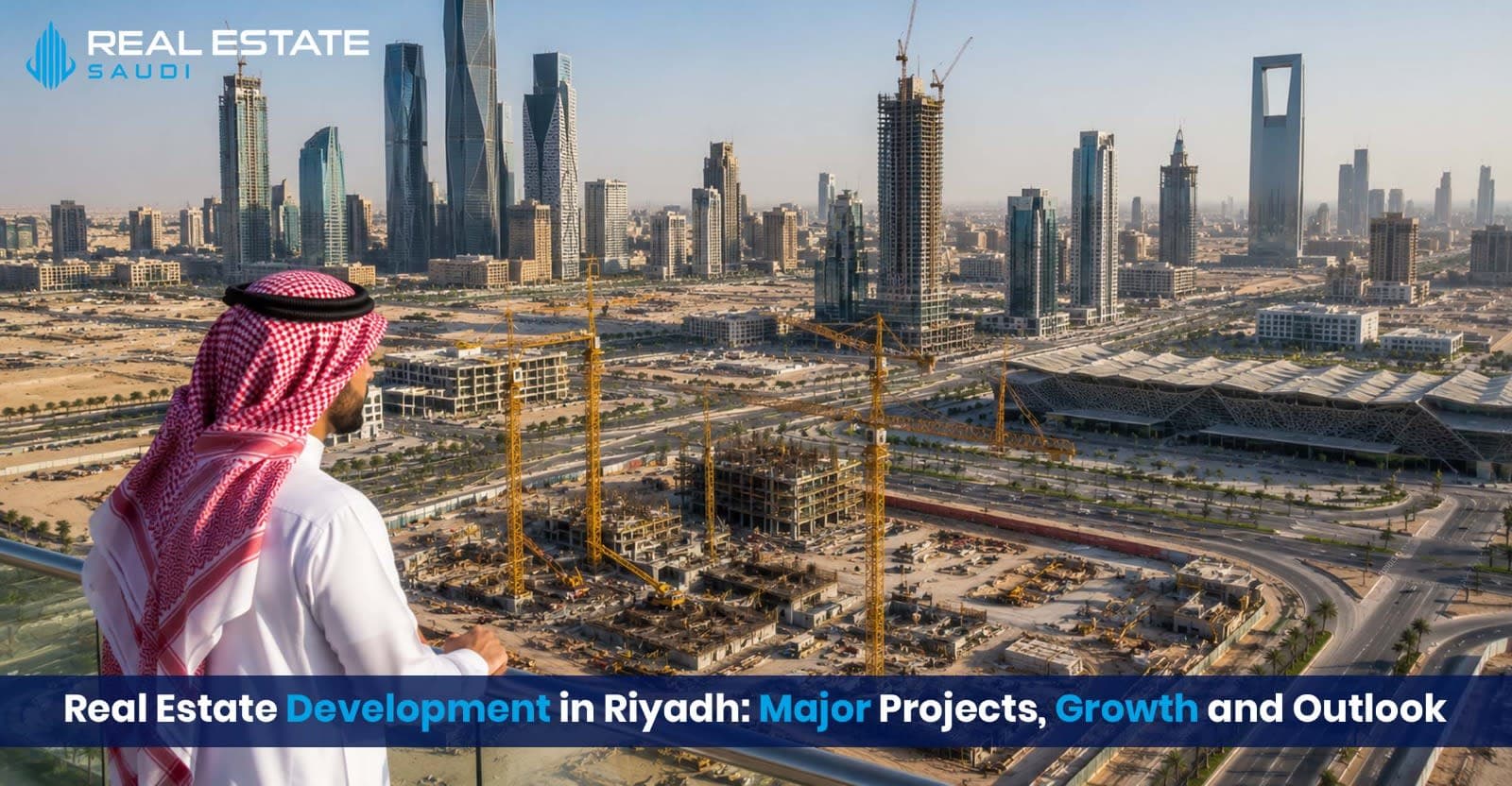
Real estate development in Riyadh is transforming Saudi Arabia's capital through large residential communities, mixed-use business districts, entertainment destinations, transport infrastructure and urban regeneration projects. Major developments include New Murabba, Diriyah, Qiddiya City, ROSHN SEDRA, National Housing Company communities and the King Salman Park programme.
These developments create opportunities for homebuyers, developers, commercial operators and property investors. However, not every masterplan represents an immediately available investment, and the completion of a major project does not guarantee rising property prices in surrounding neighbourhoods.
Riyadh's growth is closely connected to Saudi Vision 2030, economic diversification, corporate investment and changing residential requirements. New transport connections, employment districts and community infrastructure are also influencing how buyers evaluate different locations.
For investors planning decisions in 2027, understanding project delivery, residential demand, current market regulations and financial risk is essential. This guide examines Riyadh's leading developments, emerging investment corridors, ownership rules, property costs and practical strategies for evaluating opportunities.
What Is Driving Real Estate Development in Riyadh?
Riyadh's property development is supported by a combination of economic activity, urban investment, housing programmes and public infrastructure. The city serves as Saudi Arabia's administrative capital and an important centre for corporate headquarters, financial services, technology and professional employment.
New housing is needed to accommodate different household preferences, while modern business districts require offices, hospitality facilities, retail and supporting infrastructure. The government's urban-development programmes also aim to improve transport connectivity, public spaces and quality of life.
Unlike development driven exclusively by private residential construction, Riyadh's transformation includes government-supported projects, Public Investment Fund companies, private developers and public-private partnerships.
This creates opportunities across several property categories, but investors should distinguish broad economic development from proven demand for a specific building or residential unit.
How Vision 2030 Influences Riyadh's Property Market
Saudi Vision 2030 supports economic diversification, investment and improvements in urban living standards. Major Riyadh projects reflect these objectives through planned residential districts, cultural facilities, public transport and mixed-use destinations.
However, the relationship between government spending and property returns is not automatic. Large infrastructure programmes can improve accessibility and support employment, but their effect depends on actual delivery and local market conditions.
Investors should examine the projects influencing their selected neighbourhood and determine whether the expected benefits are already visible or remain dependent on future construction.
Riyadh Real Estate Market: Current Performance and Property Demand
Riyadh has an active residential and commercial property market, but its performance differs between districts and asset categories. Transaction volumes, sale prices, rental activity and construction costs should be assessed separately.
The Real Estate General Authority's Riyadh Real Estate Indicators platform provides transaction data and price indicators using information from the Ministry of Justice and Real Estate Registry. Its published data allows users to examine property activity by location, type and reporting period.
For 2027 planning, these official indicators are more useful than unsupported claims about guaranteed annual appreciation. They help investors evaluate market activity while recognising that historical transactions cannot predict future returns.
Residential Demand and Housing Supply
Riyadh offers apartments, standalone villas, townhouses, residential compounds and master-planned communities. Demand depends on household income, employment location, schools, transport and available financing.
Some households prioritise established northern districts, while others consider newer communities offering different layouts and amenities.
New construction can increase housing choice, but additional supply may also create competition between developers and landlords. Investors should therefore examine both current demand and the number of comparable properties expected to enter the market.
Commercial Property and Business Districts
Office, retail and hospitality development is another important part of Riyadh's transformation. Corporate activity supports demand for workplaces, serviced accommodation, restaurants and commercial services.
However, different types of office space can experience contrasting market conditions. Premium buildings in established business districts may attract different tenants from smaller properties in emerging areas.
Commercial investors should evaluate lease terms, tenant quality, operating expenses and competing developments before relying on optimistic occupancy forecasts.
Which property type & region do you prefer?
Select property type and preferred city in Saudi Arabia.
Major Real Estate Projects Transforming Riyadh
Several major projects are reshaping the city's urban structure. Their influence extends beyond the project boundaries because they may affect transport, employment, visitor activity and demand for nearby services.
However, each development has a different business model and delivery schedule. A residential community should not be assessed using the same assumptions as an entertainment destination or public park.
New Murabba: Riyadh's Planned Modern Downtown
New Murabba is among the capital's largest planned mixed-use developments. Located in northwestern Riyadh, the project aims to integrate housing, offices, hotels, retail, leisure and community facilities within a new urban district.
The official Saudi Vision 2030 New Murabba overview describes a development extending across approximately 14.1 square kilometres, with more than 25 million square metres of planned floor area.
The Mukaab is the best-known architectural component, but investors should examine the wider district rather than focus exclusively on its landmark building.
The project could eventually create demand for residential accommodation, professional services, retail and hospitality. However, actual property availability depends on the development phase and authorised sales arrangements.
The New Murabba development and investment guide explores its masterplan, infrastructure progress and important considerations for prospective buyers.
Diriyah: Heritage-Led Residential and Commercial Development
Diriyah combines historical preservation with contemporary housing, hospitality, retail and cultural development near Riyadh.
The destination is associated with At-Turaif, a UNESCO World Heritage Site, and a masterplan incorporating Najdi-inspired architecture and premium mixed-use facilities.
According to Diriyah Company's official development information, its approved Diriyah 1 and Diriyah 2 masterplans include more than 18,000 residential units across a development area of approximately 14 square kilometres.
During 2026, Diriyah Company announced additional construction contracts and financing agreements covering hospitality and residential components.
These announcements indicate ongoing project activity, but individual property delivery dates and public sales availability require separate confirmation.
Buyers investigating the destination can explore the Diriyah real estate area guide to understand its residential positioning and surrounding property market.
Qiddiya City: Entertainment, Sports and Tourism
Qiddiya City is being developed southwest of Riyadh as a destination combining entertainment, sports, culture and supporting urban facilities.
Its significance extends beyond attractions because successful large-scale leisure destinations can create demand for employment, hospitality, transport and commercial services.
During 2026, Qiddiya advanced its operational development, including the public opening of Aquarabia.
However, an operating attraction does not establish that every residential district or commercial asset within the wider destination has been completed.
Investors should distinguish confirmed visitor facilities from proposed real estate opportunities.
For surrounding property markets, practical access routes and actual employment creation may be more relevant than the distance shown on promotional maps.
ROSHN and NHC: Large-Scale Residential Communities
Riyadh's housing expansion is also supported by major residential developers creating integrated neighbourhoods rather than individual buildings.
These communities combine homes with planned schools, mosques, parks, retail and other facilities, although amenities may be delivered during different development phases.
ROSHN SEDRA and Warefa
ROSHN Group, owned by the Public Investment Fund, develops integrated residential communities across Saudi Arabia.
Its official residential communities portfolio identifies SEDRA in Riyadh as a large master-planned destination with more than 30,000 planned homes across approximately 20 million square metres.
The portfolio also includes Warefa, another Riyadh residential community.
ROSHN's approach emphasises walkability, local architectural character and neighbourhood amenities. However, the facilities available to a purchaser depend on the specific phase and completed infrastructure.
Buyers should request current floor plans, construction details, handover conditions and available inventory before making a reservation.
National Housing Company Destinations
NHC is another major participant in Saudi Arabia's residential development sector.
Its official residential destinations directory identifies Riyadh projects including Khuzam, Al Fursan and Al Ruba.
These communities offer different residential configurations and are intended to combine housing with supporting services.
Their appeal can depend on affordability, transport connectivity, neighbourhood planning and delivery of schools or healthcare facilities.
Investors should verify whether a project is suitable for their buyer category and whether the property is being sold directly by an authorised developer.
A nationally recognised developer does not remove the need for property-level due diligence.
King Salman Park, Sports Boulevard and Green Riyadh
Public infrastructure can influence residential preferences even when it does not directly create properties for sale.
Riyadh's major public-space initiatives aim to expand recreational opportunities, improve urban connectivity and enhance neighbourhood environments.
King Salman Park
King Salman Park is a major urban regeneration project planned around the former airport area in central Riyadh.
Its concept includes extensive green space, cultural facilities and surrounding mixed-use opportunities.
The project could influence how nearby residential and commercial locations are evaluated, particularly where accessibility and public amenities improve.
However, investors should avoid assuming that proximity to the planned park automatically produces a fixed property-value premium.
The specific entrance location, transport connections and actual construction progress matter more than a broad district-level description.
Sports Boulevard
Sports Boulevard is designed to connect parts of Riyadh through recreational corridors that support walking, cycling and other activities.
For property buyers, the relevant questions concern safe access, nearby facilities and whether completed sections connect meaningfully with residential areas.
A property advertised as being near Sports Boulevard may still require a substantial journey to reach an accessible section.
Investors should inspect the route rather than rely exclusively on the project's overall masterplan.
Green Riyadh and Neighbourhood Parks
Green Riyadh aims to increase vegetation and improve environmental conditions across the city.
In October 2026, the Royal Commission for Riyadh City reported that three major neighbourhood parks in Al Qadisiyah, Al Rimal and Al Munsiyah had reached more than 85% construction completion.
These developments may improve outdoor recreation and neighbourhood attractiveness.
However, their effect on property prices depends on actual accessibility, maintenance quality and competing housing supply.
The broader Saudi mega-projects investment overview explains how public infrastructure and large developments interact with residential market expectations.
Real Estate Development in Riyadh: Best Growth Areas for 2027
Choosing a development corridor requires more detailed analysis than identifying the largest projects on a map.
A promising location should combine realistic acquisition costs, access to employment, functioning infrastructure and demand for the intended property type.
North Riyadh and Emerging Residential Communities
Northern Riyadh contains established districts and newer residential destinations associated with major transport corridors and planned infrastructure.
Al Narjis, Al Arid, Al Malqa and Al Yasmin may appeal to different household segments, but they should not be treated as one uniform market.
Properties close to completed facilities may carry different prices from homes in areas where schools, roads or retail remain under construction.
Buyers can use the Riyadh residential area and property guide to compare locations before examining individual projects.
Eastern Riyadh and Al Rimal
Eastern Riyadh is another important development area, with continuing residential projects and urban infrastructure investment.
A notable 2026 announcement involved Arada KSA and its planned Al Rimal residential development.
The SAR 14 billion Al Rimal project announcement describes approximately 3,500 planned villas and townhouses, with construction and sales scheduled to begin in 2027.
These figures represent the developer's announced plan, not completed residential inventory.
Investors should monitor formal sales launches, regulatory approvals and project specifications before treating the development as an available purchase opportunity.
Central and Western Riyadh
Established central districts and areas near major business or cultural destinations may interest investors seeking residential and commercial opportunities.
However, established locations can also involve higher acquisition prices, older buildings and limited redevelopment space.
Property renovation, repositioning and smaller mixed-use projects may therefore be relevant alongside large new construction schemes.
The viability of these opportunities depends on building condition, planning permissions, tenant demand and the total refurbishment budget.
New Investment Opportunities Beyond Residential Property
Riyadh's development programme creates opportunities for different investor categories.
Direct residential purchasing is only one possibility. Commercial leasing, hospitality operations, logistics facilities, real estate development partnerships and municipal investment concessions may also be relevant.
However, these opportunities require different levels of capital and specialist expertise.
Municipal Land and Public-Private Partnerships
In November 2026, Riyadh authorities announced a municipal-land investment opportunity in Al Narjis.
The Al Narjis municipal land PPP announcement describes a proposed 50-year arrangement involving approximately 30,015 square metres of land for mixed-use development.
The opportunity was structured for private-sector participation rather than ordinary residential purchases.
Investors should distinguish such concession arrangements from acquiring unrestricted property ownership.
Tender conditions, financial guarantees and long-term operating obligations must be evaluated before participating.
Offices, Retail and Hospitality
New residential districts can create demand for neighbourhood retail, offices, clinics, hospitality and personal services.
However, commercial viability depends on actual occupancy, customer spending and competition.
A retail unit in a planned community may take time to establish a consistent customer base.
Office properties similarly depend on tenant requirements, building standards and lease conditions.
Investors should evaluate realistic occupancy scenarios rather than assume that every growing district will immediately support premium rents.
Can Foreigners Invest in Riyadh Real Estate Developments?
Eligible foreign individuals and qualifying entities can acquire certain real estate rights under Saudi Arabia's updated non-Saudi property ownership framework, which came into force on January 22, 2026.
However, permission depends on the purchaser's legal category, geographical designation and the rights available for the specific asset.
The framework includes designated areas associated with major Riyadh development projects, but this does not mean every property within those destinations is automatically available to foreign buyers.
The Saudi foreign property ownership zones guide explains the importance of verifying the exact property against official geographical information.
Ownership Rights and Investor Eligibility
Foreign purchasers should distinguish full ownership from usufruct and other permitted real estate rights.
They should also verify whether the intended purchase involves a completed unit, off-plan development or commercial investment arrangement.
Different structures can involve different registration and regulatory requirements.
An investor should obtain official eligibility confirmation before paying a deposit or making an unconditional commitment.
What is your approximate budget?
Narrow down property options based on your target budget.
Off-Plan Development, Licensing and Buyer Protection
Off-plan property purchases can provide access to residential projects before construction is completed.
However, buyers face risks involving delivery schedules, specification changes, financing and developer performance.
Saudi Arabia regulates qualifying off-plan activity through the Wafi framework administered by the Real Estate General Authority.
Buyers should verify the relevant project licence, escrow arrangements and contractual completion obligations.
A development's appearance in a government masterplan does not automatically establish that it has an authorised residential sales programme.
How Real Estate Development in Riyadh Affects Off-Plan Buyers
New communities may offer modern layouts and planned amenities, but purchasers must assess what is actually included in the contract.
A school, park or shopping area shown in promotional materials may belong to a later phase.
Handover dates, payment milestones and remedies for construction delays should be reviewed carefully.
Independent legal and technical advice can help identify risks before large payments are made.
Riyadh Rent Regulations and Investment Returns
Rental regulations are particularly important for investors purchasing income-producing property.
From September 25, 2025, Riyadh introduced a five-year suspension of applicable annual rental increases for residential and commercial properties within the city's regulated urban boundaries.
The Real Estate General Authority's official Riyadh rental regulations explain the restrictions, including provisions affecting previously rented vacant units and lease documentation.
Investors should therefore avoid forecasting unrestricted annual rent increases.
Calculating Property Investment Performance
An investment's attractiveness depends on purchase price, rent, vacancy, maintenance and financing expenses.
Gross rental yield provides an initial comparison but does not account for the full cost of ownership.
Net operating income is generally a more useful measure of property performance.
The Riyadh real estate investment guide provides additional detail about property categories, rental conditions and investment risks across the capital.
Investors should test conservative scenarios rather than relying on developer projections of guaranteed appreciation.
Property Taxes and Acquisition Costs
Saudi Arabia generally applies a 5% Real Estate Transaction Tax to taxable property transfers, subject to statutory exemptions and transaction-specific treatment.
The amount payable should be established for the actual purchase agreement.
Other potential costs include financing, valuation, brokerage, registration, furnishing and property management.
Foreign investors may face additional regulatory charges depending on their legal category and transaction structure.
For development projects, infrastructure contributions, construction contingencies and ongoing operating expenses can also influence financial feasibility.
A property with a competitive asking price may become less attractive once all associated costs are included.
Key Risks Facing Riyadh Property Developers and Investors
Large-scale urban development creates opportunities but also introduces uncertainty.
Construction delays, changes in financing conditions and slower-than-expected demand can affect both developers and property purchasers.
A major project may improve surrounding infrastructure while simultaneously increasing competing residential or commercial supply.
Construction and Infrastructure Risks
Investors should verify whether roads, utilities, schools and other essential facilities are functioning.
A development under construction may experience delays that affect occupation and rental income.
Property handover should be assessed using the signed specifications and an appropriate technical inspection.
Market and Resale Risks
An attractive location does not guarantee profitable resale.
Future property values depend on demand, supply, interest rates, building condition and buyer preferences.
Some premium developments may have a narrower buyer market than conventional family housing.
Investors should maintain a realistic holding period and sufficient liquidity for unexpected expenses.
How to Evaluate Riyadh Developments Before Investing
Begin by identifying the intended property use: permanent residence, rental investment, commercial operation or long-term land development.
Next, assess the location using official transaction indicators and comparable properties.
Verify developer credentials, legal ownership rights and applicable project licensing.
For off-plan purchases, examine the contractual delivery schedule and escrow arrangements.
Calculate total acquisition costs, financing obligations, recurring expenses and realistic income.
Finally, inspect the actual infrastructure and confirm which promised amenities are operational.
A disciplined assessment provides a stronger basis for investment than relying on the size of a masterplan or the reputation of an announced project.
How would you like to be contacted?
Choose your preferred channel for a private consultation.
Riyadh Real Estate Development Outlook for 2027
Riyadh enters 2027 with major residential, cultural, entertainment and infrastructure programmes at different stages of delivery.
Some destinations already have operating facilities, while others remain under construction or await future residential releases.
The most relevant developments for property buyers will be verified infrastructure completion, new housing supply, actual transaction prices and the availability of legally purchasable units.
Corporate activity, tourism investment and transport improvements may support certain locations, but the financial outcome will differ across neighbourhoods and property types.
Investors should monitor official announcements and avoid treating planned completion dates or projected economic benefits as guaranteed results.
Where Is Riyadh's Property Market Heading?
Real estate development in Riyadh is creating a more diverse urban landscape through major residential communities, mixed-use districts, public infrastructure and investment partnerships.
Projects including New Murabba, Diriyah, Qiddiya, ROSHN communities and NHC destinations illustrate the scale of the city's transformation.
However, successful investment requires more than identifying high-profile developments. Buyers must evaluate property-specific legal rights, construction progress, location, affordability and market demand.
For 2027, the strongest strategy is to distinguish confirmed delivery from future plans, use reliable transaction evidence and maintain realistic financial expectations.
Real Estate Saudi recommends evaluating each opportunity independently rather than assuming that every project associated with Vision 2030 will produce attractive investment returns.
Talk to Our Real Estate Experts
Get real-time insights on investment options, commercial properties, and market guidelines.
Frequently Asked Questions
Major developments include New Murabba, Diriyah, Qiddiya City, ROSHN SEDRA, NHC residential destinations and the urban programmes associated with King Salman Park and Sports Boulevard. They serve different purposes, including housing, business, entertainment and public infrastructure. Their construction and operational stages differ, so investors should verify project-specific progress before making decisions.
Riyadh's development is supported by housing requirements, corporate investment, government infrastructure programmes and Saudi Vision 2030. The capital has an important concentration of employment, administration and business services. New residential communities and mixed-use districts aim to improve housing choice and urban amenities. However, individual property performance still depends on location, price and demand.
New Murabba is a major planned mixed-use destination with residential components, but the availability of individual properties depends on authorised sales releases and project phases. Investors should verify the legal developer, specific unit, ownership eligibility, payment schedule and construction progress. A published masterplan does not automatically establish that residential units are available to purchase immediately.
Northern Riyadh, established business districts, eastern residential communities and locations near completed infrastructure may warrant investigation. Al Narjis, Al Malqa, Al Rimal and other districts serve different tenant and buyer groups. No neighbourhood guarantees high returns. Investors should compare current transactions, rental regulations, future supply and the property's total acquisition cost before selecting an area.
Eligible foreign individuals and companies may acquire permitted property rights under Saudi Arabia's updated ownership framework effective from January 22, 2026. However, acquisition rights depend on designated geographical areas, buyer category and the specific property. Foreign investors should verify the applicable ownership conditions and registration procedures before entering a binding agreement.
Off-plan projects are subject to applicable licensing and regulatory protections, including the Wafi framework for qualifying developments. However, construction delays, delivery uncertainty and financing risks remain possible. Buyers should verify project licences, developer credentials, escrow arrangements, contractual specifications and remedies for delay. Regulatory approval does not guarantee financial returns or eliminate every construction risk.
Riyadh introduced a five-year suspension of applicable annual rental increases within the regulated urban boundaries from September 25, 2025. The measures also address previously rented vacant units and lease documentation. Investors should review the property's Ejar history and relevant exceptions before forecasting rental income. The restrictions make assumptions about unlimited annual rent growth inappropriate.
Infrastructure improvements can influence accessibility, neighbourhood appeal and demand, but higher property prices are not guaranteed. The impact depends on completed facilities, actual travel convenience, competing housing supply and the initial purchase price. Buyers should compare transaction evidence before and after relevant improvements rather than assume that proximity to every new project produces appreciation.
Riyadh offers commercial opportunities connected with offices, retail, hospitality and urban services. However, profitability depends on tenant quality, operating expenses, location and competing supply. A new business district may generate demand over time but can initially face lower occupancy. Investors should evaluate realistic cash flow and lease conditions before committing capital.
Investors should verify developer authority, ownership rights, project licensing, construction progress and the exact property specifications. They should also examine current market transactions, financing costs, taxes, rental rules and the status of surrounding infrastructure. For off-plan properties, payment milestones and delivery obligations require careful review. Independent legal and technical advice may be appropriate for high-value transactions.
