
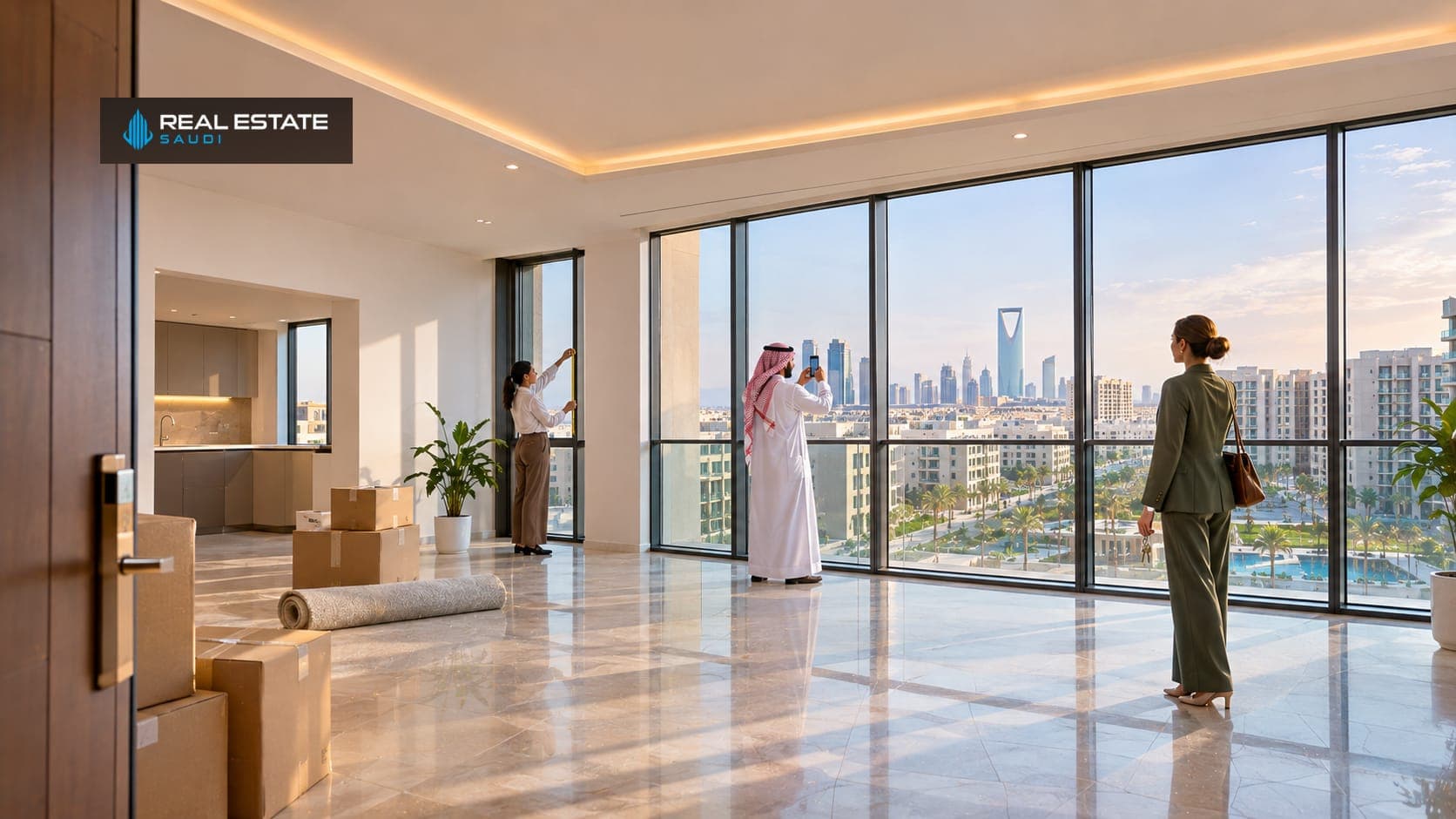
Foreign nationals can buy apartments in Saudi Arabia under the country's updated real estate ownership framework, provided they meet the applicable eligibility requirements and acquire property in legally permitted locations. The regulations cover eligible expatriates living in Saudi Arabia, non-resident international buyers and qualifying companies, although ownership permissions differ according to the purchaser and the property.
The Real Estate Ownership System for Non-Saudi Nationals came into force on 22 January 2026, establishing a clearer framework for foreign investment in residential property. Its implementation includes geographical ownership zones, digital application procedures and separate provisions for Makkah and Madinah.
For international buyers planning a purchase in 2027, understanding these rules is essential before comparing apartment listings, making reservations or arranging mortgage financing.
Saudi Arabia offers different residential opportunities in Riyadh, Jeddah, Dammam, Al Khobar and selected major developments. However, apartment prices, legal ownership rights and financing eligibility vary considerably between locations.
This guide explains foreign ownership requirements, permitted investment areas, property costs, mortgage options, registration procedures and practical steps for purchasing an apartment in Saudi Arabia.
Can Foreigners Buy Apartments in Saudi Arabia in 2027?
Yes. Eligible non-Saudi individuals and companies can purchase residential apartments or acquire other legally permitted property rights under Saudi Arabia's updated ownership legislation. However, permission is subject to the buyer's legal category, the property's geographical location and the specific ownership rights available.
The Real Estate General Authority's official foreign property ownership law establishes the legal framework for these acquisitions, including geographical restrictions and the rights that different categories of purchasers may acquire.
The legislation distinguishes between foreign individuals residing legally in Saudi Arabia, overseas purchasers, Saudi companies with foreign shareholders and other qualifying entities.
This distinction matters because the route available to a foreign professional living in Riyadh may differ from the process followed by an investor purchasing from London, Dubai or Mumbai.
Buyers must establish their eligibility before committing substantial funds. A property advertisement describing a unit as available to foreigners does not constitute official permission to acquire that specific apartment.
Can Non-Resident Foreigners Purchase Apartments?
Eligible overseas individuals can pursue qualifying property acquisitions through the Saudi Properties system without necessarily holding an ordinary Saudi residence permit.
However, they must complete the required identification and application procedures.
The official process for non-resident individuals begins through Saudi diplomatic representations abroad to establish the digital identity needed for the ownership application.
Applicants must also satisfy the relevant property and purchaser requirements.
A non-resident should not assume that purchasing an apartment automatically provides permission to live or work in Saudi Arabia.
Can Expatriates Living in Saudi Arabia Buy Property?
Foreign individuals legally residing in Saudi Arabia may apply through the official system using their residency information.
The legislation also provides a conditional route for an eligible resident non-Saudi individual to own one property for personal residence outside designated geographical areas, excluding Makkah and Madinah.
This exception is different from purchasing within an approved foreign ownership zone.
The specific conditions must be verified before relying on the provision for a particular apartment.
Saudi Arabia's Foreign Property Ownership Law: What Changed?
The regulatory changes introduced during 2026 were intended to establish a more structured system for international real estate ownership.
The updated framework regulates geographical ownership areas, available property rights, applicant categories and registration procedures.
The Real Estate General Authority's Saudi Properties guidance explains how the system provides a digital application process and geographical information for eligible investors.
For a buyer considering a 2027 purchase, the key question is not simply whether foreigners are permitted to own apartments. It is whether the particular applicant can register the intended property right in the selected location.
Freehold Ownership and Usufruct Rights
Freehold ownership generally describes an ownership interest in real estate, subject to the applicable laws and registered rights.
Usufruct is a separate legal right allowing a person or entity to use and benefit from property for a specified period.
The updated Saudi framework recognises different real estate rights, and their availability can vary by geographical zone.
Buyers should examine the proposed legal interest carefully rather than assume that every advertised property offers unrestricted ownership.
The purchase documentation should clearly identify whether the transaction involves ownership, usufruct or another recognised property right.
Why Geographical Restrictions Matter
The law establishes a system of designated areas where different categories of non-Saudi purchasers may acquire specified property rights.
The geographical framework can also regulate ownership percentages, the duration of usufruct rights and additional conditions.
A residential building located within a major city does not automatically qualify for acquisition by every foreign buyer.
Prospective purchasers should therefore verify the exact apartment and its registered location rather than rely on a general city or neighbourhood description.
Which property type & region do you prefer?
Select property type and preferred city in Saudi Arabia.
Where Can Foreigners Buy Apartments in Saudi Arabia?
Foreign buyers can investigate qualifying properties within approved geographical areas and other locations where their legal category permits ownership.
The approved zones include designated projects and districts within major Saudi cities, along with selected large-scale developments and economic destinations.
However, the presence of a project on an approved geographical list does not establish that apartments are available for immediate purchase.
For detailed location research, the guide to Saudi Arabia's designated foreign property ownership zones explains how the geographical framework applies across different regions.
Riyadh: Residential Communities and Urban Investment
Riyadh offers a diverse residential market, including established urban districts, modern apartments and developments linked to major infrastructure projects.
Buyers may consider access to employment, education, transport and commercial services when choosing a location.
Selected developments and areas are included within the foreign ownership framework, subject to official boundaries and applicable conditions.
However, a buyer should not assume that every apartment in Al Malqa, Al Narjis, Hittin or another popular neighbourhood is automatically available for foreign acquisition.
The permitted ownership right must be confirmed for the actual unit.
Jeddah: Coastal Residential Living
Jeddah offers apartment opportunities ranging from established family neighbourhoods to newer coastal and mixed-use developments.
The city's commercial importance and Red Sea location may interest both residents and long-term investors.
Selected geographical development areas are included within the ownership framework.
Buyers should investigate transport accessibility, building management, construction quality and the costs associated with coastal properties.
An attractive waterfront location may involve different acquisition and maintenance expenses from an ordinary apartment in a more established inland district.
Dammam and Al Khobar: Eastern Province Opportunities
Dammam and Al Khobar offer residential environments connected to employment, education, logistics, industry and regional commercial activity.
Apartment options vary from conventional family accommodation to newer developments.
However, investment suitability depends on local demand, transaction prices and the legal rights available to the buyer.
A lower asking price does not necessarily mean a stronger investment.
Prospective purchasers should compare completed transactions, building condition and realistic rental demand before committing capital.
Makkah and Madinah: Special Ownership Conditions
Makkah and Madinah are subject to additional legal restrictions because of their religious significance.
Under the updated framework, ownership by non-Saudi natural persons within the two holy cities is restricted to Muslims, within the applicable geographical zones and other regulatory conditions.
Being Muslim does not automatically permit a foreign individual to acquire any property in these cities.
The geographical eligibility of the precise unit must still be established.
Corporate ownership arrangements can follow different legal provisions.
Buyers should obtain professional advice when considering apartments in these locations.
How Much Do Apartments Cost in Saudi Arabia in 2027?
Apartment prices depend on the city, neighbourhood, building age, floor area, construction quality and included facilities.
Premium apartments in established commercial districts may command different prices from family accommodation in developing residential communities.
A reliable national average cannot be applied to every property category or location.
The Real Estate General Authority's Real Estate Indicators platform provides information about sales transactions, rental activity and property prices across Saudi regions and cities.
This information can help purchasers assess market conditions before comparing individual apartments.
How to Compare Apartment Prices
Buyers should start by examining comparable properties within the same neighbourhood or development.
Important characteristics include internal floor area, number of bedrooms, construction age, parking, building facilities and the quality of available maintenance services.
A newly constructed apartment may justify a different valuation from an older unit requiring refurbishment.
However, a modern appearance does not automatically establish superior construction quality.
An independent inspection and current market evidence can help determine whether an asking price is reasonable.
Price per Square Metre
Price per square metre is useful for comparing apartment values, but the measurement must be consistent.
Some advertisements may describe gross floor area, while others use internal living area or another measurement convention.
Buyers should confirm precisely what is included in the advertised area.
Balconies, storage spaces, parking and shares of common areas may be treated differently between developments.
A meaningful price comparison requires matching the area definition and accounting for differences in location, finishing and ownership rights.
Quick Facts for Foreign Apartment Buyers
Buying Consideration | Position for 2027 Planning |
|---|---|
Foreign ownership | Available to eligible buyers under applicable rules |
Updated law effective date | 22 January 2026 |
Main regulator | Real Estate General Authority |
Application system | Saudi Properties |
Permitted locations | Approved geographical areas and qualifying exceptions |
Makkah and Madinah | Special restrictions apply |
Real Estate Transaction Tax | Generally 5% on taxable transactions |
Financing | Subject to lender and borrower eligibility |
Property registration | Required under applicable real estate registration procedures |
Residency rights | Not automatically granted through ownership |
Apartment prices should be assessed using current evidence from the selected property market rather than outdated national averages.
Can Foreigners Buy Apartments in Saudi Arabia with Mortgage Financing?
Mortgage financing may be available to eligible foreign purchasers, but ownership permission and borrowing approval are separate matters.
Saudi banks and financing companies assess applicants according to their lending policies, financial circumstances, creditworthiness and the property being purchased.
Foreign residents with a stable Saudi income may have access to financing arrangements that differ from those available to overseas buyers.
The Saudi Central Bank's Responsible Lending Principles for Individual Customers require lenders to assess repayment capacity while considering income, existing financial obligations and essential living expenses.
Buyers should obtain an appropriate financing assessment before making a binding purchase commitment.
Mortgage Eligibility for Expatriates
Foreign residents may be asked to provide residency documents, employment information, income evidence, bank statements and details of existing financial obligations.
The lender may also require a property valuation and evidence that the proposed acquisition is legally permitted.
Mortgage eligibility is not guaranteed simply because the applicant holds a valid Iqama.
Each financing provider can apply additional underwriting requirements, subject to the applicable regulatory framework.
The real estate financing guide for Saudi Arabia provides further information about mortgage products, financing structures and borrower considerations.
Financing for Overseas Buyers
Non-resident buyers may face different financing requirements from applicants employed within Saudi Arabia.
A bank may assess the applicant's foreign income, credit information, financial assets and repayment arrangements.
Buyers should establish whether an appropriate mortgage product is available before assuming that the purchase can be financed.
Where financing is unavailable, the applicant may need to consider a cash purchase or another legally permitted funding arrangement.
Understanding Down Payments and Repayment Costs
The initial payment required depends on the mortgage product, lender policies and borrower eligibility.
There is no single down payment that should be assumed to apply to every foreign property transaction.
Buyers should compare the total amount payable, annual percentage rate, repayment term and early settlement conditions.
A lower monthly installment may result from a longer financing period, but it can also increase overall financing expenses.
The most suitable mortgage is one that remains affordable after household expenses, maintenance and unexpected costs.
Property Taxes and Fees Foreign Buyers Should Know
The purchase price is not the total cost of acquiring an apartment.
Saudi Arabia generally applies a 5% Real Estate Transaction Tax to taxable property disposals, subject to statutory exemptions and transaction-specific rules.
The Zakat, Tax and Customs Authority's Real Estate Transaction Tax Law establishes the applicable legal framework, which came into effect on 10 April 2025.
Buyers should determine how the tax applies to the particular transaction and which party bears the relevant payment obligation.
Foreign Ownership Fees
The non-Saudi property ownership framework also provides for a separate fee on certain dispositions of property rights involving non-Saudis.
The law establishes an upper limit of 5%, while the actual charge depends on the applicable implementing regulations, property category and transaction circumstances.
This should not be confused with the standard 5% Real Estate Transaction Tax.
Buyers should obtain an official fee assessment for the transaction rather than automatically add an assumed percentage to every purchase.
Additional Acquisition Expenses
Other potential costs include property valuation, brokerage commissions where applicable, legal advice, financing charges and registration-related expenses.
Apartment buyers should also investigate recurring service charges, common-area maintenance and insurance obligations.
A unit within a managed development may have attractive facilities but require substantial annual payments for building management.
The Saudi Arabia real estate taxes guide provides further context about transaction taxes, exemptions and property-related expenses.
What is your approximate budget?
Narrow down property options based on your target budget.
How to Buy Apartments in Saudi Arabia: Step-by-Step Process
A successful foreign apartment purchase requires legal eligibility, property selection, financial planning and correct registration procedures.
The process should begin with confirming that the buyer and the intended property qualify under the applicable ownership rules.
Step 1: Establish Buyer Eligibility
Identify whether the purchaser is a legally resident foreign individual, non-resident overseas buyer or qualifying company.
Each category can involve different identification and registration procedures.
Residents generally begin through the official system using their Iqama information, while non-residents follow the applicable digital identity arrangements.
The purchaser should complete the necessary checks before paying a substantial reservation amount.
Step 2: Confirm the Property's Geographical Eligibility
Verify the exact apartment location through the official geographical framework.
Do not rely exclusively on a development name, city address or broker's assurance.
The applicable permissions may depend on the individual unit and the ownership right being transferred.
A buyer should obtain confirmation that the intended transaction is permitted under the applicable regulations.
Step 3: Select the Apartment and Review Specifications
Compare suitable apartments according to location, floor area, layout, construction quality and ongoing expenses.
The apartments for sale in Saudi Arabia page provides a starting point for exploring residential property options.
Before making a decision, request the precise unit number, floor plan, allocated parking, finishing schedule and relevant building documents.
The advertised property information should correspond with the proposed purchase agreement.
Step 4: Verify Ownership and Seller Documentation
Confirm that the seller has legal authority to transfer the property.
Review the applicable title deed or Real Estate Registry information, including the property's description, boundaries, registered rights and restrictions.
The ownership framework makes registration essential to establishing the legal validity of the acquired right.
Buyers can review the foreign buyer property registration guide for more detailed information about the registration process.
Step 5: Review the Purchase Agreement
The contract should identify the property, purchase price, payment schedule, legal ownership interest and completion requirements.
Buyers should examine cancellation provisions, financing conditions and any obligations relating to outstanding service charges.
For off-plan properties, expected completion dates, specifications and remedies for delays require particular attention.
Independent legal review may be especially valuable when the buyer is unfamiliar with Saudi transaction procedures.
Step 6: Complete Payments and Registration
After satisfying legal, contractual and financing requirements, the transaction proceeds through the applicable official systems.
Payments and ownership registration should follow authorised procedures.
Buyers should retain copies of their purchase agreement, payment receipts, registration documents and relevant correspondence.
The transaction should not be considered complete merely because a reservation has been accepted or the purchase price has been transferred.
Buying Off-Plan Apartments Versus Ready Properties
Foreign purchasers may consider completed apartments or units sold before construction is finished.
These options involve different financial and practical considerations.
A ready apartment allows the purchaser to inspect the actual building, surrounding neighbourhood and operating facilities.
An off-plan property may offer different configurations or developer payment schedules, but it involves construction and delivery uncertainty.
Off-Plan Buyer Protections
Saudi Arabia regulates qualifying off-plan development and sales activities through the Real Estate General Authority's Wafi framework.
The official Wafi Off-Plan Sales and Lease platform provides information about development licensing, relevant documentation and regulatory requirements.
Buyers should verify the applicable project licence and understand how payments are collected and protected.
A reputable developer and attractive masterplan do not eliminate construction delays or contractual risks.
The purchase agreement should clearly identify delivery obligations, payment milestones and the procedures for addressing delays or defects.
Ready Apartment Inspection
Completed apartments should be inspected before final acceptance.
Check plumbing, electrical systems, air conditioning, windows, doors, flooring and kitchen installations.
The building's common areas, lifts, parking spaces and safety systems should also be reviewed.
The Saudi property handover checklist explains how purchasers can document defects, verify specifications and prepare for possession.
Buyers should also establish responsibility for outstanding repairs and any unpaid maintenance charges.
Is Buying an Apartment in Saudi Arabia a Good Investment?
Apartment investment can be attractive when acquisition costs, rental demand and operating expenses support sustainable returns.
However, foreign ownership reforms do not guarantee that every residential property will appreciate or generate reliable rental income.
Investment performance depends on the selected location, property condition, financing expenses, future housing supply and resale liquidity.
Rental Income Potential
Rental demand varies between cities, districts and apartment types.
Properties close to employment centres or established services may appeal to long-term residents, but investors should examine actual comparable rents before estimating returns.
Gross rental revenue should not be confused with net income.
Maintenance, vacancy, management charges and financing expenses can substantially reduce the amount available to the owner.
A realistic investment assessment should include periods without tenants and a reserve for unexpected repairs.
Capital Appreciation and Market Risk
Property prices can change in response to supply, demand, infrastructure development and financing conditions.
A newly constructed apartment may attract buyers seeking modern facilities, but future appreciation is not guaranteed.
Investors should compare completed sales and evaluate how easily the property could be resold.
High transaction costs or limited market liquidity may affect the financial outcome when the holding period is short.
The broader guide to buying property in Saudi Arabia as a foreigner provides additional context on legal rights, investment considerations and the transaction process.
Common Mistakes Foreign Apartment Buyers Should Avoid
One common mistake is assuming that foreign ownership permission applies to every residential unit within an approved city.
Another is signing a reservation agreement before verifying the purchaser's eligibility and the exact ownership right.
Buyers may also rely on outdated legal information, particularly concerning Makkah and Madinah.
Financial mistakes include underestimating taxes, financing costs, service charges and maintenance requirements.
Overseas investors should avoid treating projected rental income as guaranteed.
Similarly, a developer's advertised completion date should be evaluated against the actual contractual commitments and construction status.
Careful legal and technical due diligence can reduce these risks before funds are transferred.
How would you like to be contacted?
Choose your preferred channel for a private consultation.
Saudi Apartment Ownership Outlook for 2027
The 2026 ownership reforms provide a more structured framework for foreign participation in Saudi Arabia's real estate market.
For 2027 buyers, the most relevant developments will be the implementation of approved geographical zones, availability of qualifying residential units and operation of the digital registration system.
However, the expansion of legal eligibility should not be confused with guaranteed investment performance.
Future apartment prices will depend on housing supply, economic conditions, financing costs and demand in individual neighbourhoods.
International purchasers should monitor updated official guidance before entering a transaction, particularly where the ownership category or geographical restrictions are complex.
Should Foreigners Buy an Apartment in Saudi Arabia?
Eligible foreign nationals can buy apartments in Saudi Arabia under the updated ownership framework, provided the purchaser and property satisfy the applicable legal conditions.
The reforms introduced in 2026 create additional opportunities for international buyers, but successful property acquisition still depends on careful planning.
Buyers should verify geographical eligibility, ownership rights, property documentation, financing arrangements and total purchase costs before signing.
For those planning a purchase in 2027, a well-selected apartment may provide residential or investment value, but financial returns and property appreciation should never be assumed without reliable supporting evidence.
Talk to Our Real Estate Experts
Get real-time insights on investment options, commercial properties, and market guidelines.
Frequently Asked Questions
Yes. Eligible foreign nationals can acquire permitted residential property rights under Saudi Arabia's updated ownership framework, which entered into force on 22 January 2026. However, eligibility depends on the purchaser's legal category, the property's geographical location and applicable ownership restrictions. Buyers should verify the specific apartment through the official Saudi Properties process before signing a binding agreement.
Eligible non-resident foreign individuals may purchase qualifying property without holding an ordinary Saudi residence permit. However, they must follow the official non-resident identification process, which begins through Saudi diplomatic representations abroad. They must also satisfy the applicable ownership and registration requirements. Non-resident eligibility should be confirmed before making a reservation or arranging financing.
Foreign ownership is permitted in designated geographical areas and under qualifying exceptions, including selected locations within Riyadh, Jeddah and other Saudi regions. Makkah and Madinah have special restrictions. A city's inclusion within the ownership framework does not mean every apartment is available to foreign buyers. The exact property must be checked against the applicable official geographical information.
Non-Saudi natural persons are restricted to Muslim individuals when acquiring qualifying property rights within Makkah and Madinah under the updated law. Non-Muslim foreign individuals should not assume they can purchase residential apartments directly in these cities. Separate provisions may apply to certain companies and investment structures, but these require transaction-specific legal assessment.
Apartment prices vary considerably depending on the city, neighbourhood, floor area, construction quality, amenities and property condition. There is no single reliable price that represents the entire Saudi apartment market. Buyers should compare current property advertisements with official transaction indicators and obtain written quotations for specific units before calculating their acquisition budget.
Mortgage financing may be available to qualifying foreign residents and certain other eligible purchasers, depending on lender policies and individual circumstances. Approval can require income verification, credit assessment, property valuation and confirmation of legal ownership eligibility. Overseas buyers may face different requirements. Applicants should obtain a written financing assessment before making an unconditional purchase commitment.
Saudi Arabia generally applies a 5% Real Estate Transaction Tax to taxable property disposals, subject to exemptions and transaction-specific conditions. Certain non-Saudi property dispositions may involve a separate regulatory fee. Other expenses can include financing, valuation, professional services and registration-related charges. Buyers should obtain an official, transaction-specific cost assessment rather than assume a universal total percentage.
Eligible foreigners may purchase qualifying off-plan apartments when the property, purchaser and relevant development satisfy applicable requirements. Buyers should verify the development's Wafi licensing status, payment procedures, contractual specifications and expected completion arrangements. Off-plan purchasing involves construction and delivery risks, so the agreement should clearly address delays, defects and payment obligations.
Property ownership does not automatically provide a residence permit or the right to work in Saudi Arabia. Residency eligibility is governed by separate immigration and residency programmes. Certain qualifying property investments may be relevant to specific residency pathways, but the conditions must be assessed independently. Buyers should not assume that purchasing an ordinary apartment guarantees residency privileges.
Requirements depend on the purchaser's legal category and transaction structure. Individual buyers may need identity documents, residency or digital identity information, property details, purchase agreements and relevant financial records. Additional documents can be required for mortgage financing or corporate purchases. Buyers should confirm the current requirements through the official Saudi Properties system and applicable registration authorities.
